Tree profile
Eastern red cedar (Juniperus virginiana): how to identify it
The dense, dark spire in old fields and fencerows across the East is a juniper, not a true cedar. Prickly young shoots, frosted blue cones and peeling red bark give it away.
In short
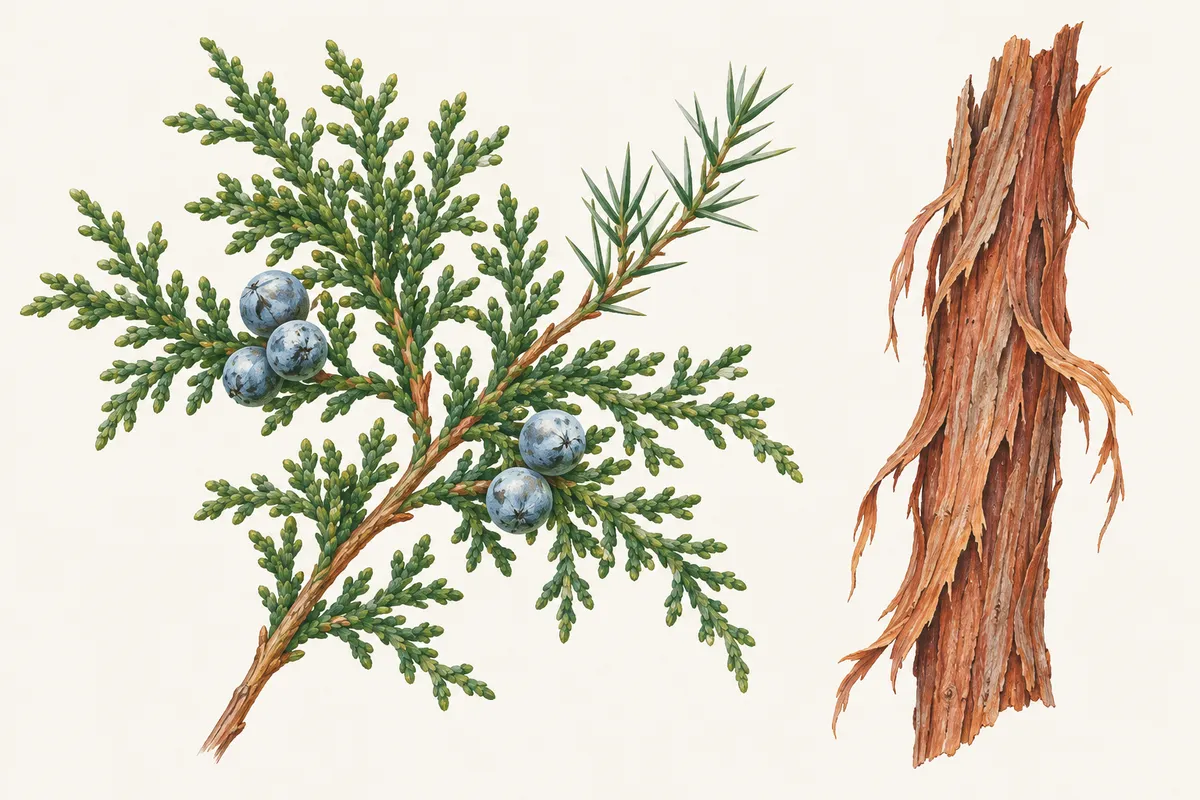
Eastern red cedar identification rests on three marks. The foliage is tiny scales about 1/16 inch long pressed to the twig, with sharp needles about 1/4 inch on young growth. Female trees carry berry-like cones about 1/4 inch, dark blue with a whitish bloom. The bark is red-brown and peels in long fibrous strips, on a dense, egg-shaped or columnar crown.
- Eastern red cedar is Juniperus virginiana, a juniper: the USDA Forest Service also calls it red juniper.
- Only female trees carry the blue berry-like cones; male trees turn yellowish brown with pollen cones in late winter.
- Orange, jelly-like horns on brown galls in a rainy spring are cedar-apple rust, a fungus the tree shares with apples.
Field marks at a glance
- Scientific name
- Juniperus virginiana
- Family
- Cupressaceae (cypress family)
- Type
- Conifer, evergreen
- Scale leaves
- Tiny, about 1/16 inch, dark green, pressed tight to the twig, opposite or in whorls of three; the dominant foliage on older trees.
- Needle leaves
- Sharp, awl-shaped, about 1/4 inch, dark blue-green; common on young trees and fast-growing shoots, so saplings feel prickly.
- Cones
- Female: berry-like, about 1/4 inch, light green turning dark blue with a whitish waxy bloom, ripening in the first fall and hanging on through winter. Male: small, yellow-brown, at branch tips.
- Bark
- Red-brown, peeling in long, narrow, fibrous strips, often ashy gray where weathered.
- Form
- Dense, egg-shaped to columnar or pyramidal crown; usually 30 to 50 feet, up to about 60 feet in Virginia Tech's description.
- Winter color
- Sage green to blue-green in summer, often bronze to yellow-brown in winter (NC State).
- Sexes
- Usually dioecious: separate male and female trees, occasionally both on one tree.
- Range
- Every US state east of the 100th meridian, north into southern Ontario and the southern tip of Quebec; spreading in the Great Plains.
Eastern red cedar is the dark, narrow evergreen that fills abandoned pastures, fencerows and rocky glades across the eastern United States. Despite the name, it is a juniper, Juniperus virginiana, and the USDA Forest Service lists red juniper and savin among its other names. It is easy to name once you know to look for two kinds of leaves, a frosted blue "berry" and peeling red bark.
How to identify eastern red cedar: five checks
Work through these in order. Three matches make a confident identification.
1. Feel the foliage. Virginia Tech's eastern redcedar fact sheet describes two leaf types, often on the same tree: tiny scales about 1/16 inch long, dark green and held tight to the twig, and longer, sharp, dark blue-green needles about 1/4 inch, more common on young trees and fast-growing shoots. Run your hand up a sapling and it prickles; stroke an old, scaled branch and it feels like braided cord. NC State Extension adds that the scales sit opposite or in whorls of three.
2. Look for the berries. Female trees carry round, berry-like cones about 1/4 inch across, light green in spring and dark blue with a whitish, waxy bloom by fall. They ripen in their first season, and NC State gives September to February as the months they show. The USDA Forest Service's Silvics of North America traces their color from green through greenish white and whitish blue to blue, and notes that most are dispersed from February to March. Each holds one to four small seeds.
3. Check the bark. Red-brown and peeling in long, narrow, fibrous strips, often ashy gray where weathered (Virginia Tech).
4. Step back for the shape. Virginia Tech describes a small tree with a dense egg-shaped or columnar crown, up to about 60 feet; NC State gives 30 to 40 feet tall and 10 to 20 feet wide for planted trees. The Forest Service gives 40 to 50 feet and 12 to 24 inches in diameter for mature trees, and up to 120 feet on the best sites.
5. Note the season's color. NC State describes sage green to blue-green foliage in summer that often turns bronze to yellow-brown in winter. A whole hillside of rusty-bronze conifers in January is usually eastern red cedar.
When the crown is out of reach, Tree Identifier can name the tree from one photo of a foliage spray, the bark or a fallen cone. It gives one name with no confidence score or look-alike list, so check the result against the scales, the blue cones and the bark.
Male and female trees
Eastern red cedar is dioecious: male and female cones grow on separate trees, though Virginia Tech notes trees occasionally carry both. The Forest Service says male trees are easy to tell from female ones in winter, when their pollen cones ripen and the tree takes on a yellowish-brown cast. NC State describes the male cones as small and yellow, at the branch tips.
That matters for identification. A tree with no blue cones may simply be male, so name it from foliage, bark and form. If a neighboring tree in the same field is covered in frosted blue cones, both are probably eastern red cedar. Birds spread the seed: NC State notes that songbirds and small mammals eat the cones and that cedar waxwings are especially fond of them.
The cones are not food for people. NC State Extension lists the flowers, fruits and leaves as causing low toxicity if eaten, from volatile oils including thujone. Never eat a cone or berry from a tree identified from a page or an app. Other trees with dusty blue fruit are compared in the guide to trees with blue berries.
Orange galls: cedar-apple rust
Many people first notice eastern red cedar in April or May, when it seems to sprout orange jelly. The Silvics account names the fungus as cedar-apple rust (Gymnosporangium juniperi-virginianae) and explains that the cedar is its alternate host, which is why apple growers care.
Illinois Extension describes the cycle on the cedar. Small galls, 3/8 to about 1 3/16 inches across, form on needles and small twigs and reach full size by fall, greenish brown to tan and round to kidney-shaped. In rainy spring weather the mature galls push out brownish horns that quickly lengthen and turn bright orange and gelatinous. As the rains end the galls die, which can kill the twig from the gall to the tip, and dead galls can hang on for a year or more.
For identification, the galls are a bonus clue: a scale-leaved evergreen covered in brown, kidney-shaped knobs in winter is almost certainly a juniper, and in the East usually eastern red cedar.
Eastern red cedar vs other cedars and junipers
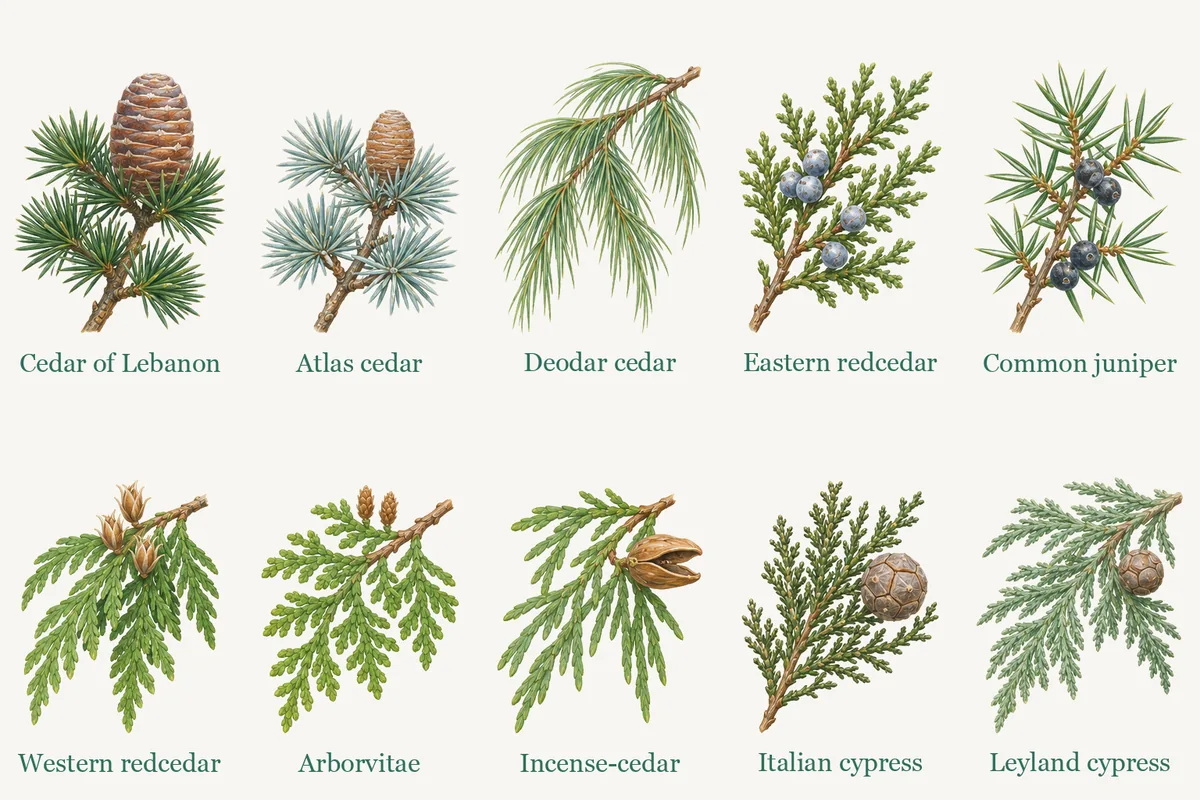
The name "cedar" is the source of most confusion. Eastern red cedar shares it with northern white cedar (an arborvitae), western redcedar of the Pacific Northwest and the true cedars of the Old World. The cedar tree identification page has a table of every tree called cedar, and the cedar vs juniper page sets the two genera side by side.
Among junipers, the closest look-alike is Rocky Mountain juniper of the West. NC State lists it as a look-alike, and the Forest Service notes that eastern red cedar readily hybridizes with Rocky Mountain, creeping and Ashe junipers, particularly in the western part of its range. In the East, the low, mat-forming common juniper is the other one you will meet; its leaves are all needles in whorls of three, never scales (Virginia Tech). The juniper page covers the western species.
Where eastern red cedar grows
The Forest Service calls it present in every state east of the 100th meridian, reaching into southern Ontario and the southern tip of Quebec, and notes that its range has expanded in the Great Plains through natural regeneration from planted trees. NC State's summary is Maine south to Florida and west to South Dakota and Texas.
It is a pioneer tree. The Forest Service describes it as common on abandoned fields and pastures, on glades with thin, rocky soils and rock outcrops, and on old fields and surface-mined land protected from fire. Its thin bark is easily damaged by fire, which is why it thrives where grass fires no longer run. The Forest Service also ranks it among the top five Christmas trees.
Two varieties are recognized in the US: a northern form with a narrow crown, var. crebra, and var. ambigens, intermediate with creeping juniper. NC State also lists southern redcedar (var. silicicola) as a look-alike. The varieties are hard to separate in the field, and a photo will give you the species, not the variety. With location turned on, Tree Identifier's Tree Map pins the identification, so you can return to the same tree in late winter to see whether it carries blue cones or turns yellowish brown with pollen.
Look-alikes and how to tell them apart
Common juniper (Juniperus communis)
Common juniper has only needles, never scales: 1/3 to 1/2 inch long, in whorls of three, with a whitish band on the upper side. It usually grows as a low, spreading mat, not an upright tree.
Rocky Mountain juniper (Juniperus scopulorum)
A close western relative with the same blue, frosted cones, listed by NC State as a look-alike. Range decides most cases; where the two meet on the western Plains, the Forest Service says they hybridize readily, and many trees cannot be named to species.
Arborvitae, northern white cedar (Thuja occidentalis)
Arborvitae holds its scales in flat, fan-like sprays and bears small, dry, woody cones that open. Eastern red cedar's twigs are rounder and its cones are fleshy, blue and closed, like berries.
Atlantic white cedar (Chamaecyparis thyoides)
Virginia Tech lists it as a look-alike. It is a tree of coastal swamps with slender, irregular branchlets and tiny round cones made of separate woody scales, not a soft, fused blue berry.
What a photo can't settle
- A young or freshly sheared eastern red cedar can be almost all sharp needles, so a photo of one shoot can look like a different juniper or even a spruce.
- Eastern red cedar hybridizes with Rocky Mountain, creeping and Ashe junipers where their ranges meet, according to the USDA Forest Service; no photo app can settle a hybrid.
- Male trees never carry the blue cones, so the berry test only works on female trees.
Questions people ask
Is eastern red cedar a true cedar?
No. It is Juniperus virginiana, a juniper in the cypress family. The USDA Forest Service lists red juniper and savin among its names. True cedars (Cedrus) are pine-family trees from the Old World with needles in tufts and upright, barrel-shaped cones.
How do you tell a male from a female eastern red cedar?
Look in late winter. The Forest Service notes that male trees turn yellowish brown with ripe pollen cones, which makes them easy to pick out. Female trees carry the round, blue, frosted berry-like cones from fall through winter. Virginia Tech adds that a few trees carry both.
Why is my eastern red cedar turning brown in winter?
Often it is normal. NC State Extension describes the foliage as sage green to blue-green in summer and bronze to yellow-brown in winter, sometimes brown-green. Browning that stays into spring, or dead twigs beyond old galls, is worth a closer look.
What are the orange blobs on my cedar tree?
Cedar-apple rust. Illinois Extension describes round to kidney-shaped galls, 3/8 to about 1 3/16 inches across, that push out bright orange, gelatinous horns in rainy spring weather. The spores infect apples and crabapples nearby. The galls then die, sometimes killing the twig beyond them.
Are eastern red cedar berries poisonous?
NC State Extension lists the flowers, fruits and leaves as causing low toxicity if eaten, from volatile oils including thujone, with diarrhea possible after large amounts. Do not eat the cones of a tree you identified from a photo or a page; if a child swallows some, call poison control.
Sources
- Eastern Redcedar (Juniperus virginiana), Silvics of North America — USDA Forest Service
- Eastern redcedar fact sheet — Virginia Tech Dendrology
- Juniperus virginiana (Eastern Redcedar) — North Carolina Extension Gardener Plant Toolbox, NC State University
- Common juniper fact sheet — Virginia Tech Dendrology
- Cedar Apple Rust — University of Illinois Extension
Keep reading
- Tree profileCedar trees: how to identify red, white and true cedars
- Tree profileJuniper trees: how to identify them
- Tree comparisonCedar vs juniper: how to tell the trees apart
- Field guideConifer identification: three questions about the needles, then the cone
- Clue guideWhich tree has blue berries? Start with needles, spines or plain leaves