Tree comparison
Cedar vs juniper: how to tell the trees apart
Needles in tufts or tiny scales, a barrel-shaped cone standing on the branch or a blue berry. Two checks separate them, and the name 'red cedar' is the trap.
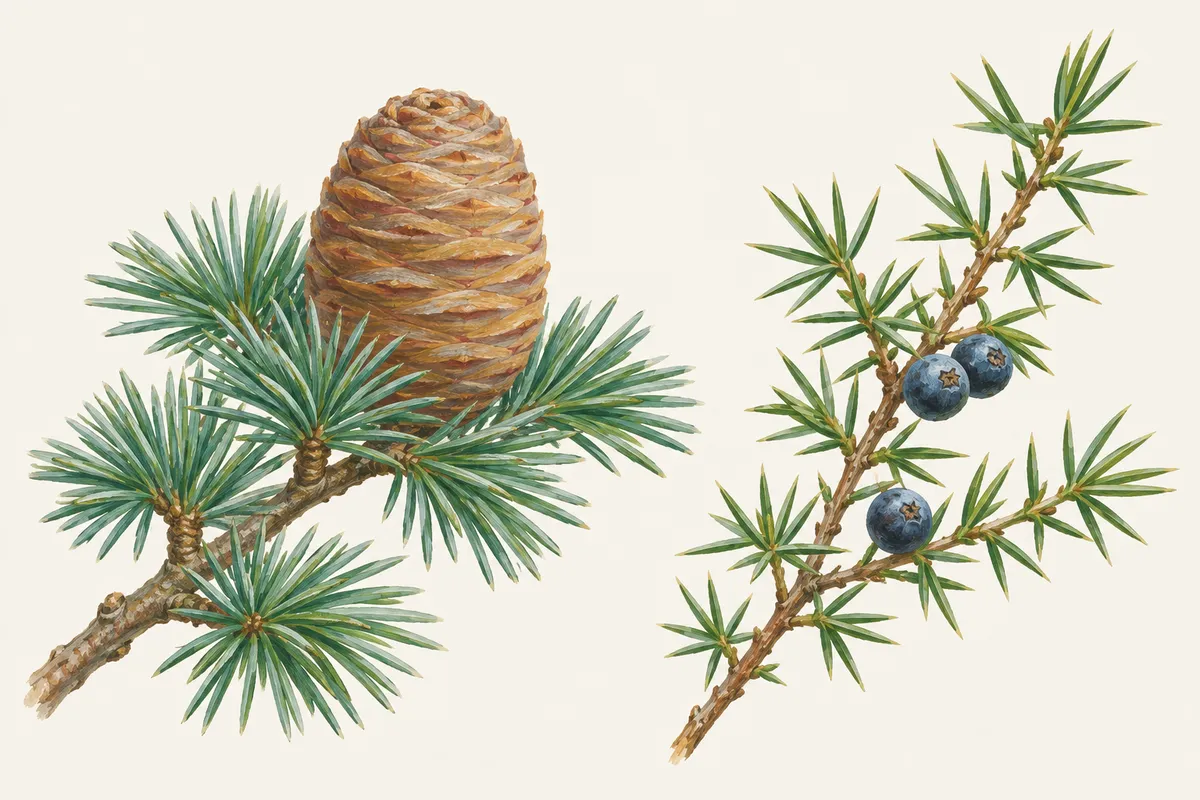
In short
Cedar vs juniper comes down to the leaves and the cone. A true cedar (Cedrus) has needles about 3/4 inch long in tufts of 10 to 20 on short spur shoots and upright, barrel-shaped cones 2 to 3 inches long. A juniper has tiny scales or short sharp needles and round, berry-like cones about 1/4 inch, usually blue with a whitish bloom. Eastern red cedar is a juniper.
- Needles in tufts on stubby spurs and big upright cones mean a true cedar, a pine-family tree planted from the Old World.
- Scales or prickly needles and small, fleshy, blue berry-like cones mean a juniper, in the cypress family.
- Eastern red cedar, the 'cedar' of eastern fields and fencerows, is Juniperus virginiana: a juniper.
Field marks at a glance
- Scientific name
- Cedrus and Juniperus
- Family
- Pinaceae (true cedars) and Cupressaceae (junipers)
- Type
- Conifer, evergreen
- Leaves
- Cedar: needles about 3/4 inch, in tufts of 10 to 20 on short spur shoots, single on new shoots. Juniper: scales about 1/16 inch tight to the twig, sharp awl-like needles on young growth, or both.
- Cone
- Cedar: upright, barrel-shaped, 2 to 3 inches, standing on top of the branch, two years to mature. Juniper: round and berry-like, about 1/4 inch, fleshy, usually blue with a whitish bloom.
- Family
- Cedar: pine family (Pinaceae). Juniper: cypress family (Cupressaceae), with arborvitae and the false cypresses.
- Common juniper
- Only needles, 1/3 to 1/2 inch, in whorls of three with a whitish band on top; usually a low, spreading mat.
- Bark
- Cedar (deodar): smooth gray when young, cracking into dark plates. Juniper (eastern red cedar): red-brown, peeling in long fibrous strips.
- Form
- Cedar: pyramidal when young, broad or flat-topped with age; deodar has drooping branches. Juniper: from ground mats to dense, narrow trees up to about 60 feet.
- Where you meet them
- True cedars: planted only in North America, native to the Atlas Mountains, the Mediterranean and the Himalayas. Junipers: native across the continent, eastern red cedar in every state east of the 100th meridian.
People say cedar for at least four different groups of trees and juniper for one, and the two overlap. The botany is simple: true cedars, genus Cedrus, belong to the pine family and come from North Africa, the Mediterranean and the Himalayas; junipers, genus Juniperus, belong to the cypress family and grow wild across North America. Two checks, the leaves and the cone, settle which one you have.
Cedar vs juniper, side by side
Pick a shoot from a low branch and look for a cone on the tree or the ground. Cedar figures come from Oregon State University's Atlas cedar page and NC State Extension's deodar cedar page; juniper figures from Virginia Tech's fact sheets on eastern redcedar and common juniper.
| Feature | True cedar (Cedrus) | Juniper (Juniperus) |
|---|---|---|
| Leaves | Needles about 3/4 in (Atlas), 1–2 in (deodar) | Scales about 1/16 in, or sharp needles 1/4–1/2 in |
| Arrangement | Tufts of 10–20 on spur shoots; single on leading shoots | Scales opposite or in threes; common juniper's needles in whorls of three |
| Cone | Upright barrel, 2–3 in (Atlas), 3–4 in (deodar) | Round, berry-like, about 1/4 in, fleshy |
| Cone color | Light brown (Atlas); bluish green when young (deodar) | Green, then dark blue with a whitish bloom |
| Time to ripen | Two years | One season (eastern red cedar), three (common juniper) |
| Bark | Smooth gray, cracking into dark plates (deodar) | Red-brown, peeling in long fibrous strips |
| Family | Pine family | Cypress family |
| In North America | Planted only | Native, coast to coast |
The leaves usually settle it before you find a cone. Pinch a twig: if it carries little brushes of needles on stubby woody spurs, it is a cedar. If it is covered in tiny overlapping scales, or in short, stiff needles that prick, it is a juniper or another member of the cypress family.
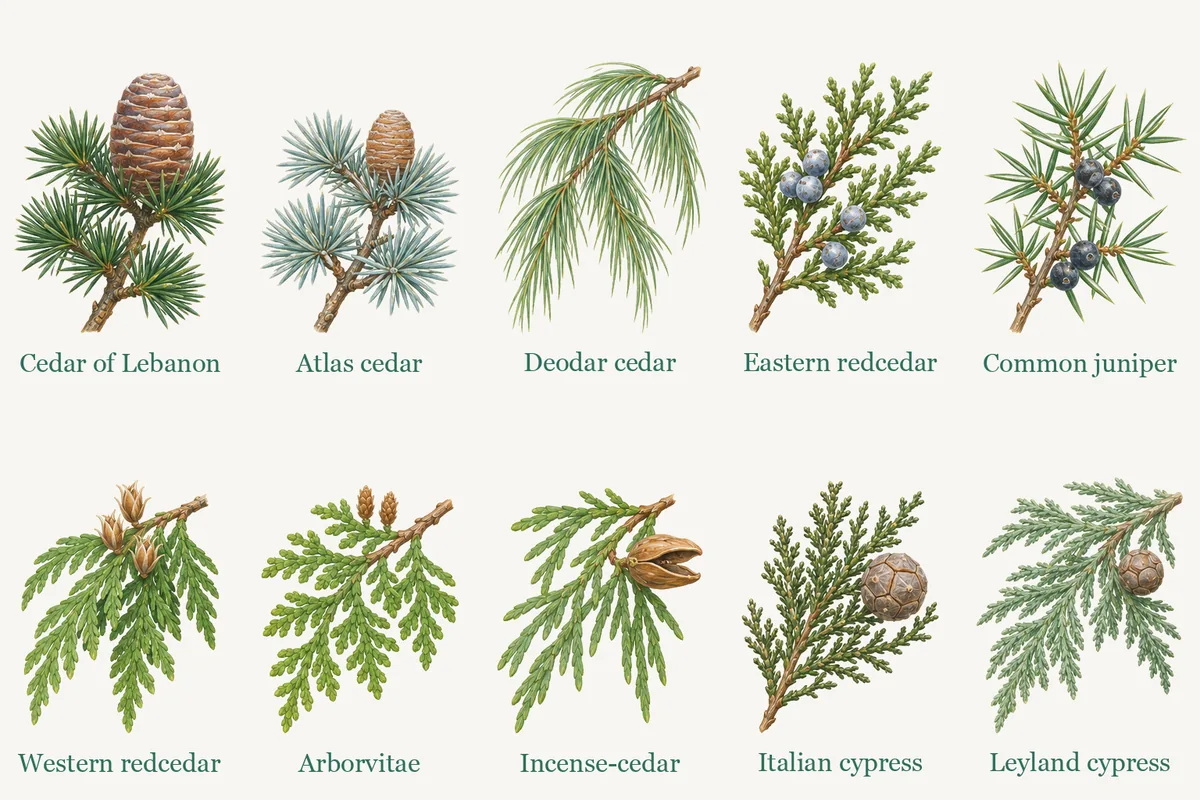
Leaves: tufts on spurs or tiny scales
A true cedar's needles grow in clusters. Oregon State describes Atlas cedar needles about 2 cm (3/4 inch) long, green to bluish green and somewhat stiff, clustered 10 to 20 on spurs and spaced singly along leading twigs. NC State gives deodar cedar longer, more pliable needles, 1 to 2 inches, blue-green to grayish green, crowded on dwarf shoots.
A juniper's leaves are of two kinds, often on one plant. Virginia Tech describes eastern red cedar's scales as about 1/16 inch, dark green and held tight to the twig, with sharp needle-like leaves about 1/4 inch on young trees and fast shoots. Common juniper has only needles, 1/3 to 1/2 inch, in whorls of three, with a whitish band on the upper side.
Larch is the tree that blurs this test, because it also carries needle clusters on spur shoots. Virginia Tech's tamarack fact sheet describes soft, light green needles 3/4 to 1 inch long that turn yellow and fall each autumn. A cedar stays green all winter.
Cones: a barrel on the branch or a blue berry
The cone is the most reliable split. Oregon State describes Atlas cedar's female cones as upright, barrel-shaped, 5 to 7.5 cm (2 to 3 inches) long and 4 cm wide, glossy light brown, sitting on top of the branches and taking two years to mature. NC State gives deodar's at 3 to 4 inches, bluish green on top of the branches. Big male cones also appear, releasing yellow pollen in fall.
A juniper's female cone looks nothing like that. Its scales stay soft and fuse together, so it looks like a berry: about 1/4 inch, light green in spring and dark blue with a whitish bloom by fall on eastern red cedar (Virginia Tech), bluish black with a white bloom on common juniper, which needs three growing seasons to ripen it. Junipers are mostly dioecious, so only female plants carry these "berries". Never eat them on the strength of an identification.
Why red cedar is a juniper
Eastern red cedar, the dense, dark tree of old fields and fencerows east of the Plains, is Juniperus virginiana. The USDA Forest Service's Silvics of North America lists red juniper and savin among its names and places it in every state east of the 100th meridian. It has every juniper mark: scales and prickly juvenile needles, and blue, berry-like cones on female trees. Its full profile is on the eastern red cedar page.
The other American "cedars" are neither true cedars nor junipers. Northern white cedar is an arborvitae, Thuja occidentalis, and western redcedar is Thuja plicata; both have flat, fan-like sprays of scales and small, dry cones that open. The cedar tree identification page has a table of every tree called cedar, and the juniper page separates the western junipers.
Where you meet each in North America
Location is a strong clue. True cedars grow only where someone planted them: Oregon State notes Atlas cedar is native to the Atlas Mountains of Algeria and Morocco and hardy only to USDA Zone 6, and NC State places deodar's native range in northeastern Afghanistan, western Nepal and northwest India. Look for them as large specimen trees on lawns, campuses and estates.
Junipers are the wild ones: eastern red cedar across the East, Rocky Mountain, Utah and alligator junipers in the dry West, and common juniper as a low, spreading mat. The Forest Service describes eastern red cedar as common on abandoned fields and pastures, so in the East a scale-leaved conifer that came up on its own in an old field is usually that juniper.
If you cannot reach the branches, Tree Identifier can name the tree from one photo of a shoot or a cone. It shows one name, without a confidence score or look-alike list, so check the result with the two tests above: tufts or scales, barrel or berry.
Look-alikes and how to tell them apart
Arborvitae and western redcedar (Thuja)
Called cedars but neither true cedar nor juniper. Thuja holds its scales in flat, fan-like sprays and carries small, dry, woody cones that open. A juniper's scaled twigs are rounder and its cone stays closed and fleshy.
Larch (Larix)
Larch also has needles in clusters on spur shoots, which can pass for a cedar's tufts. But larch needles are soft and turn yellow and drop every fall, and its cones are small, about 3/4 to 1 inch and egg-shaped, not 2- to 3-inch barrels.
Pines (Pinus)
Pine needles come in bundles of 2, 3 or 5 held by a papery sheath. A cedar's tuft holds many more needles on a woody spur with no sheath, and its cones stand upright instead of hanging.
What a photo can't settle
- Young junipers, and juvenile shoots on old ones, carry only sharp needles, so a photo of one shoot can look like a different conifer.
- Only female junipers carry the blue berry-like cones, and a true cedar takes years to cone, so many trees must be named from foliage alone.
- Garden junipers and blue cedars come in many cultivars, and a single photo rarely tells one cultivar from another; expect a species name at best.
Questions people ask
Is a juniper a type of cedar?
Not botanically. Junipers belong to the cypress family, true cedars to the pine family. But several junipers carry cedar in their common names: eastern red cedar is Juniperus virginiana, and the USDA Forest Service lists red juniper among its names.
Is red cedar a cedar or a juniper?
In the East, red cedar is a juniper, Juniperus virginiana, with blue berry-like cones. In the Pacific Northwest, western redcedar is Thuja plicata, an arborvitae with flat sprays and small woody cones. Neither is a true cedar.
Do cedars have berries?
True cedars do not. They carry upright, barrel-shaped woody cones 2 to 3 inches long that take two years to mature, according to Oregon State University. A conifer with small, round, blue 'berries' is a juniper; the berry is a cone with fleshy, fused scales.
Which is bigger, a cedar or a juniper?
Usually the cedar. Oregon State gives Atlas cedar 40 to 60 feet, sometimes up to 120. Most junipers are shrubs or small trees: Virginia Tech gives eastern red cedar up to about 60 feet and describes common juniper as a low, mat-forming shrub.
Sources
- Cedrus atlantica (Atlas cedar) — Oregon State University, Landscape Plants
- Cedrus deodara (Deodar Cedar) — North Carolina Extension Gardener Plant Toolbox, NC State University
- Eastern redcedar fact sheet — Virginia Tech Dendrology
- Common juniper fact sheet — Virginia Tech Dendrology
- Eastern Redcedar (Juniperus virginiana), Silvics of North America — USDA Forest Service
- Tamarack fact sheet — Virginia Tech Dendrology
Keep reading
- Tree profileCedar trees: how to identify red, white and true cedars
- Tree profileJuniper trees: how to identify them
- Tree profileEastern red cedar (Juniperus virginiana): how to identify it
- Field guideConifer identification: three questions about the needles, then the cone
- Tree profileArborvitae: how to identify it and tell the hedge types apart