Tree profile
Arborvitae: how to identify it and tell the hedge types apart
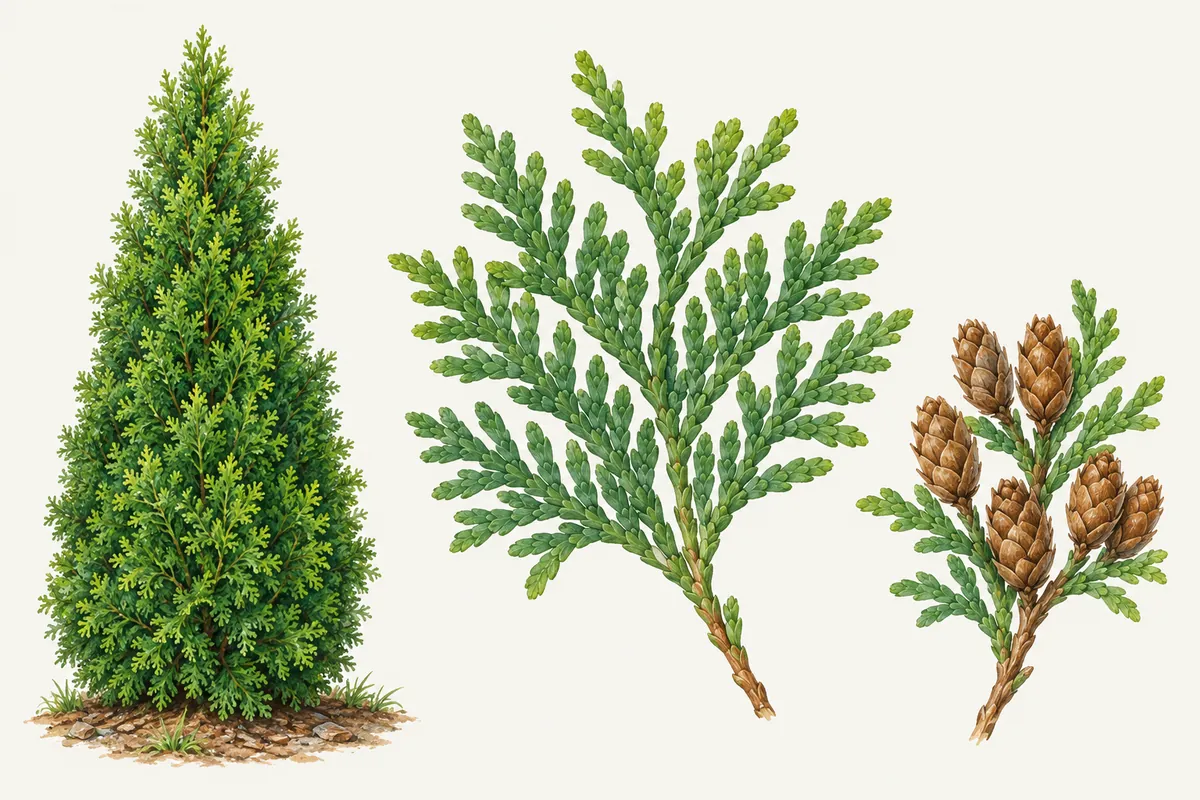
Flat, fan-like sprays of tiny scales, small upright cones and a citrus smell when crushed. Then the shape of the plant tells you which arborvitae is in your hedge.
In short
Arborvitae identification starts with the foliage: tiny scale leaves pressed flat into fan-like sprays that smell citrusy when crushed. Then look for oblong cones about 1/2 inch long held upright on the branches, with leathery scales. A narrow column 3 to 4 feet wide is usually 'Emerald Green'; a fast tree heading for 40 to 60 feet is usually 'Green Giant'.
- Arborvitae, northern white cedar and eastern white cedar are one native tree, Thuja occidentalis; most hedge arborvitae are its cultivars.
- 'Green Giant' is a different plant: a hybrid of western redcedar and Japanese arborvitae that grows up to 3 to 4 feet a year.
- Leyland cypress, the usual look-alike, has bluish-green sprays that look the same on both sides and twist slightly; arborvitae sprays are flat and paler beneath.
Field marks at a glance
- Scientific name
- Thuja occidentalis
- Family
- Cupressaceae (cypress family)
- Type
- Conifer, evergreen
- Foliage
- Scale leaves in very flattened, fan-like sprays; scales about 1/4 inch on main shoots, 1/8 inch on side shoots (Virginia Tech). Darker green above, paler below, fragrant (NC State).
- Smell
- Crushed leaves give off a citrusy scent, according to Penn State Extension.
- Cones
- Oblong, about 1/2 inch (8 to 15 mm), held upright on the branches, leathery red-brown scales with a small spine at the tip; green to light brown, ripening August to September.
- Winter color
- The wild species turns bronze in winter (NC State); 'Emerald Green' keeps its deep green, according to Penn State.
- Bark
- Thin, fibrous, red-brown, weathering to gray, in vertical strips that often make a diamond pattern.
- Form
- Wild trees are shaped like an arrowhead, often with several trunks, 35 to 65 feet tall. Hedge cultivars range from 3-foot globes to narrow columns.
- Native range
- Nova Scotia and Maine to Manitoba and Minnesota, south to central New York and central Michigan, with isolated Appalachian stands as far as North Carolina (USDA Forest Service).
- In the app's Collection
- Yes: northern white cedar (Thuja occidentalis) and western redcedar (Thuja plicata).
Arborvitae is the hedge plant of American yards and the same species as the northern white cedar of northern swamps and cliffs, Thuja occidentalis. Nurseries sell dozens of shapes of it, plus a few relatives and hybrids that look much the same. This page shows how to confirm you have an arborvitae, which type it is, and how to tell it from the trees most often mixed up with it.
How to identify an arborvitae in four checks
Work from the foliage to the cone, then step back and look at the shape.
- Flat sprays of scales. There are no needles. The leaves are tiny scales pressed against the twig, and the side shoots are flattened into fans. Virginia Tech Dendrology gives scales about 1/4 inch long with long points on the main shoots and about 1/8 inch on the side shoots. The NC State Extension Plant Toolbox adds that the scales are darker green above and paler below.
- The smell. Crush a spray between your fingers. Penn State Extension describes the scent as citrusy.
- The cone. Look near the branch tips for oblong cones about 1/2 inch long, standing upright, with leathery red-brown scales that each end in a small spine (Virginia Tech). The USDA Forest Service measures them at 8 to 15 mm, green turning light brown as they ripen in August and September, opening from mid-September to late October.
- The bark and shape. On an unsheared tree, the bark is thin, fibrous and red-brown, weathering gray, often in a diamond pattern. Wild trees are shaped like an arrowhead and often have several trunks.
If the scales wrap all the way around a four-sided twig and the plant carries blue berries, you have a juniper, not an arborvitae. If the leaves are needles in tufts and the cones are upright barrels 2 to 3 inches long, it is a true cedar: the cedar tree identification page sorts every tree called cedar.
Eastern and western arborvitae
Two Thuja species are native to North America.
Eastern arborvitae (Thuja occidentalis) is the wild northern white cedar. The Forest Service maps it from the Atlantic coast in Nova Scotia and Maine west to Manitoba and Minnesota, south to central New York and central Michigan, with isolated stands in the Appalachians as far as North Carolina. It grows in swamps, seeps, on cliffs and in old pastures, reaches 35 to 65 feet, and can live more than 400 years; trees on cliffs and bluffs pass 900. In winter its foliage turns bronze (NC State). The Forest Service counts over 100 cultivars of it planted as ornamentals, for privacy screens, windbreaks and snow fences.
Western arborvitae is western redcedar (Thuja plicata), which Penn State calls giant western arborvitae, native to the northwestern United States and western Canada. Virginia Tech gives it yellow-green scales 1/16 to 1/8 inch long, woody cones about 1/2 inch, stringy reddish-brown bark that comes off in long strips, and a height of up to 200 feet. In the East you meet it mostly as a parent of 'Green Giant'.
'Emerald Green', 'Green Giant' and other hedge arborvitae
When an arborvitae is in a row along a fence, the question is usually which cultivar it is. Size, speed and winter color separate the common ones. The rows below come from Penn State Extension and NC State Extension.
| Type | Parent | Size and shape | Notes |
|---|---|---|---|
| 'Emerald Green' ('Smaragd') | T. occidentalis | Narrow column, about 3 to 4 ft wide | Keeps deep green through winter (Penn State) |
| 'Techny' ('Mission') | T. occidentalis | Pyramidal | Dark green all year, suited to northern winters |
| 'Holmstrup' | T. occidentalis | Narrow pyramid, dense horizontal sprays | Holds its color in winter (NC State) |
| 'DeGroot's Spire' | T. occidentalis | Narrow column | Listed by NC State |
| 'Little Gem', 'Mr. Bowling Ball', 'Tater Tot' | T. occidentalis | Globes; 'Little Gem' about 3 ft | Dwarf forms |
| 'Rheingold', 'Sunkist' | T. occidentalis | Small | Golden or lemon-yellow foliage, coppery or orange-yellow in winter |
| 'Green Giant' | T. plicata × T. standishii | 40 to 60 ft tall, 12 to 18 ft wide | Up to 3 to 4 ft of growth a year; glossy sprays |
| 'Steeplechase' | T. plicata × T. standishii | 20 to 30 ft tall, about 8 ft wide | Hybrid like 'Green Giant' |
'Green Giant' has a story of its own. NC State says it was developed in Denmark in the 1930s and reached the United States in 1967 through the U.S. National Arboretum. Sources disagree on its winter color: NC State says its foliage stays deep green, Penn State says it fades to bronze. A hedge that grew a foot or two in one season is far more likely to be 'Green Giant' than 'Emerald Green'.
Arborvitae vs Leyland cypress, juniper and false cypress
All four are scale-leaved evergreens sold for hedges and screens, and all four belong to the cypress family. Take one spray, look at both sides, and find a cone.
| Plant | Spray | Cone | Size |
|---|---|---|---|
| Arborvitae (Thuja occidentalis) | Flat fans, darker above, paler below, citrus smell | Oblong, about 1/2 in, upright, leathery scales | 35 to 65 ft wild; cultivars much smaller |
| Leyland cypress | Elongated sprays, bluish-green on both sides, branchlets slightly twisted | Round, dark brown, up to 3/4 in across, 8 scales | 60 to 70 ft tall, 10 to 15 ft wide |
| Eastern red cedar (a juniper) | Scales about 1/16 in, tight to the twig; prickly needle-like leaves 1/4 in on young shoots | Berry-like, about 1/4 in, dark blue with a whitish bloom | Up to 60 ft |
| Hinoki false cypress (Chamaecyparis obtusa) | Flat, fan-shaped, with whitish X-like markings underneath | Round, about 1/2 in, orange-brown, 8 to 10 scales | 50 to 75 ft; many dwarf cultivars |
NC State's Leyland cypress page explains its origin, an accidental cross of Monterey cypress and Nootka cypress on Christopher Leyland's property in England, and notes that the foliage can irritate skin. Leyland grows up to 3 feet a year when young and can reach 50 feet in 15 years. For the other cypresses, see the cypress page; for common, Rocky Mountain and other junipers, the juniper page.
Why arborvitae turns brown
Brown arborvitae is one of the most searched questions about the plant. Two causes are normal or weather-related, and you can usually tell them apart by where the brown is.
Seasonal needle drop: brown inside, in autumn. Wisconsin Extension explains that conifers shed their oldest inner foliage after one or more years, and that on arborvitae the old leaves turn brown rather than yellow and often hang on longer than pine needles. Penn State calls browning of the oldest interior branches in autumn normal shedding. The outer, current growth stays green.
Winter burn: brown tips on the sunny side, in early spring. In winter, sun and wind dry the foliage while frozen soil keeps the roots from replacing the water. Wisconsin Extension's winter burn article lists arborvitae, false cypress and juniper among the plants affected, says browning starts at the branch tips and spreads inward, that foliage facing south, southwest or west is most often hit, and that symptoms show as the snow melts. Scratch the bark of a brown branch: if the tissue under it is green, buds may still break into new foliage. NC State adds that dry, exposed, windy sites make winter burn more likely.
Something else. Spots on current-season foliage, webbing, clusters of mined tips or hanging bags point to a fungus or a pest instead: leaf miners, spider mites and bagworms all occur on arborvitae. The tree disease identification guide sorts symptoms by the part of the tree. Tree Identifier's Diagnose tool gives a quick first opinion from one photo, with a severity badge and a dated record you can compare next spring; a large tree near a house or a whole hedge dying is a job for a certified arborist or your state's extension service.
Arborvitae, white cedar and thuja: the names
Arborvitae, northern white cedar, eastern white cedar and American arborvitae all name Thuja occidentalis; the Forest Service also records the Ojibwe name giizhik. "Thuja" is simply the genus name, so "arborvitae vs thuja" is not a comparison: every arborvitae is a thuja. "Western arborvitae" and "giant arborvitae" mean Thuja plicata. Oriental arborvitae, from China and Korea, was once called Thuja orientalis; NC State now lists it as Platycladus orientalis and notes it is often confused with American arborvitae.
Tree Identifier names a tree or shrub from one photo, and northern white cedar and western redcedar are both in its Collection. Photograph a single spray close up, ideally with a cone, rather than the whole sheared hedge.
Look-alikes and how to tell them apart
Leyland cypress (× Hesperotropsis leylandii)
Its sprays are bluish-green on both sides and the branchlets have a slight spiral twist, while arborvitae sprays are paler beneath. Its round cones reach 3/4 inch across with 8 scales; arborvitae cones are oblong, about 1/2 inch and upright.
Eastern red cedar and other junipers (Juniperus)
Eastern red cedar's scales are tiny, about 1/16 inch, and tight to the twig, young shoots often carry prickly needle-like leaves about 1/4 inch long, and female plants bear blue, berry-like cones instead of woody upright ones.
Hinoki false cypress (Chamaecyparis obtusa)
Turn a spray over: Hinoki has whitish X-shaped markings on the underside and round, orange-brown cones about 1/2 inch with 8 to 10 scales. Northern white cedar has no white marks and its cones are oblong and upright.
Western redcedar (Thuja plicata)
Another Thuja, native to the northwestern US and western Canada. Its scales are yellow-green and only 1/16 to 1/8 inch, and in the wild it is a forest giant up to 200 feet; eastern arborvitae rarely passes 65 feet.
What a photo can't settle
- Over 100 cultivars of northern white cedar are planted, according to the USDA Forest Service. A photo app can name the species or the genus, but not the cultivar on the nursery tag.
- Arborvitae, Leyland cypress and false cypresses look alike in a photo of a sheared hedge. Photograph one spray from both sides and a cone if there is one.
- Tree Identifier gives one name from one photo, with no confidence score and no look-alike list, so check the spray and cone yourself before you buy replacements.
Questions people ask
Is arborvitae the same as thuja?
Yes. Arborvitae is the common name for trees of the genus Thuja. The one in most American hedges is Thuja occidentalis, which the USDA Forest Service also lists as northern white-cedar and eastern white-cedar. 'Green Giant' is a Thuja hybrid, and Thuja plicata is western redcedar, sometimes called giant western arborvitae.
How do you tell 'Emerald Green' from 'Green Giant'?
By size and speed. 'Emerald Green', sold in Denmark as 'Smaragd', is a narrow column about 3 to 4 feet wide that keeps its deep green in winter. 'Green Giant' grows up to 3 to 4 feet a year toward 40 to 60 feet tall and 12 to 18 feet wide, with glossy, dark green sprays.
Is arborvitae a cedar or a cypress?
It is a member of the cypress family, Cupressaceae, and is commonly called white cedar, but it is not a true cedar. True cedars (Cedrus) belong to the pine family and have needles in tufts and upright barrel-shaped cones 2 to 3 inches long.
Why is my arborvitae turning brown inside?
Browning of the oldest interior foliage in autumn is normal shedding, according to Penn State Extension, and arborvitae needles turn brown rather than yellow when they age out. Brown tips on the south or west side in early spring point to winter burn instead.
What are the small brown cones hanging on my arborvitae?
Check them. Arborvitae cones are about 1/2 inch, oblong and stand upright. Penn State Extension warns that bagworm cocoons look like small brown cones hanging from the branches; a bagworm bag is made of silk and bits of foliage and hangs down.
Sources
- Northern White-Cedar, Silvics of North America — USDA Forest Service
- Northern white-cedar fact sheet — Virginia Tech Dendrology
- Thuja occidentalis (American Arborvitae) — NC State Extension Gardener Plant Toolbox
- The Mighty Arborvitae — Penn State Extension
- Thuja 'Green Giant' (Green Giant Arborvitae) — NC State Extension Gardener Plant Toolbox
- x Hesperotropsis leylandii (Leyland Cypress) — NC State Extension Gardener Plant Toolbox
- Winter Burn — Wisconsin Horticulture, UW-Madison Division of Extension
- Seasonal Needle Drop — Wisconsin Horticulture, UW-Madison Division of Extension