Tree health
Tree disease identification, symptom by symptom
Name the tree, then check leaves, crown, bark, base, holes and fungi in that order. Most problems narrow to a short list within two minutes.
In short
Tree disease identification starts with naming the tree, because most diseases and pests attack one species or genus. Then check, in order, the leaves (spots, scorched edges, wilting), the crown (dieback from the top), the bark (cankers, dark ooze, cracks), the base (fungi), and holes (D-shaped exit holes mean a borer). Note whether neighbouring trees of the same kind are affected.
- Identify the species first: the N.C. Forest Service says most insects and pathogens attack only one or a few tree species.
- If one species is sick and others nearby are fine, suspect a pest or disease; if every species suffers, suspect the site, weather or soil.
- D-shaped exit holes in bark mean a jewel beetle such as emerald ash borer; dark weeping cracks on oak bark can mean acute oak decline in Britain.
- Regulated pests and large trees near people go to a professional: an arborist, your extension or forestry office, the CFIA in Canada or Tree Alert in Britain.
A tree rarely shows one tidy symptom. It shows a pattern: which leaves, which part of the crown, what on the bark, what at the base, which trees nearby. The N.C. Forest Service guide Diagnosing Disorders of Trees starts every diagnosis with the same step: identify the tree species, because most insects and pathogens have a very narrow host range, and naming the tree eliminates the vast majority of possible causes. This page walks through the rest in the order you would look at a tree in your yard. It stops short of treatment: for that, call the people listed at the end.
Check the tree in this order
Stand back first, then walk in close.
- Leaves. Look at both sides of several leaves from different parts of the crown.
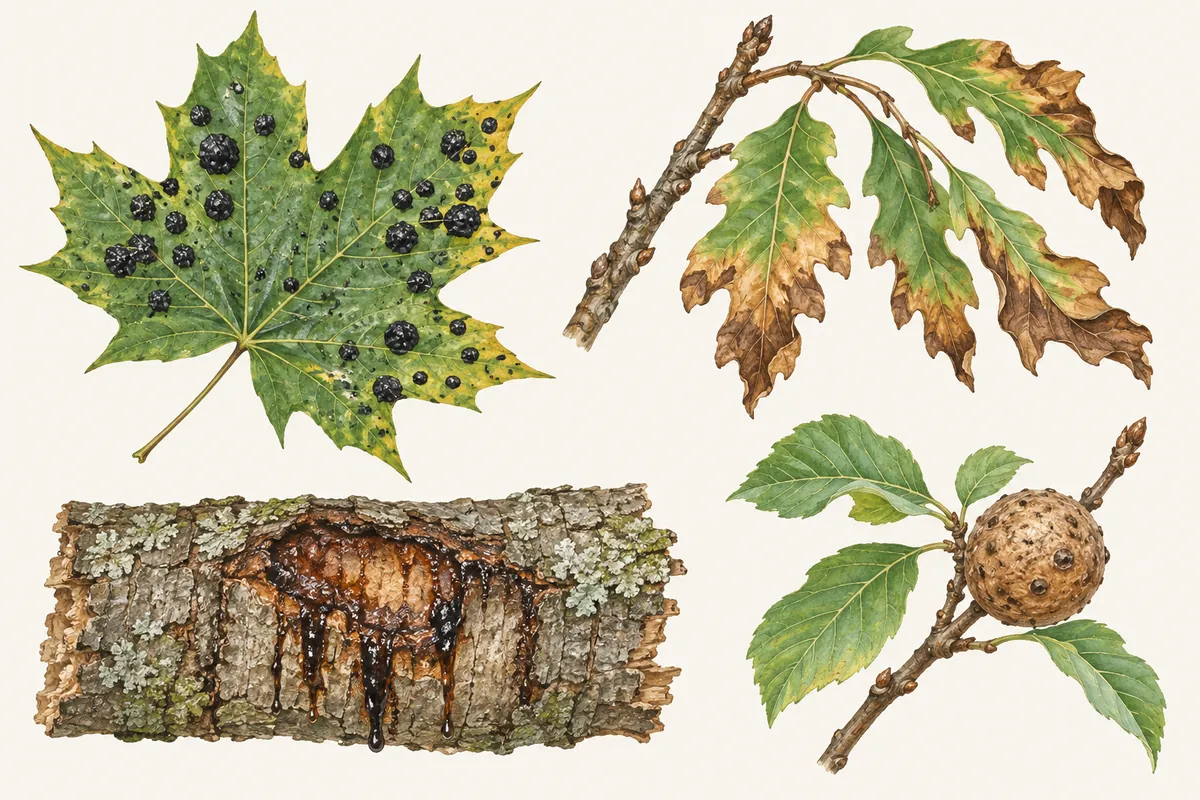
- Spots and blotches: brown patches that grow outward to the leaf edge after a cool, wet spring are typical of anthracnose; on oaks, the USDA Forest Service says it is worse in the lower crown and the leaves, though curled, usually do not wilt.
- Scorched edges: browning along the leaf margins can be drought or heat, or a disease such as bacterial leaf scorch, which comes back on the same branches year after year.
- Wilting and sudden browning in summer: a vascular disease such as oak wilt blocks the water-conducting wood. Red oaks with oak wilt can be almost bare within a few weeks.
- Galls: bumps, balls or blisters on leaves or twigs.
- Crown. Is the dieback at the top, in single branches, or all over? USDA APHIS lists dying branches near the top and unusual sprouting on the trunk among the signs of emerald ash borer, and the USDA Forest Service says two-lined chestnut borer damage on oaks usually starts in the upper crown too.
- Bark. Look for cankers (sunken, dead patches), vertical cracks, dark weeping fluid, and bark stripped off by woodpeckers.
- Base and roots. Mushrooms or brackets at ground level, soil heaved on one side, a lean that is new.
- Holes and sawdust. Note the hole's shape and size, and look for fine sawdust (frass) in bark crevices or at the foot of the tree.
- Fungi on the trunk. A bracket or conk is the fruit of a decay fungus; the tree fungus identification guide covers the common ones.
Then look around. The N.C. Forest Service's rule of thumb: if only one species, or a few closely related ones, are affected while other trees are fine, a pest or disease is likely; if many or all species in the area are affected, look at abiotic causes such as drought, soil or construction. Ask when it started, how fast it is changing, and what happened on the site in recent years.
Symptoms and their likely causes
| What you see | Common causes to check | Read next |
|---|---|---|
| Brown blotches on leaves after a wet spring, worse low in the crown | Anthracnose (described for oaks by the USDA Forest Service) | This page |
| Oak leaves bronzing from the edges and dropping in summer | Oak wilt; bacterial leaf scorch; two-lined chestnut borer | Oak wilt |
| Ash crown thinning from the top, D-shaped exit holes, woodpecker damage | Emerald ash borer (US, Canada) | Emerald ash borer |
| Ash leaves wilting and blackening, diamond-shaped bark lesions (UK, Ireland) | Ash dieback | Ash dieback |
| Dark bands between the veins of beech leaves | Beech leaf disease | Beech leaf disease |
| Dark fluid weeping from vertical cracks in oak bark (Britain) | Acute oak decline; Phytophthora | This page |
| Brackets or mushrooms at the base | Root and butt rots (Ganoderma, giant polypore, honey fungus) | Tree fungus identification |
| Bumps or balls on leaves and twigs | Galls from insects or mites; occasionally bacteria or fungi | This page |
Holes, sawdust and ooze
D-shaped exit holes. A hole with one flat side is the signature of jewel beetles (Agrilus). USDA APHIS lists D-shaped exit holes, S-shaped tunnels under the bark, vertical bark cracks, dying branches near the top, unusual sprouting on the trunk and extra woodpecker activity as signs of emerald ash borer, which APHIS says has been detected in 38 states and the District of Columbia since it was first found in Michigan in 2002 (page last modified 23 April 2026, read 2026-10-30). On oaks in the US, the USDA Forest Service describes the two-lined chestnut borer's D-shaped hole as about 1 to 2 mm across.
Dark ooze on oak bark. In Britain, Forest Research describes acute oak decline as dark-coloured, vertical, weeping fissures (stem bleeds) on mainly native pedunculate and sessile oaks, a thinning canopy, and D-shaped beetle exit holes in about a third of cases. It is found mostly in south-eastern, central and eastern England, the Welsh Borders and South-East Wales, and is listed as reportable. Forest Research adds that a stem bleed alone is not proof, since Phytophthora and other pathogens also cause weeping patches.
Galls: usually harmless, sometimes not
Galls are abnormal growths on leaves, twigs, roots or flowers. The Morton Arboretum's plant galls page says most are caused by feeding or egg laying by insects and mites, for example maple bladder gall (a mite on silver, red and Freeman maples), hackberry nipple gall and oak spangles, and that in most cases the damage is aesthetic. A few stem galls can girdle stems, and galls caused by bacteria or fungi, such as crown gall and black knot, can be far more serious. A gall on many twigs of a young tree is worth a professional look; a few galls on mature leaves rarely are.
Common causes by region
- United States. Emerald ash borer on ash; oak wilt across much of the East, the Midwest and Texas (USDA Forest Service); beech leaf disease on beech; decay fungi on old and wounded trees everywhere.
- Canada. Emerald ash borer on ash; oak wilt confirmed in three places in Ontario, as of the CFIA page read on 2026-10-30: Niagara Falls, Springwater and Niagara-on-the-Lake. The CFIA asks people to report suspect oaks.
- United Kingdom and Ireland. Ash dieback on ash, acute oak decline on oak, and root and heart rots. The RHS warns that trees weakened by bracket fungi can topple at any time and that owners are legally responsible for their trees.
Who to call
Call before anyone cuts, sprays or moves wood, and always for a large tree near a house, road, path or play area.
- US: an ISA Certified Arborist; your state extension service's plant disease clinic; your state forestry agency. For emerald ash borer, APHIS has an online report form.
- Canada: a certified arborist, your provincial forestry ministry, and the CFIA for regulated pests such as oak wilt.
- Great Britain: an arboricultural consultant, and Forest Research's TreeAlert for pests and diseases of concern. TreeAlert asks for three photos: the tree in its surroundings, the symptom on the tree, and a close-up of the symptom. Northern Ireland uses TreeCheck.
Tree Identifier can do two useful things before that call. Its Diagnose tool gives an AI health check from one photo, with a severity badge (Healthy, Mild, Moderate or Severe), a likely cause, and treatment and prevention notes, and you can ask follow-up questions under the result. Treat that as a quick first opinion, not a lab diagnosis. And because History keeps each result with its date and the Tree Map remembers where the tree stands, a photo every couple of weeks gives an arborist the progression they need to see.
What a photo can't settle
- A photo can show a symptom, but many causes look alike; diseases such as oak wilt are confirmed only by a laboratory.
- Regulated pests and diseases must be reported to the agency in charge, whatever an app suggests.
- Whether a sick tree is safe to keep near a house, road or path is a judgement for an arborist on site.
Questions people ask
How can I tell what disease my tree has?
Name the tree first, then look at the whole tree: leaves, crown, bark, base and the ground around it. Note when the symptoms appeared and whether nearby trees of the same species show them too. That narrows most problems to a few causes; a lab test or an arborist confirms the rest.
What does a diseased tree look like?
Common symptoms include leaf spots, scorched or wilting leaves, branches dying back from the top, sunken or weeping patches on the bark, fungi on the trunk or base, and holes with sawdust. One symptom alone rarely names the cause; the combination, the species and the season do.
Are galls on leaves a disease?
Usually not a serious one. The Morton Arboretum says most galls are caused by insects or mites and are an aesthetic problem. Galls caused by bacteria or fungi, such as crown gall and black knot, can be far more serious and are hard to tell apart from insect galls.
Can an app identify tree diseases from a picture?
An app can give a quick first opinion from a photo and help you keep a dated record. It cannot confirm a disease: many, such as oak wilt, need a lab test, and regulated pests must be reported to the authorities. Use the photo to prepare for an arborist or extension visit.
Who do I call about a sick tree?
In the US and Canada, an ISA Certified Arborist or your state or provincial extension service; for regulated pests in Canada, the CFIA. In Britain, an arboricultural consultant, and Forest Research's Tree Alert for pests and diseases of concern. Any large tree near people or buildings needs a professional on site.
Sources
- Diagnosing Disorders of Trees (Appendix A: The Ten S's of Tree Disorder Diagnostics) — N.C. Forest Service, N.C. Department of Agriculture and Consumer Services
- How to Identify, Prevent, and Control Oak Wilt (NA-FR-01-11, 2011; copy hosted by NYSDEC) — USDA Forest Service, Northeastern Area State and Private Forestry
- Emerald Ash Borer — USDA Animal and Plant Health Inspection Service (APHIS)
- Plant galls — The Morton Arboretum
- Acute oak decline — Forest Research
- TreeAlert — Forest Research
- Oak wilt — Canadian Food Inspection Agency
- Bracket fungi — Royal Horticultural Society
Keep reading
- Tree healthTree fungus identification, from artist's conk to honey fungus
- Tree healthOak wilt symptoms in red, white and live oaks
- Tree healthEmerald ash borer signs: how to check an ash tree
- Tree healthAsh dieback symptoms: how to check an ash tree
- Tree healthBeech leaf disease symptoms: how to check a beech