Tree health
Ash dieback symptoms: how to check an ash tree
Ash dieback is now found across Britain and Ireland. Here is what it looks like on the leaves, branches, crown and trunk base, and when a tree near a road needs a professional.
In short
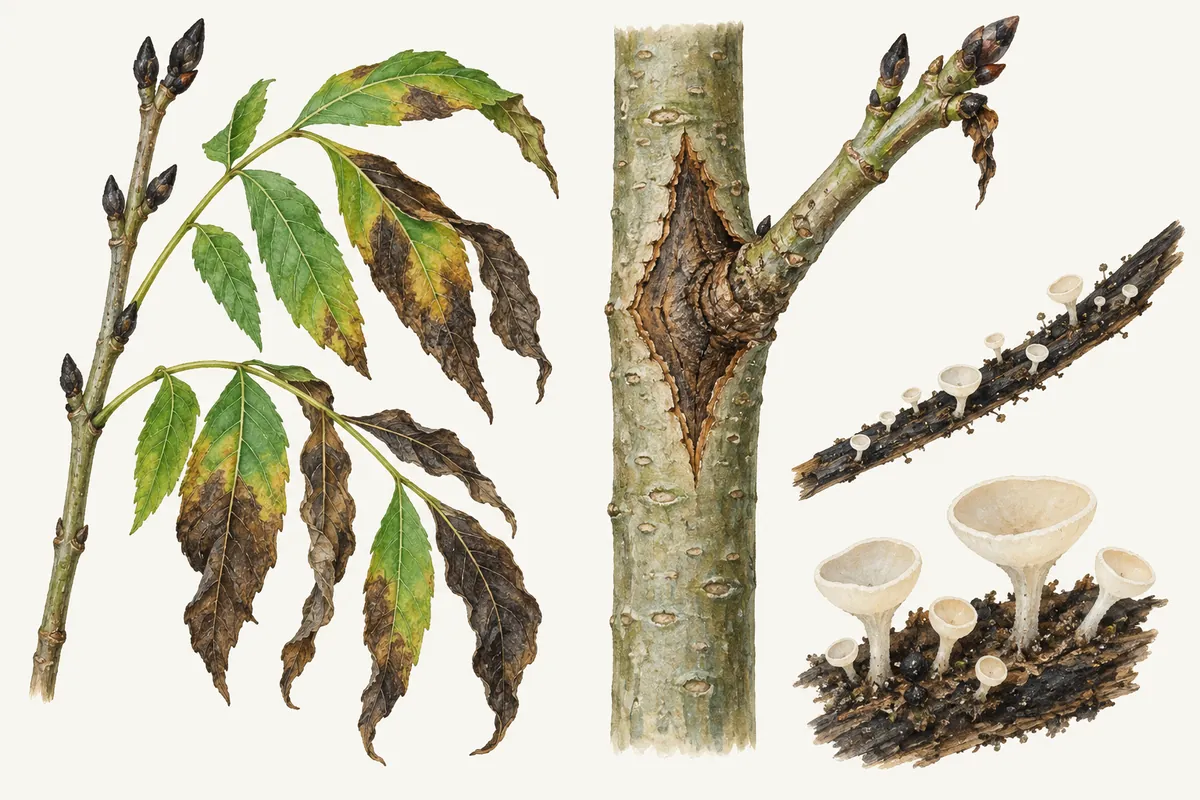
Ash dieback symptoms show in four places. In July to September, leaves and shoots wilt and blacken. On branches and the trunk, dark lesions form, often an elongated diamond centred on a branch joint. The crown thins year by year, often with bushy shoots sprouting from the trunk. Lesions at the base of the trunk matter most for safety, because they can weaken it.
- Confirm the tree is an ash: opposite pairs of leaflets and black, velvety buds.
- Forest Research describes the disease as present in most parts of the UK; Teagasc reports findings in all 26 counties of Ireland by the end of 2022.
- A declining ash next to a road, path or building is a job for a qualified arborist, not a ladder and a saw.
Ash dieback is a disease of ash trees caused by the fungus Hymenoscyphus fraxineus, of eastern Asian origin. Forest Research records that it was first confirmed in the UK in February 2012, in a consignment of ash plants from a Dutch nursery, and that it is now present in most parts of the UK. This page lists the symptoms in the order you can check them, then explains crown classes, safety near roads, and whom to tell in Britain and Ireland.
Symptoms to check, leaf to base
Start with the tree as a whole, then walk round the trunk. Do it in summer, between July and September, when leaf symptoms show.
- Is it an ash. The Woodland Trust's ash profile gives pinnately compound leaves with 3 to 6 opposite pairs of oval leaflets plus one at the tip, and black, velvety buds in opposite pairs. The disease is a disease of ash only, so this check comes first; the ash identification page covers it in detail.
- Leaves and leaflets. Forest Research describes blackening and wilting of leaves and shoots from mid to late summer. The Woodland Trust's ash dieback page adds dark patches on the leaves; affected leaves may wilt, turn black and fall early. Teagasc lists foliage wilt and discolouration first among the symptoms it sees in Ireland.
- Shoots and the crown. Dead shoots and twigs, then dead branches. Teagasc describes dieback of shoots, twigs or the main stem resulting in crown dieback, and the Forestry Commission lists leaf loss and crown dieback among the visible symptoms. Scotland's Farm Advisory Service notes the disease repeats each year until the tree dies, so the crown gets thinner season by season.
- Bark lesions on branches and the trunk. Dark lesions, or cankers, often an elongated diamond shape, centred on the joint where a smaller branch meets a larger one or the trunk. Forest Research says they spread up and down from the joint and can eventually girdle the stem. The Woodland Trust describes them as dark brown, with brownish-grey inner bark beneath. Teagasc describes brown to orange bark discolouration with a diamond shape.
- Bushy shoots on the trunk. Clusters of new shoots from dormant buds on the trunk and main branches, which the Woodland Trust calls epicormic growth, a common stress response. Teagasc lists it among the symptoms in Ireland.
- The base of the trunk. Dark lesions in the bark at ground level. Forest Research singles out these basal lesions because they can weaken the trunk. Scotland's Farm Advisory Service notes that in mature trees a secondary fungus, honey fungus, often finishes the tree off, and the Forestry Commission says weakened ash can succumb to honey fungus (Armillaria), so clusters of mushrooms at the base are worth noting too.
- Fruiting bodies in the leaf litter. Forest Research describes small, white, mushroom-like fruiting bodies on the stalks of the previous year's fallen leaves, which open in summer and release thousands of spores. They are small; look for them on last year's leaf stalks on the ground under an ash.
Crown condition classes
Councils and landowners rate infected ash by how much live crown is left, using four classes first set out in the Tree Council's Ash Dieback Action Plan Toolkit. The Farm Advisory Service in Scotland (page dated 8 July 2025) gives them as:
| Class | Live crown left | FAS advice |
|---|---|---|
| 1 | 100 % to 75 % | Inspect once a year |
| 2 | 75 % to 51 % | Inspect yearly; consider professional advice if work is needed, especially where many people pass |
| 3 | 50 % to 26 % | Seek professional advice in Red or Amber zones |
| 4 | 25 % to 0 % | As class 3 |
Some councils draw the boundaries slightly differently, so ask which version a survey used. Judge the crown in summer, against the outline the tree would have with a full crown, and photograph it from the same spot each year. The Woodland Trust notes that younger trees succumb faster, and FAS that the disease is fatal in young trees.
Trees near roads, paths and buildings
The risk from ash dieback is mostly physical. Forestry Commission Operations Note 46a (version dated 7 August 2019) says mortality has been seen in as little as two growing seasons, and that declining ash lose timber strength and become prone to structural failure, which makes felling them hazardous and costly. It asks land managers to focus on "high risk" locations: next to highways, power and other networks, buildings, and routes often used by the public.
FAS sorts trees into zones by how often people pass underneath: Red near a road or well-used path, Amber where walkers pass occasionally, Green where nobody walks under. It reminds landowners that they are responsible for the health and safety of people on or near their land.
What that means for you. If an ash with a class 3 or 4 crown, or with lesions at the base, stands over a road, a footpath, a play area or a house, have it inspected by a qualified arboricultural consultant or an arborist registered with a professional body. Do not climb it or fell it yourself: the Forestry Commission notes that a declining ash makes felling hazardous and costly. In England, felling most growing trees needs a felling licence under the Forestry Act 1967, with exceptions such as gardens and dangerous trees, according to the 2019 Operations Note; check the current rules with the forestry authority where you live (in Ireland, the Department of Agriculture, Food and the Marine).
Forest Research also advises a general presumption against felling living ash that pose no safety risk, because some trees appear to tolerate the infection. The Woodland Trust gives an initial estimate of 1 to 5 % of ash showing tolerance and warns that the disease will kill up to 80 % of ash trees across the UK.
Reporting and spread (as of October 30, 2026)
Great Britain. Forest Research lists ash dieback as reportable and asks for reports where it has not already been recorded, so check its distribution map first. Reports go through TreeAlert, with clear, well-lit, close-up photos of the symptoms. Every report is assessed, though individual replies are not guaranteed.
Northern Ireland and Ireland. Forest Research names TreeCheck as the all-Ireland tree disease reporting tool. Teagasc reports that ash dieback was first found in Ireland in October 2012, probably on imported planting material, and that by the end of 2022 it had been found in all 26 counties at over 695 locations, from forests and nurseries to roadside plantings, hedgerows and gardens.
How it spreads. Forest Research says spores carried on the wind spread the disease locally, up to tens of miles, and that moving diseased ash plants is the most likely route over longer distances. It considers moving logs or unsawn wood a low risk.
For problems that look like ash dieback on other trees, start with the tree disease identification guide. In North America the threat to ash that people search for most is an insect: see emerald ash borer signs.
Using a photo of the tree
Tree Identifier names the tree from one photo of a leaf, the bark or a winter twig, which settles whether you are looking at an ash or a rowan or elder, the two look-alikes the Woodland Trust names. Its Diagnose tool gives an AI health check from a photo, with a severity badge (Healthy, Mild, Moderate or Severe), a likely cause, treatment steps and prevention, and you can ask follow-up questions under the result. Use it as a quick first opinion, not a diagnosis: TreeAlert or TreeCheck confirms the disease, and an arborist judges the tree's safety.
What the app does well here is the record. History keeps each result with its date and the Tree Map keeps located finds, so a photo of the same crown every August shows whether a tree is holding in class 1 or sliding toward class 3.
What a photo can't settle
- Wilting or dead shoots alone are not specific to ash dieback; diamond-shaped lesions centred on branch joints are the more telling sign, and they need a close look.
- A photo can suggest dieback but cannot rate how safe a tree is. Structural safety, especially with basal lesions or honey fungus at the base, needs an on-site inspection by a qualified arborist.
- Reporting rules, felling licences and grants differ between England, Scotland, Wales, Northern Ireland and Ireland, and they change. Check the current guidance of the relevant authority.
Questions people ask
What are the first signs of ash dieback?
Forest Research lists blackening and wilting of leaves and shoots in mid to late summer, roughly July to September, as the early signs. The Woodland Trust adds dark patches on the leaves, which may then turn black and fall early. Small dead shoots in the outer crown follow.
What do ash dieback lesions look like?
Dark lesions, or cankers, in the bark, often an elongated diamond shape centred on the joint where a side shoot or branch meets a larger branch or the trunk. The Woodland Trust describes them as dark brown with brownish-grey inner bark beneath. Old lesions can dry out and crack open.
Is ash dieback dangerous to people or dogs?
None of the sources read for this page describe a direct risk to people or animals from the fungus. The danger is physical: Forestry Commission guidance says declining ash lose strength and are prone to structural failure, so falling branches and trunks near roads, paths and gardens are the hazard.
Do I have to report ash dieback?
Forest Research lists it as reportable and, as of October 30, 2026, asks for reports where it has not already been recorded: TreeAlert in Great Britain, TreeCheck in Northern Ireland. It is present in most of the UK, so check the distribution map before reporting. Photos must be clear, close-up and well lit.
Do I have to fell an ash tree with dieback?
Forest Research says owners are not legally required to take any particular action unless a Statutory Plant Health Notice says so, and it advises against felling living ash in general, because some trees tolerate the disease. Public safety comes first: a tree that threatens people or property needs an arborist.
Sources
- Ash dieback (Hymenoscyphus fraxineus) — Forest Research
- Ash dieback — Woodland Trust
- Ash (Fraxinus excelsior) — Woodland Trust
- The spread of ash dieback in Ireland — Teagasc
- Managing ash dieback — Farm Advisory Service (Scotland)
- Operations Note 46a: The management of individual ash trees affected by ash dieback — Forestry Commission
Keep reading
- Tree profileAsh trees (Fraxinus): how to identify them
- Tree healthTree disease identification, symptom by symptom
- Tree healthEmerald ash borer signs: how to check an ash tree
- Field guideTree identification in the UK: British trees by leaf, bark and picture
- Ireland field guideIrish native trees: the 28 species and one clue for each