Ireland field guide
Irish native trees: the 28 species and one clue for each
Fewer trees reached Ireland before the land bridges flooded, so its native list is shorter than Britain's. Here is every tree on it, with its name in Irish and the detail that identifies it.
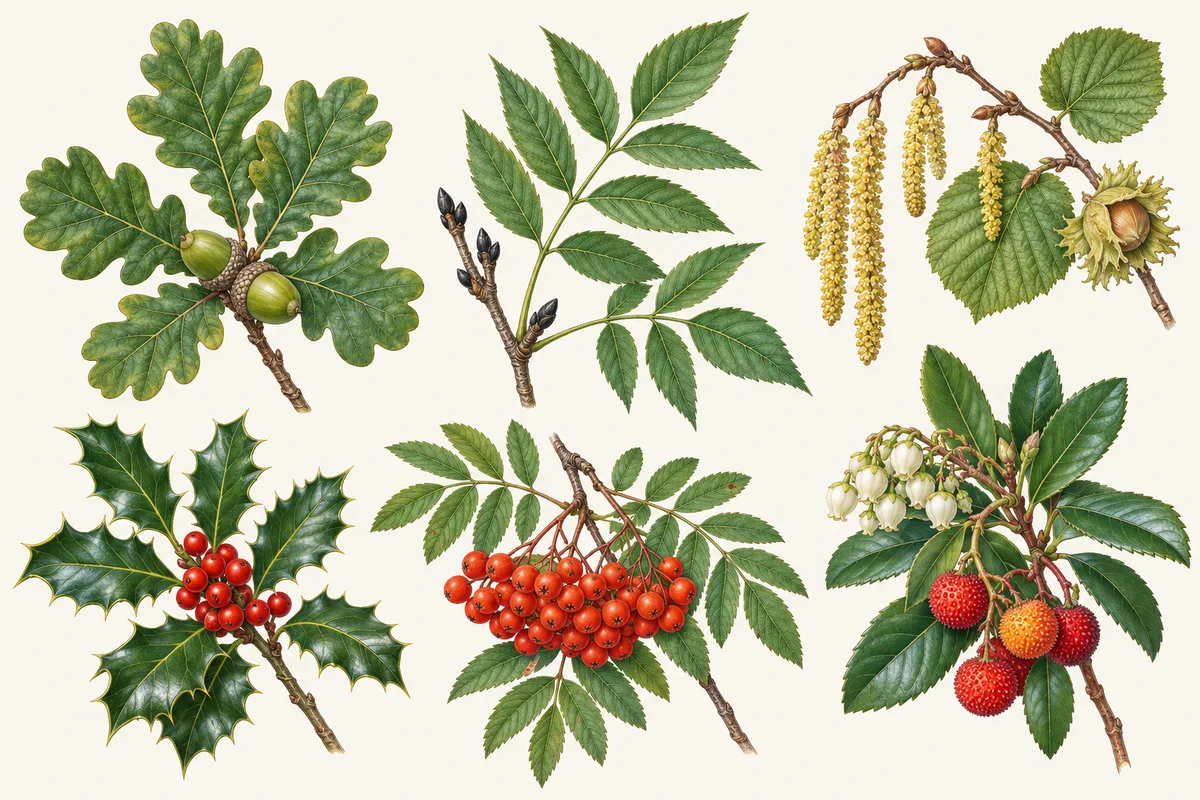
In short
Irish native trees are the 28 species that reached Ireland on their own after the last Ice Age, according to the Tree Council of Ireland. They include sessile and pedunculate oak, ash, alder, hazel, rowan, holly, yew, Scots pine and the strawberry tree of Kerry. Beech, sycamore, horse chestnut, spruce and larch were brought by people, and lime, hornbeam and field maple are not on the list.
- The Tree Council of Ireland lists 28 native tree species, from alder (fearnóg) to yew (iúr), read 21 October 2026.
- The strawberry tree (caithne) is native in Kerry, west Cork and around Lough Gill, and is thought to have come over a land bridge from Brittany.
- Sitka spruce, not a native tree, covered 44.6% of Ireland's forest area in the 2022 National Forest Inventory.
Ireland's native trees are the ones that crossed before the sea did. The Tree Council of Ireland lists 28 of them, a shorter list than Britain's, and several familiar trees of Irish towns and demesnes are not on it. Never eat a berry, nut, seed or pod on the strength of a web page or an app; check with a local expert.
The 28 native trees on the Tree Council list
The Tree Council of Ireland defines native trees as those that reached Ireland after the Ice Age, before the land bridges to Britain and mainland Europe were flooded, carried by birds and animals or, for light seeds such as willow and birch, by the wind. Names in Irish follow the Tree Council. Clues come from the Woodland Trust's British native trees profiles, which cover the same species, unless the text says otherwise.
| Tree | Irish name | One clue | Our page |
|---|---|---|---|
| Alder | Fearnóg | Grows by water; leaf tip rounded or notched; small woody cones stay all winter | Alder |
| Arbutus (strawberry tree) | Caithne | Evergreen; white flowers in November and December alongside last year's ripening fruit | |
| Ash | Fuinseóg | Pinnate leaves; black buds in opposite pairs | Ash |
| Aspen | Crann creathach | Rounded leaves that tremble in the slightest breeze | Poplar |
| Birch, downy | Beith chlúmhach | Fuzzy leaf stalks, shoots and twigs | Birch |
| Birch, silver | Beith gheal | Silver-white bark, black and rugged at the base | Birch |
| Blackthorn (sloe) | Draighean | Spiny black twigs; white blossom on bare branches in early spring | Hawthorn vs blackthorn |
| Cherry, bird | Donnroisc | Almond-scented white blossom in spring | Cherry |
| Cherry, wild | Crann silíní fiáin | Reddish-brown bark with horizontal lines; red fruits | Cherry |
| Crab apple | Crann fia-úll | Small, hard apples | |
| Elder | Tromán | Pinnate leaves and clusters of berries; usually a shrub or small tree | Elder |
| Guelder rose | Caorchon | Three-lobed leaves; translucent red berries in bunches | |
| Hawthorn (whitethorn) | Sceach gheal | Spiny twigs; deeply lobed leaves; white blossom in May; red haws | Hawthorn |
| Hazel | Coll | Many stems from the base; "lambs' tail" catkins from February | Hazel |
| Holly | Cuileann | Prickly, glossy evergreen leaves; red berries on female trees only | Holly |
| Juniper | Aiteal | Usually a shrub; needles in whorls of three; blue berry-like cones | Conifer identification |
| Oak, pedunculate | Dair ghallda | Lobed leaves on very short stalks; acorns on long stalks | English vs sessile oak |
| Oak, sessile | Dair ghaelach | Leaves on clear stalks; acorns sitting directly on the twig | English vs sessile oak |
| Rowan (mountain ash) | Caorthann | Pinnate leaves with toothed leaflets; orange-red berries from August | Rowan |
| Scots pine | An ghiúis | Blue-green needles in pairs; orange upper trunk | Pine |
| Spindle | Feoras | Pink and orange fruits in autumn | |
| Whitebeam | Fionncholl | Thick oval leaves, white and felted underneath | Whitebeam |
| Willow, eared | Saileach | Hard to tell from grey willow; see the willow note below | Willow |
| Willow, goat (pussy willow) | Saileach | Male catkins like a cat's paws | Willow |
| Willow, grey | Saileach | Soft, silvery look; fuzzy catkins in damp woodland | Willow |
| Willow, white | Saileach | Pale leaves with silky, silvery-white hairs underneath; up to 25 m | Willow |
| Wych elm | Leamhán sléibhe | Large, rough leaves with a lopsided base | Elm |
| Yew | Iúr | Flat, dark needles; a red fleshy cup around each seed | Yew |
That is 28. The Tree Council gives every willow the same Irish name, saileach, and treats whitebeam as one entry covering several Sorbus species. When a tree is out of reach, Tree Identifier can suggest a name from one photo of a leaf, the bark or a fruit; it shows one name and no list of alternatives, so check the clue in the table before you settle.
Where Ireland's list differs from Britain's
Ireland's list is shorter than the 45 trees on the Woodland Trust's British list, covered on our UK native trees page. The trees that make the difference are worth knowing, because they are common in Irish parks and estates.
On the British list but not the Irish one: beech, hornbeam, the three limes, field maple, wild service tree, the English, field and Huntingdon elms, black poplar, box, dogwood, Plymouth pear, the buckthorns, Midland hawthorn and bay willow. Wych elm is the only elm on the Irish list. National Museums Northern Ireland's native or introduced page names beech, sycamore and lime among the trees deliberately introduced to Ireland.
On the Irish list but not the British one: the strawberry tree, and white willow. The Woodland Trust gives white willow's origin in Britain as non-native, while the Tree Council includes it among Ireland's 28. The two bodies draw the line differently for this tree; neither is a field mark you can see.
Brought in by people: the Tree Council names beech, sycamore, horse chestnut, spruce, larch and fir.
The strawberry tree, Ireland's odd one out
The strawberry tree (Arbutus unedo) grows wild in Ireland but not in Britain. The Tree Council's profile describes a small evergreen that can grow into a forest tree up to 15 m in Ireland. Its clusters of white flowers open in November and December, and because the fruit takes 12 months to ripen, ripe fruit and new flowers hang on the tree at the same time in late autumn and early winter.
It grows mainly in Co. Kerry, especially around Killarney on lake islands and shores, with smaller populations in unshaded parts of Glengarriff Wood, Co. Cork, and around Lough Gill, Co. Sligo. The Tree Council says it is thought to have spread over the land bridge from Brittany rather than through Britain like most Irish natives. Some botanists have asked whether it was brought by people instead, and National Museums Northern Ireland does not list it among the trees native to Northern Ireland, so a strawberry tree in a Belfast garden was planted.
What you actually see in Irish woods
Native trees are a minority of Irish forest. The National Forest Inventory 2022, reported by the Irish Farmers Journal on 5 April 2023, put total forest at 808,848 ha, 11.6% of the land area. Sitka spruce, a North American conifer, covered 44.6% of that forest area, down from over 50% in 2007. Broadleaves, mainly native, covered 218,060 ha, about 27%, and birch alone had nearly doubled to 58,030 ha.
So in a conifer plantation the spruce is not native, while a birch in the same wood may well be. In hedgerows, hawthorn, blackthorn and hazel are natives on both the Irish and British lists; hawthorn and blackthorn are separated by flowering time and fruit on our hawthorn vs blackthorn page.
Lookalikes on the Irish list
- Sessile vs pedunculate oak. Look at the stalks: sessile oak has stalked leaves and stalkless acorns, pedunculate oak the reverse. Our English oak vs sessile oak page has the full test, and hybrids are common.
- Silver vs downy birch. Feel the young shoots: downy birch is fuzzy, silver birch is not.
- The willows. Goat and grey willow are the commonest; white willow is the tallest, up to 25 m, with silvery leaf undersides. Eared willow is the least familiar of the four; separating it from grey willow is a job for a botanist with a hand lens.
- Rowan vs whitebeam. Both are Sorbus with red or orange fruit, but rowan leaves are divided into leaflets and whitebeam leaves are single, white-felted underneath.
What a photo can't settle
- Native status is history, not a feature of the leaf: a photo can name an oak but cannot say whether that tree was planted from Irish or imported seed.
- The four native willows and the whitebeams hybridise and vary, so a single photo often cannot separate them; catkins, leaf undersides and a local botanist help.
- Silver and downy birch, and the two native oaks, also cross, and some trees sit between two entries on the list.
Questions people ask
How many native trees are there in Ireland?
The Tree Council of Ireland lists 28 native tree species (read 21 October 2026). Counts differ between sources because some split the whitebeams and willows into more species or add native shrubs; the Tree Council keeps shrubs such as gorse and bramble on a separate list.
Is beech native to Ireland?
No. The Tree Council of Ireland names beech among the trees brought in by people, with sycamore, horse chestnut, spruce, larch and fir. In Britain beech is native only in south-east England and south-east Wales, and it never reached Ireland on its own.
Is the strawberry tree native to Ireland?
The Tree Council of Ireland lists it as native (caithne), growing mainly around Killarney in Co. Kerry, in Glengarriff Wood, Co. Cork, and around Lough Gill, Co. Sligo. It is thought to have spread from Brittany over a land bridge, not through Britain. Some botanists have questioned whether it arrived with people.
Is Scots pine native to Ireland?
It is on the Tree Council's native list (an ghiúis), because it arrived naturally after the Ice Age. National Museums Northern Ireland notes that it then became extinct before 1700 and was re-introduced, so most Scots pines you see today were planted or descend from planted trees.
Sources
- Native Irish trees — Tree Council of Ireland
- Arbutus (Strawberry) — Tree Council of Ireland
- Native or introduced? Flora of Northern Ireland — National Museums Northern Ireland (habitas.org.uk)
- British native trees — Woodland Trust
- White willow (Salix alba) — Woodland Trust
- Total forest area now at 808,848ha or 11.6% of land area — Irish Farmers Journal (5 April 2023, reporting the National Forest Inventory 2022)
Keep reading
- Field guideNative trees of the UK: the full list with one clue for each
- Tree comparisonSessile oak vs English oak: how to tell them apart
- Tree comparisonHawthorn vs blackthorn: how to tell the two hedgerow thorns apart
- Tree profileRowan tree (mountain ash): how to identify it
- Tree profileHolly tree (Ilex): how to identify American and English holly