Tree health
Emerald ash borer signs: how to check an ash tree
Crown thinning and trunk sprouts say an ash is stressed. Only D-shaped exit holes, S-shaped galleries or the beetle itself point to emerald ash borer.
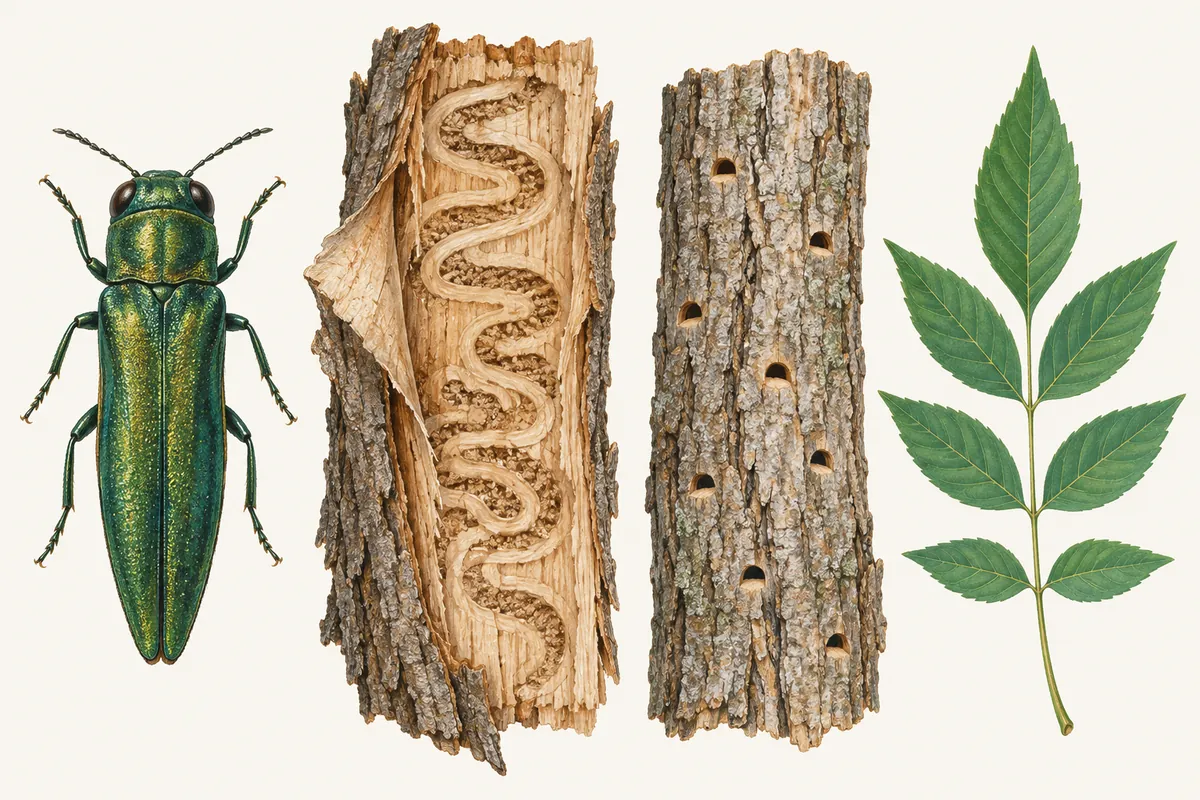
In short
Emerald ash borer signs, in the order you can see them: a crown that thins and dies back from the top, sprouts on the trunk, pale patches where woodpeckers have flaked off bark, vertical bark splits, D-shaped exit holes about 1/8 inch wide, and S-shaped tunnels under the bark. The first four can have other causes; the holes and tunnels on an ash are the specific signs.
- Confirm the tree is an ash first: opposite branching and compound leaves. Mountain-ash, prickly-ash and wafer-ash are not attacked, according to The Morton Arboretum.
- A D-shaped hole about 1/8 inch wide is the borer's exit; a round or oval hole belongs to a native borer.
- As of October 30, 2026, APHIS lists the borer in 38 states and the District of Columbia; the federal domestic quarantine ended on January 14, 2021.
Emerald ash borer (Agrilus planipennis) is a metallic green beetle from Asia whose larvae feed under the bark of ash trees. A Forest Service pest alert dates its first detection to Michigan in 2002 and says it infests all species of ash in North America. This page lists the signs in the order you can check them, then how to tell the beetle from look-alikes and whom to call in the US and Canada.
Signs to check, from the crown down
Stand back from the tree first, then walk up to the trunk. Each step takes a minute.
- Is it an ash. Leaves and twigs come in opposite pairs, and each leaf is pinnately compound, usually with 7 to 11 leaflets. If the leaves alternate along the twig, it is not an ash and it is not emerald ash borer. The ash identification page has the full check, including white, green and black ash.
- The crown. Look for thinning in the upper canopy and dead branches at the top, with the rest of the tree still leafy. The Wisconsin EAB program describes thinning in the upper canopy as early damage; the CFIA adds yellowing leaves and branch dieback. Mississippi State calls crown dieback the most visible symptom.
- Sprouts on the trunk. Clusters of leafy shoots growing straight out of the trunk or around its base (epicormic sprouts, or suckers). They are a stress response.
- Woodpecker damage. Woodpeckers flake off the outer bark to reach larvae, leaving pale, light-brown patches on the darker trunk. The Maine Forest Service calls this the "blonding" effect; Wisconsin calls heavy damage "flecking" or "bronzing" and treats heavy woodpecker work on any ash as a strong sign.
- Vertical bark splits. Callus tissue forming around larval tunnels can split the bark lengthwise, sometimes exposing the tunnels.
- Exit holes. Small holes shaped like a capital D, about 1/8 inch wide. Mississippi State Extension calls them very small and distinctive, and notes the earliest ones are made high in the canopy. Look at eye level on trees that already show crown dieback.
- Galleries under the bark. Winding, S-shaped tunnels about 1/8 inch wide, packed with frass (fine sawdust and insect waste). You see them where bark has split, been stripped by woodpeckers or fallen off.
Steps 2 to 5 are general stress symptoms: Wisconsin's program says drought, soil compaction, winter injury, other insects and disease can cause them too. Steps 6 and 7, or finding the larvae or adults, are the specific signs. The Minnesota Department of Agriculture calls S-shaped galleries in ash a definitive sign.
What the beetle and its larvae look like
The adult is a slender, bright metallic green beetle. APHIS describes it as about half an inch long with a reddish-copper rear section; the CFIA gives 8.5 to 14 mm long and about 3 mm wide. Mississippi State describes it as three-eighths to one-half inch long. Adults leave the tree through the D-shaped holes. In the northern states, the Forest Service pest alert says they emerge in May and early June and stay active until the end of summer; Wisconsin gives June and July for emergence there. In warmer states the season runs longer: Mississippi State reports adults active from March through November in the north of that state.
The larvae are what kill the tree. The Forest Service pest alert explains that eggs are laid between layers of bark and in bark crevices, the larvae hatch in about a week, bore in and feed on the inner bark and phloem, making the S-shaped galleries, and overwinter in the tree before pupating in late spring. You only see them by peeling bark, which is a job for an arborist or a state inspector on a tree you suspect.
Look-alikes: other beetles, other holes
Six-spotted green tiger beetle. The Forest Service names this one as the insect most often mistaken for the borer. It is also bright green, but it is a predator of small insects and is frequently found on hiking trails, while emerald ash borers live on and in ash trees. Where you found the insect is the first clue.
Other green metallic insects. Minnesota's agriculture department warns that many insects in the state can be mistaken for the borer because of their size, shape or metallic green color. A green beetle on a porch or a car is hard to name; a beetle coming out of a D-shaped hole in an ash is not.
Native borers. The redheaded ash borer, a native beetle, also bores into stressed ash, but its exit hole is round. Wisconsin's program notes that native borers in general leave round or oval holes. The D shape matters more than the size.
Trees that are called ash but are not. The Morton Arboretum notes that mountain-ash, prickly-ash and wafer-ash are not attacked. Mountain-ash is a rowan with alternate leaves, which is why the opposite-branching check comes first.
Where it is found and what to do (as of October 30, 2026)
United States. APHIS reports infestations in 38 states and the District of Columbia, on a page last modified April 23, 2026. APHIS removed the federal domestic quarantine regulations; the rule took effect on January 14, 2021, so movement rules are now set by each state. APHIS asks people to buy only local firewood or certified heat-treated firewood. To report a suspected borer, APHIS has an online report form and a phone line, 1-866-322-4512. Many states take reports directly: Minnesota's Department of Agriculture uses reportapest@state.mn.us and 1-888-545-6684, Maine asks for photos through its forest health report form, and Mississippi asks residents to call the Mississippi Forestry Commission or MSU Extension.
Canada. The CFIA page, modified July 27, 2026, lists the borer as present and regulated in southern and middle Ontario, Quebec and New Brunswick, and in Thunder Bay, Winnipeg, Halifax and part of Hants County, and Burnaby, New Westminster, Surrey and Vancouver. It asks people not to move firewood, especially ash, out of regulated areas, and to report any detection outside them immediately through its online form.
Who to call about your own tree. For a tree in a yard or along a street, call an ISA Certified Arborist, your state forestry agency or your county extension office. Whether a tree is worth protecting depends on how much of the crown is still alive and on the tree's position, and that is judged on site. A dying ash becomes brittle; do not climb it or fell it yourself, especially near a house, a road or power lines. If an ash has already died, the guide to identifying a dead tree shows how to confirm what it was.
Using a photo of the tree
Tree Identifier can name the tree from one photo of a leaf, the bark or a twig, which settles the first question: is this an ash. Its Diagnose tool gives an AI health check from a photo, with a severity badge (Healthy, Mild, Moderate or Severe), a likely cause, treatment steps and prevention, and you can ask follow-up questions under the result, such as how a D-shaped hole differs from a woodpecker hole. Treat it as a quick first opinion. A suspected emerald ash borer is a regulated pest: the confirmation comes from APHIS, the CFIA or your state agency, and decisions about the tree come from an arborist.
The app's History keeps each result with its date, and the Tree Map keeps located finds, so you can photograph the same ash each June and compare the crown year to year. For other symptoms on other trees, start with the tree disease identification guide.
What a photo can't settle
- Crown thinning, trunk sprouts and woodpecker damage also follow drought, ash yellows and native borers. A photo of a declining crown cannot confirm emerald ash borer; only exit holes, galleries or the insect can.
- Many green metallic insects look like the borer in a photo. An insect found off an ash tree is especially hard to name, as the Minnesota Department of Agriculture points out.
- Whether an ash can still be saved, and how, is a decision for a certified arborist on site, not for an app or a web page.
Questions people ask
What are the first signs of emerald ash borer?
Usually thinning in the upper crown, then dead branches at the top. The Forest Service warns that damage may not show for up to three years after a tree is infested, and Mississippi State notes the first exit holes are made high in the canopy, where they are hard to see from the ground.
What does an emerald ash borer exit hole look like?
A small hole shaped like a capital D, about 1/8 inch wide, with one flat side. Wisconsin's EAB program notes the flat side can face any direction. The native redheaded ash borer and other native borers leave round or oval holes.
Does emerald ash borer attack trees other than ash?
The Forest Service says that in North America it infests all species of true ash (Fraxinus). The Morton Arboretum notes that mountain-ash, prickly-ash and wafer-ash, which are not true ashes, are not attacked. A D-shaped hole in an oak or a maple has another cause.
How long does an ash tree live after emerald ash borer arrives?
The CFIA states that infested trees generally die within 2 to 3 years, and sometimes after only one year when heavily infested. Because early damage is hidden, a tree may already have been infested for a few years when you first notice the crown.
Who do I report emerald ash borer to?
In the US, APHIS takes reports through its online form or at 1-866-322-4512, and many states run their own lines, such as Minnesota's 1-888-545-6684. In Canada, the CFIA asks for immediate reports of detections outside its regulated areas. Take clear photos of the holes, galleries or beetle.
Sources
- Emerald Ash Borer — USDA Animal and Plant Health Inspection Service (APHIS)
- What is the Emerald Ash Borer? (Pest alert NA-PR-05-04, reprinted May 2015) — USDA Forest Service, Northeastern Area State and Private Forestry
- Emerald ash borer – Agrilus planipennis — Canadian Food Inspection Agency (CFIA)
- Symptoms and Signs of EAB — Wisconsin Emerald Ash Borer Program, University of Wisconsin–Madison
- Signs and Symptoms of Emerald Ash Borer (P2896) — Mississippi State University Extension
- Signs and Symptoms of Emerald Ash Borer Infestation — Maine Forest Service
- Emerald ash borer — The Morton Arboretum
- Emerald Ash Borer — Minnesota Department of Agriculture