Tree health
Beech leaf disease symptoms: how to check a beech
A nematode too small to see is killing American and European beech from Ohio to New England and Ontario. The first sign is a pattern of dark stripes you can see by looking up.
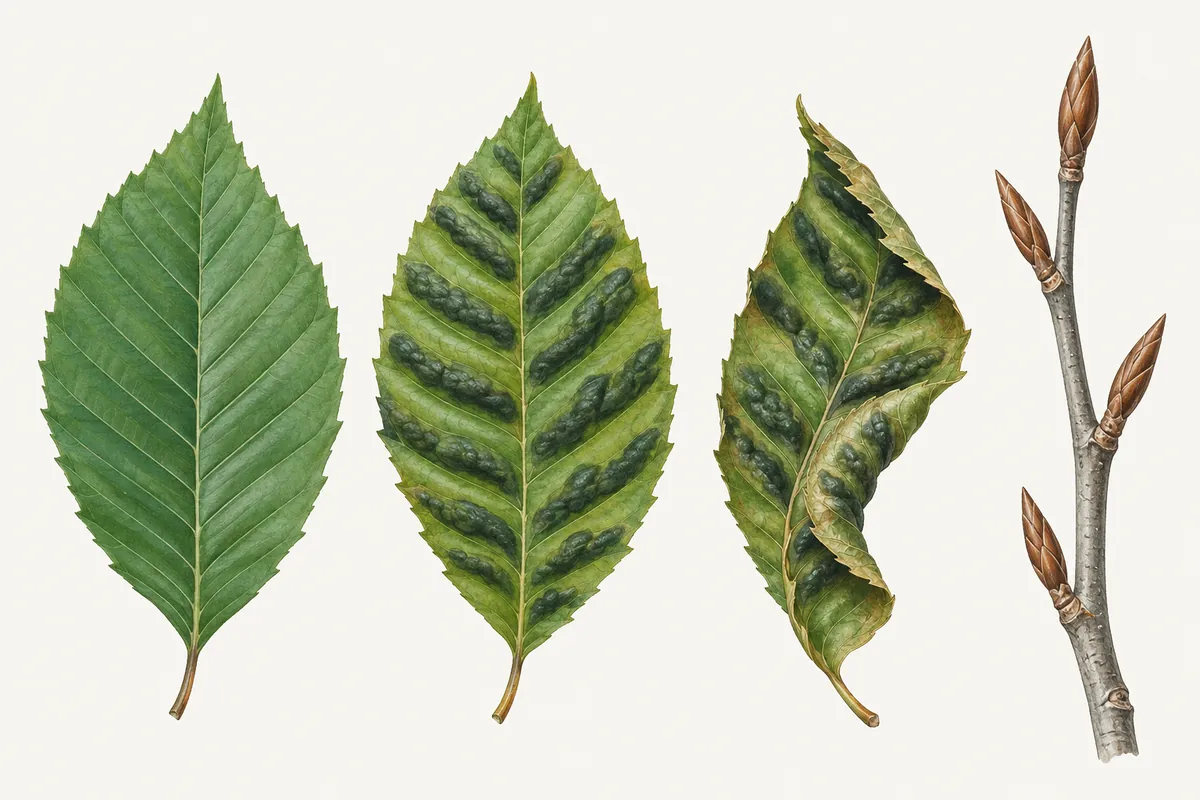
In short
Beech leaf disease symptoms start in the leaves: dark green bands between the side veins, easiest to see by looking up into the canopy or holding a leaf against the light. Badly affected leaves turn thick, leathery, crinkled or curled, and smaller. Over several years the crown thins as buds fail to open. Bark stays smooth; a white, fuzzy trunk points to beech bark disease instead.
- Look up, not down: New York's DEC says symptoms are easiest to notice looking up into the canopy, from leaf-out in May to leaf fall in October.
- Caused by a foliar nematode, Litylenchus crenatae mccannii; first found in Lake County, Ohio, in 2012.
- As of EPPO Reporting Service 02-2026, recorded in 16 US states, and in Ontario since 2017.
Beech leaf disease is a disease of beech trees caused by a foliar nematode, Litylenchus crenatae mccannii, a microscopic roundworm that lives in the leaves and buds. Penn State Extension and The Morton Arboretum both date its first identification to Lake County, Ohio, in 2012. It has since spread through the Northeast, the Mid-Atlantic and into Ontario. This page lists the symptoms in the order you can check them, then the look-alikes, the spread as of October 30, 2026, and whom to call.
Symptoms to check, from the leaves up
Do this between May and October, when the tree is in leaf.
- Is it a beech. Smooth gray bark even on a big trunk, long cigar-shaped buds and leaves with one straight vein running into each tooth. The beech identification page covers American and European beech and the hornbeam look-alike.
- Bands between the veins. Stand under the tree and look up at leaves against the sky. Infected leaves show dark green stripes between the side veins, where the leaf tissue is also thicker. New York's DEC says symptoms are most easily noticed by looking up into the canopy, and asks for photos of leaves held up to the light; the Invasive Species Centre says the same about holding leaves to the light. Penn State notes the leaves emerge in spring already banded.
- Lower branches first. The Morton Arboretum says symptoms usually appear first on the lower branches, which is convenient: those are the leaves you can reach and photograph.
- Leaf texture and shape. On heavily infected trees the leaves become thick, leathery and crinkled (Penn State), curled (DEC), and distorted and small (Morton). Run a leaf between your fingers: a banded, leathery leaf feels quite different from a thin healthy one.
- The crown. As the disease builds over the years, more leaves and buds are infected, buds fail to open and the canopy thins. DEC lists reduced leaf and bud production; the Invasive Species Centre notes severe cases can stop buds from producing new leaves at all. A beech with sparse, small leaves on otherwise healthy-looking branches fits that pattern.
- The bark. Beech leaf disease does not change the bark. If the trunk is coated in white fuzz, or pocked with cankers, look at beech bark disease below.
Early infections may involve only a few leaves, DEC notes, so look over several branches before deciding a tree is clear.
Look-alikes: what else marks a beech leaf
New York's DEC lists the problems most often confused with beech leaf disease. All of them are common, and most are harmless.
| What you see | Likely cause (per NY DEC) | How it differs from beech leaf disease |
|---|---|---|
| White, fuzzy coating on trunk and branches | Beech bark disease (scale insect plus a canker fungus) | On the bark, not in the leaves; DEC says most affected trees die within 10 years |
| Yellowish patches on the upper leaf surface, light green turning orange then brown | Erineum patch (mites) | Patches, not stripes between veins; rarely enough to affect the tree |
| White powder like powdered sugar on leaves and stems | Powdery mildew (native fungus) | A white surface coating; DEC calls it cosmetic |
| Small brown or black spots that become dead areas | Anthracnose (fungi), worse after cool, wet springs | Spots and dead patches, not dark green bands |
| Fluffy white insects that "dance" when the branch is disturbed | Beech blight aphid (native) | The insects are visible; little harm |
| Curled leaves, faded or yellow between the veins | Beech leaf rolling aphid (native) | Pale, not dark, between the veins; little harm |
| Dead brown leaves hanging on all winter | Marcescence | Normal beech habit, harmless |
The key test is color and texture: beech leaf disease makes the tissue between the veins darker and thicker, while aphid feeding makes it paler. On a copper or purple beech, Penn State notes the bands can be hard to see early; backlight the leaf. For European beech hedges in yards, the beech vs hornbeam page helps you check the hedge is beech in the first place.
Where it has spread (as of October 30, 2026)
United States. The EPPO Reporting Service (no. 02, 2026) records beech leaf disease in 16 US states, among them Delaware (first detected in 2023), Vermont (first detected in October 2023 in Windham County) and North Carolina (one county in 2025). The Morton Arboretum names Ohio, Pennsylvania, Connecticut and New York among the places it has been seen. In New York, DEC reports a first observation in 2018 in Chautauqua County, Suffolk and Nassau counties in 2019, and spread since across western, central and southern New York, with a county map dated June 2026.
Canada. The Invasive Species Centre reports that it was first detected in Ontario in 2017 and that sightings now run from Windsor east to Prince Edward County (article dated September 23, 2025).
How it spreads. Penn State and DEC both say the way it moves between trees is not yet known. Within a tree, Penn State says nematodes move from leaves into new buds, with populations peaking from September to November. DEC asks people in New York to follow the state's firewood rule, which limits moving firewood to no more than 50 miles, and not to move firewood out of areas with symptoms.
Counts change every season. For your area, check your state forestry agency's current map.
Who to call and how to report
About your own tree. Beech leaf disease is diagnosed from leaves and buds, and decisions about a yard tree depend on how many seasons it has been affected. Penn State notes that trees damaged for multiple years may not be saved. Call an ISA Certified Arborist or your county extension office; the Morton Arboretum's Plant Clinic (630-719-2424) also takes questions. A thin, declining beech over a house, a drive or a path should be inspected on site; do not climb or fell it yourself.
Reporting. As of October 30, 2026:
- New York: DEC asks for photos and the location by email to foresthealth@dec.ny.gov, takes calls at the Forest Health Diagnostic Lab (1-866-640-0652) and accepts reports through iMapInvasives. Because Long Island is well documented, DEC says reports from there are no longer needed.
- Ontario: the Invasive Species Centre asks for sightings on iNaturalist or EDDMapS and runs a Beech Leaf Disease Monitoring Network.
- Other states: report to your state forestry agency or extension service, especially where the disease has not yet been recorded.
Photograph a banded leaf held up against the sky, the underside, and the whole crown, and note the date and place.
Using a photo of the tree
Tree Identifier names the tree from one photo of a leaf, a bud or the bark, which matters here because only beeches get this disease. Its Diagnose tool gives an AI health check from a photo, with a severity badge (Healthy, Mild, Moderate or Severe), a likely cause, treatment steps and prevention, and you can ask follow-up questions under the result, for example how erineum patches differ from banding. Treat it as a quick first opinion; the nematode itself can only be confirmed in a lab.
Because the disease builds over several seasons, a dated record helps. History keeps each result with its date and the Tree Map keeps located finds, so you can photograph the same branch each June and see whether the bands are spreading. For other symptoms on other trees, start with the tree disease identification guide.
What a photo can't settle
- The nematode is microscopic. A photo shows the banding pattern; only a lab test of leaves or buds confirms the cause.
- Copper and purple beeches hide the bands, and early infections may affect only a few leaves, so a photo of a whole crown can miss the disease.
- How beech leaf disease spreads between trees is not yet known, according to Penn State and New York's DEC, so no page or app can tell you whether a healthy tree nearby will be infected.
Questions people ask
What does beech leaf disease look like?
Dark green stripes between the side veins of the leaf, where the tissue is also thicker. Penn State calls it a distinctive interveinal banding pattern. Heavily infected leaves become leathery, crinkled, curled and small, and the crown thins over several years as buds die.
When can you see beech leaf disease symptoms?
From leaf-out in spring until leaf fall. New York's DEC gives May to October; the leaves emerge already banded, so symptoms show soon after the leaves open. Morton notes they usually appear first on the lower branches.
What is the difference between beech leaf disease and beech bark disease?
Beech leaf disease shows in the leaves: dark bands, leathery or curled leaves, a thin crown. Beech bark disease shows on the trunk: New York's DEC describes a white, fuzzy coating of scale insects on the trunk and branches, followed by cankers. A tree can have both.
Does beech leaf disease kill trees?
Yes, it can. New York's DEC says it can kill beech of all ages, with younger trees dying more quickly. The Invasive Species Centre reports understory beech dying within two to five years, and the Morton Arboretum says trees can die within six years of symptoms appearing.
Is European beech affected by beech leaf disease?
Yes. The Morton Arboretum lists American, European and Turkish beech as susceptible. Penn State notes that symptoms can be harder to see early on beeches with dark leaves, such as copper beech, so hold a leaf up to the light.
Sources
- Beech Leaf Disease — New York State Department of Environmental Conservation
- Beech Leaf Disease — Penn State Extension
- Beech leaf disease — The Morton Arboretum
- Beech Trees Under Threat: Leaf It to the Community — Invasive Species Centre (Ontario)
- EPPO Reporting Service no. 02-2026, article 2026/045: update on beech leaf disease in the USA — European and Mediterranean Plant Protection Organization (EPPO)
Keep reading
- Tree profileBeech (Fagus): how to identify a beech tree
- Tree comparisonHornbeam vs beech: how to tell them apart
- Tree healthTree disease identification, symptom by symptom
- Clue guideWhich tree has smooth gray bark? Sort it by trunk size, shape and leaf
- Tree healthEmerald ash borer signs: how to check an ash tree