Tree health
Tree fungus identification, from artist's conk to honey fungus
A bracket on a trunk is the fruit of a fungus already rotting the wood. Where it grows, what tree it is on and what the underside looks like tell you which fungus it is and how worried to be.
In short
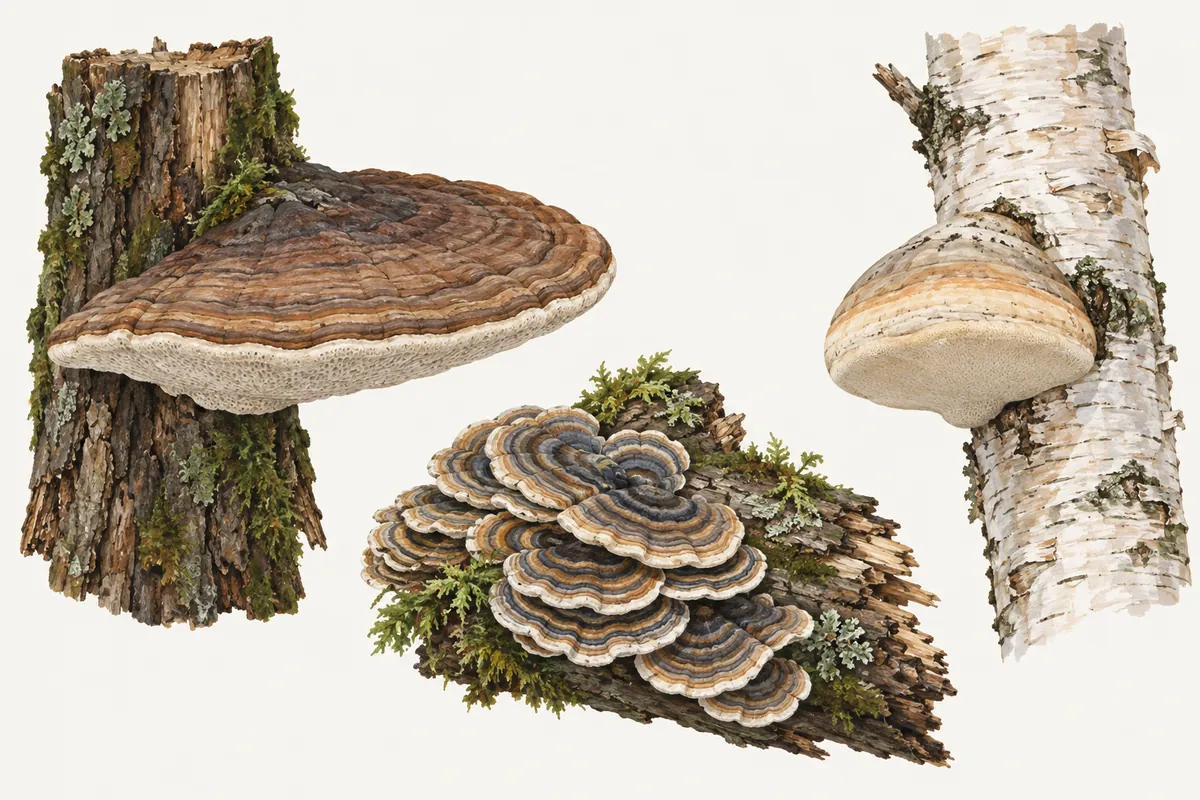
Tree fungus identification starts with three checks: where the fungus sits (roots and base, trunk, or branches), what tree it grows on, and its underside (pores, gills or a maze). Artist's conk is a woody shelf, brown above and white below, low on the trunk. Sulphur shelf is bright orange-yellow. Birch polypore grows only on birch. Most brackets mean decay is already advanced inside.
- A conk or bracket is the fruiting body of a wood-decay fungus; UC IPM says a visible one usually goes with advanced decay.
- Position matters most for safety: fungi at the base or on the roots (giant polypore, honey fungus, Ganoderma) can mean the whole tree may fall.
- White rot leaves wood soft, spongy or stringy; brown rot leaves it dry and crumbling into cubes.
- This page does not cover edibility. No app or photo can make a mushroom safe to eat.
A bracket, conk or cluster of mushrooms on a tree is the fruiting body of a fungus that has been feeding on the wood, often for years. Naming it tells you what kind of rot is inside and where. UC IPM's Wood Decay Fungi in Landscape Trees puts it plainly: when a fruiting body is visible, it is usually associated with advanced decay, and a loss of only 10% of the wood's weight can mean a 70 to 90% loss of its strength. This page is about identification and tree safety only. It does not cover edibility: no app or photo can make a mushroom safe to eat.
Check these five things, in order
- Where on the tree. Roots and base, the main trunk, or branches. A fungus at the base or on the roots is the most serious for a tree near people, because root and butt rots can bring the whole tree down.
- What tree it is on. Many fungi favour one host: birch polypore grows on birch, giant polypore mainly on beech, shaggy bracket mostly on ash. Name the tree first; the birch and beech pages help.
- Shape and texture. Hard and woody (perennial, adds a layer each year), leathery and thin, or soft and fleshy (annual).
- The underside. Tiny pores, gills, slots or a maze. Note colour, and whether it marks or bruises when scratched or pressed.
- The wood, if you can see it. UC IPM describes white rot as moist, soft, spongy or stringy wood that looks white or yellow, and brown rot as dry, fragile wood that crumbles into cubes.
Take three photos: the whole tree with the fungus in view, the fungus in context on the trunk, and a close-up of the underside. That is also what tree-health services ask for.
Common tree fungi at a glance
Sizes are the maximum widths the cited sources give.
| Fungus | Looks like | Where and on what | Rot it causes |
|---|---|---|---|
| Artist's conk (Ganoderma applanatum) | Hard, flat semicircle, brown above, white below and darkening when scratched; 2 to 30 in. (UC IPM) | Low on the trunk, near ground level; oak, maple, poplar, willow, beech and many others | White rot of sapwood and heartwood in roots and trunk |
| Southern bracket (Ganoderma australe) | Thick, knobbly, dark brown or reddish above, white below; up to 60 cm (Woodland Trust) | Beech especially, on living and dead trees | Heart rot of beech (RHS) |
| Varnish fungus (Ganoderma polychromum, formerly G. lucidum) | Red-brown, shiny varnish-like top; up to 14 in. (UC IPM) | Trunk base, usually in summer; oak, maple, pine, olive | White rot of roots and trunk |
| Sulphur shelf (Laetiporus) | Soft, lumpy, bright orange-yellow overlapping shelves; up to 40 cm (Woodland Trust) | Oak, yew, eucalyptus; often high on standing trunks | Brown heart rot, one of the few brown rots of hardwoods (UC IPM) |
| Turkey tail (Trametes versicolor) | Thin, leathery fans in coloured concentric bands, cream pored underside; up to 10 cm | Deciduous trees, living or dead wood, often in tiers | White, spongy rot of stressed sapwood |
| Birch polypore (Fomitopsis betulina) | Thick, rounded, smooth cream or grey-brown top, pale finely pored underside; up to 30 cm | Birch only, living or dead | Very common on stressed and weakened birch (RHS) |
| Hoof fungus (Fomes fomentarius) | Hard, hoof-shaped, grey with growth layers; up to 25 cm | Birch in particular, mainly dead wood | Wood decay of birch |
| Dryad's saddle (Polyporus squamosus) | Large, flat, yellow-brown with dark brown scales, short black-based stem; up to 60 cm | Broadleaved trees, such as horse chestnut; best seen April to August | Wood decay |
| Shaggy bracket (Inonotus hispidus) | Thick, ginger, velvety top, turning black and falling off with age | Mostly ash, also walnut, apple, plane, elm | Heart rot of ash (RHS) |
| Giant polypore (Meripilus giganteus) | Large brackets at the foot of the tree | Mainly beech, at the roots and base | Root or butt rot; the whole tree may fall (RHS) |
| Honey fungus (Armillaria) | Clumps of honey-coloured mushrooms with a ring on the stem, late summer to autumn | Around the base, on stumps or over dead roots of many trees | Kills roots, then white rot of roots and butt |
Fungi at the roots and base: the ones that matter most for safety
These fungi decay the anchoring roots and the lower trunk, so a tree can look leafy and healthy and still fail.
Ganoderma (artist's conk, southern bracket, varnish fungus). The brackets are perennial and add a new layer each year; the Woodland Trust's Ancient Tree Inventory post Fungi - fruits of the forest notes that the upper surface often looks dusted with brown, cocoa-like spores. UC IPM says artist's conk decay can extend up to 15 feet above and below the conk, and varnish fungus can kill its host in 3 to 5 years, with rapid decay in oaks and maples.
Giant polypore. The RHS bracket fungi page lists it as a root or butt rot found mainly on beech, where the whole tree may fall. Look for it at the foot of beech trees, and check the roots of any beech that carries it.
Honey fungus. The RHS honey fungus page calls it the most destructive fungal disease in UK gardens. Its key sign is a white or creamy-white, paper-thin sheet of fungus between bark and wood at ground level, smelling strongly of mushrooms, sometimes with black bootlace-like cords (rhizomorphs) in the soil. Above ground, upper parts of the tree die back, leaves come out small and pale or colour early in autumn. The mushrooms appear in dense clumps in late summer or autumn but may be missing even when the fungus is active.
Fungi on the trunk and branches
Sulphur shelf. The brightest fungus on a tree: thick, lumpy, orange-yellow shelves that turn pale and crumbly with age. UC IPM ranks it among the most serious causes of decay in oaks and eucalyptus, and says the shelves appear many years after the decay began, so they signal extensive internal damage.
Shaggy bracket. A ginger, velvety lump on an ash trunk, which turns black and drops to the ground beside the tree. The RHS links it to heart rot in ash.
Birch polypore and hoof fungus. Both are classic birch fungi. Birch polypore is smooth and rounded; hoof fungus is hard, grey and hoof-shaped with visible growth rings. The Woodland Trust's bracket fungi guide shows both. A birch carrying either is usually already stressed or dead.
Turkey tail. Thin, leathery, banded fans, common on dead branches and stumps. UC IPM notes it can also colonise stressed sapwood of living trees and cause cankers and dieback.
Phellinus. Dark, cracked, hoof-shaped conks with a tan underside. UC IPM says Phellinus species cause heart rot in standing trees that otherwise look intact.
If the bracket is on a dead tree or a stump, the dead tree guide and the tree stump guide help name what the tree was.
What the fungus means for the tree
Decay is not always a death sentence. The RHS notes that most bracket fungi only live on and decay the heartwood, and do not infect and kill the living parts of the tree; hollow trees may remain stable. But it also warns that weakened trees can topple at any time, and that in the UK owners are legally responsible for their trees and may be liable if falling timber causes damage or injury.
The practical rule: a bracket on a branch over a lawn is a watch-and-photograph job; a bracket at the base of a large tree beside a house, road, path or play area is a call-a-professional job, this week.
Who to call
- US and Canada: an ISA Certified Arborist, who can assess the decay on site, or your state or provincial extension service's plant clinic for a specimen identification. UC IPM says hazardous trees should be assessed by a qualified arborist.
- UK: an arboricultural consultant; the RHS points to the Arboricultural Association for help finding one. Forest Research's Tree Health Diagnostic and Advisory Service identifies decay fungi from a specimen; the RHS page listed a fee of £48 per specimen when read on 2026-10-30.
- Ireland: a qualified arborist or arboricultural consultant.
Tree Identifier can help you get there faster. Photograph the tree with its fungus in the Diagnose tool for an AI health check with a severity badge and a likely cause, and ask follow-up questions under the result, such as what the underside should look like. Treat it as a first opinion, not a lab identification, and never as advice on eating anything. History keeps each dated photo, so you can see whether a bracket is growing from year to year, and the Tree Map remembers which tree it was. For other symptoms (leaf spots, cankers, wilting), see the tree disease identification guide.
What a photo can't settle
- A photo of a bracket can suggest a genus, but many species look alike; Forest Research's diagnostic service and university clinics confirm decay fungi from a specimen.
- How far decay has spread inside a trunk cannot be seen in a photo; only an arborist's inspection on site can judge it.
- No photo app can decide whether a fungus is safe to eat or touch; this page and the app do not cover edibility.
Questions people ask
Is fungus on a tree trunk bad for the tree?
Usually it means decay. The RHS says bracket fungi cause rot in the heartwood and usually lead to weakening, sometimes to breakage or the fall of the tree. Many only decay heartwood and do not kill the living tissue, and a hollow tree may stay stable for years, so have it assessed rather than assuming the worst.
Should I knock the bracket off the tree?
It won't help. The RHS says removing brackets to stop spore release has very little effect on the overall risk, because the fungus lives inside the wood. The bracket is useful evidence: photograph it, note where it grows, and show it to an arborist.
Can a tree with a bracket fungus be saved?
There is no cure for the decay itself; the RHS states there are no chemicals for control of bracket fungi. What an arborist decides is whether the tree is still safe, perhaps with pruning, and how often to check it. UC IPM says trees near buildings or other targets should be inspected regularly by a qualified expert.
Are tree fungi poisonous?
This site does not cover edibility or toxicity of fungi. No app, photo or web page can make a wild mushroom safe to eat. If a child or pet has eaten one, call a poison control centre, a doctor or a vet straight away.
What is the white fungus at the base of my tree?
Several fungi fit. A woody shelf, white underneath and brown on top, low on the trunk, points to artist's conk or southern bracket (Ganoderma). A soft white sheet under the bark at ground level that smells of mushrooms is the RHS's key sign of honey fungus. Both need an arborist's look.
Sources
- Pest Notes: Wood Decay Fungi in Landscape Trees (Publication 74109, updated 08/2019) — University of California Statewide IPM Program (A.J. Downer, E.J. Perry)
- Bracket fungi identification: 10 common UK species for beginners — Woodland Trust (Amy Lewis, 21 Oct 2021)
- Bracket fungi — Royal Horticultural Society
- Honey fungus — Royal Horticultural Society
- Fungi - fruits of the forest — Woodland Trust Ancient Tree Inventory (Helen Leaf, 13 Nov 2020)