Tree health
Oak wilt symptoms in red, white and live oaks
Oak wilt looks different in each oak group. Know which oak you have, then read the leaves, the crown, the ground underneath and the neighbouring oaks, in that order.
In short
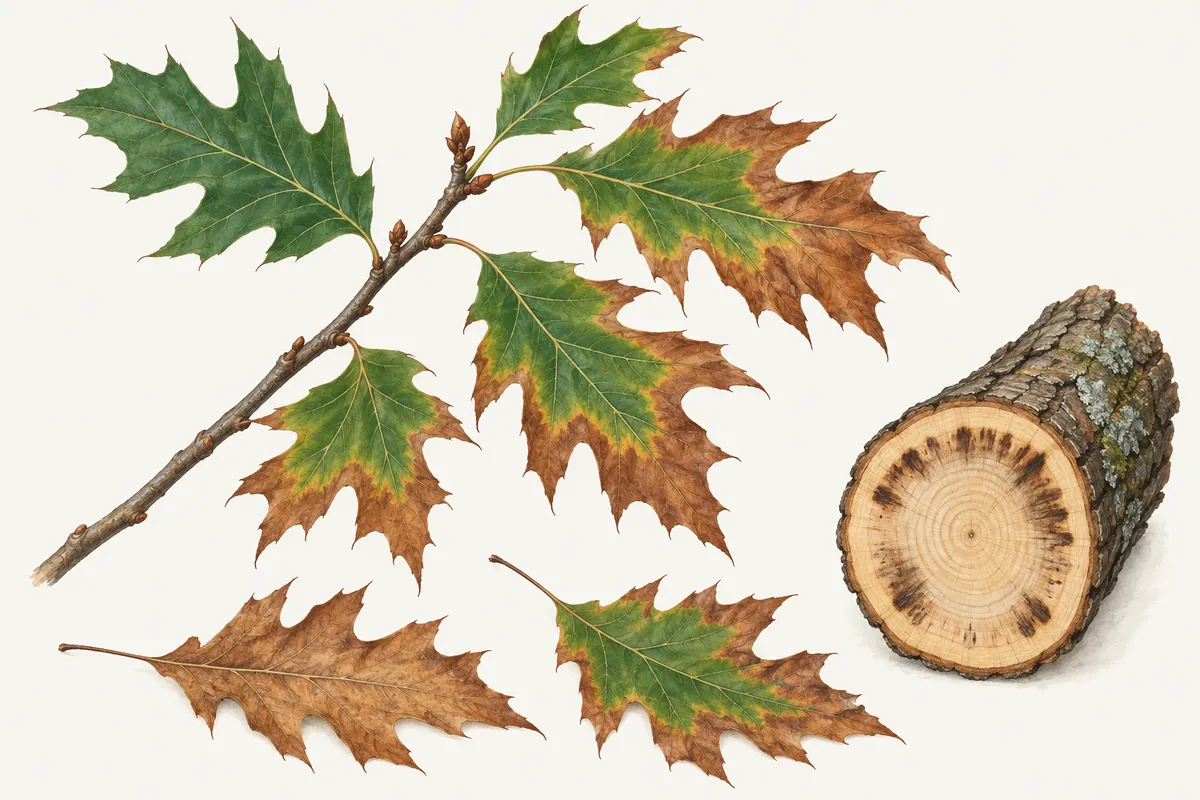
Oak wilt symptoms depend on the oak. Red oaks (pointed lobe tips) wilt from the top of the crown in early summer, their leaves bronze from the edges inward, and the tree can lose nearly all of them in a few weeks. White and bur oaks die back slowly, branch by branch. Texas live oaks show yellow veins that turn brown. Infected oaks often die in groups, linked by their roots.
- First decide the oak group: pointed, bristle-tipped lobes mean red oak group; rounded lobes mean white oak group.
- Red oaks can be almost bare within a few weeks of the first symptoms; a carpet of green and bronze leaves under an oak in June to mid-September is a warning sign, per the Minnesota DNR.
- Agencies set no-wounding seasons by region: April through July in Minnesota, mid-April to mid-October at the Morton Arboretum near Chicago, February through June in Texas.
- Only a lab test confirms oak wilt. Send suspect trees to an arborist or your state extension or forestry office.
Oak wilt is a fungal disease, caused by Bretziella fagacearum, that clogs an oak's water-conducting wood. The USDA Forest Service calls it one of the most serious tree diseases in the eastern United States, and its 2010 map shows it across much of the East and Midwest and into Texas; it is not known west of Texas. In Canada it has been found in three places in Ontario. What you see depends on which oak you have, so name the oak group first, then work through the tree in the order below.
Check your oak in this order
- The oak group. The Minnesota DNR's one-line test: oaks in the red oak group have leaves with pointed tips, oaks in the white oak group have rounded tips. Live oaks have oval leaves. The red oak vs white oak guide covers the other differences (acorn caps, bark).
- The leaves. On red and white oaks, oak wilt browns the leaf from the edge inward, starting at the tip, sometimes stopping at the veins. On Texas live oak it does the opposite: the veins go yellow, then brown.
- The crown. Red oaks wilt from the top of the crown downward. White oaks lose single branches at the ends.
- The ground. The Minnesota DNR says a carpet of freshly fallen oak leaves from June through mid-September, before normal autumn leaf drop, could be oak wilt. Some of those leaves are still green with bronze or brown edges.
- The bark of dead red oaks. Cracks in the bark of a red oak that died the year before can hide grey to black fungal mats with a fruity smell.
- The neighbours. Oak wilt usually kills oaks in expanding pockets, because it passes through grafted roots from tree to tree.
If what you see matches, stop wounding the tree and its neighbours, take dated photos, and call a certified arborist or your state extension or forestry office before anyone cuts anything. Removing a living infected tree the wrong way can push the fungus into its root-grafted neighbours, the USDA Forest Service warns.
Red oak group: fast, from the top down
Red oaks are the most important hosts throughout the disease's range, and the USDA Forest Service publication How to Identify, Prevent, and Control Oak Wilt treats all red oaks in the eastern US as susceptible. The trees it lists as commonly killed include northern red oak, black oak, northern pin oak, Shumard oak, southern red oak, blackjack oak and Texas red (Spanish) oak.
The sequence it describes:
- A subtle off-green colour shift high in the crown, seen in late June to early July in the north.
- Leaves wilting from the top of the crown downward, then quickly bronzing. The colour moves around the leaf margins from the tip toward the base.
- Leaves dropping fast: infected trees are commonly almost bare within a few weeks of the first symptoms. Fallen leaves are brown at the tips and edges and sometimes still green at the base.
The Morton Arboretum's oak wilt page adds that leaves can turn grayish-green, curl and stiffen, the base of the tree may send up many suckers, and leaves have usually all dropped by midsummer. Trees usually die within weeks or months.
White oak group and bur oak: slow, branch by branch
White oaks resist the fungus better. The USDA Forest Service explains that they plug their own sapwood vessels with tiny balloon-like structures called tyloses, which also blocks the fungus. Infected white oaks usually die one branch at a time over one to many years, and the leaves brown from the margins in the same pattern as red oaks, only slower. Brown streaks in the outer growth rings, seen when bark is peeled from a symptomatic branch, are often easier to see in white and bur oaks than in red oaks.
The Minnesota DNR brochure Oak wilt: identification, prevention, and control calls white and bur oaks challenging to diagnose: they shed leaves quickly, but only from a few outer branch ends, bur oaks die faster than white oaks, and laboratory confirmation is often best. Trees infected for two years or more can take on a stag-headed look, with isolated dead branches poking out of the crown. The bur oak page covers the tree itself.
Texas live oak: yellow veins that turn brown
In Central Texas, oak wilt is mainly a live oak problem. The USDA Forest Service describes the diagnostic symptom as veinal necrosis: the leaf veins turn yellow and then brown, the leaves fall, and the crown thins until the tree dies, generally within 1 to 6 months of infection. Fallen leaves may keep their dark brown veins for months. Brown leaf tips or edges alone are not a reliable sign on live oak.
Texas A&M Forest Service (Prevent the spread of oak wilt this spring in Texas, 2022) says oak wilt has killed millions of trees in 76 counties of Central, North and West Texas. It spreads through root connections an average of 75 feet per year, mainly among live oaks, and that root spread accounts for most new cases in Central Texas. Spring diagnosis is tricky because evergreen oaks drop old leaves while growing new ones. In Texas, red oaks often show red or brown leaves in summer as a first symptom, and spore mats form only on Texas red oak and blackjack oak, never on live oak. The live oak page covers identification.
How oak wilt spreads, and the no-pruning seasons
The fungus moves two ways, the USDA Forest Service explains:
- Through roots. Oaks of the same group graft their roots together, and the fungus passes along the network. Grafts can link trees 100 feet or more apart in sandy soil. The Minnesota DNR gives up to 25 feet per year in Minnesota.
- By beetles. On red oaks that died the year before, spore mats push the bark apart and smell fruity. Sap beetles (nitidulids) feed on them and carry spores to fresh wounds on healthy oaks. That is why wounds matter.
The no-wounding season is set by each agency for its own region. In their words:
| Agency | Region | Rule |
|---|---|---|
| Minnesota DNR | Minnesota | Don't wound oaks from April through July |
| USDA Forest Service (2011) | Lake States; Texas | Favourable conditions usually April 15 to July 1, longer to the south; in Texas avoid damage February through June |
| The Morton Arboretum | Chicago region | Don't prune between mid-April and mid-October; early November to very early April is safest |
| Texas A&M Forest Service | Texas | Avoid pruning or wounding February through June; paint oak wounds at any time of year |
| CFIA | Canada | Don't prune oaks between April and November; don't move firewood |
Storm damage and construction wounds count too. Don't move oak firewood from a tree that died of wilt: the Minnesota DNR says not to move oak firewood or logs from a dying oak within one year of its death.
Look-alikes to rule out
The USDA Forest Service names four disorders that are confused with oak wilt, and Iowa State adds a fifth:
- Bacterial leaf scorch: marginal browning that comes back on the same branches year after year, with no wilting or bronzing; trees decline over several years.
- Oak anthracnose: brown spots or patches spreading out to the leaf edge after a cool, wet spring, worst in the lower crown; leaves may curl and fall in early summer but do not wilt.
- Oak decline: drought, defoliation, root disease and borers together. Dead leaves often stay on the tree, while oak wilt usually strips it bare.
- Two-lined chestnut borer: scattered dying branches, often from the top down, that keep brown leaves until autumn, and D-shaped exit holes about 1 to 2 mm across. The Morton Arboretum's two-lined chestnut borer page says the beetle mainly targets oaks already stressed by drought, soil compaction or defoliation.
- Bur oak blight: per Iowa State Extension, it infects only bur oak, browns the tissue along the veins with wedge-shaped dead areas, shows dramatically from July and gets worse in August and September, usually starting on the lower branches. Dead leaves stay attached through winter with black pustules on their stalks.
Who to call, and where a photo helps
The USDA Forest Service says field diagnosis by an experienced forester, arborist or pathologist is often possible from the species, the symptoms and the pattern of dying trees, with a lab culture when in doubt. In practice:
- US: a certified arborist (ISA certification is the usual credential in the US and Canada), your state extension service's plant disease clinic, or your state forestry agency. The Morton Arboretum recommends a certified arborist for removing infected trees and severing root grafts, and says injected fungicides must be applied by licensed arborists. In Minnesota, the DNR asks people to report oak wilt found north of or at the edge of its known range.
- Texas: a certified arborist, your local Texas A&M Forest Service office, or your city's oak wilt program where one exists.
- Canada: report suspect trees to the CFIA. As of the page read on 2026-10-30, owners of affected properties may receive a notice restricting the movement of oak material.
Tree Identifier can help before that call. Its Diagnose tool gives an AI health check from one photo, with a severity badge, a likely cause and next steps, and you can ask follow-up questions under the result. Treat it as a quick first opinion, never a lab diagnosis. It is most useful as a record: photograph the same tree every week or two, and History keeps the dated results while the Tree Map pins where each oak stands, which is exactly what an arborist wants to see when a pocket of oaks starts dying. The tree disease identification guide covers other problems that brown oak leaves.
What a photo can't settle
- A photo of a leaf can show a symptom pattern, but it cannot confirm oak wilt: the fungus has to be cultured or tested in a lab.
- Oak wilt, bacterial leaf scorch and two-lined chestnut borer damage can look alike from the ground; the pattern across several trees and over weeks matters more than one picture.
- Whether a tree near a house, road or play area is safe is a call for a certified arborist on site, not for an app.
Questions people ask
Does oak wilt always kill the tree?
In red oaks, almost always: the USDA Forest Service says recovery is possible but rare. White oaks are moderately resistant and may decline over one to several years, and the Morton Arboretum notes that white and bur oaks sometimes recover. A small share of Texas live oaks survive with a thinned crown.
How fast does oak wilt kill an oak?
Red oaks die fastest: the USDA Forest Service reports mortality within 3 weeks of infection in some cases, and the Minnesota DNR says within a few months. Texas live oaks generally die within 1 to 6 months. White and bur oaks can take a few years.
When is it safe to prune an oak?
Follow your own state's rule. The Minnesota DNR says not to wound oaks from April through July. The Morton Arboretum, near Chicago, says not between mid-April and mid-October, with early November to very early April safest. Texas A&M Forest Service says avoid February through June and paint every oak wound.
Is oak wilt in Canada?
Yes, in Ontario. As of the CFIA page read on 2026-10-30, oak wilt had been confirmed in the City of Niagara Falls (the first detection in Canada), the Township of Springwater and the Town of Niagara-on-the-Lake. The CFIA asks people to report suspected trees through its online form.
What else looks like oak wilt?
The USDA Forest Service lists bacterial leaf scorch, oak anthracnose, oak decline and the two-lined chestnut borer. Bur oak blight, which only infects bur oak, also browns leaves along the veins in late summer. A lab test separates them.
Sources
- How to Identify, Prevent, and Control Oak Wilt (NA-FR-01-11, 2011; copy hosted by NYSDEC) — USDA Forest Service, Northeastern Area State and Private Forestry
- Oak wilt — The Morton Arboretum
- Oak wilt: identification, prevention, and control (brochure FOR_0034_22) — Minnesota Department of Natural Resources
- Prevent the spread of oak wilt this spring in Texas — Texas A&M Forest Service
- Oak wilt — Canadian Food Inspection Agency
- Bur oak blight — Iowa State University Extension and Outreach, Yard and Garden
- Two-lined chestnut borer — The Morton Arboretum
Keep reading
- Tree comparisonRed oak vs white oak trees: how to tell the living trees apart
- Tree profileOak trees (Quercus): how to identify them
- Tree healthTree disease identification, symptom by symptom
- Tree profileLive oak (Quercus virginiana): how to identify it
- Tree profileBur oak (Quercus macrocarpa): how to identify it