Clue guide
Which tree has blue berries? Start with needles, spines or plain leaves
Blue berries on a tree come from a short list, and the leaf sorts it fast: scale-like needles, spiny holly-like leaflets, feather-like compound leaves or plain simple leaves.
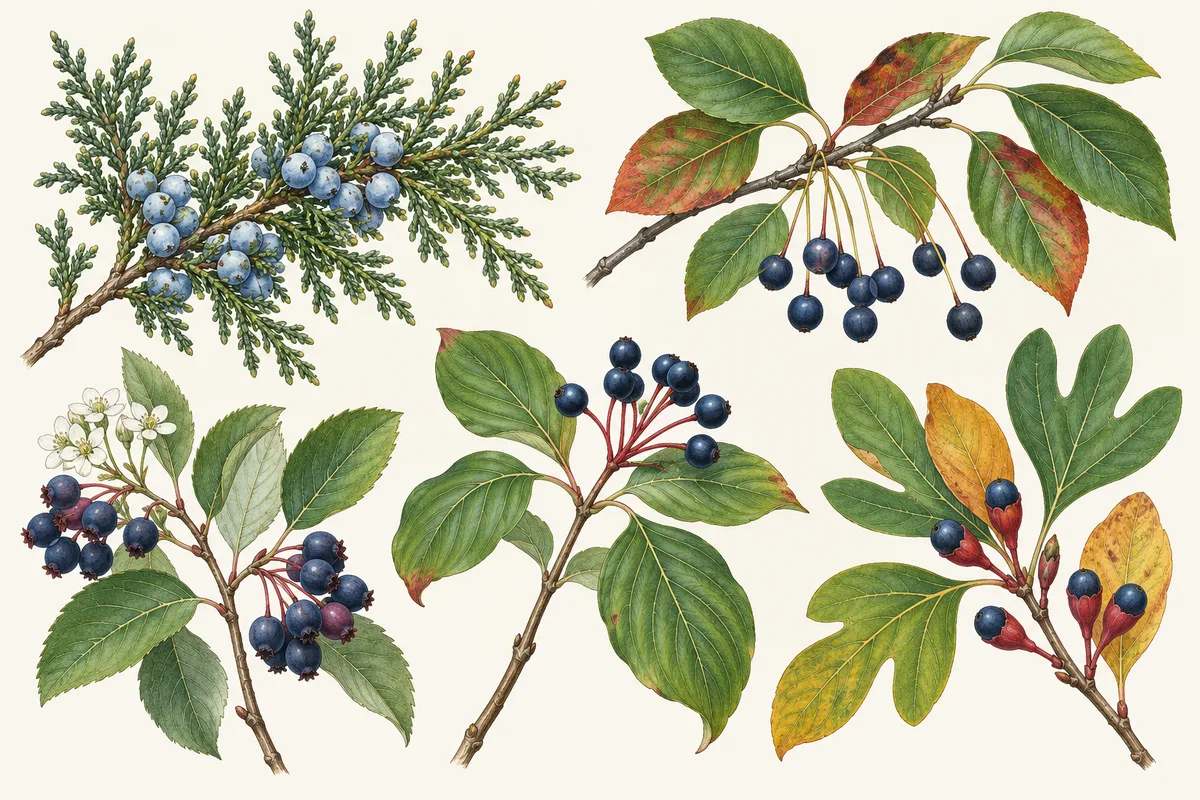
In short
A tree with blue berries is most often a juniper such as eastern red cedar (scale-like needles, frosted blue berry-like cones about 1/4 inch across from September to February), a blue elderberry in the western US (flat clusters of powder-blue fruit on feather-like leaves), or sassafras and pagoda dogwood in the East, whose blue-black fruit sits on red stalks. Spiny leaflets mean mahonia.
- Scale-like or prickly needles with frosted blue 'berries' mean a juniper: eastern red cedar in the East, Texas and the Midwest; common juniper in the UK.
- Spiny, holly-like leaflets with blue-black berries in clusters mean leatherleaf mahonia, which NC State lists as invasive in North Carolina.
- In the UK and Ireland, small blue-black fruit with a dusty bloom on a thorny shrub are sloes, the fruit of blackthorn.
A tree with blue berries comes from a short list, and one look at the leaf settles most cases. Never eat a berry, nut, seed or pod on the strength of a web page or an app; check with a local expert. This page only helps you put a name on the plant. Many "blue" fruits are really blue-black with a pale waxy bloom that rubs off, so count anything from powder blue to inky blue-black as a candidate.
Blue-berried trees by leaf and region
| Tree | Leaf | Blue fruit | When | Where |
|---|---|---|---|---|
| Eastern red cedar (Juniperus virginiana) | Scale-like, or prickly needles on young growth | Frosted blue cones, about 1/4 in, female trees only | September–February | Maine to Florida, west to South Dakota and Texas |
| Blue elderberry (Sambucus nigra ssp. caerulea) | Opposite, feather-like, 5–9 toothed leaflets | Blue to purple-black, 5–6 mm, white waxy bloom, in flat clusters | July–October | West Texas to Montana and British Columbia, all western states |
| Sassafras (Sassafras albidum) | Oval, mitten-shaped or three-lobed on one tree | Bluish-black, in a red cup on 1-inch red stalks | Matures in September | Maine to Michigan, Iowa, east Texas and Florida |
| Pagoda dogwood (Cornus alternifolia) | Alternate, crowded at branch tips; tiered branches | Bluish-black on orange-red stalks | July–August | Eastern Canada and eastern US to Minnesota and Mississippi |
| White fringetree (Chionanthus virginicus) | Opposite, 3–8 in, simple | Dark bluish-black, olive-like, under 1 in | July–September | Eastern US, Texas to New York and Massachusetts |
| Leatherleaf mahonia (Berberis bealei) | Compound, 5–9 spiny, holly-like leaflets | Blue-black, in clusters | Summer | Planted and spreading in the Southeast |
| Laurustinus (Viburnum tinus) | Evergreen, opposite, glossy, 1–3 in | Metallic blue, turning black | Fall to spring | Planted hedges, UK and the South |
| Blackthorn (Prunus spinosa) | Oval, toothed; thorny twigs | Blue-black sloes, about 1 cm | Autumn | UK and Ireland |
Data come from NC State Extension (eastern red cedar, sassafras, pagoda dogwood, fringetree, mahonia, laurustinus), USDA NRCS (blue elderberry) and the Woodland Trust (blackthorn), read on 21 October 2026.
Needles or scales: junipers and eastern red cedar
If the "berries" sit on a tree with scale-like leaves or short prickly needles, you are looking at a juniper, and the berries are really small fleshy cones. In most of the eastern US, the Midwest and Texas the answer is eastern red cedar, a juniper despite its name. The juniper page separates eastern red cedar from the other junipers. NC State describes round, berry-like, blue, frosted-looking cones about 1/4 inch across with a white waxy coating, ripening in the fall and on show from September to February. Only female trees carry them; male trees bear yellow pollen cones at the branch tips. Mature foliage is scale-like in four ranks, while young growth has prickly, awl-shaped needles about 1/4 inch long, which is why searches for "pine tree with blue berries" and "cedar tree with blue berries" both end here. The bark is red-brown to gray-brown and peels in long, narrow, fibrous strips. The tree reaches 30 to 40 feet and grows from Maine to Florida and west to South Dakota and Texas.
In the UK and Ireland, the native common juniper carries the same kind of blue cones on a low, prickly shrub. The cedar page explains why eastern red cedar is not a true cedar and how to tell it from the other "cedars".
Feather-like leaves in the West: blue elderberry
Across the western US, a shrub or small tree with opposite, feather-like leaves and heavy, flat-topped clusters of powder-blue fruit is a blue elderberry. The USDA NRCS plant guide describes plants 2 to 4 m tall, less often small single-stemmed trees to 8 m, with leaves 15 to 35 cm long made of 5 to 9 toothed leaflets. The fruit is 5 to 6 mm wide, blue to purple-black under a white, waxy bloom that makes it look powder blue, which gives the plant its name. It flowers from May to September and fruits from July to October. Its range runs from west Texas north to Montana, western Alberta and southern British Columbia and through all the other western states into northwest Mexico. Elders with purple-black fruit, such as the European elder, are covered on the elder page.
Red stalks under blue-black fruit: sassafras and pagoda dogwood
Two eastern trees hold blue-black fruit up on bright red stalks, a combination that is easy to spot from late summer.
Sassafras is the one with three leaf shapes on the same tree. NC State lists oval, mitten-shaped and three-lobed leaves, and bluish-black fruit sitting in a red, cup-like base on red stalks about 1 inch long, on female trees only, maturing in September. It grows from southwestern Maine to central Michigan, southeastern Iowa, eastern Texas and Florida, 30 to 60 feet tall. Birds strip the fruit fast, so the red stalks often outlast the berries. The sassafras page covers the leaves through the year.
Pagoda dogwood, also called alternate-leaf dogwood, is the only common dogwood with alternate leaves. NC State describes leaves that look whorled at the stem tips, horizontal branches in layered tiers, and fruit that turns from green to white and then bluish-black by midsummer, hanging on orangish-red stalks in July and August. It is a small tree of 15 to 25 feet, native from Ontario and Quebec south to Florida and west to Minnesota and Mississippi.
Opposite leaves and olive-like fruit: fringetree and laurustinus
White fringetree is a small eastern tree, 12 to 30 feet, best known for its fringe of white flowers in April and May. NC State gives opposite leaves 3 to 8 inches long that turn yellow in fall, and dark bluish-black fruit, olive-like and under an inch long, ripening from July to September. Fruit forms mainly on female trees.
Laurustinus is an evergreen viburnum grown as hedges in the UK and across the South. NC State describes glossy, dark green, opposite leaves 1 to 3 inches long, flat clusters of white flowers from pink buds in winter and spring, and metallic blue fruit about 0.4 inch long that turns black. It grows 6 to 12 feet and comes from the Mediterranean.
Spiny leaflets or thorns: mahonia and blackthorn
Leatherleaf mahonia answers "holly tree with blue berries". NC State describes compound leaves 1 to 1.5 feet long with 5 to 9 spiny, holly-like leaflets, and blue-black berries in clusters in summer, on a plant 4 to 10 feet tall. It is native to China, and NC State lists it as invasive in North Carolina. NC State also reports that the berries contain berberine and that eating them can cause stomach upset.
Blackthorn is the answer in the UK and Ireland. The Woodland Trust describes a thorny shrub or small tree around 4 m tall whose white flowers open in March and April before the leaves, followed by blue-black fruits about 1 cm across, the sloes. Its leaves are oval, toothed and wrinkled, and its twigs end in spines. The hawthorn and blackthorn page separates it from hawthorn when neither has fruit.
Using a photo
A photo that shows a fruit cluster together with a leaf, and the twig if there are spines, gives the best lead. Tree Identifier names a plant from one photo, and common juniper and sassafras are among the species in its Collection. It shows no confidence score or list of alternatives, so check the result against the leaf and region columns in the table. The follow-up chat under each result can answer questions such as how eastern red cedar differs from common juniper. Its Toxicology notes are AI-written and are not a safety verdict: for anything about eating fruit, ask a local expert. If the fruit is truly black rather than blue, go on to trees with black berries.
What a photo can't settle
- Several junipers, and the many cultivars of each, look alike in a photo of the berries alone; the shape of the tree and where it grows narrow it further.
- Blue fruit may belong to a vine or shrub growing through the tree. Follow the stem before you name the tree.
- No page or app can tell you a berry is safe to eat. Treat any identification as a name to check with a local expert.
Questions people ask
What evergreen tree has blue berries?
Usually a juniper. Eastern red cedar, the commonest in the eastern US, Midwest and Texas, carries round, frosted blue berry-like cones about 1/4 inch across on female trees, from September to February, according to NC State. The 'berries' are really cones, which is why they appear on a tree with needles.
What tree has blue berries and thorns or prickles?
Spiny, holly-like leaflets with clusters of blue-black berries point to leatherleaf mahonia, a Chinese shrub planted and spreading in the Southeast. A thorny shrub or small tree with blue-black fruit about 1 cm across and a dusty bloom is blackthorn, whose fruit are sloes, in the UK and Ireland.
What tree has blue berries in Texas?
Most often a juniper. NC State gives eastern red cedar a native range west to South Dakota and Texas, and its frosted blue cones show from September to February. In west Texas and the western states, blue elderberry is the other common answer, with flat clusters of powder-blue fruit from July to October.
Are blue berries on trees edible?
No page or app can tell you. Several plants on this page are reported toxic: NC State, for example, lists the fruit of eastern red cedar as poisonous if eaten. Never eat a berry, nut, seed or pod on the strength of a web page or an app; check with a local expert.
Why does only one of my junipers or sassafras trees have berries?
Both have separate male and female trees. NC State says eastern red cedar's blue cones form on female trees only, while males carry yellow pollen cones, and sassafras fruit is borne on female trees. A tree that never fruits is often a male.
Sources
- Juniperus virginiana (eastern red cedar) — North Carolina Extension Gardener Plant Toolbox, NC State University
- Blue Elderberry, Sambucus nigra ssp. caerulea (Plant Guide) — USDA Natural Resources Conservation Service
- Sassafras albidum (sassafras) — North Carolina Extension Gardener Plant Toolbox, NC State University
- Cornus alternifolia (pagoda dogwood) — North Carolina Extension Gardener Plant Toolbox, NC State University
- Chionanthus virginicus (white fringetree) — North Carolina Extension Gardener Plant Toolbox, NC State University
- Berberis bealei (leatherleaf mahonia) — North Carolina Extension Gardener Plant Toolbox, NC State University
- Viburnum tinus (laurustinus) — North Carolina Extension Gardener Plant Toolbox, NC State University
- Blackthorn (Prunus spinosa) — Woodland Trust
Keep reading
- Clue guideWhich tree has black berries? Sort it by leaf and cluster
- Tree profileCedar trees: how to identify red, white and true cedars
- Tree profileSassafras (Sassafras albidum): how to identify it
- Tree profileElder tree (Sambucus nigra): how to identify it
- Clue guideWhich tree has red berries? Sort it by leaf and season