Tree profile
Blackjack oak (Quercus marilandica): how to identify it
A small, scrubby red oak of poor, dry ground, with leaves shaped like a bell or a wedge and bark broken into black squares.
In short
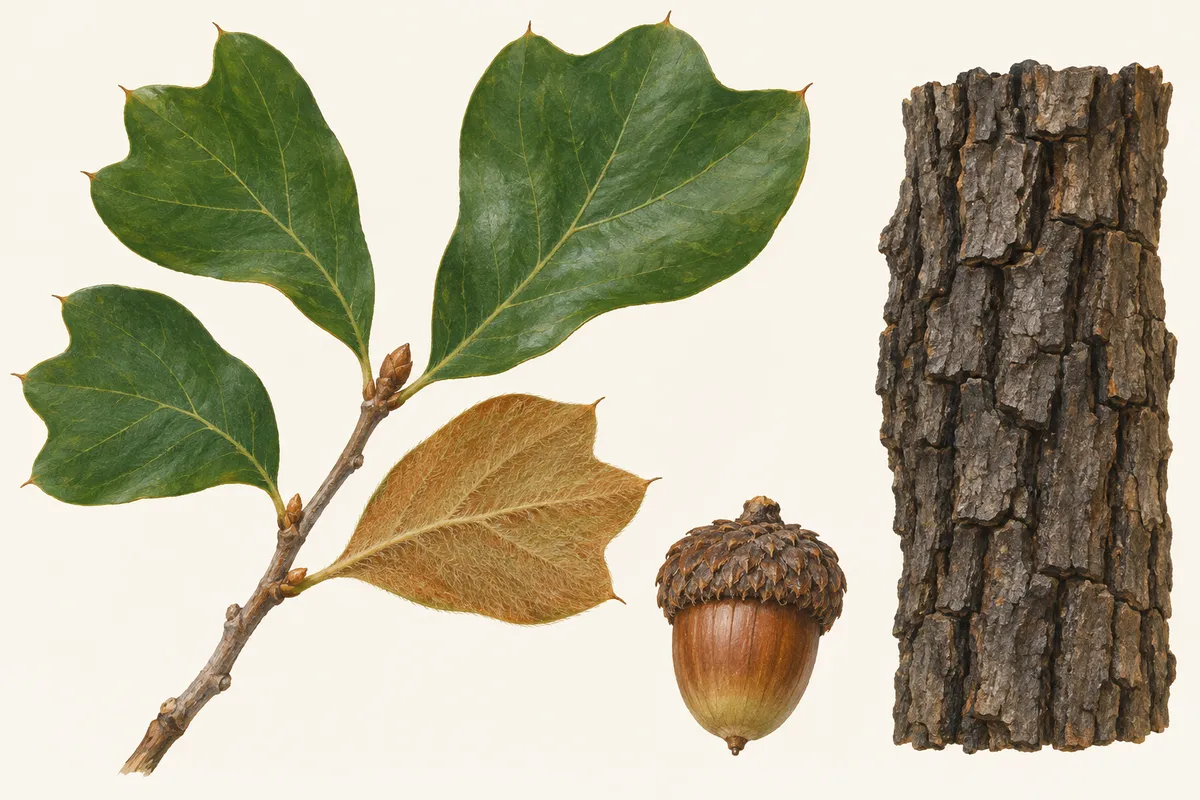
Blackjack oak identification is mostly about one leaf shape: thick and leathery, 4 to 8 inches long, narrow at the base and widening into a broad top with three shallow, bristle-tipped lobes, like a bell or a wedge. The underside carries orange-brown hairs. The bark is nearly black and broken into square blocks, and the tree is small, often 20 to 40 feet, on dry, poor soil.
- No other common eastern oak has a leaf shaped like a bell, broad and shallowly three-lobed at the top and narrow at the base.
- Blackjack oak is a red oak: bristle tips on the lobes and acorns that ripen in their second year.
- Turkey oak is the main look-alike on southern sandhills; its lobes are cut more than halfway to the midrib.
Field marks at a glance
- Scientific name
- Quercus marilandica
- Family
- Fagaceae (beech family)
- Type
- Broadleaf, deciduous
- Leaves
- Alternate, simple, thick and leathery, 4 to 8 inches long and 2 1/2 to 6 inches wide, wedge- or bell-shaped: narrow at the base, broad at the top with 3 shallow, bristle-tipped lobes.
- Leaf surfaces
- Glossy dark green above; underside paler, yellow-brown, with orange-brown to tan hairs. Several dead leaves often stay on through winter.
- Acorns
- 1/2 to 1 inch, light or yellow-brown, often striped, in a deep, turban-shaped cap of loose, hairy scales covering about 1/3 to 1/2; very short stalk; ripen in the second year, September to October.
- Bark
- Very dark, almost black, rough, broken into square or rectangular blocks like alligator hide.
- Twigs and buds
- Twigs stout, dark brown, scruffy-hairy; buds reddish-brown, about 1/4 inch, sharp, angled and fuzzy.
- Size and form
- Small tree, usually 20 to 40 ft, up to 60 ft; short trunk, round or irregular crown of twisted limbs, often with dead lower branches.
- Habitat
- Dry, poor, often sandy or rocky soils: uplands, ridges, savannas, glades and old fields; fire-tolerant, shade-intolerant.
- Range
- From New York and New Jersey west to Iowa, south to Florida and Texas (Oregon State University; Iowa State Extension).
Blackjack oak is the scrubby oak of ground nothing else wants: thin sandy soil, rocky ridges, chert glades and burned-over uplands. It rarely grows tall or straight, and it often keeps dead branches along its trunk. But its leaf is one of the easiest oak leaves to name. Narrow at the base and wide at the top, with three shallow bristle-tipped lobes, it looks like a bell or a wedge, and a black, blocky trunk confirms it.
How to identify a blackjack oak
1. The bell-shaped leaf. The Virginia Tech blackjack oak fact sheet describes thick leaves 5 to 8 inches long with 3 shallow, bristle-tipped lobes near the tip. NC State Extension gives 4 to 8 inches long and 2 1/2 to 6 inches across, obovate or wedge-shaped, with "3 poorly defined bristle-tipped lobes near the end of the leaf". The Missouri Department of Conservation calls the shape a wedge or a bell.
2. Turn the leaf over. Virginia Tech describes a shiny green top and a paler underside with orange-brown hairs; Missouri's field guide calls it yellow-brown or yellow-green with tan to brown hairs. Rub it with a thumb: the hairs feel like felt.
3. Black, blocky bark. Virginia Tech calls the bark very dark, almost black, rough, with blocky plates. Missouri describes it as blackish and divided into square or rectangular blocks that resemble alligator hide. Oregon State University gives the plates as nearly square, 2.5 to 7.5 cm (1 to 3 inches) across.
4. Hairy twigs and fuzzy buds. Twigs are stout, dark brown and scruffy-hairy; the buds are reddish-brown, about 1/4 inch long, sharp, angled and fuzzy (Virginia Tech).
5. The tree and its ground. Expect a small tree with a short trunk and a crown of twisted limbs. Missouri notes it often keeps dead branches on the middle and lower trunk, and that some leaves stay on through winter.
If the leaves are high, a photo of a fallen leaf or of the bark gives Tree Identifier enough to name the tree. It shows one name, without a confidence score or a list of look-alikes, so check the leaf shape and the hairy underside yourself.
Blackjack oak vs turkey oak, water oak and post oak
Virginia Tech names turkey oak as the look-alike; Missouri adds water, post, overcup, swamp white, scarlet, southern red and cherrybark oak. The three below cause the most trouble. Figures come from the Virginia Tech fact sheets for turkey oak, water oak, post oak and blackjack oak.
| Mark | Blackjack oak | Turkey oak | Water oak | Post oak |
|---|---|---|---|---|
| Leaf | 5–8 in, bell-shaped, 3 shallow bristle lobes at the top | 4–8 in, 3–7 bristle lobes cut more than halfway | 2–4 in, spoon-shaped, 0–5 shallow lobes | 6–10 in, 5 rounded lobes, middle two square |
| Underside | Orange-brown hairs | May have some brown hairs | Hairless, tufts in vein angles | Paler, hairy |
| Acorn | About 3/4 in, cap over about half | About 1 in, thin cap over about 1/3 | About 1/2 in, flat cap over 1/3 | 1/2–2/3 in, warty bowl over 1/3–1/2 |
| Bark | Almost black, blocky | Very rough, deep furrows, can be nearly black | Dark, fairly tight | Ashy gray, scaly to blocky |
Turkey oak is the hard one on dry southern sand, because its bark can also turn nearly black. Look at how deep the lobes go: turkey oak's sinuses cut more than halfway to the midvein, blackjack oak's barely dent the top of the leaf. The water oak page covers the spoon-shaped leaf, and the post oak page the cross-shaped one. The bristle test that puts blackjack oak in the red oak group is on red oak vs white oak.
Acorns and seasons
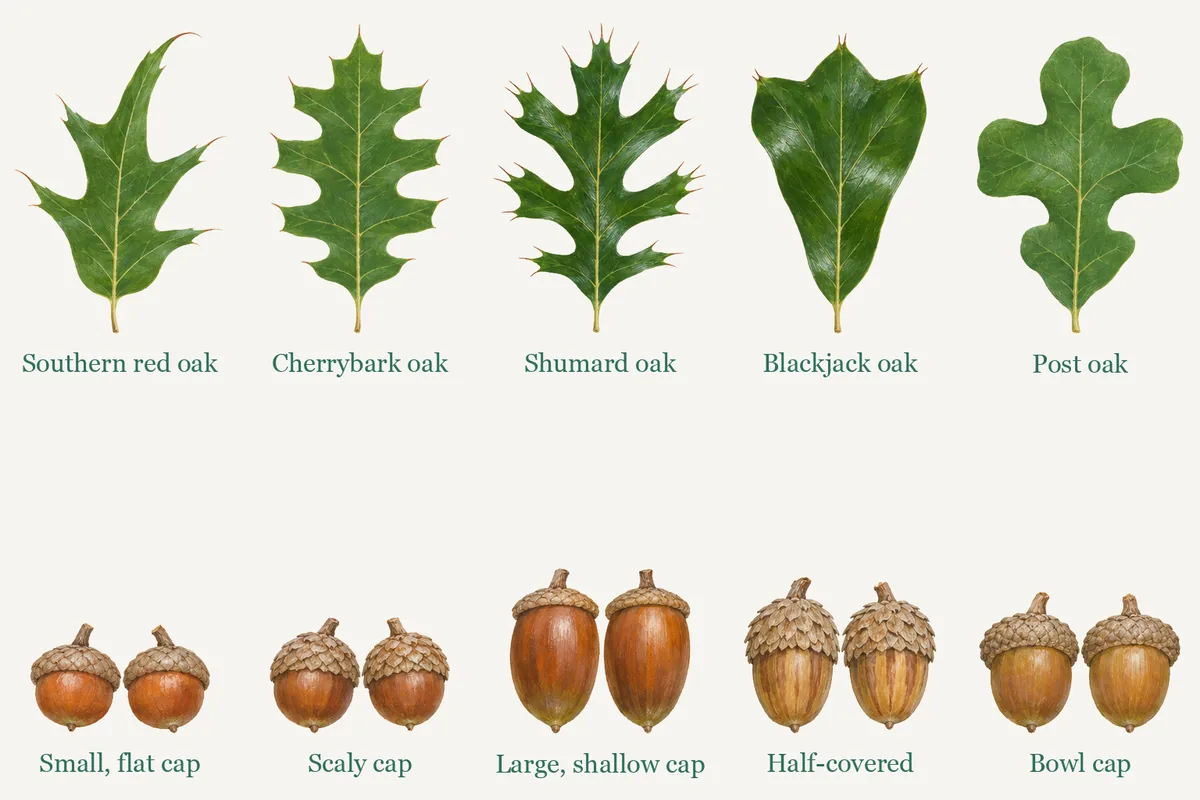
Missouri describes yellow-brown acorns 1/2 to 1 inch long in a deep, turban-shaped, red-brown cup with loose, hairy scales covering a third to half of the nut, on a very short stalk. They take two years to mature and ripen in September and October of the second year. Virginia Tech gives about 3/4 inch, often striped. Flowers appear in catkins in April and May.
Missouri lists blue jays, woodpeckers, wild turkey, mice, squirrels, raccoons and deer among the animals that eat the acorns. NC State lists blackjack oak leaves and acorns as low-severity toxic if eaten uncooked, and as a problem for horses.
In fall the leaves turn red, yellow or brown (NC State), and Oregon State notes they often persist into winter: a small oak still holding brown bell-shaped leaves in January on a dry hillside is worth a closer look.
Where blackjack oak grows
Oregon State University gives a native range from New York to Iowa, south to Florida and Texas; Iowa State Extension's Trees of Iowa page describes it from southeastern New York to southern Michigan and Nebraska, and says it grows with post oak. In Missouri it is scattered to common nearly statewide, on acidic soils over sandstone, chert or igneous rock.
Its home is the poorest ground: dry uplands, slopes, savannas and glades. Missouri describes it as short-lived, slow-growing and unable to grow in shade, but tolerant of fire thanks to thick, insulating bark and resprouting, and among the first trees to recolonize burned areas. In Texas it shares the dry uplands of the east with post oak; the Texas tree identification guide covers those forests.
Wood and uses
Blackjack oak is not a timber tree. Missouri says its wood has been used for railroad ties, fence posts, charcoal and fuel, and that its short stature and slow growth made it a common choice for firewood. Virginia Tech notes its generally poor form. For the rest of the eastern oaks and the two-group key, see the oak identification page; with location turned on, Tree Identifier's Tree Map pins a find so you can come back for the second-year acorns.
Look-alikes and how to tell them apart
Turkey oak (Quercus laevis)
Turkey oak leaves are deeply cut: 3 to 7 bristle-tipped lobes, usually 3 or 5, with sinuses reaching more than halfway to the midrib. Blackjack oak's 3 lobes are shallow, so the top of the leaf reads as one broad, bell-like edge.
Water oak (Quercus nigra)
Water oak's leaf is also widest near the tip, but small, 2 to 4 inches, thin and hairless, on a tall tree of wet ground. Blackjack oak's leaf is twice the size, thick, and rusty-haired underneath, on a small tree of dry ground.
Post oak (Quercus stellata)
Post oak often grows beside blackjack oak on the same dry ridges. Its leaves have rounded lobes with no bristles, the two middle lobes squared off into a cross, and its bark is ashy gray, not black.
What a photo can't settle
- Leaves on sprouts, seedlings and shaded branches are often less typical than sun leaves at the top of the crown, so a single low leaf can look like turkey oak or southern red oak; collect several.
- Missouri's field guide lists seven oaks that can be confused with blackjack oak, and oaks of one group can hybridize; a tree that mixes marks may need an expert, not a photo.
- Tree Identifier names a tree from one photo and shows no confidence score and no list of alternatives, so check the leaf underside and the bark yourself.
Questions people ask
Why is it called blackjack oak?
The black is the bark: very dark, almost black, broken into blocks, in the Virginia Tech and Missouri Department of Conservation descriptions. The species name marilandica refers to Maryland, according to Oregon State University.
Is blackjack oak a red oak or a white oak?
A red oak. Its lobes end in bristles, and the Missouri Department of Conservation and NC State both say its acorns take two years to ripen, the two red oak group marks.
How big does a blackjack oak get?
Small. Virginia Tech gives 20 to 30 feet, and the Missouri Department of Conservation says it can reach 60 feet but is rarely more than 30 to 40. It usually has a short trunk and a crown of twisted limbs.
Where does blackjack oak grow?
On poor, dry ground across the eastern and central US: sandy or rocky uplands, ridges, glades, savannas and old fields. Oregon State University gives a native range from New York to Iowa, south to Florida and Texas.
Sources
- Blackjack oak (Quercus marilandica) fact sheet — Virginia Tech Dendrology
- Blackjack Oak — Missouri Department of Conservation, Field Guide
- Quercus marilandica (blackjack oak) — North Carolina Extension Gardener Plant Toolbox, NC State University
- Quercus marilandica — Landscape Plants, Oregon State University
- Blackjack Oak, Trees of Iowa — Iowa State University Extension and Outreach, Forestry
- Turkey oak (Quercus laevis) fact sheet — Virginia Tech Dendrology
- Water oak (Quercus nigra) fact sheet — Virginia Tech Dendrology
- Post oak (Quercus stellata) fact sheet — Virginia Tech Dendrology
Keep reading
- Tree profileOak trees (Quercus): how to identify them
- Tree profilePost oak (Quercus stellata): how to identify it
- Tree profileWater oak (Quercus nigra): how to identify it
- Tree comparisonRed oak vs white oak trees: how to tell the living trees apart
- Regional guideTexas tree identification, from the Pineywoods to the Trans-Pecos