Tree profile
Water oak (Quercus nigra): how to identify it
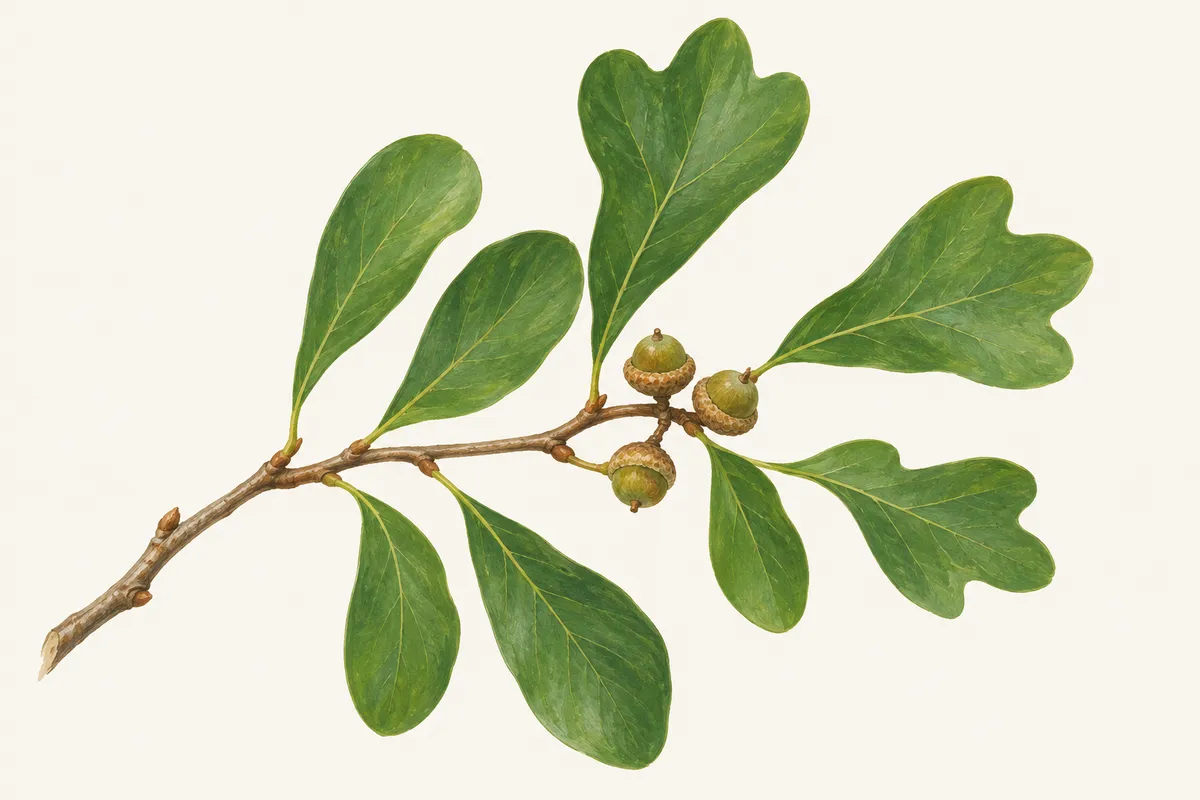
A southern red oak with small, oddly shaped leaves, widest near the tip and often with a few lobes, and dark acorns that take two years to ripen.
In short
Water oak tree identification rests on the leaf: 2 to 4 inches long, hairless, and very variable, but usually spoon-shaped, widest near the tip, with up to 5 shallow lobes or none. The acorns are about 1/2 inch long and nearly black under a flat cap covering about a third of the nut, and the bark stays dark and fairly tight. It grows on the southeastern Coastal Plain.
- Look for the widest point of the leaf: near the tip on water oak, near the middle on laurel oak, nowhere at all on the narrow, even willow oak leaf.
- Water oak belongs to the red oak group: its lobes, when it has any, end in bristles, and its acorns take two seasons to ripen.
- Leaves on one tree can be entire, three-lobed or five-lobed, so look at a dozen before deciding.
Field marks at a glance
- Scientific name
- Quercus nigra
- Family
- Fagaceae (beech family)
- Type
- Broadleaf, deciduous
- Leaves
- Alternate, simple, 2 to 4 inches long, very variable: usually spatulate (spoon-shaped, widest near the tip) to lanceolate, with 0 to 5 lobes; edges smooth or with bristle tips. Hairless on both sides apart from small tufts in the vein angles below.
- Leaf color
- Bluish green above and paler below (NC State); fall color brown to copper, not showy.
- Leaf habit
- Deciduous, but NC State notes that leaves may hang on through winter in zones 8 and 9 and that the tree is sometimes evergreen in the Deep South.
- Acorns
- About 1/2 inch long, very dark, nearly black, under a flattened cap with pressed-down scales covering about a third of the nut; they ripen in fall of the second year.
- Twigs and buds
- Twigs slender and red-brown; buds short, sharp-pointed, angular, red-brown and clustered at the twig tip.
- Bark
- Dark and fairly tight; smooth when young, then with irregular rough patches, and finally wide, scaly ridges.
- Size and form
- Usually 50 to 80 ft tall (NC State), with a slender trunk and a rounded crown of upward-angled branches; the Forest Service reports up to 125 ft on good sites.
- Range
- Coastal Plain from southern New Jersey and Delaware to southern Florida, west to eastern Texas, and up the Mississippi Valley to southeastern Oklahoma, Arkansas, Missouri and southwestern Tennessee.
Water oak is the common, fast-growing oak of southern yards, roadsides and bottomlands, and it is hard to pin down because its leaves refuse to keep one shape. Some are plain and spoon-shaped, some have three shallow lobes at the tip, and a few are almost narrow enough for a willow oak. The tree is Quercus nigra, a member of the red oak group, and the USDA Forest Service also lists the names possum oak and spotted oak.
How to identify a water oak
Check these in order. The first two settle most trees; the others confirm.
1. The leaf is widest near the tip. The Virginia Tech water oak fact sheet describes leaves 2 to 4 inches long, highly variable, from spatulate to lanceolate, with 0 to 5 lobes and edges that are either smooth or bristle-tipped. Spatulate is the key word: most leaves look like a small spoon or paddle, narrow at the base and broadening toward a rounded, often three-lobed tip. Both surfaces are hairless apart from small tufts of hair in the angles of the veins underneath.
2. Look at many leaves. One branch can hold an unlobed spoon, a three-lobed leaf and a narrow, almost strap-shaped one. That spread on a single tree is itself a water oak clue.
3. Acorns: small and nearly black. Virginia Tech gives acorns about 1/2 inch long, very dark, under a flattened cap with pressed-down scales covering about a third of the nut. They ripen in fall of the second year, about September according to the USDA Forest Service Silvics of North America, so a twig in summer shows two sizes of acorn. NC State Extension describes the acorn as nearly black and 1/2 to 1 inch long.
4. Twig tip. Twigs are slender and red-brown, with short, sharp, angular, red-brown buds clustered at the tip, the bud cluster every oak shares.
5. Bark. Dark and fairly tight. Virginia Tech describes it as smooth when young, then developing irregular rough patches, and on old trees wide scaly ridges.
The general red-oak and white-oak test is on the oak identification page; water oak passes the red-oak side of it, with bristles on its lobes and two-season acorns.
If the crown is high, a photo of a fallen leaf or a twig gives Tree Identifier something to name. It returns one name with no confidence score and no list of alternatives, so check the widest point of several leaves yourself before accepting "water oak" over "laurel oak".
Water oak vs willow oak vs laurel oak
These three southern red oaks have small, mostly unlobed leaves and grow in the same lowlands. Virginia Tech lists each one as a look-alike of the other two. Figures are from the Virginia Tech fact sheets for willow oak and laurel oak, and from the water oak sheet above.
| Mark | Water oak | Willow oak | Laurel oak |
|---|---|---|---|
| Leaf length | 2–4 in | 2–5 in | 3–5 in |
| Widest point | Near the tip | Even width, very narrow | Near the middle, 1–1 1/2 in wide |
| Lobes | 0–5, often 3 at the tip | None | None, occasionally shallow |
| Texture | Thin, hairless | Thin, hairless | Thick, shiny above, persistent |
| Acorn | About 1/2 in, nearly black, cap about 1/3 | 1/4–1/2 in across, nearly round, cap about 1/4 | 1/2–2/3 in, dark brown and striated, shallow cap |
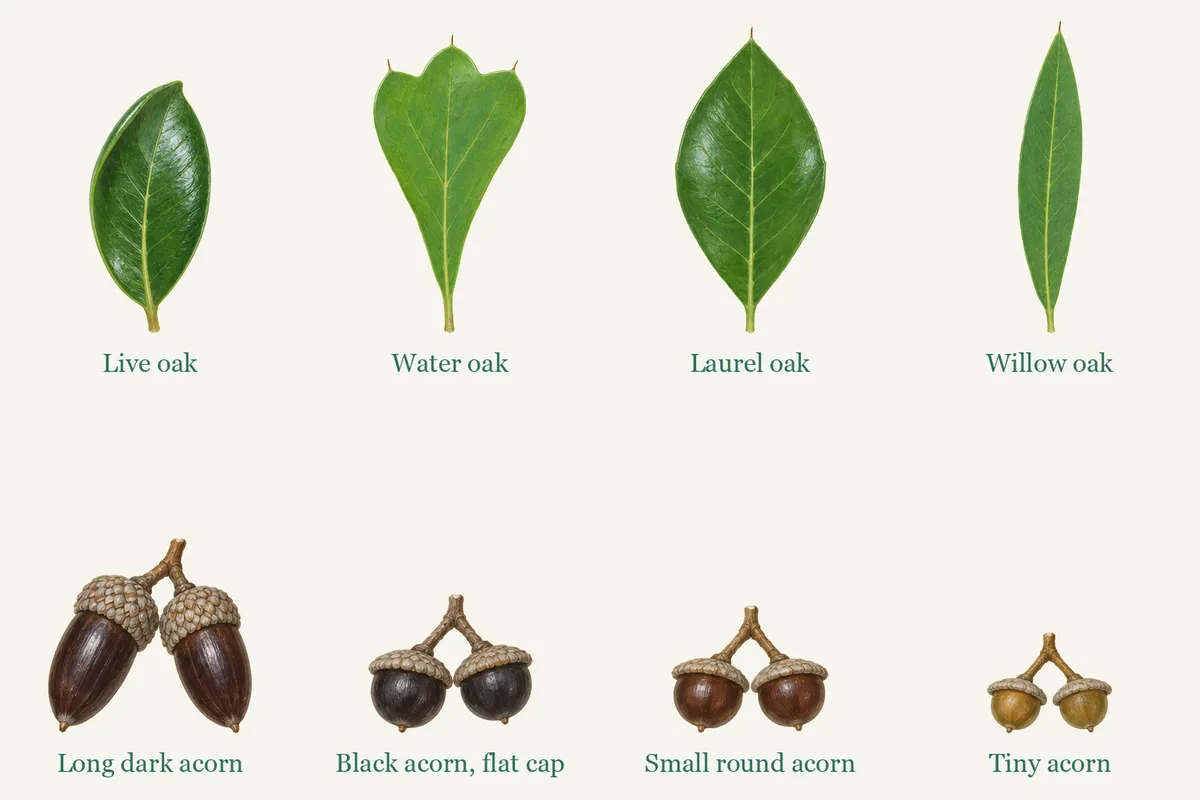
The quickest field test is to hold a leaf by its stalk and find the widest point. A water oak leaf widens toward the tip, a laurel oak leaf toward the middle, and a willow oak leaf stays narrow from end to end. Willow oak gets its own page: willow oak identification. So does laurel oak, with its look-alike Darlington oak: laurel oak identification.
Live oak is the other classic mix-up on the Coastal Plain, because some water oaks keep their leaves into winter. Live oak leaves are thick and leathery with edges rolled under, and its acorns ripen in one season; the live oak page has the full side-by-side.
Leaves in winter, and the evergreen question
NC State Extension lists water oak as deciduous but adds that leaves may persist through winter in USDA zones 8 and 9 and that the tree is sometimes evergreen in the Deep South. Its fall color is brown to copper, not a showy red.
That partial evergreen habit is why winter is tricky. A green-leaved oak in January in Louisiana or Florida may be a live oak, a laurel oak or a water oak holding on to its leaves. Check the leaf texture first: thick, leathery and rolled at the edges points to live oak, thick and shiny but flat to laurel oak, thin with a spoon shape to water oak.
Where water oak grows and how big it gets
The Forest Service range runs along the Coastal Plain from southern New Jersey and Delaware to southern Florida and west to eastern Texas, and north in the Mississippi Valley to southeastern Oklahoma, Arkansas, Missouri and southwestern Tennessee. It grows along southeastern watercourses and lowlands, on sites from wet bottomlands to well-drained uplands, and is often abundant as second growth on cut-over land. It is also planted widely as a street and shade tree, so a water oak outside that range is usually a planted one.
NC State gives a size of 50 to 80 feet tall and 50 to 70 feet wide, with a conical to broad, rounded crown; the Forest Service reports trees up to 125 feet on good sites. NC State warns that its limbs and wood are weak and prone to breakage in wind, snow and ice.
Hybrids and acorns on the ground
The Forest Service lists hybrids of water oak with southern red oak, bluejack oak, turkey oak, blackjack oak, willow oak, Shumard oak and black oak. The willow oak hybrid, Q. × capesii, is the one most likely to puzzle you in a southern yard, with leaves halfway between a spoon and a strap.
On the ground, a small, nearly black acorn under a flat, thin cap, beneath a tree with spoon-shaped leaves, is a strong water oak signal. The acorn identification guide keys acorns by cap, size and stalk if you only have the acorn. NC State lists water oak leaves and acorns as having low-severity toxicity for people and flags the tree as a problem for horses; never eat acorns because of a web page or an app.
Tree Identifier's follow-up chat can take a question such as "is this water oak or laurel oak", and, with location turned on, its Tree Map pins the find so you can come back in winter to see whether the leaves stayed on.
Look-alikes and how to tell them apart
Willow oak (Quercus phellos)
Willow oak leaves are narrow and even, 2 to 5 inches long and under about 1 inch wide, never lobed and not widened toward the tip. Its acorns are smaller, 1/4 to 1/2 inch across, nearly round and yellow-green to tan, not nearly black.
Laurel oak (Quercus laurifolia)
Laurel oak leaves are widest near the middle, 3 to 5 inches long and 1 to 1 1/2 inches wide, thick, shiny above and persistent into winter. A water oak leaf is thinner and widest near its tip, like a spoon or a small paddle.
Shingle oak (Quercus imbricaria)
Shingle oak leaves are 3 to 7 inches long, unlobed, somewhat leathery and fuzzy underneath. Water oak leaves are shorter, 2 to 4 inches, and hairless below except for small tufts in the vein angles.
Southern live oak (Quercus virginiana)
Live oak leaves are thick, leathery and evergreen with edges rolled under, and its acorns ripen in one season. Water oak leaves are thin and flat, and a summer twig carries two sizes of acorns because they take two years.
What a photo can't settle
- Water oak hybridizes with willow oak, Shumard oak, southern red oak, black oak and several other red oaks (USDA Forest Service), and a hybrid can carry leaves halfway between the parents.
- Laurel oak itself is a muddled name: some authors split it from Darlington oak (Quercus hemisphaerica) and others do not, so a photo app's name for an unlobed southern oak is a starting point, not a final answer.
- A single leaf photo is weak evidence for such a variable species. Photograph a twig with several leaves and, if possible, an acorn.
Questions people ask
Is water oak a red oak or a white oak?
A red oak. Water oak acorns take two growing seasons to ripen, and any lobes on its leaves end in bristles, both marks of the red oak group. A summer twig often carries two sizes of acorn, this year's tiny ones and last year's nearly ripe ones.
Why do the leaves on my water oak all look different?
Variable leaves are typical of the species. Virginia Tech describes shapes from spatulate to lanceolate with anywhere from 0 to 5 lobes, so one branch can carry a plain spoon-shaped leaf, a three-lobed leaf and a nearly entire narrow leaf. Judge the tree by the common shape across many leaves.
Is water oak evergreen?
Usually not. NC State Extension lists it as deciduous, but notes that leaves may persist through winter in zones 8 and 9 and that the tree is sometimes evergreen in the Deep South, which is one reason it gets confused with laurel oak and live oak.
How do I tell water oak from laurel oak?
Find the widest part of the leaf. Water oak leaves widen toward the tip like a spoon and often carry a few shallow lobes; laurel oak leaves are widest near the middle, thicker and shinier, 1 to 1 1/2 inches wide, according to Virginia Tech. Many trees in the South are hard to place, so check several leaves.
Are water oak acorns toxic?
NC State Extension lists water oak leaves and acorns as having low-severity toxicity for people, notes that acorns can obstruct the digestive tract, and flags the tree as a problem for horses. Never eat acorns or any other wild plant on the strength of a web page or an app.
Sources
- Water oak (Quercus nigra) fact sheet — Virginia Tech Dendrology
- Water Oak, Silvics of North America — USDA Forest Service
- Quercus nigra (water oak) — North Carolina Extension Gardener Plant Toolbox, NC State University
- Willow oak (Quercus phellos) fact sheet — Virginia Tech Dendrology
- Laurel oak (Quercus laurifolia) fact sheet — Virginia Tech Dendrology
- Shingle oak (Quercus imbricaria) fact sheet — Virginia Tech Dendrology
Keep reading
- Tree profileOak trees (Quercus): how to identify them
- Tree profileLive oak (Quercus virginiana): how to identify it
- Tree profileWillow oak (Quercus phellos): how to identify it
- Clue guideAcorn identification: which oak dropped this acorn?
- Tree comparisonRed oak vs white oak trees: how to tell the living trees apart