Tree profile
Laurel oak (Quercus laurifolia): how to identify it
A fast-growing, short-lived red oak of southern floodplains and yards, with laurel-like leaves that stay green well into winter.
In short
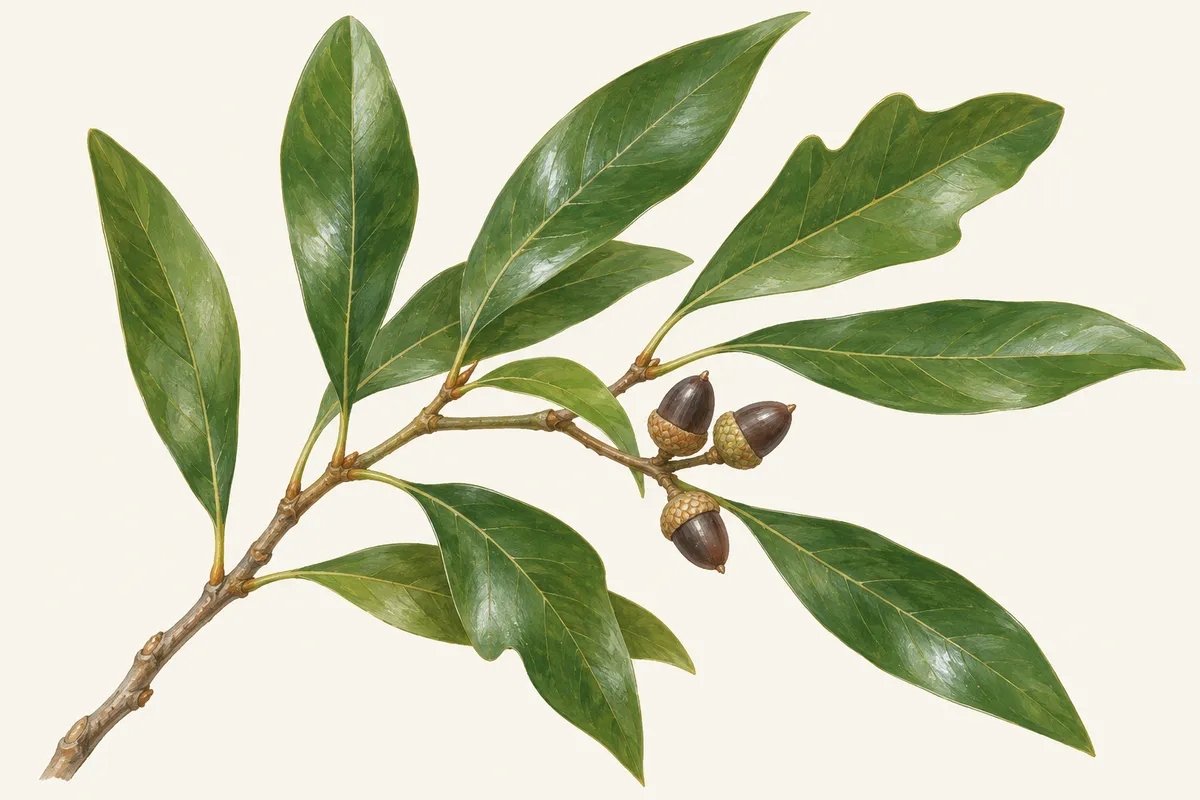
Laurel oak identification starts with the leaf: 3 to 5 inches long and 1 to 1 1/2 inches wide, smooth-edged, thick and shiny, widest near the middle, often diamond-shaped, and kept into winter in warm climates. The acorns are small, about 1/2 inch, nearly round and dark brown in a shallow cap, ripening over two years. Water oak's leaf is widest near the tip.
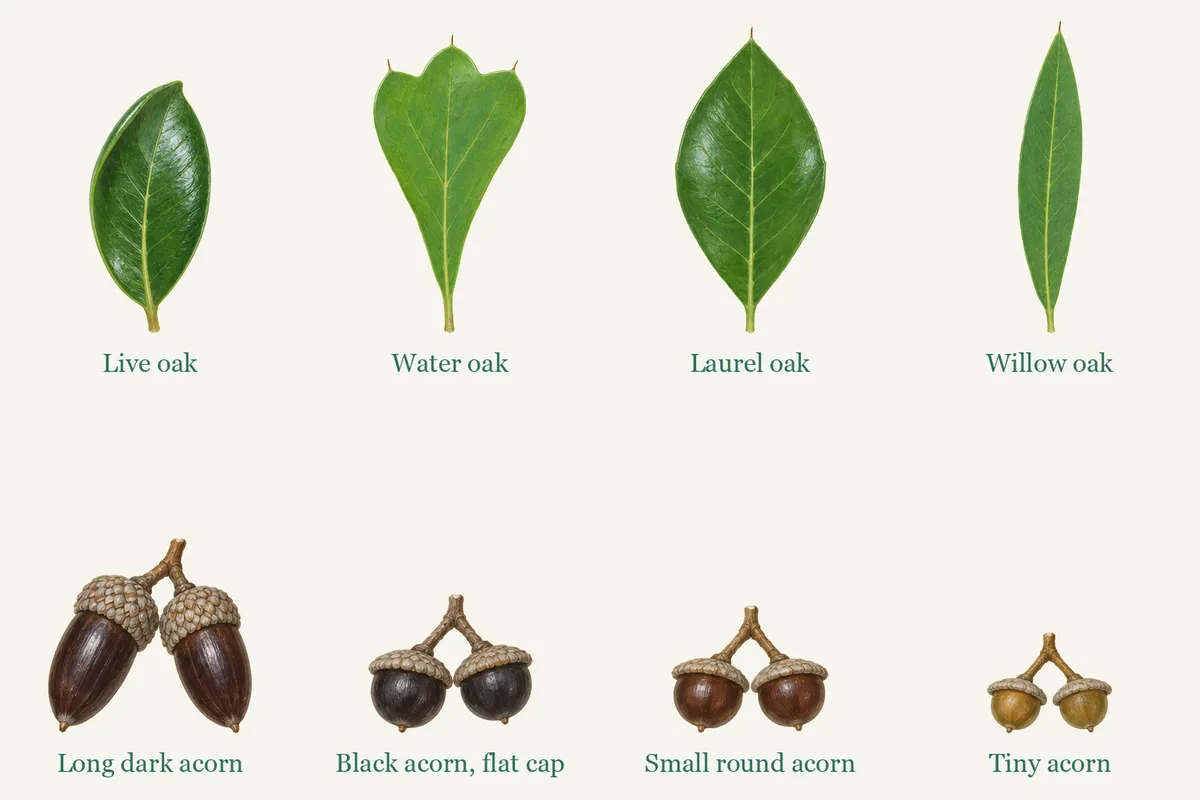
- Hold a leaf by the stalk and find the widest point: the middle for laurel oak, near the tip for water oak, nowhere for the narrow willow oak leaf.
- Laurel oak is in the red oak group: its acorns take two years to ripen, so summer branches carry two sizes of acorn.
- Darlington oak (Quercus hemisphaerica) of dry sandy uplands is so similar that some botanists do not separate the two.
Field marks at a glance
- Scientific name
- Quercus laurifolia
- Family
- Fagaceae (beech family)
- Type
- Broadleaf, semi-evergreen
- Leaves
- Alternate, simple, 3 to 5 inches long and 1 to 1 1/2 inches wide, widest near the middle, often diamond-shaped; edges smooth, now and then with a shallow lobe; thick, shiny above, pale and smooth below.
- Leaf tip and edge
- A small pointed tip (mucro) that wears off; the edge is wavy, so a leaf does not lie flat (University of Florida).
- Leaf habit
- Semi-evergreen to deciduous: leaves last into winter in warmer climates (NC State).
- Acorns
- 1/2 to 2/3 inch, nearly round, dark brown and often striped; shallow cap of tight reddish-brown scales covering 1/4 to 1/3; take two years to ripen, falling late September and October.
- Twigs and buds
- Slender, light reddish-brown, hairless twigs; sharp-pointed, reddish-brown buds clustered at the tip.
- Bark
- Dark brown and smooth when young, later with shallow fissures and flat, rough ridges; thin for an oak. The trunk base may be buttressed or fluted on wet ground.
- Size and form
- Usually 40 to 60 ft, sometimes near 100 ft; straight trunk 1 to 3 ft across and a dense, rounded crown.
- Range and site
- Atlantic and Gulf Coastal Plains from southeastern Virginia to southern Florida, west to southeastern Texas; moist woods, floodplains and swamp edges, often on sandy soil.
Laurel oak is one of the oaks that fill southern yards, streets and river bottoms with green leaves in January. The leaves are not lobed. They are smooth-edged and glossy, shaped more like a bay laurel's than an oak's, and that is the source of both the name and the confusion: water oak, willow oak, Darlington oak and live oak all grow alongside it with similar leaves. The quickest test is where the leaf is widest.
How to identify a laurel oak
1. Find the widest point of the leaf. The Virginia Tech laurel oak fact sheet describes leaves 3 to 5 inches long and 1 to 1 1/2 inches wide, widest near the middle, with smooth edges that occasionally carry a shallow lobe. They are thick, shiny above, pale and smooth below. The University of Florida's tree tour page adds that many leaves are diamond-shaped, narrowing to the base, with a wavy edge that keeps them from lying flat and a small point at the tip that wears off.
2. Check the season. NC State Extension calls laurel oak semi-evergreen to deciduous: in warm climates the leaves last into winter. A smooth-leaved oak still green in December, on a floodplain in the Southeast, is a strong lead.
3. Pick up an acorn. Virginia Tech gives a nearly round, dark brown acorn 1/2 to 2/3 inch long, often striped, in a shallow cap of tight reddish-brown scales that covers at most a third of the nut. The acorns take two years to ripen, so a branch in summer carries both tiny first-year acorns and nearly ripe ones.
4. Twigs and bark. Twigs are slender, light reddish-brown and hairless, with sharp, reddish-brown buds clustered at the tip. Bark is dark brown and smooth when young, later shallowly fissured with flat, rough ridges (Virginia Tech). The University of Florida notes thin, tight bark and a base that may be buttressed on wet soil.
5. The setting. Laurel oak is a tree of moist ground: the USDA Forest Service's Silvics of North America places it on alluvial floodplains, often on sandy soil near rivers and swamp edges, though it does not tolerate long flooding. It is also widely planted as a street and shade tree in the South.
When the crown is high, a photo of a fallen leaf or a twig gives Tree Identifier enough to name the tree. It shows one name, without a confidence score or a list of look-alikes, so measure a few leaves before you accept "laurel oak" over "water oak".
Laurel oak vs water oak, willow oak and live oak
All four grow on the southern Coastal Plain, and Virginia Tech lists water, willow, shingle and Darlington oak as laurel oak's look-alikes. Figures come from the Virginia Tech fact sheets for water oak, willow oak, live oak and laurel oak.
| Mark | Laurel oak | Water oak | Willow oak | Southern live oak |
|---|---|---|---|---|
| Leaf length | 3–5 in | 2–4 in | 2–5 in | 2–5 in |
| Widest point | Middle | Near the tip (spoon) | Nowhere, narrow and even | Middle; oblong |
| Edge | Smooth, wavy, rarely a shallow lobe | Smooth or 0–5 shallow lobes | Smooth, bristle tip | Smooth or spiny, rolled under |
| Underside | Pale, smooth | Hairless, tufts in vein angles | Not stated | Pale, hairy |
| Acorn | 1/2–2/3 in, nearly round | About 1/2 in, very dark | 1/4–1/2 in across | About 3/4 in, in clusters of 3–5 |
| Ripens | Two years | Two years | Not stated | One season |
The leaf-width test separates laurel oak from willow oak, the leaf-shape test from water oak, and the leaf underside and acorn from live oak. The water oak page shows the spoon-shaped leaf in detail, the willow oak page the narrow one, and the live oak page the evergreen oaks of the coast.
Laurel oak or Darlington oak
The hardest look-alike is Darlington oak (Quercus hemisphaerica). Botanists disagree on whether it is a separate species. The USDA Forest Service lists Darlington oak as one of laurel oak's common names, and NC State lists Q. hemisphaerica both as a separate species and as a former name of laurel oak.
Where the two are kept apart, the clues are habitat and leaf. NC State's Darlington oak page describes leaves 2 to 5 inches long and 1 to 1 1/2 inches wide, with a rounded base, that generally stay on until new leaves form in spring, on sandhills, dry hammocks and other dry, sandy sites. The University of Florida separates laurel oak by its diamond-shaped leaves and swampy habitat. So a tree on a wet floodplain with diamond leaves points to laurel oak, and one on dry sand with rounded leaf bases to Darlington oak.
Acorns, growth and lifespan
The Forest Service describes acorns about 1/2 inch long and wide, brown to almost black, in a cap that encloses a quarter of the nut or less. They take two years to mature and fall in late September and October. Deer, raccoons, squirrels, wild turkeys, ducks, quail and smaller birds and rodents eat them. The acorn identification guide keys loose acorns by cap and size.
Laurel oak grows fast and dies young for an oak. The Forest Service calls it short-lived, usually maturing in about 50 years, with thin bark that makes it prone to fire damage. The University of Florida gives a lifespan of 50 to 70 years in towns, up to 200 in nature, and warns that decay often shortens it, so old yard trees may become hazardous.
Where laurel oak grows
The Forest Service range covers the Atlantic and Gulf Coastal Plains from southeastern Virginia to southern Florida and west to southeastern Texas, with a few populations north of the main range. The largest and best trees grow in north Florida and Georgia. NC State places it in the Piedmont and Coastal Plain of North Carolina on moderately dry to seasonally flooded floodplains and swamp margins.
The Florida tree identification guide sets laurel oak beside turkey oak, live oak and the other trees of that state. Tree Identifier's follow-up chat can take a question such as "is this laurel oak or water oak", and, with location turned on, the Tree Map pins the tree so you can check in midwinter whether its leaves stayed on.
Look-alikes and how to tell them apart
Water oak (Quercus nigra)
Water oak leaves are smaller, 2 to 4 inches, thinner, and widest near the tip like a spoon, often with up to 5 shallow lobes. A laurel oak leaf is widest near the middle, thicker and shinier.
Willow oak (Quercus phellos)
Willow oak leaves are narrow and even from end to end, linear to lanceolate, 2 to 5 inches long, and fall in autumn. Its acorn is smaller, 1/4 to 1/2 inch across, yellow-green turning tan.
Darlington oak (Quercus hemisphaerica)
Nearly identical leaves, 2 to 5 inches, with a rounded base, kept until new leaves come out in spring. Darlington oak grows on sandhills and dry, sandy sites; laurel oak on floodplains and swamp margins, with more diamond-shaped leaves.
Southern live oak (Quercus virginiana)
Live oak leaves are evergreen too, 2 to 5 inches, but leathery with edges rolled under and pale, hairy undersides. Its acorns ripen in one season, in clusters of 3 to 5. Laurel oak leaves are flat and smooth below.
What a photo can't settle
- Laurel oak, Darlington oak, water oak and willow oak vary leaf by leaf, even on one tree, and laurel oak may itself have arisen from willow oak and water oak (a view the USDA Forest Service reports as disputed). Treat a single leaf as a hint, not an answer.
- Tree Identifier returns one name with no confidence score and no list of alternatives, and whether that name is laurel oak or Darlington oak can depend on which taxonomy a source follows.
- In winter, whether leaves stay green depends on the climate as much as the species, so leaf persistence alone cannot separate laurel oak from water oak in the Deep South.
Questions people ask
Is laurel oak evergreen?
Partly. NC State Extension calls it semi-evergreen to deciduous, with leaves that last into winter in warmer climates, and Virginia Tech describes the leaves as thick and persistent. The University of Florida lists it as deciduous. Expect a laurel oak to hold green leaves well into winter in the Deep South, then drop them.
How long do laurel oaks live?
Not long, for an oak. The USDA Forest Service calls it a rapid-growing, short-lived tree that usually matures in about 50 years. The University of Florida gives a lifespan of 50 to 70 years, up to 200 in nature, and notes that decay often shortens it.
Is laurel oak the same as Darlington oak?
Botanists disagree. The USDA Forest Service lists Darlington oak among laurel oak's common names, while NC State treats Darlington oak as a separate species, Quercus hemisphaerica, of dry sandy sites. The University of Florida separates them by laurel oak's diamond-shaped leaves and wet habitat.
Is laurel oak a red oak or a white oak?
A red oak. Its acorns take two years to mature, according to the USDA Forest Service and NC State, and two-season acorns are a red oak group mark. White oak group acorns ripen in a single season.
Where does laurel oak grow?
On the Atlantic and Gulf Coastal Plains, from southeastern Virginia to southern Florida and west to southeastern Texas. The USDA Forest Service says it is most common on alluvial floodplains, often on sandy soil near rivers and swamp edges, and that the best trees grow in north Florida and Georgia.
Sources
- Laurel oak (Quercus laurifolia) fact sheet — Virginia Tech Dendrology
- Laurel Oak, Silvics of North America — USDA Forest Service
- Quercus laurifolia (laurel oak) — North Carolina Extension Gardener Plant Toolbox, NC State University
- Quercus hemisphaerica (Darlington oak) — North Carolina Extension Gardener Plant Toolbox, NC State University
- Laurel oak, Tree Tour — University of Florida IFAS, School of Forest, Fisheries, and Geomatics Sciences
- Water oak (Quercus nigra) fact sheet — Virginia Tech Dendrology
- Willow oak (Quercus phellos) fact sheet — Virginia Tech Dendrology
- Live oak (Quercus virginiana) fact sheet — Virginia Tech Dendrology
Keep reading
- Tree profileOak trees (Quercus): how to identify them
- Tree profileWater oak (Quercus nigra): how to identify it
- Tree profileWillow oak (Quercus phellos): how to identify it
- Tree profileLive oak (Quercus virginiana): how to identify it
- Regional guideFlorida tree identification, from the Panhandle to the Keys