Clue guide
Acorn identification: which oak dropped this acorn?
Read the cap first, then the nut and the stalk. Four checks name the common North American and British oaks, and the ripening time sorts the rest into the red or white oak group.
In short
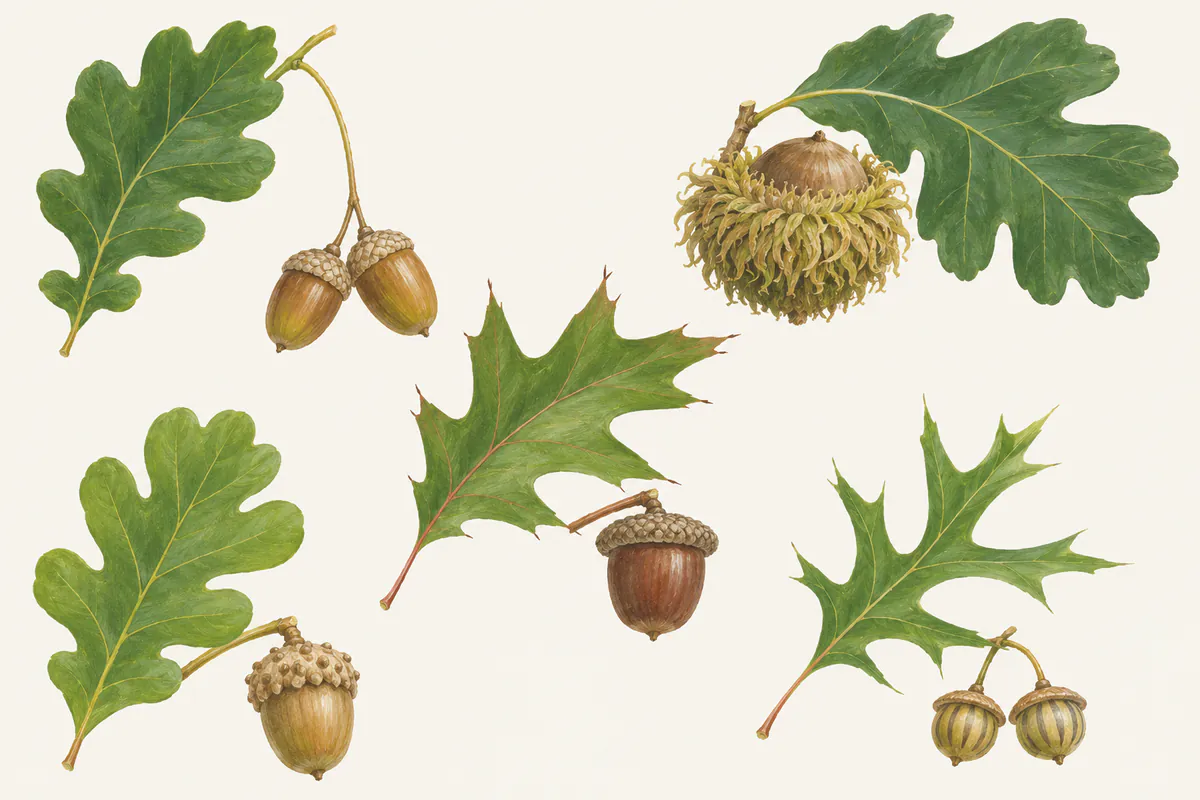
Acorn identification starts with the cap. A fringed cap covering half of a 1 1/2-inch nut is bur oak; a flat, beret-like cap on a nearly round 3/4- to 1-inch nut is northern red oak; a warty bowl covering a quarter of the nut is white oak; a thin saucer on a striped half-inch acorn is pin oak. In Britain, acorns hanging on long stalks are English oak.
- Cap depth and texture name most acorns: a long fringe means bur oak, a flat beret northern red oak, a warty bowl white oak, a thin saucer pin oak.
- Pin oak and northern red oak acorns take two growing seasons to ripen; white, bur and live oak acorns ripen in one.
- In Britain, acorns on long stalks are English oak and acorns sitting straight on the twig are sessile oak.
Acorn identification is a three-step key: read the cap, measure the nut, and check whether it hung on a stalk. An acorn always means an oak; this page tells you which one. For the leaves, bark and range of each oak, follow the links to the species pages; the oak page covers the genus as a whole. Never eat a nut, seed or fruit because a page or an app named the tree.
Read an acorn in four checks
- Cap depth. Hold the acorn on its side. A cap that is a flat disk or a thin saucer belongs to the red oak group in this guide (northern red oak, pin oak). A cap that is a deeper bowl, covering a quarter to a half of the nut, points to the white oak group (white, bur, live oak).
- Cap scales. Run a finger over the cap. Warty, knobby scales mean white oak or live oak. A rim of long, curly fringe means bur oak. Thin, flat red-brown scales pressed tight against a saucer mean pin oak.
- The nut. Measure the length. About 1/2 inch with fine stripes is pin oak; 3/4 to 1 inch and nearly round is northern red oak; about 1 1/2 inches is bur oak. A dark nut in a cluster of three to five is southern live oak.
- The stalk. In Britain, an acorn on a long stalk is English oak; one sitting straight on the twig is sessile oak.
If the cap and nut disagree, use the leaf: bristle-tipped lobes mean the red oak group, rounded lobes the white oak group (Virginia Tech fact sheets for northern red oak and white oak).
Acorn size and cap by oak
| Oak | Group | Acorn length | Cap | Stalk | Ripens in |
|---|---|---|---|---|---|
| Bur oak (Quercus macrocarpa) | White | About 1 1/2 in (3.8 cm) | Warty, long-fringed rim, encloses about 1/2 of the nut | — | 1 season, late summer and fall |
| White oak (Q. alba) | White | About 1 in (2.5 cm), ovoid to oblong | Warty bowl covering about 1/4; always detaches at maturity | — | 1 season, early fall |
| Southern live oak (Q. virginiana) | White | About 3/4 in (1.9 cm), dark | Warty, bowl- to top-shaped, covering about 1/3 | Clusters of 3 to 5 | 1 season, early fall |
| Northern red oak (Q. rubra) | Red | 3/4–1 in (1.9–2.5 cm), nearly round | Flat and thick like a beret, 1/4 or less | — | 2 seasons, late summer and fall |
| Pin oak (Q. palustris) | Red | About 1/2 in (1.3 cm), striped, flattened at the cap | Thin saucer, red-brown scales pressed flat | — | 2 years, falls fall to early winter |
| English oak (Q. robur) | White | 2–2.5 cm (about 3/4–1 in) | Scaly cup | Long stalk | — |
| Sessile oak (Q. petraea) | White | — | Scaly cup | None: on the twig | — |
Figures come from the Virginia Tech Dendrology fact sheets, except white oak's length (the Morton Arboretum) and the English and sessile oak rows (the Woodland Trust), all read on 9 November 2026. A dash means the source does not state it. Centimetres are converted from the inches the US sources give, and inches from the centimetres the Woodland Trust gives.
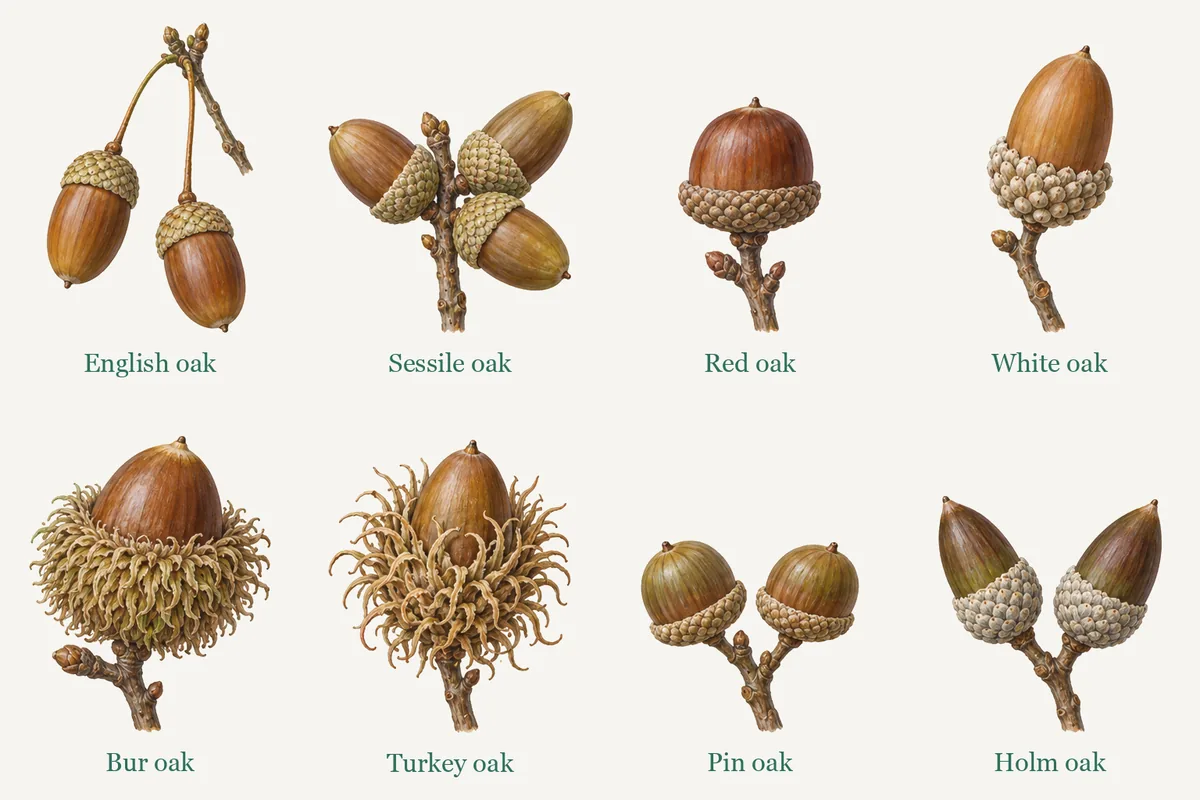
The chart adds two European oaks the table leaves out: Turkey oak, whose cap is covered in long, curling bristles like bur oak's, and holm oak, an evergreen. Bur oak's fringe and its 1 1/2-inch nut are the easiest marks in North America: Virginia Tech describes a quite large acorn half enclosed in a warty cap with a long-fringed margin. For bur oak's leaf, bark and range, see the bur oak page.
One year or two: the red and white oak group test
The ripening time is the classic way to sort an oak into its group from its acorns. Virginia Tech's fact sheets give white oak, bur oak and southern live oak acorns as maturing in one growing season, and northern red oak and pin oak acorns as taking two.
You can see this on the tree in summer. Because each crop takes two seasons, a red oak group tree can carry two sizes of acorns at once: this year's tiny ones and last year's, which are close to full size. A white oak group tree carries a single crop.
The red oak vs white oak page adds the leaf, bark and shell-lining tests, and the oak page has an acorn table for eleven US oaks, including black, scarlet, chestnut and willow oak.
White oak and southern live oak. Both have warty bowls. White oak's nut is longer, about an inch according to the Morton Arboretum, and its cap covers about a quarter of it. Southern live oak's nut is dark, about 3/4 inch, covered a third by the cap, and grows in clusters of three to five, according to Virginia Tech. Live oak keeps its leathery leaves through winter, which settles it on the tree.
Northern red oak and pin oak. Both have shallow caps and ripen in two seasons. Northern red oak's acorn is twice the size, nearly round, under a thick beret. Pin oak's is about half an inch, striped, under a thin saucer with flat red-brown scales.
Acorns in Britain: English oak or sessile oak
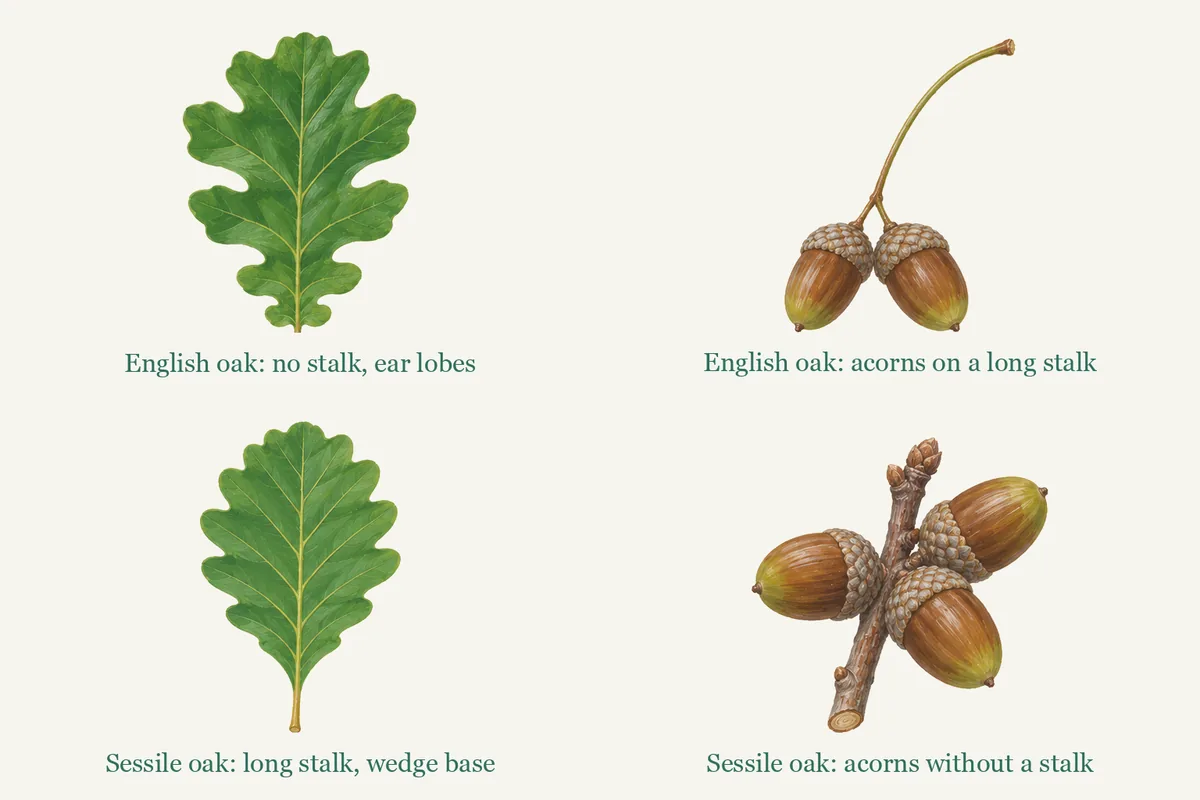
UK searches for acorn identification come down to two native oaks. The Woodland Trust gives English (pedunculate) oak acorns as 2 to 2.5 cm long, held in cups on long stalks, green at first and turning brown as they ripen. Sessile oak's acorns have no stalk and sit directly on the twig; sessile means stalkless. The leaves swap the pattern: English oak leaves have tiny or no stalks, sessile oak leaves have longer ones.
The two often hybridize, so collect several acorns from one tree before deciding. The English oak vs sessile oak page adds the leaf base, the lobes and where each grows. The chart above also shows Turkey oak, whose cap is covered in long, curling bristles.
The sheet below shows the two native oaks side by side, English oak above and sessile oak below: the acorn stalks on the right, the leaf stalks on the left.
Acorn or look-alike
An acorn is a single nut held in a scaly cap open at the top. Four other tree nuts get mistaken for one:
- Hazelnut. A round nut wrapped in a leafy, frilled husk rather than a scaly cap; see the hazel page.
- Beechnut. Small three-sided nuts in a woody husk covered with spines; see the beech page.
- Chestnut. Shiny brown nuts inside a very spiny burr; the horse chestnut vs sweet chestnut page separates the two.
- Buckeye and horse chestnut. A shiny brown seed with a pale scar, the "buck's eye", inside a leathery husk that NC State describes as warty or prickly, on a tree with opposite, hand-shaped leaves of 5 to 7 leaflets. Ohio buckeye's fruits, leaves and stems are listed as toxic by NC State Extension. The chestnut vs buckeye page shows the husks side by side.
None of these sits in a cup with an open top. If a child or pet has swallowed any nut or seed you cannot name, call poison control. The seeds and nuts guide sorts every other kind of tree fruit.
Using a photo
An acorn on its own is a good photo subject: put it on your palm or next to a coin for scale, with the cap still on, and take a second photo of a leaf from the same tree. Tree Identifier names a tree from one photo of the leaf, bark, flowers or fruit, using a cloud AI model, so it needs a connection. It shows no confidence score or list of alternatives, so check the name against the cap and size table above. The follow-up chat under each result can answer questions such as whether a striped acorn could be scarlet oak rather than pin oak, and, with location turned on, the Tree Map pins where you found the tree.
What a photo can't settle
- Acorns are moved by squirrels, jays and water, so an acorn on the ground may not come from the tree above it; check the leaves overhead.
- Oaks hybridize, and acorn size varies from tree to tree and year to year, so a borderline acorn can sit between two rows of the table.
- A cap that has fallen off (white oak's always detaches at maturity) leaves only the nut, which is harder to name; look for loose caps under the tree.
Questions people ask
How do you identify an acorn by its cap?
Look at how much of the nut the cap covers and at its scales. Virginia Tech describes bur oak's cap as warty with a long fringe, covering half the nut; white oak's as a warty bowl covering a quarter; northern red oak's as flat and thick like a beret; pin oak's as a thin saucer.
Which oak has the biggest acorns?
Of the common oaks in this guide, bur oak. Virginia Tech gives its acorn as about 1 1/2 inches (3.8 cm) long and half enclosed in a fringed cap. White oak and northern red oak acorns are about 3/4 to 1 inch (1.9 to 2.5 cm); pin oak's about 1/2 inch.
Which acorns have stripes?
Pin oak acorns. Virginia Tech describes them as about 1/2 inch long, striated, round but flattened at the cap, in a thin saucer-like cap. They take two years to mature, so a pin oak in summer carries small and full-size acorns together.
How do I tell English oak acorns from sessile oak acorns?
Check the stalk. The Woodland Trust says English oak acorns sit on long stalks, while sessile oak acorns have no stalk and grow straight on the twig. The leaves swap: English oak's are almost stalkless, sessile oak's have stalks. The two often hybridize, so check several acorns.
Is a buckeye an acorn?
No. A buckeye seed is shiny brown with a pale scar, inside a leathery, warty or prickly husk, and grows on a tree with opposite, hand-shaped leaves of 5 to 7 leaflets (NC State). An acorn sits in a scaly cap open at the top. NC State lists buckeye fruits as toxic.
Sources
- White oak (Quercus alba) fact sheet — Virginia Tech Dendrology
- Northern red oak (Quercus rubra) fact sheet — Virginia Tech Dendrology
- Bur oak (Quercus macrocarpa) fact sheet — Virginia Tech Dendrology
- Pin oak (Quercus palustris) fact sheet — Virginia Tech Dendrology
- Live oak (Quercus virginiana) fact sheet — Virginia Tech Dendrology
- White oak — The Morton Arboretum
- English Oak (Quercus robur) — Woodland Trust
- Aesculus glabra (Ohio buckeye) — North Carolina Extension Gardener Plant Toolbox, NC State University
Keep reading
- Tree profileOak trees (Quercus): how to identify them
- Tree comparisonRed oak vs white oak trees: how to tell the living trees apart
- Tree comparisonSessile oak vs English oak: how to tell them apart
- Tree profileBur oak (Quercus macrocarpa): how to identify it
- Field guideTree seed identification: from acorn, pod or samara to the tree