Tree profile
Willow oak (Quercus phellos): how to identify it
An oak dressed as a willow: narrow, smooth-edged leaves, each ending in a tiny bristle, and some of the smallest acorns of any eastern oak.
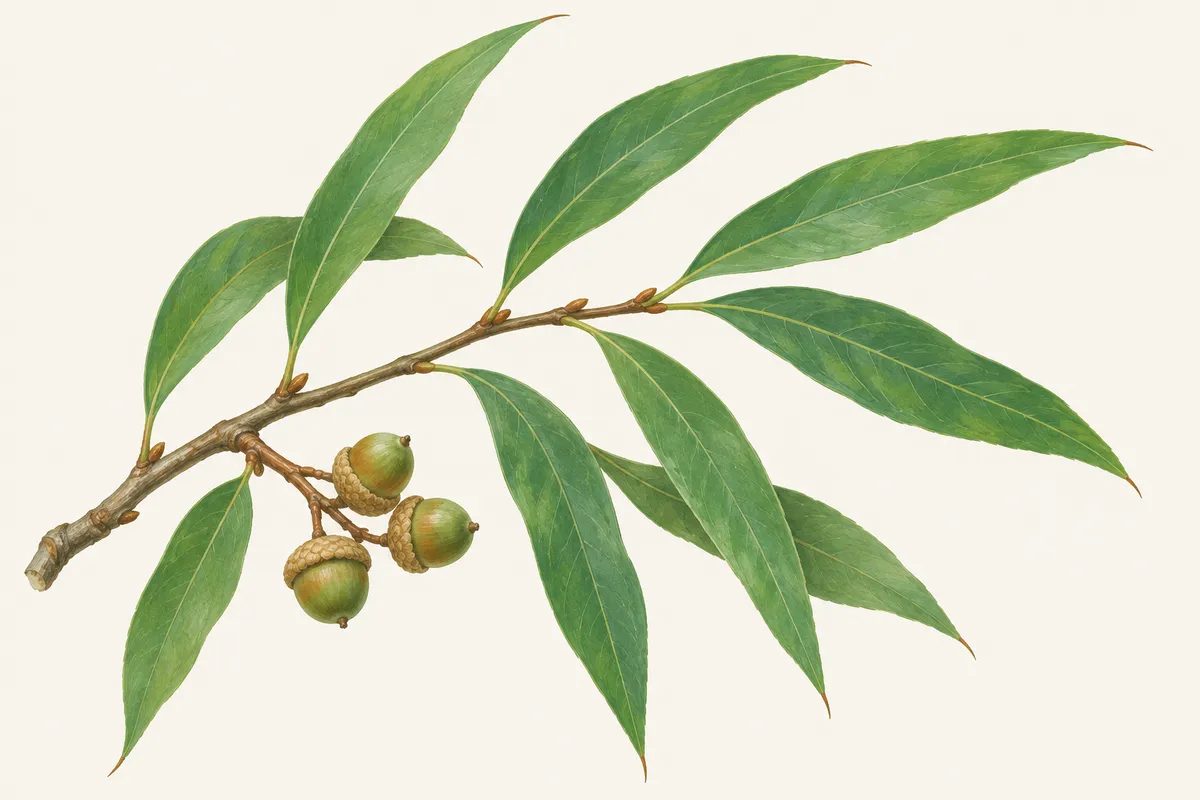
In short
Willow oak tree identification comes down to a willow-like leaf on an oak: narrow, 2 to 5 inches long and usually under an inch wide, with a smooth edge and a small bristle at the tip. Willow oak bears tiny, nearly round acorns 1/4 to 1/2 inch across under a thin saucer cap, and carries a cluster of small, sharp buds at each twig tip.
- Smooth edge plus a bristle at the tip means willow oak; a finely toothed edge means a true willow.
- Acorns are tiny, 1/4 to 1/2 inch across, and take two seasons to ripen.
- Water oak and laurel oak leaves are wider; measure the widest point before deciding.
Field marks at a glance
- Scientific name
- Quercus phellos
- Family
- Fagaceae (beech family)
- Type
- Broadleaf, deciduous
- Leaves
- Alternate, simple, linear to lanceolate, 2 to 5 inches long (Virginia Tech; NC State gives 3 to 6 inches) and under about 1 inch wide, edges entire, with a bristle at the tip.
- Leaf color
- Shiny light green above, paler below; fall color yellowish orange-brown to red-brown, not showy (NC State).
- Acorns
- Very small, 1/4 to 1/2 inch across, nearly round, yellow-green turning tan; thin saucer-like cap covering about a quarter of the nut; ripen August to October of the second year.
- Twigs and buds
- Twigs slender, hairless, olive-brown when young; several very small, sharp, reddish-brown buds clustered at the tip.
- Bark
- Smooth, gray and tight on young stems; older bark darker, with irregular rough ridges and furrows.
- Size and form
- Medium to large: 40 to 75 ft in cultivation (NC State), up to 80 to 120 ft in the wild (Forest Service); dense oblong crown, and lower branches do not readily drop off.
- Flowers
- Slender yellow-green male catkins and tiny female flowers in the leaf angles, February to May, about a week before the leaves open (Forest Service).
- Range
- Coastal Plain bottomlands from New Jersey and southeastern Pennsylvania to Georgia and northern Florida, west to eastern Texas, north in the Mississippi Valley to Oklahoma, Missouri, Illinois, Kentucky and Tennessee.
Willow oak looks like a willow until you see the acorns. Its leaves are long, narrow and smooth-edged, it grows along southern streams and is a common planted street tree, and many people never notice it is an oak at all. Quercus phellos is a member of the red oak group, and the USDA Forest Service also lists the names peach oak and, confusingly, pin oak.
How to identify a willow oak
1. The leaf. The Virginia Tech willow oak fact sheet describes alternate, simple leaves 2 to 5 inches long, linear to lanceolate and "willow-like", with an entire (smooth) edge and a bristle tip. NC State Extension gives about 1 inch wide or less, shiny light green above and paler beneath, with smooth or slightly wavy edges.
2. The bristle. Look at the very tip of the leaf: a tiny hair-like point, the bristle that marks the red oak group. It is the quickest way to tell willow oak from a real willow, whose leaves are finely toothed.
3. The twig tip. Willow oak twigs are slender, hairless and olive-brown when young, ending in several very small, sharp, reddish-brown buds. A cluster of buds at the tip is an oak mark; a willow has no true end bud.
4. The acorns. Very small, 1/4 to 1/2 inch across and nearly round, yellow-green turning tan, under a thin saucer cap with fine hairy scales covering only about a quarter of the acorn (Virginia Tech). The USDA Forest Service Silvics of North America gives 10 to 15 millimeters long and about as wide, borne singly or in pairs, maturing between August and October of the second year after flowering.
5. Bark and form. Young stems are smooth, gray and tight; older bark turns darker, with irregular rough ridges and furrows. Open-grown trees form a dense oblong crown, and Virginia Tech notes that the lower branches do not readily self-prune.
Tree Identifier can name a willow oak from one photo of a leaf or twig, which helps when the tree is a street tree with leaves well overhead. Follow up by checking the leaf width and the acorn, because the app shows one name and no list of look-alikes.
Willow oak vs willow
Willow oak is the classic willow mimic, and the willow page covers the true willows in detail. Three checks settle it in seconds:
- Leaf edge. Willow oak: smooth, with a bristle at the tip. Willow: finely toothed.
- Buds. Willow oak: a cluster of several tiny, sharp buds at the twig tip. Willow: each bud covered by a single cap-like scale, and no true end bud.
- Fruit. Willow oak: acorns, often on the ground under the tree. Willow: small capsules on catkins that release cottony seeds in late spring or summer, never acorns.
Willow oak vs water, laurel and shingle oak
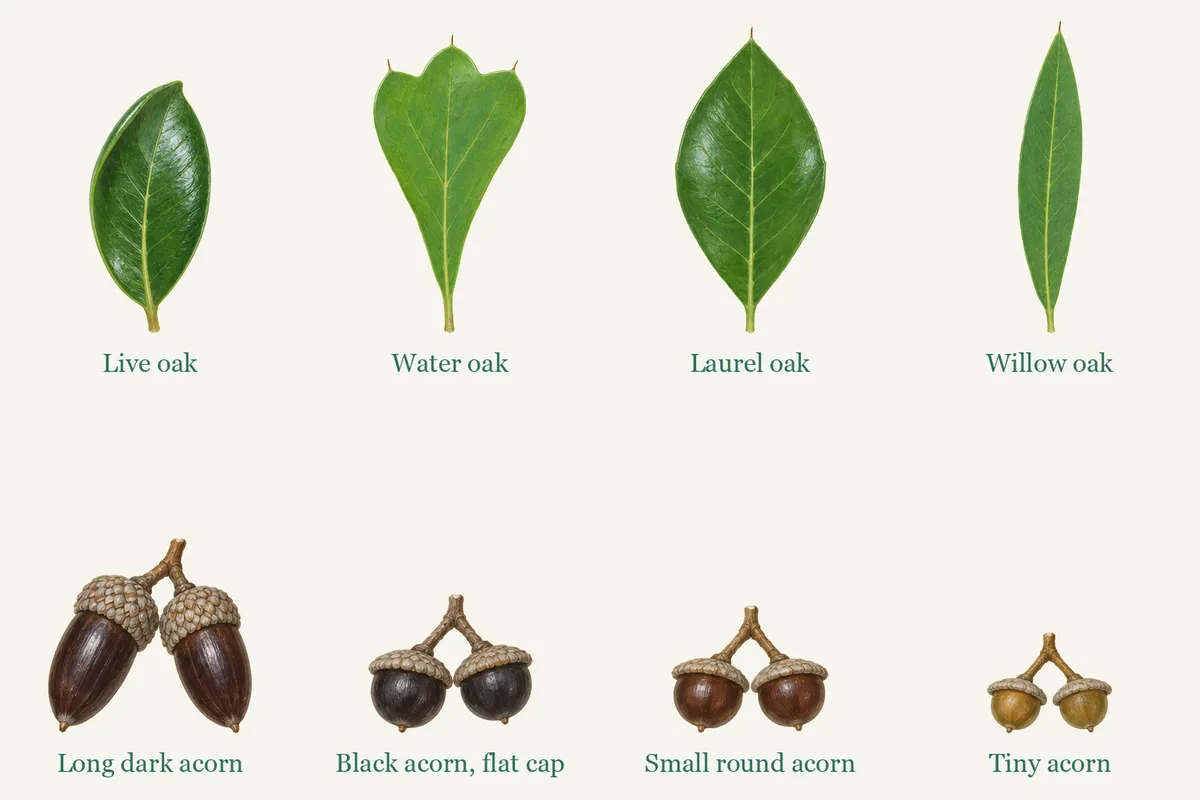
Virginia Tech lists water oak, laurel oak, shingle oak and Darlington oak as willow oak's look-alikes. All are red oaks with mostly unlobed leaves. Measure the widest point of a few leaves.
| Mark | Willow oak | Water oak | Laurel oak | Shingle oak |
|---|---|---|---|---|
| Leaf length | 2–5 in | 2–4 in | 3–5 in | 3–7 in |
| Shape | Narrow, even width | Spoon-shaped, widest near the tip, 0–5 lobes | Widest near the middle, 1–1 1/2 in wide | Broadly lanceolate |
| Underside | Paler | Hairless except vein tufts | Pale, smooth | Fuzzy |
| Acorn | 1/4–1/2 in across, cap about 1/4 | About 1/2 in, nearly black, cap about 1/3 | 1/2–2/3 in, dark brown, shallow cap | About 5/8 in, cap 1/3–1/2 |
Figures come from the Virginia Tech fact sheets for water oak, laurel oak and shingle oak. Water oak is the commonest mix-up in the South, and the hybrid between the two, Q. × capesii, sits between them; the water oak page shows the spoon-shaped leaf in detail.
Despite the shared nickname, willow oak is easy to tell from the true pin oak (Quercus palustris): pin oak leaves are deeply cut into 5 to 9 bristle-tipped lobes. The pin oak page has the full profile.
Where willow oak grows
The Forest Service range covers mainly Coastal Plain bottomlands from New Jersey and southeastern Pennsylvania south to Georgia and northern Florida, west to eastern Texas, and north through the Mississippi Valley to Oklahoma, Arkansas, Missouri, Illinois, Kentucky and Tennessee. It grows on moist alluvial soils, usually along watercourses, does best on clay loam ridges of new alluvium and is rarely found on upland sites in the wild.
Planted trees are another matter. NC State recommends it as a shade tree for streets, parks, golf courses and large yards, rates it for USDA zones 5a through 9b, and notes that in North Carolina it grows in all regions. A willow oak on a dry city street outside the Coastal Plain is very likely planted.
Size, flowers and seasons
NC State gives a planted size of 40 to 75 feet tall and 25 to 50 feet wide, with a possible 100 feet. The Forest Service gives 80 to 120 feet in the wild, with trunks commonly up to about 39 inches across, and notes the species for its "rapid growth and long life".
Willow oak flowers from February to May, about a week before the leaves open: slender, yellow-green, hairy male catkins and tiny female flowers at the leaf bases (Forest Service). Leaves turn yellowish orange-brown to red-brown in fall without much show (NC State). In winter, the clusters of tiny sharp buds and the small acorns on the ground are the best clues; the acorn identification guide helps with acorns alone.
The oak identification page puts willow oak in context with the other common US oaks, and, with location turned on, Tree Identifier's Tree Map pins a street tree you want to check again when the acorns drop.
Look-alikes and how to tell them apart
Willows (Salix)
Willow leaves are finely toothed, and a willow bud is covered by a single cap-like scale with no cluster of buds at the twig tip. Willow oak leaves have a smooth edge and a bristle tip, the twig ends in several small buds, and the tree bears acorns.
Water oak (Quercus nigra)
Water oak leaves are 2 to 4 inches long and usually widen toward the tip like a spoon, often with 3 shallow lobes. Its acorns are about 1/2 inch long and nearly black under a flat cap, darker than willow oak's yellow-green to tan acorns.
Laurel oak (Quercus laurifolia)
Laurel oak leaves are widest near the middle, 3 to 5 inches long and 1 to 1 1/2 inches wide, thick, shiny and persistent into winter. Willow oak leaves are thinner, narrower and fall in autumn.
Shingle oak (Quercus imbricaria)
Shingle oak leaves are longer, 3 to 7 inches, broadly lanceolate and fuzzy underneath. Its acorn is about 5/8 inch long with a cap covering a third to half of the nut, deeper than willow oak's thin saucer over a quarter.
What a photo can't settle
- The Forest Service lists eight hybrids of willow oak, with water, black, bear, northern red, southern red, Shumard, blackjack and pin oak; hybrid leaves can be wider or lobed.
- Young sprouts and shade leaves can be wider than typical; measure several leaves from the outer crown.
- A photo app gives one name for a leaf shape shared by willow, water, laurel and shingle oak. Tree Identifier shows no list of alternatives, so check the leaf width and the acorn yourself.
Questions people ask
Is a willow oak a willow or an oak?
An oak. Willow oak (Quercus phellos) is a red oak with willow-shaped leaves. It bears acorns, has a cluster of buds at each twig tip and a small bristle at the end of each leaf, none of which a true willow has.
How big are willow oak acorns?
Tiny. Virginia Tech gives 1/4 to 1/2 inch across, nearly round, under a thin saucer cap covering about a quarter of the nut; the Forest Service gives 10 to 15 millimeters long. They take two growing seasons to ripen, maturing between August and October.
Does willow oak have good fall color?
Not much. NC State Extension describes it as yellowish orange-brown to red-brown and not showy. Willow oak is planted for its fine texture and shade rather than its autumn display.
Is willow oak toxic?
NC State Extension lists willow oak as toxic to horses. Never eat acorns or any wild plant on the strength of a web page or an app.
Sources
- Willow oak (Quercus phellos) fact sheet — Virginia Tech Dendrology
- Willow Oak, Silvics of North America — USDA Forest Service
- Quercus phellos (willow oak) — North Carolina Extension Gardener Plant Toolbox, NC State University
- Water oak (Quercus nigra) fact sheet — Virginia Tech Dendrology
- Laurel oak (Quercus laurifolia) fact sheet — Virginia Tech Dendrology
- Shingle oak (Quercus imbricaria) fact sheet — Virginia Tech Dendrology