Regional guide
Florida tree identification, from the Panhandle to the Keys
North Florida grows southern pines and oaks, the center adds scrub and cypress ponds, and the south turns tropical. Work out where you are, then check leaves, bark and roots.
In short
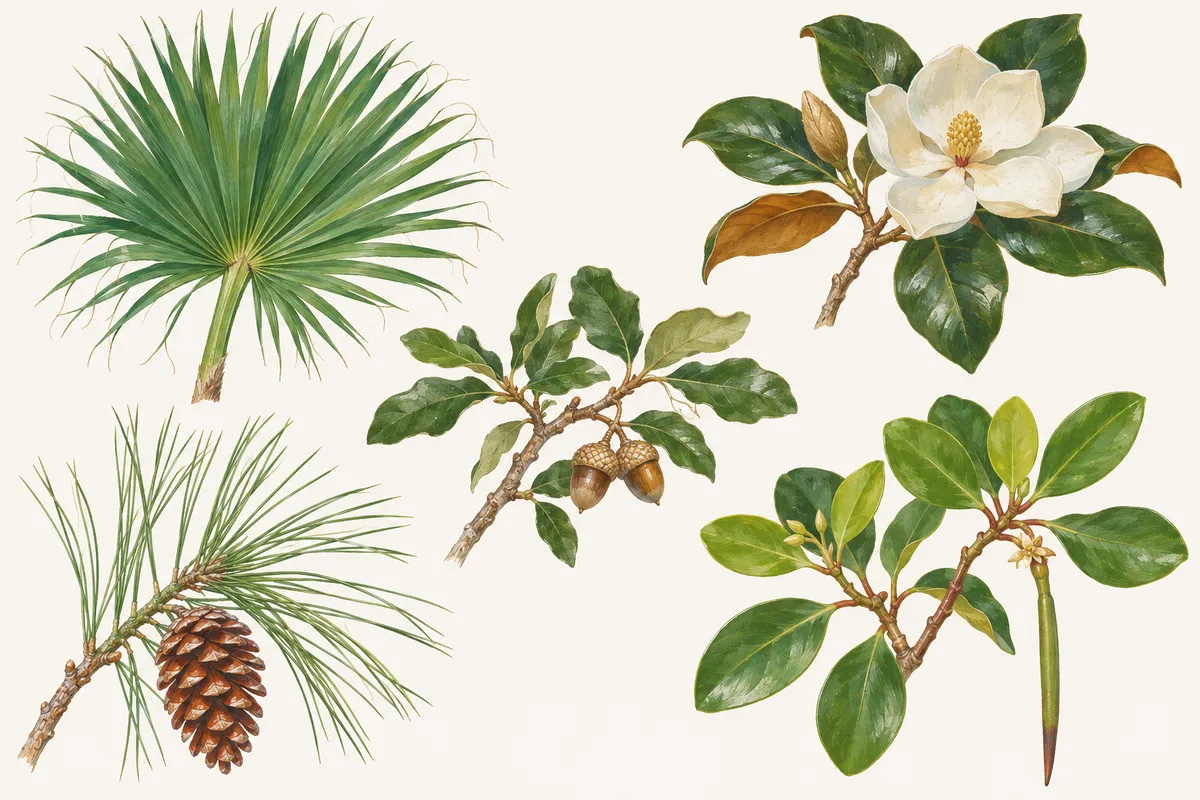
Florida tree identification starts with latitude. In North Florida, count pine needles and check oak leaves: turkey oak has bristle-tipped lobes, laurel oak smooth narrow leaves. In Central Florida scrub, sand pine carries two short needles and closed cones. In South Florida, peeling copper bark means gumbo limbo, and arching prop roots at the shore mean red mangrove. The fan palm everywhere is the sabal palm, the state tree.
- The longleaf-slash pine group covers 34% of Florida's timberland, the largest forest type, ahead of oak-gum-cypress at 20% (USDA Forest Service, Forests of Florida, 2015).
- Florida counted about 108 million cabbage palms on timberland in 2015, up 25% since 1980.
- Red mangrove stands on tangled prop roots; black mangrove sends up finger-like roots from the mud around its base (Virginia Tech Dendrology).
Florida's trees change as you drive south. The USDA Forest Service splits the state into four inventory units, Northwest, Northeast, Central and South, and its Forests of Florida, 2015 report counts 17.16 million acres of forest land. Pine forest types cover the most ground; tropical hardwoods grow mostly in the Central and South units. North Florida shares its pines, live oak, magnolia and swamp trees with the rest of the region, covered in southern tree identification; this page adds the trees that make Florida different.
The Florida trees to learn first
| Tree | Where in Florida | The feature that settles it |
|---|---|---|
| Sabal (cabbage) palm | Statewide | Curved fan leaves on stalks 3 to 6 ft; trunk 10 to 16 in thick |
| Slash pine | Pine flatwoods | Two or three needles per bundle, 5 to 11 in; cones 3 to 6 in |
| Sand pine | Scrub ridges | Two needles 2 to 3 in; prickly cones that stay on the tree |
| Turkey oak | Sandhills, with longleaf pine | Deep lobes, 3 to 7, each bristle-tipped |
| Laurel oak | Woods and yards | Smooth narrow leaves 3 to 5 in, thick and persistent |
| Pond cypress | Wet ground | Short awl-like needles pressed against the twig |
| Gumbo limbo | South Florida and the Keys | Copper bark peeling to show green beneath |
| Red mangrove | Salt-water shorelines | Arching prop roots; seedlings that sprout on the tree |
By area, the Forest Service puts 34% of Florida's timberland in the longleaf-slash pine group, 20% in oak-gum-cypress, 17% in oak-hickory, 12% in loblolly-shortleaf pine and over 9% in oak-pine. The loblolly-shortleaf group is a northern one: 55% of it grows in the Northwest unit, the Panhandle.
The state tree: sabal palm
Florida Statute 15.031 names the sabal palmetto palm, "also known as the cabbage palm," as the state tree. UF/IFAS Gardening Solutions describes curved, fan-shaped leaves with blades 3 to 4 feet long on leaf stalks 3 to 6 feet long, a trunk 10 to 16 inches thick and up to 40 feet tall under a full, round canopy, and black fruit in late summer. It is native throughout Florida and north along the coast to North Carolina.
It is common almost everywhere: the Forest Service counted 108.34 million cabbage palms on Florida timberland in 2015, 25% more than in 1980, though fewer of them are tall. The palm page separates it from the royal, queen, coconut and fan palms planted in Florida towns.
North Florida: pines, sandhills and oaks
The Panhandle and the north share longleaf, loblolly and slash pine and live oak with Georgia and Alabama. Two trees are worth adding.
- Turkey oak (Quercus laevis): leaves 4 to 8 inches long with 3 to 7 bristle-tipped lobes, mostly 3 or 5, cut more than halfway to the midrib; acorns about 1 inch long with a thin cap covering about a third of the nut; large, fuzzy, sharp-pointed reddish-brown buds; very rough, deeply furrowed bark. A small tree, 20 to 30 feet, with a short trunk (Virginia Tech Dendrology). It grows on dry sand, often under longleaf pine; blackjack oak and southern red oak are its look-alikes.
- Laurel oak (Quercus laurifolia): leaves 3 to 5 inches long and 1 to 1 1/2 inches wide, smooth-edged (now and then shallowly lobed), widest near the middle, thick, shiny and persistent; small, nearly round acorns 1/2 to 2/3 inch long; a straight trunk to about 60 feet (Virginia Tech Dendrology). Water oak, willow oak and Darlington oak look similar; the laurel oak page sorts them out.
Slash pine, the other big pine of the flatwoods, has two or three needles per bundle, 5 to 11 inches long, and cones 3 to 6 inches (NC State Extension); the slash pine page adds South Florida slash pine, the variety of the southern peninsula and the Keys. Live oak has thick leaves 2 to 5 inches long, pale with gray hairs underneath; NC State Extension notes it is not a true evergreen but keeps its leaves until the new ones come out.
Central Florida: scrub and cypress ponds
In Florida scrub, on dry, deep sand, one pine stands out.
- Sand pine (Pinus clausa): needles in bundles of two, only 2 to 3 inches long, yellow-green and slightly twisted; cones 2 to 3 1/2 inches long, each scale with a short, stout prickle, often in clusters that stay closed and attached to the tree; thin, reddish-brown bark. It is a small, scrubby tree of 20 to 40 feet with a bushy crown (Virginia Tech Dendrology). Slash pine, by contrast, has needles 5 to 11 inches long.
Florida's second cypress is pond cypress (Taxodium ascendens). Its leaves are awl-like, about 3/8 inch long and held close against the twig, so shoots look like green cords, while baldcypress has flat needles in two rows like a feather. Cones are round, 3/4 to 1 inch across, and the bark is fibrous and shreddy. Virginia Tech calls it generally smaller than baldcypress (Virginia Tech Dendrology). The bald cypress page covers knees and swamp habitat.
South Florida: tropical trees and mangroves
South Florida adds tropical trees that also grow in the West Indies. The Forest Service maps most of the tropical hardwood forest type in the Central and South units.
- Gumbo limbo (Bursera simaruba): the bark settles it, orange-brown and peeling to show olive green beneath, with a smell of turpentine. Leaves are pinnately compound, 8 to 12 inches long, with 7 to 9 shiny leaflets; small red fruit about 1/2 inch long hang in clusters. It grows up to 60 feet with a round crown and large limbs (Virginia Tech Dendrology). The Forest Products Laboratory calls it common in southern Florida, the West Indies, southern Mexico, Central America and northern South America.
At the shore, three unrelated trees share the name mangrove. Red and black mangrove both have opposite, leathery evergreen leaves, so look at the roots and the leaf stalk first.
| Mangrove | Roots and form | Leaf | Fruit |
|---|---|---|---|
| Red (Rhizophora mangle) | Tangled, arching prop roots from trunk and branches | 1 to 5 in, shiny green above, paler below | Egg-shaped, 1 to 1 1/2 in, often sprouting on the tree |
| Black (Avicennia germinans) | Many finger-like roots poking up from the mud around the tree | 2 to 5 in, silvery-hairy below, often salt-crusted on top | Egg-shaped capsule 1 to 2 in |
| White (Laguncularia racemosa) | Low, sprawling tree to 50 ft, often with a crooked trunk | Reddish leaf stalk with salt glands at the base of the blade | Ribbed, vase-shaped, 1/2 in, in clusters |
Details come from the Virginia Tech fact sheets for red, black and white mangrove, which list buttonwood and pond apple as further look-alikes.
Brazilian peppertree and other invaders
Florida's worst tree invaders look like natives at first. Brazilian peppertree (Schinus terebinthifolia) grows throughout the peninsula: evergreen compound leaves with 5 to 9 narrow leaflets, and small fruit that turns red, pink or dark brown-red from November to January. UF/IFAS lists it as nonnative, on the Florida Noxious Weed List and a Florida Invasive Species Council Category 1 invasive. Chinese tallow is another; the invasive trees guide covers both and how to tell them from native look-alikes.
Never eat a berry, fruit or seed on the strength of a web page or an app; check with a local expert.
Using a photo in Florida
Florida trees grow fast and are often planted far from home, so a photo of a single leaf may point to a tree from another continent. Photograph the feature that settles it: the bark of a gumbo limbo, the roots of a mangrove, a pine cone with a needle bundle on your palm for scale. Tree Identifier names a tree from one photo, and its follow-up chat can answer "red or black mangrove?". It shows no confidence score, so check the answer against the tables above. The app's Collection includes the cabbage palm, live oak and baldcypress; finds outside it are kept under Wild Discoveries, and, with location turned on, the Tree Map pins where each tree grew.
What a photo can't settle
- Florida yards and streets are full of planted palms and tropical trees from other continents, such as royal, queen and coconut palms, that a list of native forest trees does not cover.
- Pond cypress and baldcypress grade into each other, and some botanists treat pond cypress as a variety; a photo of one shoot may not settle which you have.
- Mangrove seedlings and shrubby black and white mangroves at the northern edge of their range can be hard to separate without roots or leaf stalks in the photo.
Questions people ask
What is the state tree of Florida?
The sabal palm, also called the cabbage palm or cabbage palmetto, named by Florida Statute 15.031 as a tree native to Florida; UF/IFAS dates the designation to 1953. Look for curved fan leaves with blades 3 to 4 feet long on stalks 3 to 6 feet long, a trunk 10 to 16 inches thick and black fruit in late summer.
What is the most common tree in Florida?
Pines dominate the forests. The USDA Forest Service's Forests of Florida, 2015 puts the longleaf-slash pine group on 5.25 million acres, 34% of Florida's timberland. Among palms, it counted about 108 million cabbage palms on timberland in 2015, up from 87 million in 1980.
How do I identify Florida oaks?
Start with the leaf edge. Turkey oak has deep lobes, 3 to 7 per leaf, each ending in a bristle, on dry sandhills. Laurel oak has smooth-edged leaves 3 to 5 inches long, widest near the middle, thick and persistent. Live oak has thick leaves 2 to 5 inches long, pale with gray hairs underneath, that last into winter.
How do I tell the three Florida mangroves apart?
Look at the roots, then the leaf. Red mangrove stands on tangled, arching prop roots. Black mangrove has finger-like roots poking up from the mud and leaves that are silvery-hairy below, often salty on top. White mangrove is a low, sprawling tree whose reddish leaf stalk carries salt glands at the base of the blade.
What Florida tree has red berries in winter?
Across the peninsula, often Brazilian peppertree, an invasive from South America. UF/IFAS describes leaves divided into 5 to 9 leaflets and small fruit that turns red from November to January. It is on Florida's Noxious Weed List. Native hollies also carry red berries in winter but have simple leaves.
Sources
- Forests of Florida, 2015 (Resource Update FS-137) — USDA Forest Service, Southern Research Station, with the Florida Forest Service
- Florida Statutes 15.031: State tree — The Florida Senate
- Sabal Palmetto — UF/IFAS Gardening Solutions
- Fact sheets: sand pine, turkey oak, laurel oak, pondcypress, gumbo-limbo, red, black and white mangrove — Virginia Tech Dendrology
- Pinus elliottii (Slash Pine) — NC State Extension Gardener Plant Toolbox
- Bursera simaruba, Gumbo-Limbo: Wood Technical Fact Sheet — USDA Forest Service, Forest Products Laboratory
- Quercus virginiana (Live Oak) — NC State Extension Gardener Plant Toolbox
- Schinus terebinthifolia (Brazilian peppertree) — UF/IFAS Center for Aquatic and Invasive Plants
Keep reading
- Regional guideSouthern tree identification for the Southeast US
- Tree profilePalm trees (Arecaceae): how to identify them
- Tree profileLive oak (Quercus virginiana): how to identify it
- Tree profileBald cypress (Taxodium distichum): how to identify it
- Field guideInvasive tree identification, one field test per tree