Tree profile
Slash pine (Pinus elliottii): how to identify it
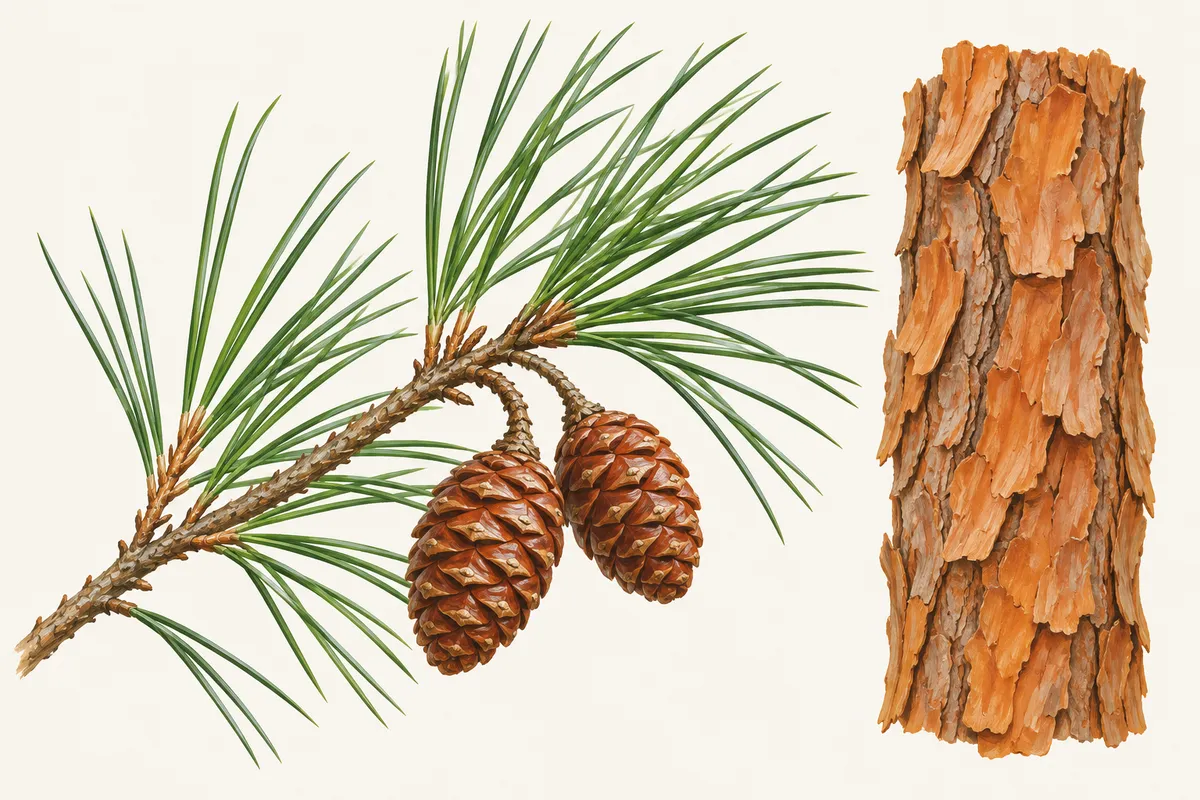
A long-needled southern pine whose cone gives it away: glossy, caramel-brown, on a short stalk, with a small spine curving outward from each scale.
In short
Slash pine identification depends on the needles and above all the cone. The needles are dark green, flexible, 7 to 10 inches long, usually three per bundle and sometimes two, tufted at the branch ends. The cones are 3 to 6 inches, glossy and caramel-colored, borne on a short stalk, with a small outward-curving spine on each scale. Older bark forms large plates that flake in thin, papery layers.
- A glossy, caramel-colored cone on a short stalk means slash pine; loblolly cones are dull red-brown and sit directly on the branch.
- Slash needles, 7 to 10 inches, overlap both loblolly (6 to 9) and longleaf (8 to 18), so needle length alone rarely settles it.
- South Florida slash pine, a variety of the southern peninsula and the Keys, has needles mostly in twos and seedlings with a grass stage like longleaf.
Field marks at a glance
- Scientific name
- Pinus elliottii
- Family
- Pinaceae (pine family)
- Type
- Conifer, evergreen
- Needles
- 3 per bundle, sometimes 2, 7 to 10 inches long, flexible, dark green, with a long sheath that stays on (Virginia Tech); NC State gives 5 to 11 inches, dark blue-green, 2 to 3 per bundle.
- Cones
- 3 to 6 inches, ovoid, glossy caramel to light reddish brown, on a short stalk, thin scales each with a small spine curving outward.
- Cone timing
- Cones mature in September, about 20 months after pollination; most seed falls in October (USDA Forest Service).
- Twigs and buds
- Twigs stout and orange-brown; South Florida slash pine has whitish bud scales (USDA Forest Service).
- Bark
- Red-brown and furrowed when young, then very platy; thin, loose scales flake off to show light brown to cinnamon bark beneath.
- Form
- Medium-sized tree that can exceed 100 ft, with a narrowly oval crown and needles in tufts at the branch ends.
- Native range
- The smallest native range of the four major southern pines: Georgetown County, South Carolina, south to central Florida and west to Tangipahoa Parish, Louisiana.
- Habitat
- Best on pond margins and drainages with ample but not excessive moisture; poor on deep, dry sandhills and on waterlogged savanna soils (USDA Forest Service).
Slash pine (Pinus elliottii) is the long-needled pine of wet flatwoods and pond edges in the lower Southeast. It shares the woods with loblolly and longleaf pine, and its needles overlap both in length, so the needles alone are a weak clue. The cone is not: glossy, caramel-colored and hung on a short stalk, it looks unlike any other southern pine cone.
How to identify a slash pine
Start on the ground: in a pine stand, fallen cones and needle bundles are easier to study than the crown.
1. Pick up a cone. Virginia Tech's slash pine fact sheet describes ovoid cones 3 to 6 inches long, caramel-colored, borne on a stalk, with a small spine on each scale that curves outward. NC State's Plant Toolbox adds that they are glossy brown or light reddish brown with thin scales and fine prickles. The gloss and the stalk are the two details to check; hold a loblolly cone next to it and the difference is plain.
2. Count and measure the needles. Usually three per bundle, sometimes two, 7 to 10 inches long, flexible and dark green, with a long sheath that stays on (Virginia Tech). NC State gives a wider span, 5 to 11 inches, in bundles of two to three. Count ten bundles: a mix of threes and twos fits slash pine.
3. Look at the branch ends. Slash needles are clustered in tufts at the ends of stout, orange-brown twigs, a detail Virginia Tech notes for slash and longleaf pine alike.
4. Read the bark. Young bark is red-brown and furrowed; older bark becomes very platy, and thin, loose scales flake off to show light brown to cinnamon bark underneath (Virginia Tech).
Tree Identifier can name a pine from one photo of a fallen cone and a needle bundle side by side. Slash pine is not among the 138 species in the app's Collection, and the app shows no confidence score or list of alternatives, so check the cone's gloss and stalk yourself.
Slash vs loblolly and longleaf pine
All three carry long needles in threes and grow together across the lower Coastal Plain. The cone separates them fastest.
| Pine | Needles | Cone | Bud and seedling |
|---|---|---|---|
| Slash | 3 or 2, 7–10 in, dark green, tufted | 3–6 in, on a stalk, glossy caramel, small outcurved spine | Typical variety: no grass stage |
| Loblolly | 3 (usually), 6–9 in, yellow-green | 3–6 in, stalkless, red-brown, short stout spine | Narrow, light reddish brown buds |
| Longleaf | 3, 8–18 in, feathery tufts | 6–10 in, curved prickle, the largest in the East | Large silvery-white buds; years in a grass stage |
Figures from Virginia Tech's fact sheets for slash pine, loblolly pine and longleaf pine.
Loblolly is the one people confuse most with slash. Its cones are dull red-brown and sit directly on the branch, its spines are stout and triangular, and its needles are paler, yellow-green. The loblolly pine page covers it and shortleaf pine in detail.
Longleaf has the longest needles of any southern pine and cones up to 10 inches. Its thick twigs end in big, silvery-white buds, a test that works even in winter. See the longleaf pine page for its grass stage and fire ecology.
South Florida slash pine
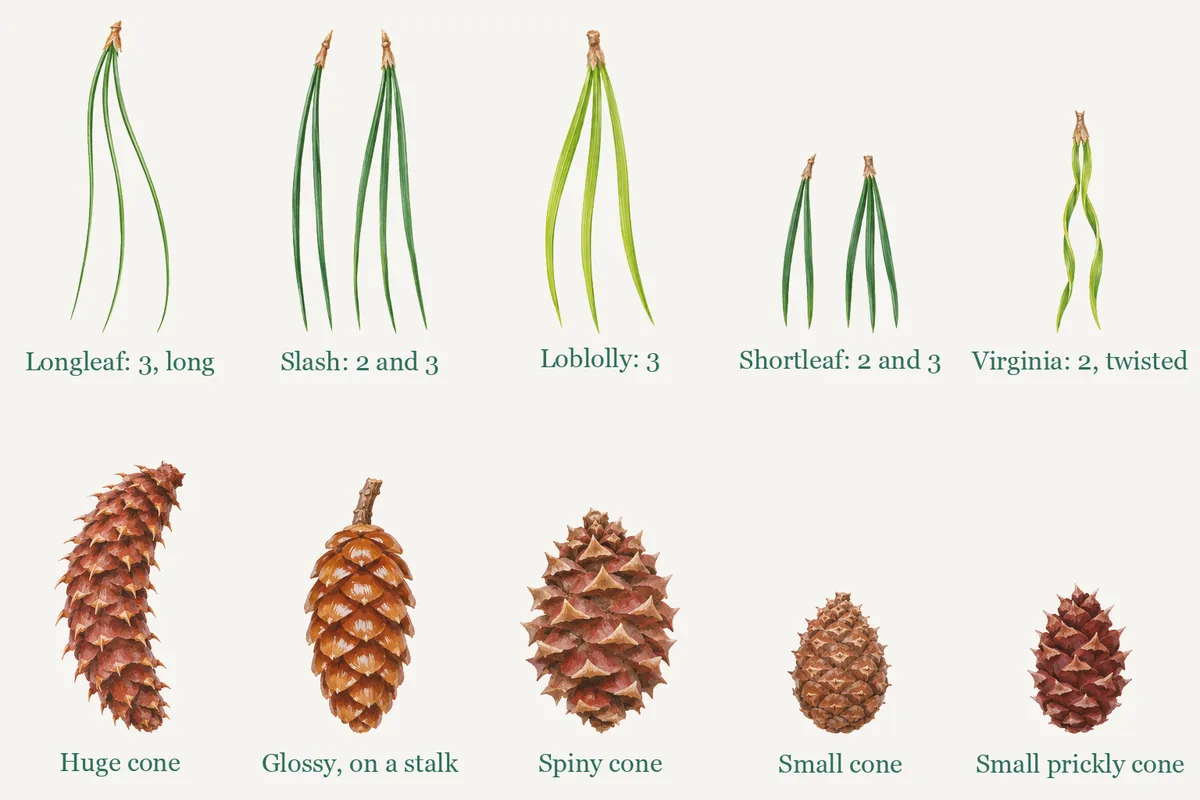
The USDA Forest Service's Silvics of North America recognizes two varieties. Typical slash pine (var. elliottii) is the one you meet across most of the range. South Florida slash pine (var. densa) grows naturally only in the southern half of the Florida peninsula and the Keys, on about 300,000 acres, and differs in ways you can see:
- needles in twos, rarely threes, long but shorter than longleaf's;
- seedlings with a grass stage and a thick taproot, like longleaf;
- cones about 20 percent smaller than typical slash cones;
- whitish bud scales and an irregular crown on mature trees;
- thicker bark on seedlings and saplings, which makes them more fire resistant than the typical variety.
Where the two varieties meet, the Forest Service describes a transition zone where they cross naturally. A South Florida slash seedling in its grass stage can pass for a young longleaf; the location and, later, the needle count tell them apart. The Florida tree identification guide places both among the other pines and palms of the state.
Where slash pine grows, and when its cones ripen
Slash pine has the smallest native range of the four major southern pines, according to the Forest Service: from Georgetown County, South Carolina, south to central Florida and west to Tangipahoa Parish, Louisiana. Georgia holds 45 percent of the present growing stock. It grows best on pond margins and drainages where the soil is moist but well aerated, and poorly on deep, dry sands and on the waterlogged savanna soils foresters call crawfish flats. The climate there brings about 50 inches of rain a year and a 250-day growing season.
It grows fast. The Forest Service reports dominant trees averaging about 64 feet at 20 years on good sites in Louisiana and Mississippi. Cones mature in September, about 20 months after pollination, and natural seed fall comes mainly in October. Slash pine has been crossed by hand with longleaf, loblolly, shortleaf, pitch and Caribbean pine, but the Forest Service says differences in flowering time usually prevent natural hybrids, apart from crosses between its own two varieties.
Look-alikes and how to tell them apart
Loblolly pine (Pinus taeda)
Loblolly needles are 6 to 9 inches and yellow-green rather than dark green, and its cones are dull red-brown, stalkless, with a short, stout spine on each scale. A glossy, stalked, caramel cone means slash.
Longleaf pine (Pinus palustris)
Longleaf needles are longer, 8 to 18 inches, its cones larger, 6 to 10 inches with a curved prickle, and its buds large and silvery-white. Seedlings sit for years in a grassy tuft; typical slash pine seedlings do not.
South Florida slash pine (Pinus elliottii var. densa)
The same species, but its needles grow in twos, rarely threes, its cones are about 20 percent smaller, its crown is irregular and its seedlings pass through a grass stage. It grows naturally only in the southern half of the Florida peninsula and the Keys.
What a photo can't settle
- Slash needles overlap loblolly and longleaf in length, and the cones are often high up; without a fallen cone, a photo of the foliage rarely settles which southern pine it is.
- Where the typical and South Florida varieties meet, the USDA Forest Service describes a transition zone of intermediate trees; an app names the species, not the variety.
- Slash pine has been planted far outside its native range across the South, so location is weak evidence.
Questions people ask
How do you identify a slash pine?
Find a cone: slash pine cones are 3 to 6 inches, glossy and caramel-colored, on a short stalk, with a small spine curving outward from each scale. The needles are dark green, 7 to 10 inches, in threes or twos, tufted at the branch ends, and older bark flakes in thin layers over cinnamon-colored patches.
What is the difference between slash pine and loblolly pine?
The cone is the clearest test. Virginia Tech describes slash cones as stalked, glossy and caramel-colored, and loblolly cones as stalkless and red-brown with a short spine. Slash needles are dark green, 7 to 10 inches; loblolly needles are yellow-green, 6 to 9 inches, almost always in threes.
How do I tell slash pine from longleaf pine?
Longleaf has longer needles, 8 to 18 inches, larger cones, 6 to 10 inches, and big silvery-white buds at the branch tips. Slash cones stop at about 6 inches and are glossy and stalked. Young longleaf spends years as a grassy tuft at ground level; typical slash pine seedlings grow upward from the start.
Where does slash pine grow naturally?
From Georgetown County, South Carolina, south to central Florida and west to Tangipahoa Parish, Louisiana, the smallest native range of the four major southern pines, according to the USDA Forest Service. It has been planted widely beyond that range, and Georgia holds 45 percent of the growing stock.
What does slash pine bark look like?
Young bark is red-brown and furrowed. With age it becomes very platy, and Virginia Tech describes thin, loose scales that flake off to reveal light brown to cinnamon bark beneath. NC State describes irregular, scaly, flaking blocks on older trees.
Sources
- Slash pine fact sheet — Virginia Tech Dendrology
- Slash Pine (Pinus elliottii), Silvics of North America — USDA Forest Service
- Pinus elliottii (slash pine) — North Carolina Extension Gardener Plant Toolbox, NC State University
- Loblolly pine fact sheet — Virginia Tech Dendrology
- Longleaf pine fact sheet — Virginia Tech Dendrology
Keep reading
- Tree profilePines (Pinus): how to identify a pine tree
- Tree profileLoblolly pine (Pinus taeda): how to identify it
- Tree profileLongleaf pine (Pinus palustris): how to identify it
- Regional guideFlorida tree identification, from the Panhandle to the Keys
- Regional guideSouthern tree identification for the Southeast US