Tree profile
Longleaf pine (Pinus palustris): how to identify it
The longest needles and the biggest cones of any eastern pine, large silvery-white buds, and a seedling that spends years looking like a clump of grass.
In short
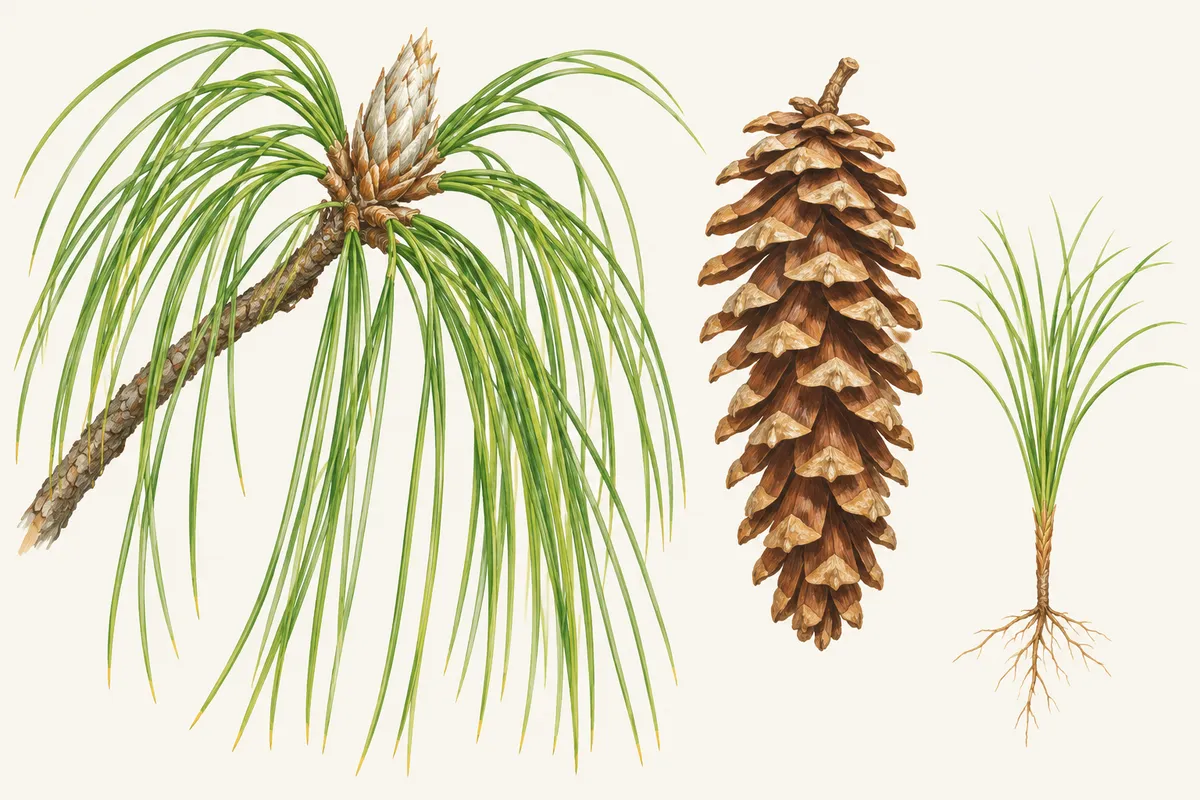
Longleaf pine identification is easiest of all the southern pines: the needles grow three per bundle and are 8 to 18 inches long, gathered in feathery tufts at the branch ends; the cones are 6 to 10 inches, the largest in the eastern United States, with a curved prickle on each scale; and the stout twigs end in large, silvery-white buds. Young trees spend years in a grassy tuft at ground level.
- A needle longer than about 10 inches in a three-needle bundle points to longleaf; slash pine stops near 10 inches and loblolly near 9.
- Big silvery-white buds at the branch tips mark longleaf even in winter; loblolly buds are narrow and reddish brown.
- A fountain of long needles at ground level with no visible stem is a longleaf seedling in its grass stage, which can last from 2 to 15 years or more.
Field marks at a glance
- Scientific name
- Pinus palustris
- Family
- Pinaceae (pine family)
- Type
- Conifer, evergreen
- Needles
- 3 per bundle, 8 to 18 inches long (Virginia Tech; NC State gives 6 to 12 inches), flexible, bright to dark green, tufted at the branch ends.
- Cones
- 6 to 10 inches (Virginia Tech; the USDA Forest Service gives 4 to 10, NC State up to 15), red-brown, ovoid to conical, a curved prickle on each scale; the largest cones in the eastern US.
- Cone timing
- Mature in September or October of their second year, turning from bright green to brown (USDA Forest Service).
- Buds
- Large, egg-shaped and silvery-white at the tips of stout, gray-brown twigs; new shoots (candles) 3 to 15 inches long in spring (NC State).
- Bark
- Scaly, orange-brown to gray, forming flat or irregular, flaky plates with age.
- Seedlings
- A grass stage: a dense tuft of needles at ground level with almost no stem, lasting usually up to 15 years and sometimes as few as 2 (USDA Forest Service).
- Form
- Medium to large tree, 60 to 120 ft (NC State), with a straight trunk, coarse branches and an open, spreading crown.
- Native range
- Atlantic Coastal Plain from southeastern Virginia to central peninsular Florida, and the Gulf Coastal Plain from the Florida Panhandle to eastern Texas.
Longleaf pine (Pinus palustris) is the signature tree of the old Southern pine savanna, a tall, open-crowned pine standing over grass, kept clear by frequent fire. The USDA Forest Service estimates it once dominated about 74 million acres of the Southeast; by the 1990s that was down to about 3 million acres, and the current estimate is about 4.4 million. It is also the easiest southern pine to name, because nearly every part of it is the biggest of its kind.
How to identify a longleaf pine
Three measurements and one look at a branch tip.
1. Measure the needles. Virginia Tech's longleaf pine fact sheet gives needles 8 to 18 inches long, three per bundle, long and feathery, often tufted at the branch tips. NC State's Plant Toolbox gives 6 to 12 inches, flexible and bright green. Either way, a three-needle bundle longer than about 10 inches is beyond what slash or loblolly pine produces.
2. Measure a cone. Longleaf cones are 6 to 10 inches long, red-brown, ovoid to conical, with a curved prickle on each scale; Virginia Tech calls them the largest cones in the eastern United States. The sources disagree on the upper end: the USDA Forest Service gives 4 to 10 inches at maturity, NC State up to 15. A cone longer than your hand in the Southeast is almost certainly longleaf.
3. Look at the bud. The stout, gray-brown twigs end in large, egg-shaped, silvery-white buds (Virginia Tech). In spring the new shoots, which NC State calls candles, can be 3 to 15 inches long. No other southern pine has a bud like this, and it works in every season.
4. Read the bark and crown. The bark is scaly and orange-brown to gray, breaking into flat or irregular, flaky plates with age. Mature trees grow 60 to 120 feet (NC State) with a straight trunk, coarse branches and an open, spreading crown.
When the cones are 80 feet up, photograph a fallen cone next to a needle bundle. Tree Identifier can name the tree from that one photo; it gives no confidence score or list of alternatives, so check the needle length and the bud against the list above.
The grass stage: a pine that looks like a clump of grass
A young longleaf does something no other common eastern pine does. After germinating, it sits at ground level for years as a dense fountain of long needles with almost no visible stem. The USDA Forest Service's Silvics of North America explains that in this grass stage the seedling puts its resources into roots, a thickening root collar and stored carbohydrates. Height growth barely starts until the root collar reaches about 1 inch across.
How long it lasts varies: usually up to 15 years, sometimes as few as 2, and unpublished records suggest up to 24 (Forest Service); NC State gives about five years as typical. The first needles of a new seedling are short and blue-green, replaced within two months by the long green needles of the grass stage.
To tell one from a real clump of grass, look into the center of the tuft for the pine's bud, which on longleaf is silvery-white. Grass-stage seedlings are very susceptible to brown spot needle blight, caused by the fungus Lecanosticta acicola, which the Forest Service says causes early needle loss, stunting and a longer grass stage, and can kill seedlings after repeated defoliation.
South Florida slash pine seedlings also have a grass stage, so in the southern half of the Florida peninsula a needle count helps: that variety carries mostly twos, longleaf always threes. The slash pine page covers it.
Longleaf vs slash and loblolly pine
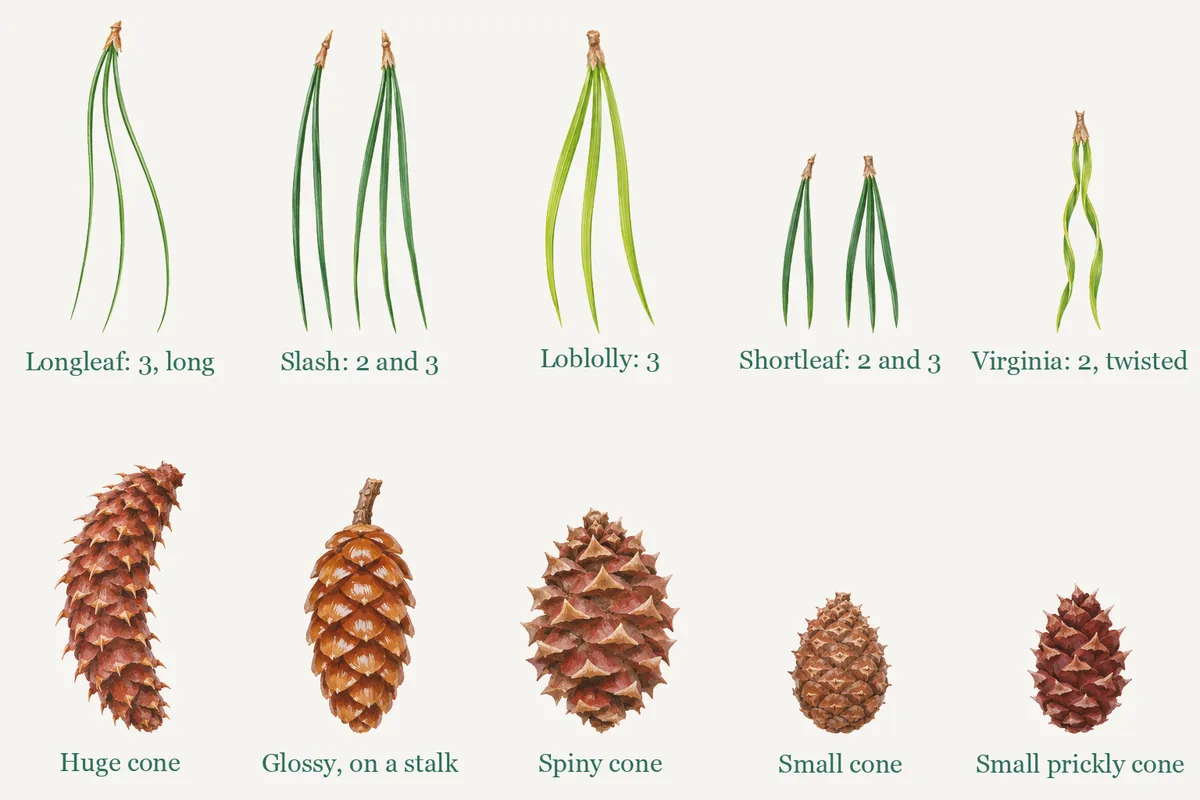
| Pine | Needles | Cone | Bud |
|---|---|---|---|
| Longleaf | 3, 8–18 in, feathery tufts | 6–10 in, curved prickle | Large, silvery-white |
| Slash | 3 or 2, 7–10 in, dark green | 3–6 in, glossy caramel, on a stalk | Not distinctive (whitish scales in South Florida) |
| Loblolly | 3, 6–9 in, yellow-green | 3–6 in, stalkless, red-brown, stout spine | Narrow, light reddish brown |
Figures from Virginia Tech's fact sheets for longleaf, slash and loblolly pine.
The Forest Service records natural crosses between longleaf and loblolly, called Sonderegger pine (Pinus × sondereggeri), but says natural hybrids with slash pine are unlikely. For loblolly in full, with shortleaf pine, see the loblolly pine page; for the whole set of eastern pines, the pine identification page.
Fire, range and the longleaf forest
Longleaf pine grows on the Atlantic Coastal Plain from southeastern Virginia to central peninsular Florida, and on the Gulf Coastal Plain from the Florida Panhandle to eastern Texas (Forest Service). NC State lists it as the state tree of North Carolina.
Its forest is built around fire. The Forest Service gives longleaf one of the most frequent fire return intervals of any forest in North America, about every 1 to 5 years, and counts its needle litter and cones among the most flammable in North America. Mature trees survive a complete scorch of the crown and regrow their foliage within 8 weeks. Grass-stage seedlings with a root collar wider than about 0.6 inch have better than even odds of surviving a burn, while burning young saplings and poles can kill 10 to 20 percent of them.
Cones take two years. Fertilized conelets are about 1 inch long and ripen in September or October of their second year, turning from bright green to brown. Crops are irregular: the Forest Service counts fair crops about every 3.6 years and good crops only about every 9.6, and most seed lands within 66 feet of the parent tree. Historical stands held trees of many ages, the oldest over 250 years. The Southeast tree identification guide sets longleaf among the oaks, magnolias and palms that share its range.
Look-alikes and how to tell them apart
Slash pine (Pinus elliottii)
Slash needles are 7 to 10 inches, in threes or twos, and its cones are 3 to 6 inches, glossy caramel-brown and on a short stalk. Longleaf cones are larger, 6 to 10 inches, and its buds are big and silvery-white.
Loblolly pine (Pinus taeda)
Loblolly needles are 6 to 9 inches and yellow-green, its cones 3 to 6 inches, stalkless and spined, and its buds narrow and light reddish brown. A cone longer than your hand and a white bud mean longleaf.
Sonderegger pine (Pinus × sondereggeri)
The natural hybrid of longleaf and loblolly pine recorded by the USDA Forest Service. A tree whose needles, cones and buds seem to sit between the two parents may be one; check several branches and fallen cones before naming it.
What a photo can't settle
- Longleaf crosses naturally with loblolly pine, producing Sonderegger pine, whose traits fall between the parents; no single photo settles a hybrid.
- Needle length varies with site: the USDA Forest Service notes shorter needles on trees in windy coastal areas, so measure several bundles.
- A grass-stage longleaf seedling can be hard to spot in a photo among real grasses; look for the silvery-white bud at the center of the tuft.
Questions people ask
How do you identify a longleaf pine?
Measure a needle and a cone. Longleaf needles grow in threes and are 8 to 18 inches long, tufted at the branch ends; its cones are 6 to 10 inches with a curved prickle on each scale. Then look at a branch tip: longleaf buds are large and silvery-white. Seedlings sit for years as a grassy tuft.
What is the grass stage of longleaf pine?
The first years of a longleaf seedling, when it builds roots and stores food instead of growing tall, looking like a dense clump of long needles at ground level. The USDA Forest Service says it lasts up to 15 years, sometimes only 2, and height growth starts once the root collar is about 1 inch across.
How do I tell longleaf pine from slash pine?
Longleaf needles are longer, 8 to 18 inches against 7 to 10, its cones bigger, 6 to 10 inches against 3 to 6, and its buds large and silvery-white. Slash cones are glossy, caramel-colored and borne on a short stalk. The USDA Forest Service says natural hybrids between the two are unlikely.
How big are longleaf pine cones?
Virginia Tech gives 6 to 10 inches and calls them the largest cones in the eastern United States. The USDA Forest Service gives 4 to 10 inches at maturity, and NC State Extension up to 15 inches. They ripen in September or October of their second year.
Why does longleaf pine need fire?
Longleaf forests have one of the most frequent fire return intervals in North America, about every 1 to 5 years, according to the USDA Forest Service. Mature trees survive a full crown scorch and regrow foliage within 8 weeks, and grass-stage seedlings with a root collar over 0.6 inch have better than even odds of surviving a burn.
Sources
- Longleaf pine fact sheet — Virginia Tech Dendrology
- Longleaf Pine (Pinus palustris), Silvics of North America — USDA Forest Service
- Pinus palustris (longleaf pine) — North Carolina Extension Gardener Plant Toolbox, NC State University
- Slash pine fact sheet — Virginia Tech Dendrology
- Loblolly pine fact sheet — Virginia Tech Dendrology