Tree profile
Loblolly pine (Pinus taeda): how to identify it
The most common pine of the South sits in the middle of every measurement: needles longer than shortleaf, shorter than longleaf, cones spinier than slash. Measure, then compare.
In short
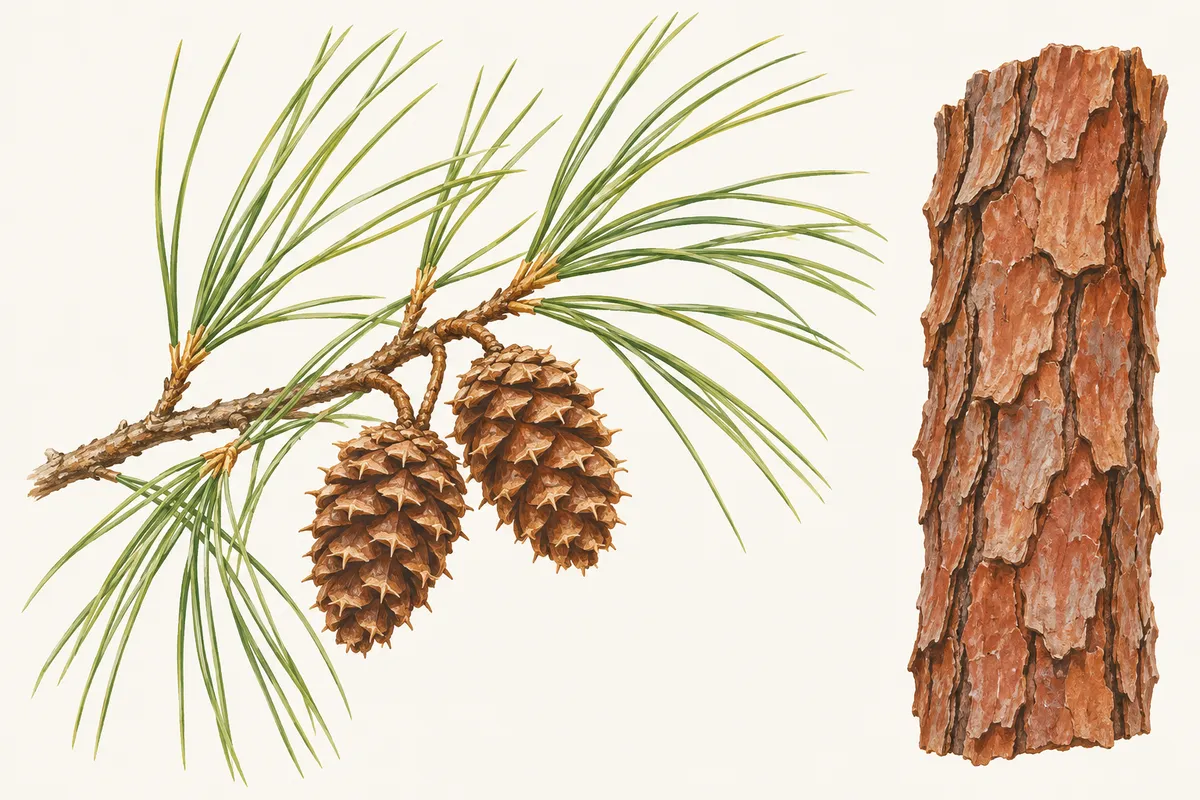
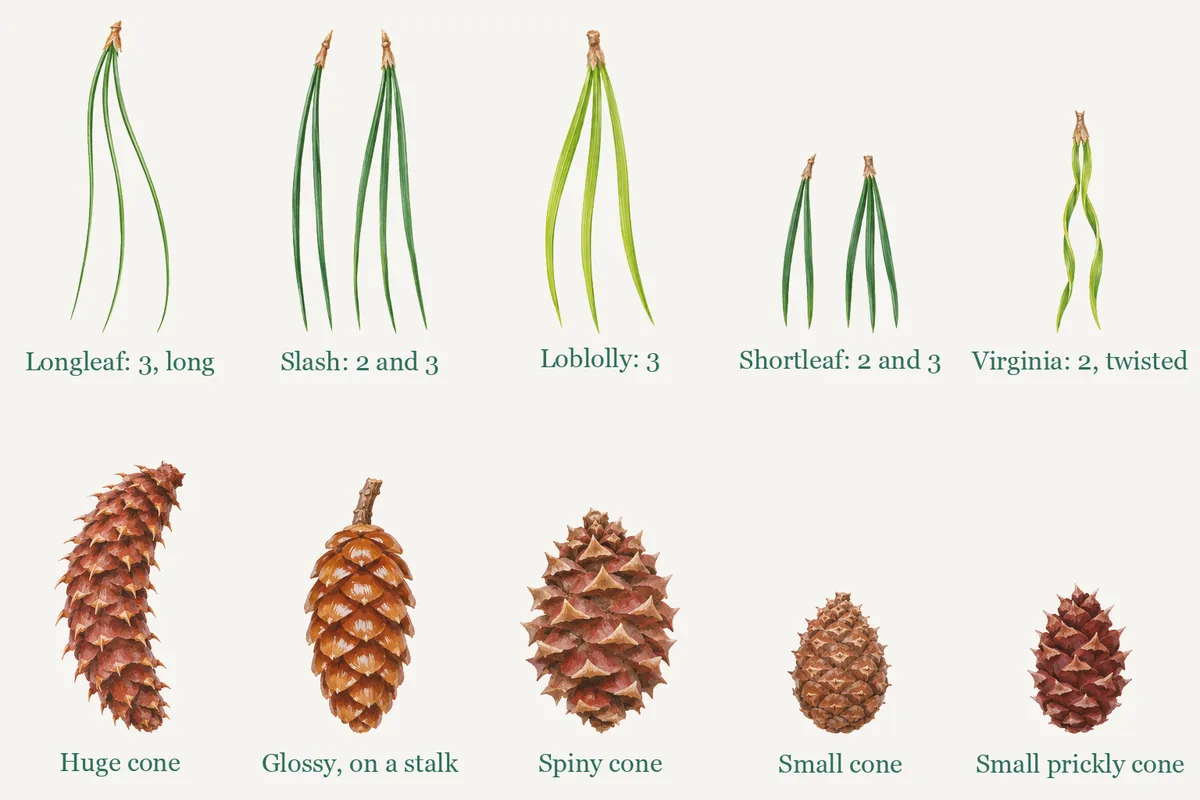
Loblolly pine identification comes down to two measurements. The needles grow usually three per bundle, yellow-green, 6 to 9 inches long, and the cones are 3 to 6 inches, red-brown, with a short, sharp spine on every scale. Shortleaf pine has shorter needles in twos and threes, slash pine glossy stalked cones, and longleaf pine needles 8 to 18 inches with silvery-white buds.
- Measure a needle: 3 to 5 inches points to shortleaf, 6 to 9 to loblolly, 8 to 18 to longleaf; slash pine (7 to 10) overlaps loblolly, so check the cone.
- Loblolly cones have a stout triangular spine on each scale that pricks your palm; slash pine cones are glossy, caramel-colored and borne on a short stalk.
- A big silvery-white bud at the branch tip means longleaf, not loblolly, whose buds are narrow and reddish brown.
Field marks at a glance
- Scientific name
- Pinus taeda
- Family
- Pinaceae (pine family)
- Type
- Conifer, evergreen
- Needles
- Usually three per bundle, yellow-green, 6 to 9 inches long (Virginia Tech); the bundle sheath stays on.
- Cones
- Egg-shaped to cylindrical, 3 to 6 inches, light red-brown, without a stalk; each scale tip carries a short, stout triangular spine.
- Cone timing
- Mature in early fall by the second October after flowering, about 26 months after the flowers form; seed falls October to early December (USDA Forest Service).
- Twigs and buds
- Orange-brown, fine to moderately stout; buds narrowly egg-shaped and light reddish brown.
- Bark
- Red- to gray-brown and scaly when young; ridged and furrowed with rounded scaly plates when older; red-brown, flat scaly plates on very old trees.
- Form
- Medium to large tree, often over 100 ft, with a straight, self-pruned trunk and an oval, somewhat open crown.
- Native range
- 14 states, from southern New Jersey south to central Florida and west to eastern Texas; absent from the Mississippi River flood plain.
- Record size
- Champion near Urania, Louisiana: 163 ft tall, 56.3 in in diameter; oldest recorded about 245 years (USDA Forest Service).
Loblolly pine (Pinus taeda) is the pine of Southern woods, old fields and timber plantations. The USDA Forest Service calls it the most commercially important forest species in the southern United States, dominating about 29 million acres and making up over half of the region's standing pine volume. On our pine identification page it is one row of a 14-pine chart; this page goes further, into the three look-alikes that grow beside it and the bud, cone and bark details that separate them.
How to identify a loblolly pine
Measure first, then turn to the cone and the bud. A ruler or tape measure helps.
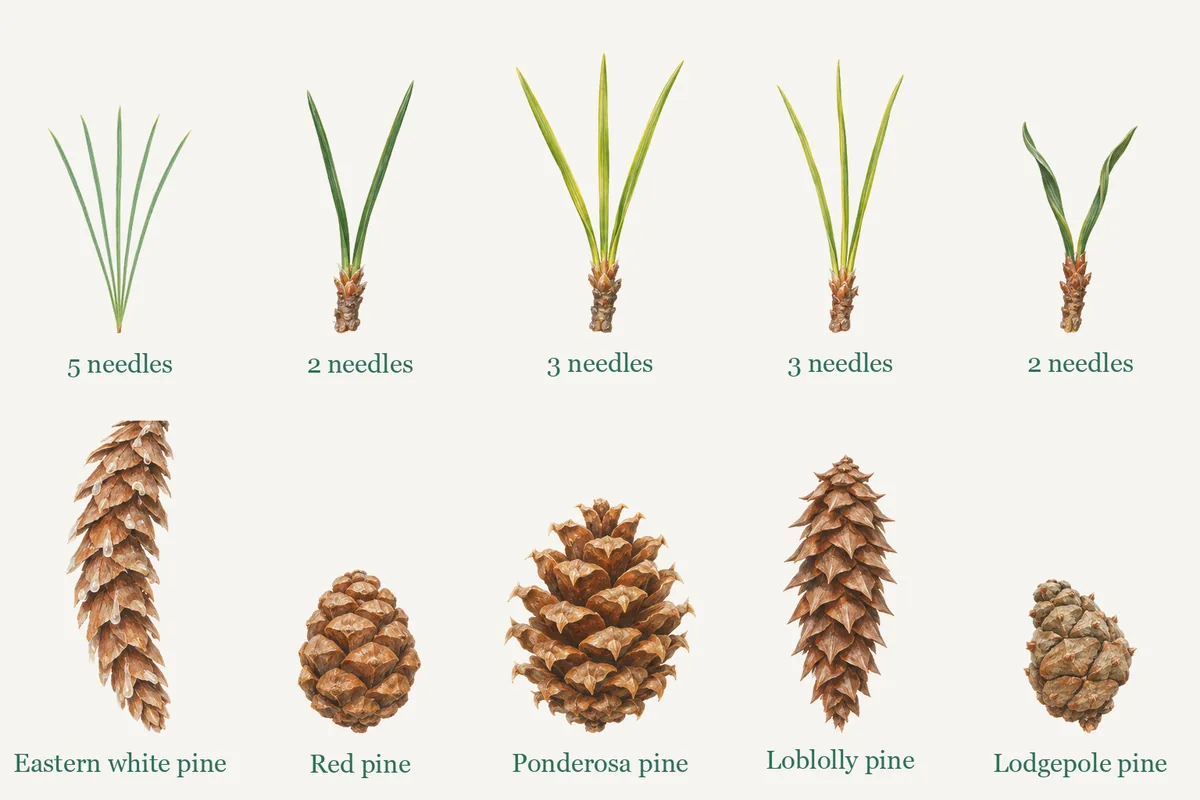
1. Count and measure the needles. Virginia Tech's loblolly pine fact sheet gives evergreen needles 6 to 9 inches long, usually three yellow-green needles per bundle. Count ten bundles from the middle of a branch: an occasional pair does not rule loblolly out, but many pairs on short needles point to shortleaf pine.
2. Pick up a cone. Loblolly cones are 3 to 6 inches long, egg-shaped to cylindrical and red-brown, and the knob at each scale tip is armed with a short spine (Virginia Tech). The USDA Forest Service's Silvics of North America describes the mature cones as light reddish brown, with a stout triangular spine on each scale. Close your hand around one: it pricks. Cones sit directly on the branch, with no stalk.
3. Look at the bud. Virginia Tech gives narrowly egg-shaped, light reddish brown buds on orange-brown twigs. This is the fast test against longleaf pine, whose large buds are silvery-white.
4. Read the bark and shape. Young trees have red- to gray-brown, scaly bark; older trees are ridged and furrowed with rounded scaly plates, and very old trees have flat, red-brown scaly plates (Virginia Tech). The trunk is straight and sheds its lower branches well, under an oval, somewhat open crown.
If the branches are too high, Tree Identifier can name a pine from one photo of a fallen bundle or cone. Loblolly is not among the 138 species in the app's Collection, and the app shows no confidence score or alternatives, so measure the needles and cone yourself and check the table below.
Loblolly vs shortleaf, slash and longleaf pine
All four grow in the Southeast, often in the same county. Needle length does most of the work, the cone settles the overlaps.
| Pine | Needles per bundle | Needle length | Cone | Bud |
|---|---|---|---|---|
| Loblolly | 3 (usually) | 6–9 in, yellow-green | 3–6 in, stalkless, red-brown, stout spine | Narrow, light reddish brown |
| Shortleaf | 2 and 3 on one branch | 3–5 in, dark yellow-green | About 2 in, egg-shaped, small prickle | — |
| Slash | 3 (sometimes 2) | 7–10 in, dark green, tufted | 3–6 in, on a stalk, glossy caramel, small outcurved spine | — |
| Longleaf | 3 | 8–18 in, dark green, feathery tufts | 6–10 in, curved prickle, the largest in the East | Large, silvery-white |
Figures from Virginia Tech's fact sheets for shortleaf, slash and longleaf pine.
Shortleaf pine is the easiest to separate: its needles are half as long, slender and flexible, and two and three share the same branch. Virginia Tech notes small resin pockets on its bark, sometimes called volcanoes, which loblolly does not show. The shortleaf pine page covers its cones, bark and fire-sprouting seedlings.
Slash pine is the hard one, because its 7 to 10 inch needles overlap loblolly's. Use the cone: Virginia Tech describes slash cones as borne on a stalk and caramel colored, with a small spine curving outward; it also notes slash bark whose thin, loose scales flake off to show light brown to cinnamon beneath. Virginia Tech also describes slash pine needles as tufted at the branch ends.
Longleaf pine has the longest needles of the four, 8 to 18 inches, and the biggest cones, 6 to 10 inches. Its silvery-white buds and thick, sturdy twigs give it away even in winter. The Southeast tree guide covers its grass stage and the other trees of the region, and the pine cone identification chart sets the four cones side by side.
Hybrids: when a pine sits between two species
The USDA Forest Service records three natural hybrids involving loblolly:
- Sonderegger pine (Pinus × sondereggeri), longleaf × loblolly, found frequently in Louisiana and east Texas.
- Loblolly × shortleaf, natural in Oklahoma and east Texas.
- Pond × loblolly, observed in North Carolina.
A tree whose needles and cones fall between the ranges in the table may be one of these. No photo, and no field test on one twig, settles a hybrid; note it as "loblolly-like" and look at several branches and cones.
Where loblolly grows, and how big
The Forest Service gives a native range of 14 states, from southern New Jersey south to central Florida and west to eastern Texas, but not in the Mississippi River flood plain. It grows up to about 500 feet on the Atlantic Plain and about 1,000 feet in the Georgia Piedmont, in a humid, warm-temperate climate with 40 to 60 inches of rain a year, and grows best on moderately acid soils with imperfect to poor surface drainage. Loblolly is also second only to red maple among the most common trees in the US.
Size and age. The champion near Urania, Louisiana, measured 163 feet tall and 56.3 inches in diameter, and the oldest recorded stand averaged 240 years, with a maximum of 245 (Forest Service). Virginia Tech describes a medium to large tree that can reach well over 100 feet.
Seasons. Cones take two growing seasons: they mature by the second October after flowering, and seed falls from October into early December. Good seed crops come every 3 to 6 years.
Look-alikes and how to tell them apart
Shortleaf pine (Pinus echinata)
Shortleaf needles are 3 to 5 inches, in bundles of two and three on the same branch, and its egg-shaped cones are only about 2 inches with a small prickle. Its bark shows tiny resin pockets that Virginia Tech calls volcanoes. Loblolly needles are 6 to 9 inches, nearly all in threes.
Slash pine (Pinus elliottii)
Slash needles overlap loblolly at 7 to 10 inches, dark green, three or sometimes two, tufted at the branch ends. Check the cone: slash cones sit on a short stalk, are glossy and caramel-colored, with a small spine curving outward. Loblolly cones are stalkless, red-brown and stoutly spined.
Longleaf pine (Pinus palustris)
Longleaf needles are 8 to 18 inches, dark green and feathery in tufts, its cones 6 to 10 inches, the largest in the eastern United States, and its large, egg-shaped buds silvery-white. Loblolly buds are narrow and reddish brown, and its cones stop at 6 inches.
What a photo can't settle
- Southern pines overlap: slash pine needles (7 to 10 in) fall inside loblolly's range, and longleaf × loblolly and shortleaf × loblolly hybrids exist, so measure a cone and several bundles, not one.
- Loblolly is widely planted, and Virginia Tech notes its range may be expanded by planting, so location helps little across the South.
- Cones are high on tall trees; without a fallen cone or a reachable branch, a photo of the crown rarely separates loblolly from slash or shortleaf pine.
Questions people ask
How do you identify a loblolly pine?
Count and measure the needles: usually three per bundle, yellow-green, 6 to 9 inches long. Then pick up a cone: 3 to 6 inches, red-brown, stalkless, with a sharp triangular spine on each scale tip. Virginia Tech Dendrology gives these figures; the USDA Forest Service describes the spines as stout.
What is the difference between loblolly and shortleaf pine?
Needle length and count. Shortleaf needles are 3 to 5 inches, in twos and threes on the same branch; loblolly needles are 6 to 9 inches, usually in threes. Shortleaf cones are about 2 inches, loblolly cones 3 to 6 inches. The two hybridize naturally in Oklahoma and east Texas, according to the USDA Forest Service.
How can I tell loblolly pine from slash pine?
Look at the cone. Virginia Tech describes slash pine cones as borne on a stalk, glossy and caramel-colored, with a small spine curving outward; loblolly cones are stalkless, red-brown and armed with a short, stout spine. Slash needles, 7 to 10 inches, are dark green and tufted at the branch ends.
How do I tell longleaf pine from loblolly pine?
Longleaf needles are 8 to 18 inches, its cones 6 to 10 inches and its buds large and silvery-white; loblolly needles reach 9 inches, its cones 6, and its buds are narrow and reddish brown. Natural longleaf × loblolly hybrids, called Sonderegger pine, occur in Louisiana and east Texas.
Where does loblolly pine grow naturally?
In 14 states, from southern New Jersey south to central Florida and west to eastern Texas, but not in the Mississippi River flood plain, according to the USDA Forest Service. It grows best on moderately acid soils with imperfect to poor surface drainage. Other common names are oldfield pine, North Carolina pine and Arkansas pine.
Sources
- Loblolly pine fact sheet — Virginia Tech Dendrology
- Loblolly Pine (Pinus taeda), Silvics of North America — USDA Forest Service
- Shortleaf pine fact sheet — Virginia Tech Dendrology
- Slash pine fact sheet — Virginia Tech Dendrology
- Longleaf pine fact sheet — Virginia Tech Dendrology
Keep reading
- Tree profilePines (Pinus): how to identify a pine tree
- Regional guideSouthern tree identification for the Southeast US
- Field guidePine cone identification: what tree a cone came from
- Data guideThe most common trees in the US, by number of trees
- Field guideConifer identification: three questions about the needles, then the cone