Tree profile
Shortleaf pine (Pinus echinata): how to identify it
The southern pine with the shortest needles after Virginia pine, and the only one that mixes bundles of two and three on the same branch. Count ten bundles, then look closely at the bark.
In short
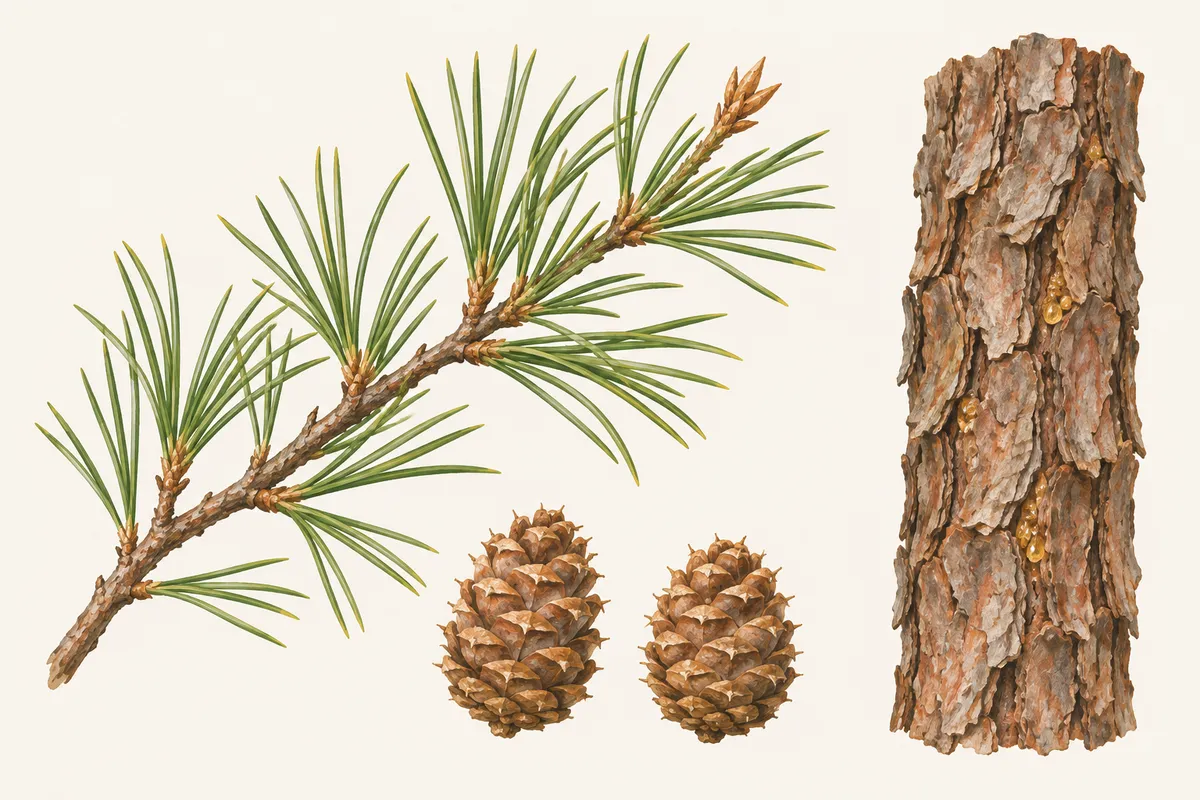
Shortleaf pine identification starts with a needle count: slender, flexible, dark yellow-green needles 3 to 5 inches long, in bundles of two and three on the same branch, with the sheath kept at the base. The cones are egg-shaped, about 2 inches, with a small prickle on each scale, and older bark forms flat, scaly plates dotted with pencil-point resin pockets.
- Bundles of two and three on one branch, with needles 3 to 5 inches long, point to shortleaf pine.
- Look for tiny resin pockets, the size of a pencil point, on the bark plates; Virginia Tech calls them volcanoes.
- Loblolly needles are 6 to 9 inches and nearly all in threes; Virginia pine needles are 1 1/2 to 3 inches and always in twos.
Field marks at a glance
- Scientific name
- Pinus echinata
- Family
- Pinaceae (pine family)
- Type
- Conifer, evergreen
- Needles
- Two and three per bundle on the same branch, slender and flexible, dark yellow-green, 3 to 5 inches long; the bundle sheath stays on (Virginia Tech).
- Cones
- Egg-shaped, about 2 inches, red to brown, with a small prickle on each scale tip; scales stay fairly flexible, and cones hang on for a while after opening.
- Cone timing
- Ripe by late summer or early fall, green to dull brown; seed falls from late October or early November, about 70% within a month (USDA Forest Service).
- Twigs
- Green and purple when young, turning red-brown.
- Bark
- Scaly and dark on young trees, then flat, scaly plates with very small, pencil-point resin pockets that Virginia Tech calls volcanoes.
- Seedlings
- A J-shaped crook forms near the ground at 2 to 3 months; buds there let young trees resprout after fire or cutting (USDA Forest Service).
- Form
- Medium to large tree, over 100 ft on good sites, with a straight, self-pruned trunk and a small, open, pyramidal crown.
- Native range
- 22 states, from New York and New Jersey west to Missouri and Texas and south to northern Florida; about 10 ft to 3,000 ft in elevation.
- Record size
- Largest known tree, in Mississippi: 138 ft tall and 41.5 in in diameter (USDA Forest Service).
Shortleaf pine (Pinus echinata) is the southern yellow pine that reaches farthest north and west: the USDA Forest Service maps it in 22 states, from New York to Texas. It shares old fields and upland forests with loblolly and Virginia pine, and the three are easy to mix up from the ground. Two features settle most cases: a needle count that mixes twos and threes on one branch, and bark speckled with tiny resin pockets. Our pine identification chart sets it beside 13 other US pines; this page goes into the details that separate it from its neighbors.
How to identify a shortleaf pine
Check these four things in order. A ruler helps.
1. Count the needles in ten bundles. Virginia Tech's shortleaf pine fact sheet describes two or three needles per bundle on the same branch, slender and flexible, dark yellow-green. Finding both counts on one branch is the strongest single clue. The papery sheath at the base of the bundle stays on.
2. Measure a needle. Shortleaf needles are 3 to 5 inches long. That is the middle of the southern range: longer than Virginia pine, about half the length of loblolly.
3. Pick up a cone. The cones are egg-shaped, about 2 inches long, red to brown, and the knob at each scale tip carries a small prickle (Virginia Tech). The scales stay fairly flexible, and old cones hang on the branches for a while. The USDA Forest Service's Silvics of North America says cones ripen by late summer or early fall, green to dull brown, and that seed starts to fall in late October or early November.
4. Look closely at the bark. Young trees have dark, scaly bark; older trees form flat, scaly plates. Virginia Tech points to very small resin pockets, the size of a pencil point, that may show on the plates and that it calls volcanoes. Look at eye level on a mature trunk, in good light.
If the needles are out of reach, Tree Identifier can name a pine from one photo of a fallen bundle or cone. Shortleaf pine is not among the 138 species in the app's Collection, and the app gives no confidence score or alternatives, so count and measure the needles yourself before you accept a name.
Shortleaf vs loblolly, Virginia and pitch pine
All four grow in the East, and their ranges overlap across the Piedmont and the Appalachian foothills.
| Pine | Needles per bundle | Needle length | Cone | Other clue |
|---|---|---|---|---|
| Shortleaf | 2 and 3 on one branch | 3–5 in, flexible | About 2 in, egg-shaped, small prickle | Pencil-point resin pockets in the bark |
| Loblolly | 3 (usually) | 6–9 in, yellow-green | 3–6 in, red-brown, short spine | Straight trunk, oval open crown |
| Virginia | 2, twisted | 1 1/2–3 in | 1 1/2–2 1/2 in, sharp needle-like prickle | Dead gray branch stubs on the trunk |
| Pitch | 3, twisted | 2 1/2–5 in | 2–4 in, short stout prickle, stays for years | Needle tufts sprouting from the trunk |
Figures from Virginia Tech's fact sheets for loblolly, Virginia and pitch pine.
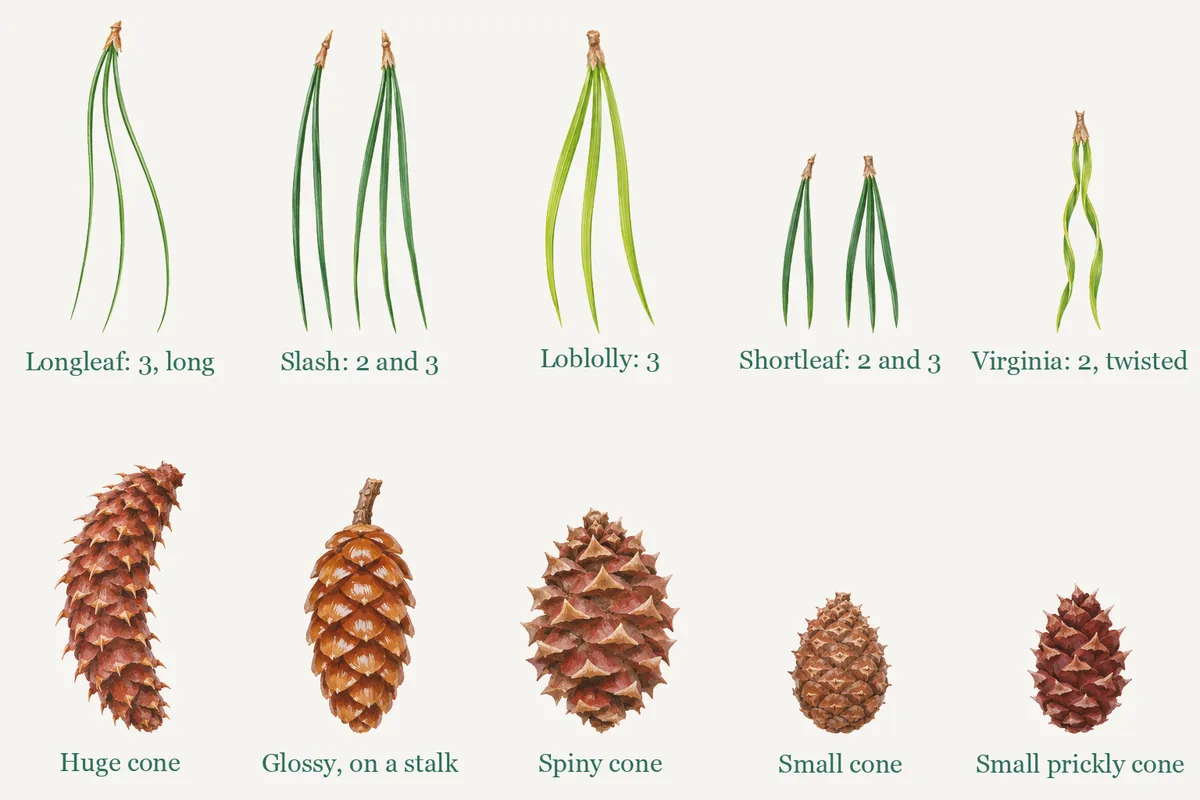
Loblolly pine is the usual confusion in the South. Its needles are much longer and nearly all in threes, and its cones are bigger and spinier. The loblolly pine page covers it in detail, with slash and longleaf pine.
Virginia pine has the shortest needles of the group, always in twisted pairs, and a cone whose prickle is sharp enough to notice. Its trunk almost always keeps dead, gray branch stubs angled upward; the Virginia pine page describes it.
Pitch pine is the third look-alike in the East. Its three twisted needles per bundle and its habit of sprouting needle tufts straight from the trunk set it apart; its cones can stay on the tree for many years.
Hybrids, fire and the J-shaped crook
The Forest Service reports that shortleaf and loblolly pine hybridize naturally, extensively west of the Mississippi River. West of the Mississippi, a tree whose needles and cones fall between the two species in the table may be a hybrid, and neither a photo nor a single twig settles that.
Shortleaf pine has an unusual way of surviving fire when young. At 2 to 3 months, a seedling forms a persistent J-shaped crook near the ground, and buds near the crook start growing if fire or cutting kills the stem above. Young trees sprout vigorously at the root collar, typically up to 6 to 8 inches in diameter (Forest Service). A burned young stand of shortleaf can therefore come back as clumps of sprouts from the base.
Where shortleaf grows, and how big
The Silvics manual gives a range of about 440,000 square miles in 22 states, from New York and New Jersey west to Missouri and Texas and south to northern Florida. It grows from about 10 feet above sea level in southern New Jersey to 3,000 feet in the Appalachians, with the best growth at 600 to 1,500 feet in the Piedmont and 150 to 1,150 feet in Louisiana and Arkansas. Annual rainfall across the range runs from about 40 inches on the western edge to 60 inches in the south. The Forest Service counts it among the four most important commercial conifers of the southeastern United States.
Size. On good sites trees reach 100 feet or more and 24 to 36 inches in diameter. The largest known tree, in Mississippi, measured 138 feet tall and 41.5 inches in diameter. Virginia Tech describes a straight, well-pruned trunk under a small, open, pyramidal crown.
Disease. Littleleaf disease is the most serious threat to shortleaf pine, on poorly drained soils from Virginia to Mississippi and south to the Gulf Coast. Symptoms usually appear in stands 30 to 50 years old (Forest Service). A thin, unhealthy crown changes the look of the tree but not the needle count or the bark, so check those before deciding.
For the rest of the region's trees, see the Southeast tree identification guide; for the cones of all the southern pines side by side, the pine cone identification chart. With location turned on, Tree Identifier's Tree Map pins the identification, so you can return to the same tree in October to check its cones.
Look-alikes and how to tell them apart
Loblolly pine (Pinus taeda)
Loblolly needles are 6 to 9 inches, usually three per bundle, and its cones are 3 to 6 inches with a short spine. Measure: a needle under 5 inches and pairs mixed with threes point to shortleaf.
Virginia pine (Pinus virginiana)
Virginia pine needles are shorter, 1 1/2 to 3 inches, twisted and always in pairs; its cones carry a sharp, needle-like prickle, and dead gray branch stubs stay on the trunk.
Pitch pine (Pinus rigida)
Pitch pine has three stiff, twisted needles per bundle, 2 1/2 to 5 inches, cones 2 to 4 inches with a short stout prickle that stay on the tree for years, and often tufts of needles sprouting straight from the trunk.
What a photo can't settle
- Shortleaf and loblolly pine hybridize, extensively west of the Mississippi River according to the USDA Forest Service; a tree with in-between needles cannot be settled from one photo.
- A single bundle can mislead: shortleaf makes both twos and threes, and loblolly sometimes makes twos. Count at least ten bundles.
- Cones and needles are often out of reach on tall trees; a photo of the crown alone rarely separates the southern pines.
Questions people ask
How do you identify a shortleaf pine?
Count several bundles: shortleaf carries both two and three needles per bundle on the same branch, 3 to 5 inches long, dark yellow-green and flexible. Then check for a small egg-shaped cone about 2 inches long with a small prickle, and bark plates with tiny resin pockets. The figures are from Virginia Tech Dendrology.
What is the difference between shortleaf and loblolly pine?
Shortleaf needles are 3 to 5 inches in twos and threes; loblolly needles are 6 to 9 inches, usually in threes. Shortleaf cones are about 2 inches, loblolly cones 3 to 6. The USDA Forest Service reports extensive natural hybrids between the two west of the Mississippi River.
Why is it called shortleaf pine?
Its needles are short for a southern yellow pine: 3 to 5 inches, against 6 to 9 for loblolly pine, according to Virginia Tech Dendrology. Another of its names in the USDA Forest Service Silvics manual, shortstraw pine, makes the same point.
Where does shortleaf pine grow?
The USDA Forest Service gives 22 states, from New York and New Jersey west to Missouri and Texas, south to northern Florida, from about 10 feet above sea level in southern New Jersey to 3,000 feet in the Appalachians.
Can shortleaf pine resprout after a fire?
Young ones can. The USDA Forest Service describes a J-shaped crook that forms near the ground in the first months, with buds that start growing if fire or cutting kills the stem above. Young trees sprout at the root collar up to about 6 to 8 inches in diameter; large trees can die in very hot fires.
Sources
- Shortleaf pine fact sheet — Virginia Tech Dendrology
- Shortleaf Pine (Pinus echinata), Silvics of North America — USDA Forest Service
- Loblolly pine fact sheet — Virginia Tech Dendrology
- Virginia pine fact sheet — Virginia Tech Dendrology
- Pitch pine fact sheet — Virginia Tech Dendrology
Keep reading
- Tree profilePines (Pinus): how to identify a pine tree
- Tree profileLoblolly pine (Pinus taeda): how to identify it
- Regional guideSouthern tree identification for the Southeast US
- Field guidePine cone identification: what tree a cone came from
- Field guideConifer identification: three questions about the needles, then the cone