Tree profile
Virginia pine (Pinus virginiana): how to identify it
A scrubby pine of old fields and roadcuts, with short twisted needles in pairs, prickly little cones that stay for years, and a trunk bristling with dead branch stubs.
In short
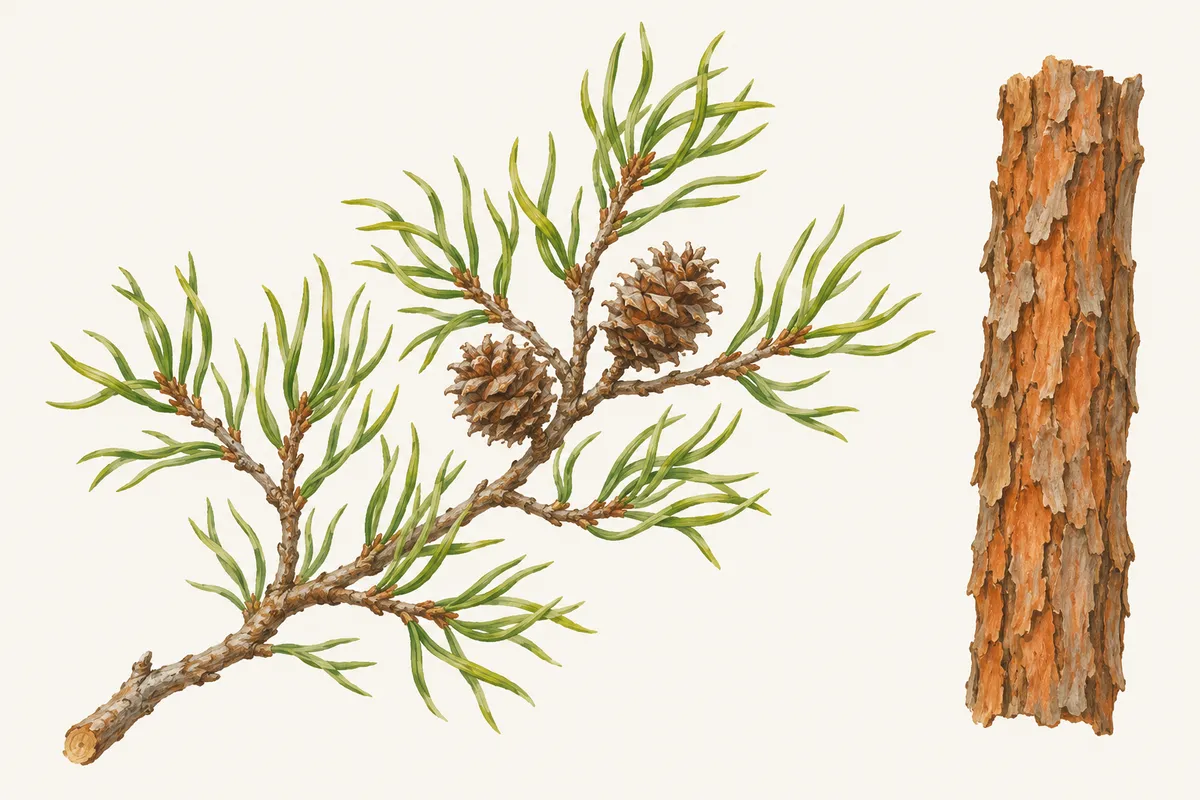
Virginia pine identification rests on three marks. Its needles grow two per bundle, 1 1/2 to 3 inches long, yellow-green and twisted. Its cones are 1 1/2 to 2 1/2 inches, stalkless, red-brown, with a sharp, needle-like prickle on every scale, and empty cones stay on the branches for years. Along the trunk, dead gray branch stubs angled upward are nearly always present.
- Two short, twisted needles per bundle, 1 1/2 to 3 inches long: the shortest-needled pine of the Southeast.
- Run a finger over a cone: each scale ends in a sharp prickle you can feel.
- Dead gray branch stubs along the trunk, angled upward, are the clue you can see from the road.
Field marks at a glance
- Scientific name
- Pinus virginiana
- Family
- Pinaceae (pine family)
- Type
- Conifer, evergreen
- Needles
- Two per bundle, 1 1/2 to 3 inches long, yellow-green, twisted and somewhat spread apart (Virginia Tech).
- Cones
- Conical to egg-shaped, 1 1/2 to 2 1/2 inches, stalkless, red-brown, each scale with a sharp, needle-like prickle; borne all over the crown.
- Cone timing
- Ripe late September to early November; seed falls mostly within 3 months. Empty cones stay for several years, up to 15 (USDA Forest Service).
- Twigs and buds
- Slender, green turning purple-green with a whitish bloom that rubs off; buds gray-brown and narrowly egg-shaped.
- Bark
- Orange-brown and scaly on young trees; thin, small scaly plates later, with cinnamon-colored patches, often on the upper trunk.
- Trunk
- Dead gray branch stubs angled upward are nearly always present along the trunk (Virginia Tech).
- Form
- Small to medium tree, up to about 70 ft (Virginia Tech), with a flat, sparse crown when mature; the record tree reached 114 ft (USDA Forest Service).
- Native range
- Central Pennsylvania southwest to northeastern Mississippi, Alabama and northern Georgia; Coastal Plain north to New Jersey and Long Island; scattered into Ohio, southern Indiana and Tennessee.
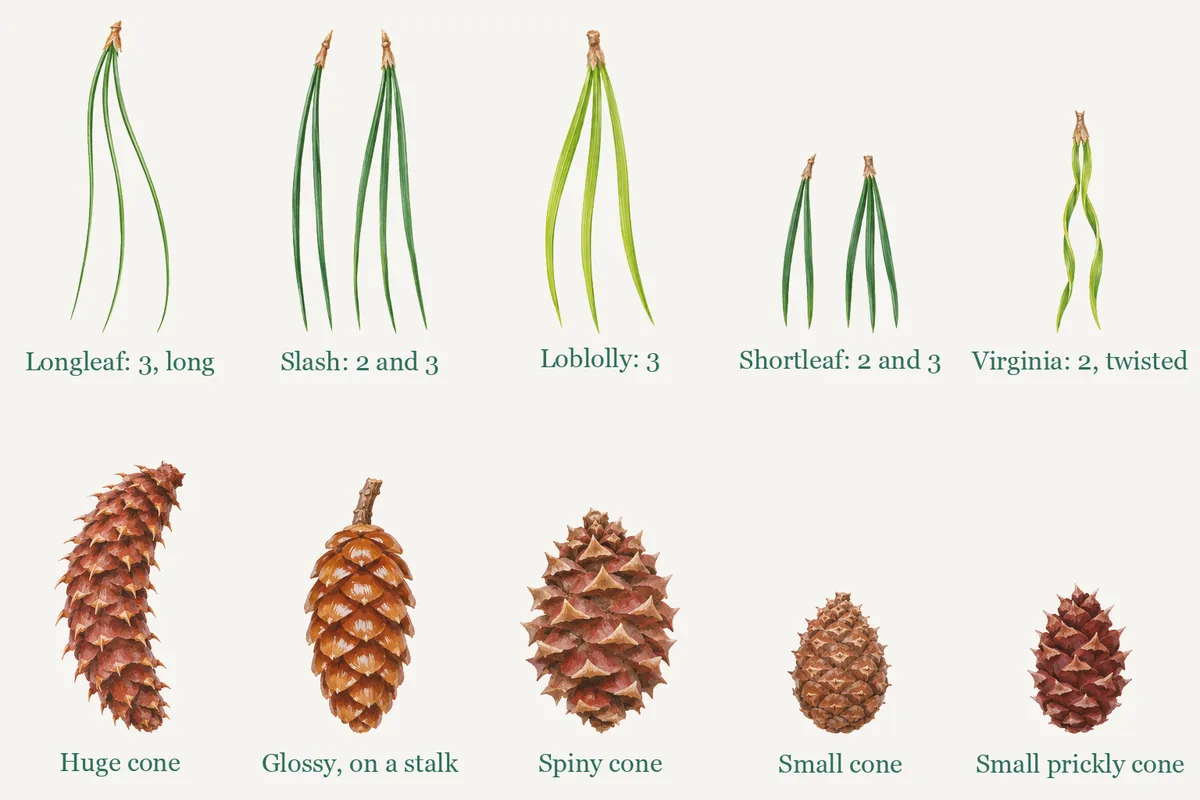
Virginia pine (Pinus virginiana) is the scrubby little pine of abandoned farms, roadcuts and dry ridges from Pennsylvania to Alabama. It has the shortest needles of the southeastern pines, cones that stay on for years, and a trunk that keeps its dead branches. It is also the South's Christmas tree. The pine identification chart shows it among 14 US pines; this page covers the marks that separate it from the pines it grows with.
How to identify a Virginia pine
Check these in order. A cone, which is easy to find under or on the tree, settles most doubts.
1. Needles: short, twisted pairs. Virginia Tech's Virginia pine fact sheet describes two yellow-green, twisted, somewhat spreading needles per bundle, 1 1/2 to 3 inches long. Count several bundles: every one should hold two.
2. Cones: small and prickly. The cones are conical to egg-shaped, 1 1/2 to 2 1/2 inches long, stalkless and red-brown, and the knob on each scale ends in a sharp, needle-like prickle. Close your hand gently around one: you will feel it. The USDA Forest Service's Silvics of North America adds that cones form in all parts of the crown, unlike many pines, and that empty cones usually stay for several years, up to 15.
3. Trunk: dead branch stubs. Virginia Tech notes dead, grayish branch stubs angled upward that are nearly always present along the trunk. On a roadside stand, this is the mark you see first: trunks bristling with gray twigs well below the live crown.
4. Twigs and bark. Young twigs are slender, green turning purple-green, with a whitish bloom that rubs off. Bark is orange-brown and scaly on young trees, later in thin, small scaly plates, with cinnamon-colored patches often on the upper trunk.
Tree Identifier can name a pine from one photo of a cone or a bundle of needles. Virginia pine is not among the 138 species in the app's Collection, and the app shows no confidence score or alternatives, so count the needles and feel the cone prickles before you trust a name.
Virginia pine vs shortleaf, Table Mountain and Scots pine
| Pine | Needles | Cone | Other clue |
|---|---|---|---|
| Virginia | 2, twisted, 1 1/2–3 in, yellow-green | 1 1/2–2 1/2 in, stalkless, sharp needle-like prickle | Dead gray branch stubs on the trunk |
| Shortleaf | 2 and 3 on one branch, 3–5 in | About 2 in, egg-shaped, small prickle | Pencil-point resin pockets in the bark |
| Table Mountain | 2, stiff and twisted, about 1.5–2.5 in | 2.5–3 in, glossy and knobby, hooked spine, in clusters of 3–4 | Dry, rocky Appalachian slopes |
| Scots | 2, stout and twisted, 1 1/2–3 in, blue-green | 1 1/2–2 1/2 in, slightly stalked, blunt spine | Orange, peeling bark in the upper crown |
Figures from Virginia Tech's shortleaf and Scotch pine fact sheets and NC State's Table Mountain pine page.
Shortleaf pine is longer-needled and mixes twos and threes; see the shortleaf pine page.
Table Mountain pine is the hardest look-alike in the mountains, because its needles match. Look at the cones: NC State describes them as stout, glossy and knobby, 2.5 to 3 inches long, in clusters of three or four, each scale ending in a hooked spine. Virginia pine cones are smaller and lighter, with a slender prickle. The Appalachian tree guide covers the other ridge-top trees.
Scots pine is a planted European tree. Its needles are blue-green rather than yellow-green, and Virginia Tech says its upper crown always shows orange, peeling bark. The Scots pine page has the details.
Old fields and Christmas trees
The Forest Service describes Virginia pine as shade-intolerant and a pioneer on old fields, burned areas and eroded land, coming in freely on abandoned farmland throughout its range. It is usually replaced by more shade-tolerant hardwoods unless fire or other disturbance intervenes. That history explains its old name, scrub pine, given when foresters treated it as a weed. In dense stands, 20-year-old trees can number up to 1,600 per acre, thinning to about 200 per acre by age 70.
Open-grown trees often bear cones by age 5, which is why even small Virginia pines in a field may carry cones. Cones ripen from late September to early November; seed starts falling in October and is mostly down within three months.
The Silvics manual also calls it the most preferred Christmas tree among the southern conifers, with marketable trees in as few as 3 years and a usual rotation of 5 to 10 years. Sheared farm trees are dense cones of foliage, nothing like the open, scraggly wild tree, but the needles and cones are the same. Our Christmas tree identification guide separates it from the firs and spruces sold beside it.
Where Virginia pine grows, and how big
The Forest Service range runs through the Piedmont and lower mountains from central Pennsylvania southwest to northeastern Mississippi, Alabama and northern Georgia, along the Atlantic Coastal Plain north to New Jersey and Long Island, and in scattered areas west into Ohio, southern Indiana and Tennessee. It grows mostly between about 50 and 2,500 feet, in a humid climate with 35 to 55 inches of rain a year. It needs moderately well to well-drained soil and is less tolerant of wet sites than pitch or loblolly pine, and it does poorly on serpentine, shallow shaly and very sandy soils.
Size. Virginia Tech describes a small to medium tree up to about 70 feet with a flat, sparse crown. On the best sites the Forest Service reports trees of about 120 feet at maturity, and the record tree measured 114 feet tall and 31.8 inches in diameter. Typical trees at age 50 average 50 to 75 feet. With location turned on, Tree Identifier's Tree Map pins the find, so you can come back in October to check the cones.
Look-alikes and how to tell them apart
Shortleaf pine (Pinus echinata)
Shortleaf needles are longer, 3 to 5 inches, and come in twos and threes on the same branch; its cones carry only a small prickle, and its bark plates show tiny resin pockets. Virginia pine needles stop at 3 inches and are always in pairs.
Table Mountain pine (Pinus pungens)
Also two twisted needles of similar length, on dry Appalachian ridges, but its cones are bigger and heavier, 2.5 to 3 inches, glossy and knobby, in clusters of three or four, with a stout hooked spine on each scale.
Scots pine (Pinus sylvestris)
A planted European pine with two stout, twisted needles 1 1/2 to 3 inches, but blue-green rather than yellow-green, cones slightly stalked with only a blunt spine, and bright orange, peeling bark in the upper crown.
What a photo can't settle
- Virginia, Table Mountain and Scots pine share short, twisted needles in pairs; without a cone or a look at the bark, a needle photo may not separate them.
- Christmas-tree farms shear Virginia pine into a dense cone, which hides the sparse, flat crown and the branch stubs of wild trees.
- Old-field stands are often crowded and stressed, so tree size and crown shape vary widely; rely on needles and cones, not form.
Questions people ask
How do you identify a Virginia pine?
Count and measure the needles: two per bundle, twisted, 1 1/2 to 3 inches long. Then check a cone for a sharp, needle-like prickle on each scale, and look at the trunk for dead gray branch stubs angled upward. All three marks are from Virginia Tech Dendrology.
What is the difference between Virginia pine and shortleaf pine?
Virginia pine needles are 1 1/2 to 3 inches and always in pairs; shortleaf needles are 3 to 5 inches, in twos and threes on the same branch. Virginia pine cones have a sharp prickle and stay on the tree for years; shortleaf cones have a small prickle and bark with tiny resin pockets.
Why is Virginia pine called scrub pine?
The USDA Forest Service lists scrub pine among its names, from a time when it was treated as a forest weed. It is a shade-intolerant pioneer that moves onto old fields, burned areas and eroded land, often in dense stands with dead branches held on the trunk.
Is Virginia pine used as a Christmas tree?
Yes. The USDA Forest Service calls it the most preferred Christmas tree of the southern conifers, with marketable trees in as few as 3 years and a usual rotation of 5 to 10 years. A cut tree with short, twisted needles in pairs is often a Virginia pine.
How long do Virginia pine cones stay on the tree?
Empty cones usually stay for several years and can remain up to 15 years, according to the USDA Forest Service. That is why many Virginia pines carry cones of several ages, open and gray, all over the crown.
Sources
- Virginia pine fact sheet — Virginia Tech Dendrology
- Virginia Pine (Pinus virginiana), Silvics of North America — USDA Forest Service
- Shortleaf pine fact sheet — Virginia Tech Dendrology
- Pinus pungens (Table Mountain pine) — North Carolina Extension Gardener Plant Toolbox, NC State University
- Scotch pine fact sheet — Virginia Tech Dendrology
Keep reading
- Tree profilePines (Pinus): how to identify a pine tree
- Tree profileShortleaf pine (Pinus echinata): how to identify it
- Tree profileScots pine (Pinus sylvestris): how to identify it
- Regional guideAppalachian tree identification, from the peaks down to the coves
- Field guideChristmas tree identification: which tree is in your living room