Tree profile
Scots pine (Pinus sylvestris): how to identify it
Britain's only native pine and the "Scotch pine" of American windbreaks and Christmas tree lots. Look up the trunk first, then at one pair of needles.
In short
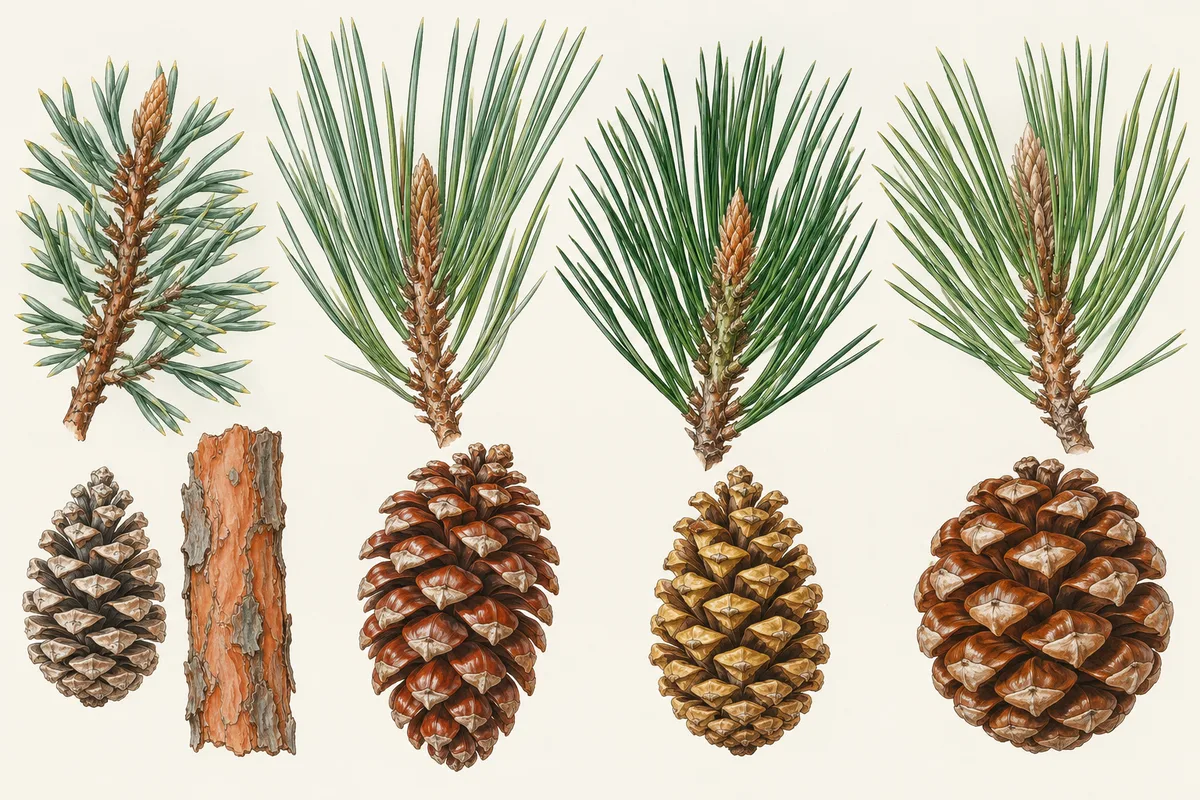
Scots pine identification starts with the bark: the upper trunk and branches are orange and flaking, while the lower trunk turns grey-brown to reddish and plated. Then check the needles, in pairs, short (about 4 to 8 cm), twisted and blue-green, and the cones, small, egg-shaped, 4 to 6 cm long and grey-brown, with a raised knob in the middle of each scale.
- Orange, peeling bark high on the trunk is the one mark no other common pine in Britain shares.
- Scots pine is the only native pine in Britain, and its natural range there is the Scottish Highlands.
- Scots pine and Scotch pine are the same tree; Americans use the second name for the planted and Christmas tree pine.
Field marks at a glance
- Scientific name
- Pinus sylvestris
- Family
- Pinaceae (pine family)
- Type
- Conifer, evergreen
- Bark
- Orange-red and papery on the upper trunk and branches; grey to reddish-brown plates up to 5 cm thick with deep fissures lower down. Virginia Tech: upper crowns always show orange peeling bark.
- Needles
- In pairs, slightly twisted, blue-green, about 5 cm (Trees for Life); 4 to 8 cm (1 1/2 to 3 in) in Virginia Tech's measure. A broken needle shows a fine white fringe of hairs (Woodland Trust).
- Cones
- Egg-shaped, 4 to 6 cm (1 1/2 to 2 1/2 in), slightly stalked, grey-brown when ripe, a raised knob in the centre of each scale with a blunt spine. Two years from flower to ripe cone.
- Flowers
- Male: clusters of yellow anthers at the base of new shoots. Female: small, red-purple and round, at the shoot tips (Woodland Trust).
- Shape
- Conical when young; old trees in the Caledonian remnants have flat or rounded tops. To 35 m in the Woodland Trust's figure; about 20 m in most Scottish remnants.
- Lifespan
- Usually 250 to 300 years in Scotland, one tree over 520 years (Trees for Life); up to 700 years according to the Woodland Trust.
- Range
- Native in Britain only in the Scottish Highlands; worldwide from Scandinavia beyond the Arctic Circle to Spain and eastern Siberia. Planted in North America.
- In the app's Collection
- Yes: Scots pine (Pinus sylvestris) is one of the 138 species in Tree Identifier's Collection.
Scots pine is the only pine native to Britain and the most widespread conifer in the northern hemisphere, from the Scottish Highlands across Europe to the Pacific coast of Asia. In North America the same tree, called Scotch pine, was brought over by settlers and is grown for windbreaks and Christmas trees. Wherever you are, three looks identify it: the orange upper trunk, a short pair of blue-green needles and a small, knobbly cone.
How to identify a Scots pine
- Look at the upper trunk. On a mature tree the bark near the crown is orange-red, thin and papery, and it flakes. Trees for Life describes the lower trunk as grey to reddish-brown, in plates up to 5 cm thick with deep fissures. Virginia Tech Dendrology puts it more bluntly: upper crowns always show orange peeling bark.
- Pull a needle pair. Needles grow two together on short side shoots, slightly twisted and blue-green. Trees for Life gives about 5 cm; Virginia Tech gives 1 1/2 to 3 inches (4 to 8 cm), stout and twisted, with distinct bands of pores. The Woodland Trust adds a detail you can test: snap a needle and the broken end shows a fine white fringe of hairs.
- Find a cone. Egg-shaped, 4 to 6 cm, slightly stalked, grey-brown when ripe. In the centre of each scale sits a raised, circular knob (Woodland Trust) with a blunt spine (Virginia Tech). The cones take two years to develop from the female flower, ripen in April and open on the tree.
- Check the shape. Young trees are conical. Old trees in the Caledonian remnants have flat or rounded tops (Trees for Life).
In late spring, the flowers help too: male flowers are clusters of yellow anthers at the base of the new shoots, female flowers small, red-purple and round at the shoot tips.
The only native pine in Britain
The Woodland Trust calls Scots pine the only truly native pine in the UK and one of three native conifers. Forest Research considers it native in the north and west of Scotland, in what are known as the Caledonian pinewoods, and calls it the only native conifer of commercial importance. The Woodland Trust gives its natural range as confined to the Highlands, so Scots pines elsewhere in Britain were planted or grew from planted trees.
Trees for Life tells the history. Scots pine spread north from continental Europe after the last Ice Age, about 10,000 years ago, reached its greatest extent about 6,000 years ago, and declined from about 4,000 years ago. The native pinewoods now cover about 17,000 hectares in scattered remnants, just over 1% of an estimated original 1,500,000 hectares. In most of those remnants the largest trees stand about 20 m; exceptional ones reach 27 m. Trees usually live 250 to 300 years in Scotland, and one in a western remnant has been dated at over 520.
The pinewoods carry wildlife found almost nowhere else in Britain: red squirrel, pine marten, capercaillie, crested tit and the Scottish crossbill, a bird endemic to the UK. The Woodland Trust counts about 1,600 species supported by Scots pine, 215 of them found only on it. For the other trees of these woods (birch, rowan, aspen, juniper), see Scottish native trees.
Scots pine vs Corsican, black and lodgepole pine
In British forests, the pine most often confused with Scots pine is Corsican pine, Pinus nigra subsp. laricio, one of the black pines. Forest Research says it was the first pine planted at scale in Britain, from 1919, suits the drier lowlands, grows at Thetford and near Ringwood in the New Forest, and is still the dominant commercial pine, although it is no longer recommended for planting because of red band needle blight. The Austrian pine fact sheet from Virginia Tech describes the black pine of American gardens.
| Pine | Needles | Cone | Bark |
|---|---|---|---|
| Scots pine | 2, 4–8 cm, stout, twisted, blue-green | 4–6 cm, egg-shaped, grey-brown, blunt spine | Orange and flaking high on the trunk |
| Black pine (Corsican, Austrian) | 2, 10–15 cm (4–6 in), dark green | 5–8 cm (2–3 in), yellow-brown, minute prickle | Brown to grey, ridged, no orange |
| Lodgepole pine | 2, 4–8 cm (1 1/2–3 in), twisted, yellow-green to green | 2.5–5 cm (1–2 in), often lopsided, short spine | Thin, grey-brown, small scales |
| Jack pine | 2, 2–4 cm (3/4–1 1/2 in), spread apart, yellow-green | 4–5 cm (1 1/2–2 in), curved, stays closed | Dark and scaly |
Black pine and lodgepole measurements are Virginia Tech's. The needle color and the upper bark settle most trees: blue-green and orange means Scots pine. For North American look-alikes, the jack pine page covers the short-needled native pine of Canada and the Great Lakes.
Scotch pine in the United States and Canada
In America, Pinus sylvestris goes by Scotch pine. The University of Illinois Extension says it was introduced into the United States by European settlers and calls it the most common Christmas tree, with stiff branches, an open look that leaves room for ornaments, and needles that hold for about four weeks and stay on even when dry. Virginia Tech notes that it is planted widely and may seed into the landscape, grows up to 90 feet, and often has a twisted or poorly formed trunk depending on seed origin.
In North America it is most often confused with other two-needle pines: red pine, Austrian pine and jack pine. The orange upper bark separates it from every one of them, and its needles are shorter than red or Austrian pine needles and longer than jack pine's. The pine identification chart lists the needle counts and lengths of 14 common US pines.
Needles turning yellow: normal shedding or disease
Yellowing needles are a common worry with Scots pine, and in autumn the tree is usually fine. Trees for Life says Scots pine keeps its needles for two to three years; the oldest turn yellow in September or October and fall. Wisconsin Extension gives about three years for Scotch pine and describes natural drop as uniform yellowing of the older, inner needles while the current season's growth stays green.
Spots or bands on current needles, or browning from the needle tips, point elsewhere. Forest Research lists red band needle blight (Dothistroma septosporum) and other needle and shoot diseases among Scots pine's problems, and the pine-tree lappet moth, found in northern Scotland west of Inverness in 2008, as a notifiable pest. A pine near a house or road that is losing needles fast is a job for an arboricultural consultant.
Scots pine is one of the 138 species in Tree Identifier's Collection. A photo of the orange upper trunk or a needle pair gives the app the most to work with, and you can ask the Tree Expert follow-up questions about the result.
Look-alikes and how to tell them apart
Corsican pine (Pinus nigra subsp. laricio)
A black pine planted in Britain's drier lowlands, at Thetford and around the New Forest. Virginia Tech gives black pine needles as much longer, 10 to 15 cm, and dark green, and its bark as brown to grey and ridged, without the orange upper trunk of Scots pine.
Austrian pine (Pinus nigra)
The black pine of American yards and windbreaks: two thick, dark green needles 4 to 6 inches long and cones 2 to 3 inches with a minute prickle. Scots pine needles are half as long and blue-green.
Lodgepole pine (Pinus contorta)
Two twisted needles of a similar length, but yellow-green to green rather than blue-green, and thin grey-brown bark with small scales; no orange upper trunk. Its cones are often lopsided and lumpy near the base.
Jack pine (Pinus banksiana)
A North American pine with even shorter needle pairs, 2 to 4 cm, spread apart and yellow-green, and curved cones that stay closed for years. Its bark is dark and scaly all the way up.
What a photo can't settle
- A photo can name a Scots pine but cannot say whether it is a native Caledonian tree or grown from imported seed; that needs records or genetic work.
- Young Scots pines have longer needles than old ones, according to the Woodland Trust, and the orange bark only develops as the tree grows, so a sapling is harder to name than a mature tree.
- Tree Identifier gives one name from one photo with no look-alike list. For pines, photograph the upper trunk and a needle pair rather than a distant crown.
Questions people ask
Is Scots pine the same as Scotch pine?
Yes. Both names mean Pinus sylvestris. Britain and Ireland say Scots pine; in the United States the same tree is usually sold and searched as Scotch pine, and the University of Illinois Extension lists it as Scots or Scotch pine. The tree is the same whether it grows in Speyside or a Christmas tree farm in Ohio.
Is Scots pine native to the UK?
Yes, and it is the only truly native pine in the UK, according to the Woodland Trust, and one of three native conifers. Forest Research considers it native in the north and west of Scotland, the Caledonian pinewoods. Its natural range is confined to the Highlands, so Scots pines in England and Wales were planted or seeded from planted trees.
How do you tell Scots pine from Corsican pine?
Look up the trunk. Scots pine turns orange and flaky near the crown; black pines such as Corsican pine have brown to grey, ridged bark. Then compare needles: Scots pine pairs are short and blue-green, while Corsican pine, a black pine, has much longer needles. Corsican pine is planted in lowland forests such as Thetford.
Why are my Scots pine needles turning yellow?
In autumn it is often normal. Trees for Life says Scots pine keeps its needles for two to three years, and the older ones turn yellow in September or October and drop. Yellowing of current needles, bands or spots, or browning from the tips points to a disease such as red band needle blight.
How big are Scots pine cones?
About 4 to 6 cm (1 1/2 to 2 1/2 inches), egg-shaped and slightly stalked, according to Virginia Tech Dendrology. They take two years to ripen, turn grey-brown, and open on the tree in spring. Each scale has a raised, circular knob in the middle.
Sources
- Scots pine (Pinus sylvestris) — Woodland Trust
- Scots pine facts — Trees for Life
- Scots pine (SP), Tree species database — Forest Research
- Corsican pine (CP), Tree species database — Forest Research
- Scots pine fact sheet — Virginia Tech Dendrology
- Austrian pine fact sheet — Virginia Tech Dendrology
- Christmas tree species — University of Illinois Extension
- Seasonal Needle Drop — Wisconsin Horticulture, UW-Madison Division of Extension
Keep reading
- Scotland field guideScottish native trees, wood by wood
- Tree profilePines (Pinus): how to identify a pine tree
- Tree profileJack pine (Pinus banksiana): how to identify it
- Field guidePine cone identification: what tree a cone came from
- Field guideNative trees of the UK: the full list with one clue for each