Scotland field guide
Scottish native trees, wood by wood
Each of Scotland's native trees grows in a recognisable kind of wood. Learn the six native woodland types and you know which trees to expect before you reach the first one.
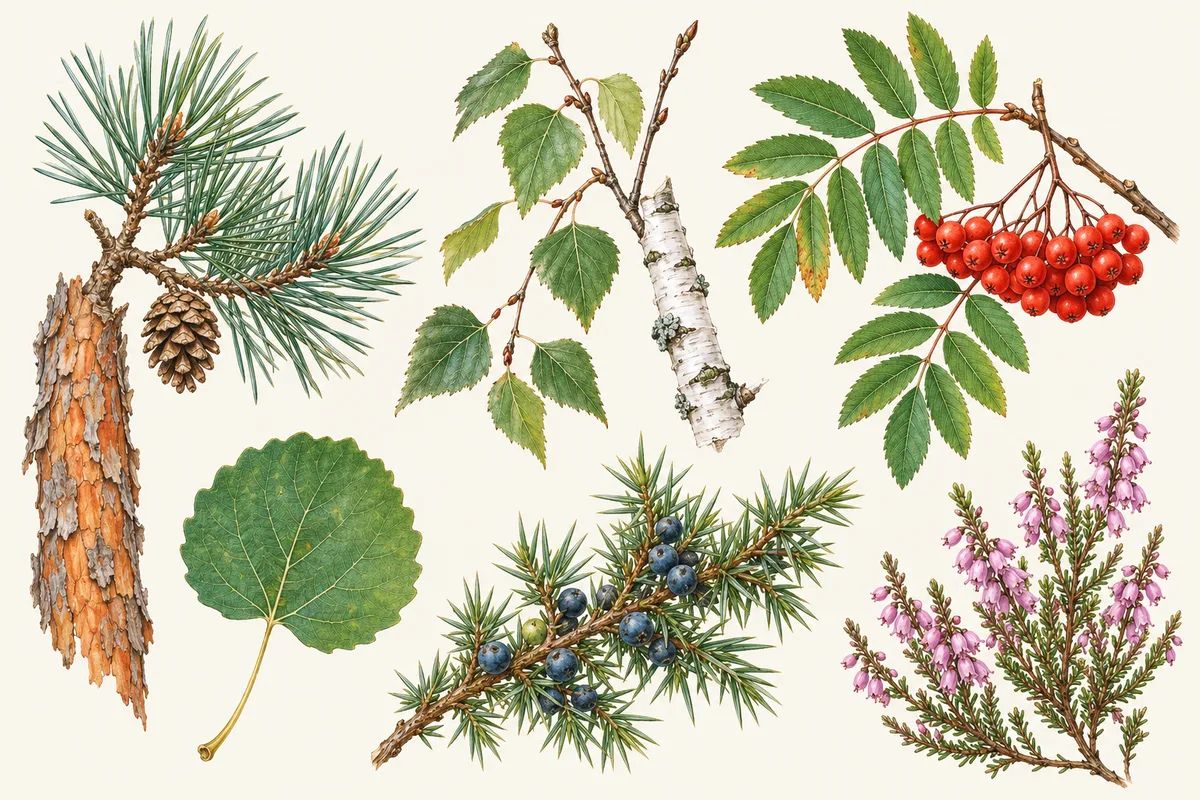
In short
Scottish native trees are the species that colonised Scotland after the last Ice Age: Scots pine, the national tree, plus oak, ash, hazel, silver and downy birch, rowan, willows, alder, aspen, gean (wild cherry), wych elm, hawthorn, holly and juniper. Wych elm is the only native elm. Beech, sycamore, Sitka spruce and larch were planted, however wild they look.
- Scots pine was voted Scotland's national tree in 2014; the Woodland Trust says its natural range in Britain is confined to the Scottish Highlands.
- The Forestry Commission recognises six native woodland types in Scotland, from upland birchwoods to wet alder and willow woods.
- Beech is native only in south-east England and south-east Wales; in Scotland it was introduced.
Scotland's native trees are a shorter list than Britain's, and they sort neatly by the kind of wood they grow in. Know the wood and you already know most of the trees in it. Never eat a berry, nut, seed or pod on the strength of a web page or an app; check with a local expert.
The native trees of Scotland, and one clue for each
The Forestry Commission's booklet Native Woodlands of Scotland (1998) names Scots pine as the best-known native tree, and among the others oak, ash, hazel, birch, rowan, willow, alder, aspen, gean (the wild cherry), wych elm, hawthorn and the shrubby juniper. They colonised Scotland after the last Ice Age, their seeds blown by the wind, carried by water or passed through birds. NatureScot adds holly among the trees of western pinewoods, and Trees for Life lists cherry and holly among the native Caledonian forest trees it supports.
| Tree | One clue | Where in Scotland | Our page |
|---|---|---|---|
| Scots pine | Blue-green needles in pairs; orange upper trunk | Caledonian pinewoods of the Highlands | Pine |
| Silver birch | White bark, black and rugged at the base | Central and eastern Highlands; underwood of lowland oakwoods | Birch |
| Downy birch | Fuzzy leaf stalks, shoots and twigs | Dominant in the north-west Highlands | Birch |
| Sessile and pedunculate oak | Stalked leaves and stalkless acorns, or the reverse | Upland oakwoods of the west, lowland woods | English vs sessile oak |
| Ash | Pinnate leaves; black buds in opposite pairs | Gullies and fertile, damp ground | Ash |
| Rowan | Pinnate leaves with toothed leaflets; orange-red berries | Highland hillsides and gorges, pinewoods | Rowan |
| Hazel | Many stems from the base; catkins from February | Understorey, Atlantic hazelwoods of the west | Hazel |
| Aspen | Round leaves with large, irregular teeth that tremble | Most common in the north-west | Poplar |
| Alder | Grows by water; rounded leaf tip; small woody cones | Wet woodland, river banks | Alder |
| Wych elm | Large, rough leaves with a lopsided base | Old trees now mostly in the north and west | Elm |
| Gean (wild cherry) | Reddish-brown bark with horizontal lines | Native mixed woods | Cherry |
| Hawthorn | Spiny twigs; lobed leaves; white May blossom | Named native by the Forestry Commission | Hawthorn |
| Holly | Prickly, glossy evergreen leaves | Western pinewoods | Holly |
| Juniper | Needles in whorls of three; usually a shrub | Scattered through pinewoods | Conifer identification |
| Willows (goat, grey, bay and others) | Catkins in spring; narrow to oval leaves | Wet woods, burnsides | Willow |
The leaf and bark clues are the Woodland Trust's, as used on our UK native trees page, which lists all 45 British natives. The Scotland column comes from the Forestry Commission, NatureScot and the Woodland Trust profiles cited below. When a tree is too tall to reach, Tree Identifier can suggest a name from one photo of the bark, a cone or a fallen leaf; Scots pine, silver birch, rowan, hazel and alder are in the app's Collection. It gives one name and no list of alternatives, so check the clue above before you settle.
The six native woodland types
The Forestry Commission recognises six main types of native woodland in Scotland. Each has a short cast of trees, so the type narrows your list fast.
- Lowland mixed broadleaved woods. Native oak predominates, sometimes with ash and wych elm; silver birch and hazel commonly grow in the underwood.
- Upland mixed ashwoods. Usually confined to gullies and fertile, damp ground; larger woods are rare, with well-known examples at Rassal in Wester Ross and Tokavaig on Skye.
- Upland oakwoods. Characteristic of the west from Galloway to Sutherland. Bluebells grow beneath the oaks in the west, wood anemones in the colder, drier east, and blaeberry is common.
- Upland birchwoods. Downy birch dominates in the north-west Highlands, where it is too cold, wet and windy for oak and pine, with rowan, sallows and hazel; silver birch woods mark the central and eastern Highlands.
- Native pinewoods. Scots pine predominates around the Cairngorms, and pinewoods mixed with birch are scattered through the Highlands. Juniper occurs here and there, and rowan is common where grazing is light.
- Wet woodlands. Alder, willow or birch on wet, poorly drained soils along river valleys and around bogs; some alder woods on slopes are the last survivors of ancient woodland in their landscape.
Caledonian pinewood and the Scots pine
Scots pine is the tree most people mean by a Scottish native. The Woodland Trust says it was voted the national tree of Scotland in 2014 and that its natural range is confined to the Highlands. NatureScot's Caledonian pinewood page calls these Scotland's only native coniferous forests. In the cold, dry east, Scots pine almost wholly dominates; in the milder, more humid west the canopy mixes in birch, rowan, alder, willow, holly and hazel. A lone, wide-crowned "granny" pine on heather moor may be the last trace of a wood that burning and grazing stopped from regenerating.
The best places to see native pinewood, NatureScot lists, include Abernethy (Britain's largest native Scots pinewood), Glen Affric, Beinn Eighe and the Loch Maree islands, Glen Tanar, Glenmore and Invereshie and Inshriach. The Forestry Commission adds that Scots pines native to Wester Ross, around Loch Maree, are distinct from any others.
Other conifers in the same glens are planted: Sitka spruce, Douglas fir and the larches all came from elsewhere. A pine with blue-green needles in pairs and an orange upper trunk is Scots pine; our pine page separates it from the planted pines.
Scotland's rainforest on the west coast
NatureScot's page on Scotland's rainforest, also called Atlantic woodland or Celtic rainforest, describes the native woods of the "hyper-oceanic" west coast, where high rainfall and mild temperatures all year suit rare mosses, liverworts and lichens. The trees themselves are familiar natives: oak, birch, ash, native pine and hazel, with Atlantic hazelwoods and western oakwoods as named types. Some estimates put what remains at as little as 30,000 hectares (page updated March 2023), much of it grazed hard and almost half choked with Rhododendron ponticum.
Taynish, Glasdrum Wood, Ariundle Oakwood and Beinn Eighe national nature reserves are where NatureScot sends visitors to see it. Look for the lichens and mosses on the trunks: they mark the habitat more surely than any single tree.
Planted trees often taken for natives
- Beech. The Forestry Commission says beech was introduced to Scotland from southern England, though given time it might have arrived naturally, and counts it, with sycamore and larch, as "naturalised": here so long that it seems at home.
- Sycamore. Brought from continental Europe, the Forestry Commission says, and another of its naturalised trees. It is a maple, Acer pseudoplatanus.
- Sitka spruce and Douglas fir. Both came from North America; the Forestry Commission calls Sitka spruce the most common introduced species, and in 1998 introduced species made up 75 per cent of Scotland's forests.
- Sweet chestnut, silver fir, Norway spruce and European larch. All brought from continental Europe, according to the same booklet.
Three native trees are rarer than they look. Aspen grows in clonal colonies and is most common in north-west Scotland. Wych elm is the only elm native to Scotland, and old trees are now uncommon outside northern and western Scotland after Dutch elm disease. Juniper, dwarf birch and woolly willow are among the rare and endangered natives that Trees for Life grows in its nursery.
What a photo can't settle
- A photo can name a Scots pine but not say whether it is a native Caledonian tree or a planted one from imported seed; that is a question for records and genetics.
- Silver and downy birch, the willows and the two native oaks hybridise in Scotland as elsewhere, so some trees will not match either name cleanly.
- Dwarf birch, creeping willow and the other montane shrubs grow low on high ground; a single photo rarely shows enough of them, and a botanist's key does better.
Questions people ask
Are oak trees native to Scotland?
Yes. Oak is one of the native trees the Forestry Commission names for Scotland, and upland oakwoods are one of its six native woodland types, typical of the west from Galloway to Sutherland. The same booklet notes that many oakwoods that look natural today were planted in the 18th and 19th centuries.
Are pine trees native to Scotland?
One is. The Woodland Trust says Scots pine is the only native pine in Britain, and it was voted Scotland's national tree in 2014. Other pines in Scottish plantations were brought in, as the Forestry Commission says of Sitka spruce, Douglas fir and the larches.
Is beech native to Scotland?
No. The Forestry Commission says beech was introduced to Scotland from southern England, and the Woodland Trust considers it truly native only in south-east England and south-east Wales. The Commission calls it naturalised: here so long that it seems at home, which is why old beech woods there look wild.
Which birches are native to Scotland?
Both British tree birches. The Forestry Commission says downy birch becomes dominant in the north-west Highlands, where it is too cold, wet and windy for oak and pine, while silver birch woods are a feature of the central and eastern Highlands. Downy birch has fuzzy young shoots; silver birch does not.
Sources
- Native Woodlands of Scotland — Forestry Commission (1998)
- Caledonian pinewood — NatureScot (last updated 30 January 2026)
- Scotland's Rainforest — NatureScot (last updated 16 March 2023)
- Scots Pine (Pinus sylvestris) — Woodland Trust
- Aspen (Populus tremula) — Woodland Trust
- Wych Elm (Ulmus glabra) — Woodland Trust
- Plant trees — Trees for Life
- Common Beech (Fagus sylvatica) — Woodland Trust
Keep reading
- Field guideNative trees of the UK: the full list with one clue for each
- Field guideTree identification in the UK: British trees by leaf, bark and picture
- Tree profilePines (Pinus): how to identify a pine tree
- Tree profileBirches (Betula): how to identify a birch tree
- Tree profileRowan tree (mountain ash): how to identify it