Tree profile
Jack pine (Pinus banksiana): how to identify it
The shortest needles of any common northern pine, in spread-apart pairs, and curved cones that cling to the branches unopened for years.
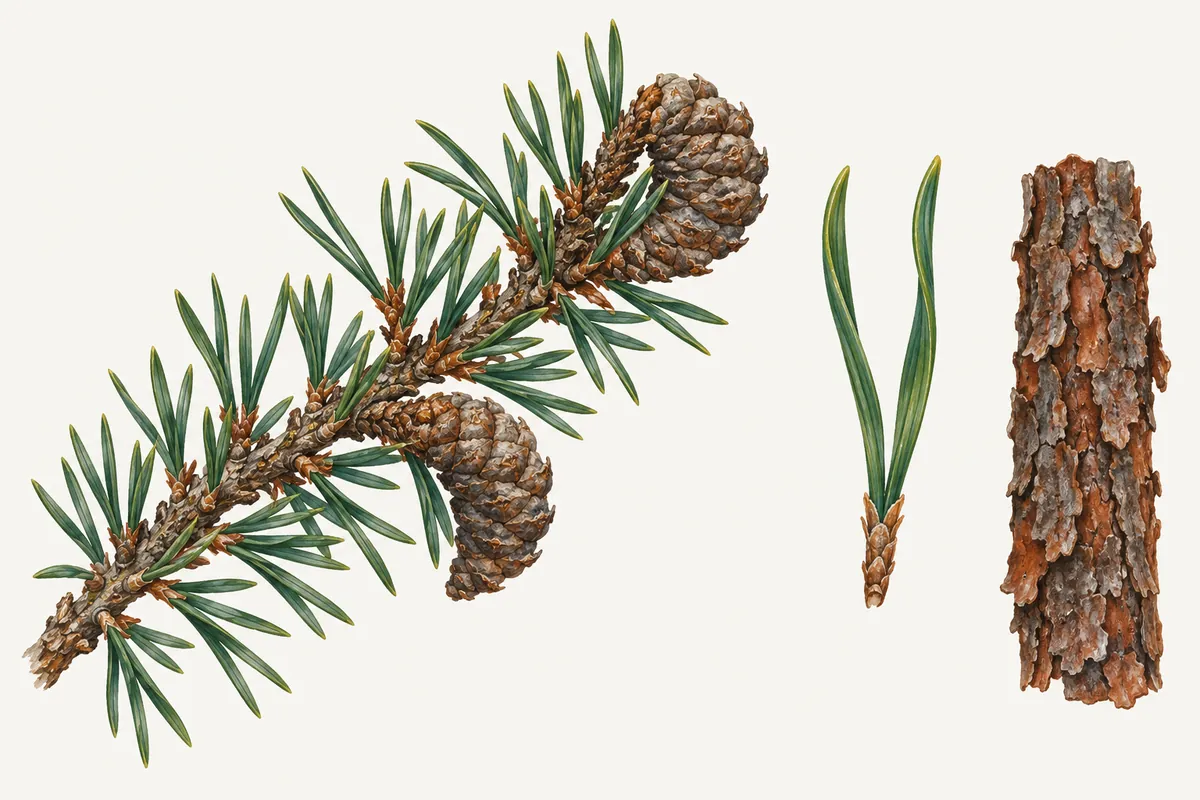
In short
Jack pine identification takes three checks. The needles grow two per bundle and are the shortest of the northern pines, 3/4 to 1 1/2 inches, twisted, spread apart and yellow-green. The cones are 1 1/2 to 2 inches, curved and often closed for years. And the tree looks scruffy, keeping dead branches and old cones along its trunk.
- Two needles per bundle, each shorter than your thumb: on a native pine of the Great Lakes or the boreal forest, that is jack pine.
- Red pine also has two needles, but they are 4 to 6 inches long and snap cleanly when bent; white pine has five.
- Jack pine cones are serotinous over most of the range: they stay sealed until fire or strong heat opens them.
Field marks at a glance
- Scientific name
- Pinus banksiana
- Family
- Pinaceae (pine family)
- Type
- Conifer, evergreen
- Needles
- 2 per bundle, 3/4 to 1 1/2 inches (about 2 to 4 cm), twisted and spread apart, yellow-green, with a short sheath at the base (Virginia Tech).
- Cones
- 1 1/2 to 2 inches, curved, light brown turning gray with age, each scale with a small prickle. Serotinous: they stay on the tree, often closed, for several years.
- Bark
- Dark and scaly at first, later breaking into scaly ridges.
- Twigs and buds
- Yellow to greenish brown when young, gray-brown later, very resinous; buds narrowly egg-shaped.
- Form
- Small to medium tree with a small, irregular crown; dead branches stay on, and the retained cones give it a coarse look. Usually 55 to 65 ft, sometimes 100 ft.
- Range
- Mostly Canada, from the Mackenzie River in the Northwest Territories east to Cape Breton Island; in the US, Maine, New Hampshire, northern New York, Michigan, Wisconsin and Minnesota, with small areas in Indiana and Illinois.
- Habitat
- Sandy soils, sand plains, thin soils over rock, even permafrost; a pioneer after fire. It does not grow naturally where the surface soil is alkaline.
- Other names
- Scrub pine, Banksian pine and Hudson Bay pine, according to the USDA Forest Service.
Jack pine is the pine of sand plains, burned-over land and the rocky boreal forest of Canada and the upper Great Lakes. It is easy to overlook because it rarely grows tall or straight, but two details make it one of the easiest pines to name: the shortest needles of any native northern pine, and curved cones that stay on the branches, sealed, for years.
How to identify a jack pine
Check these in order on one branch.
- Count the needles. Two per bundle, held at the base by a short sheath. Virginia Tech Dendrology describes them as twisted and divergent, which means the two needles of a pair spread apart in a V instead of lying together.
- Measure them. 3/4 to 1 1/2 inches long, about 2 to 4 cm, yellow-green. That is shorter than your thumb, and shorter than any other common pine in the Northeast and the Great Lakes.
- Find the cones. 1 1/2 to 2 inches long and curved, light brown when new and graying with age, with a small prickle on each scale. They persist on the tree for several years, many still closed.
- Step back. A small to medium tree, usually 55 to 65 feet according to the USDA Forest Service, with a small, irregular crown. Jack pine prunes itself poorly, so dead branches stay on the trunk, and the old cones give the whole tree a coarse, knobby look.
The bark helps less: dark and scaly on young trees, later broken into scaly ridges. The twigs are very resinous, yellow to greenish brown at first and gray-brown later.
Red pine vs jack pine, and white pine vs jack pine
All three are native to the Great Lakes states and Ontario, and people search for each pairing. The needle bundle settles all of them, and the cone confirms. Data from Virginia Tech's fact sheets for jack pine, red pine and eastern white pine.
| Check | Jack pine | Red pine | Eastern white pine |
|---|---|---|---|
| Needles per bundle | 2 | 2 | 5 |
| Needle length | 3/4–1 1/2 in | 4–6 in | 3–5 in |
| Needle feel and color | Twisted, spread apart, yellow-green | Straight, snap cleanly when bent, dark green | Slender and flexible |
| Cone | 1 1/2–2 in, curved, small prickle, stays closed for years | 1 1/2–2 1/2 in, egg-shaped, shiny chestnut brown, no prickle | 4–7 in, cylindrical, thick rounded scales |
| Bark | Dark, scaly, then scaly ridges | Red-brown or pinkish flakes, later plates with a reddish tinge | Smooth gray-green when young; thick, reddish to gray-brown ridges when old |
| Form | Small irregular crown, keeps dead branches and cones | Oval crown, clear trunk, foliage tufted, up to 90 ft | Very straight trunk, often well over 100 ft |
Red pine vs jack pine. Both are two-needle pines, so compare length and feel. A red pine needle is about four times as long as a jack pine needle, and it breaks in half when you bend it. Red pine cones are straight and smooth to the touch; jack pine cones are curved and prickly, and they hang on unopened.
White pine vs jack pine. There is nothing to weigh here once you count: five needles means white pine. From a distance, an old white pine is a tall, straight tree with long horizontal branches; a jack pine of the same age is shorter and rougher.
For red pine and white pine side by side, including Norway pine and their wood, see red pine vs white pine.
Jack pine vs lodgepole pine and Scots pine
Lodgepole pine is jack pine's western counterpart. Virginia Tech gives it two twisted needles 1 1/2 to 3 inches long, yellow-green to green, and cones 1 to 2 inches that are often asymmetrical and lumpy near the base, with a short spine on each scale, and that may stay closed for several years. So the cone shape (lopsided rather than curved) and the longer needles separate them. The Forest Service notes that the two species meet in central and northwestern Alberta and in parts of Saskatchewan, where natural hybrids, Pinus × murraybanksiana, occur.
Scots pine is the European two-needle pine planted in yards, windbreaks and Christmas tree farms across the jack pine's range, and Virginia Tech lists the two as look-alikes. Scots pine needles are stout, twisted and blue-green, 1 1/2 to 3 inches long, and its cones are straight, egg-shaped and slightly stalked. The giveaway is the bark: Scots pine's upper trunk always shows orange, peeling bark. See the Scots pine page for the rest.
Closed cones and fire
Jack pine's cones explain where it grows. Over much of the range they are serotinous, held shut with resin and full of seed. The Forest Service reports that many stay closed until fire, strong heat near the ground, wind breakage or logging exposes them. In dry weather at or above 80 °F (27 °C), up to half the cones on the sunny side of the crown may open, and very cold winters, at −50 °F or below, can open them too. In the southern part of the range, cones open normally.
After a fire, the released seed lands on bare mineral soil, and jack pine comes back as a pioneer. The Forest Service notes that most older stands seem to have started after fires. This cycle matters for a bird: the endangered Kirtland's warbler nests in dense young jack pine stands about 5 to 20 feet tall, roughly 7 to 20 years old.
Where jack pine grows
Jack pine is mostly a Canadian tree. Its northern edge runs east from the Mackenzie River in the Northwest Territories, and it reaches Cape Breton Island in Nova Scotia. It was the Northwest Territories' tree symbol until 1999, when Canadian Heritage records that the tamarack replaced it. In the United States it grows in Maine, New Hampshire and northern New York, and in the Lake States: Michigan, Wisconsin and Minnesota hold the largest areas, with outliers in extreme northwest Indiana and northeast Illinois.
Look for it on sandy soils, sand plains and thin soil over granite; it even grows over permafrost. Stands begin to break up after about 60 to 80 years, though the Forest Service reports vigorous 185-year-old trees in northwestern Minnesota and a 230-year-old tree east of Lake Nipigon in Ontario. The Ontario tree identification guide places it among the province's other conifers.
If the branches are high, a photo of a fallen cone or a needle bundle in Tree Identifier gives you a name to check. Jack pine is not one of the 138 species in the app's Collection, while eastern white pine and Scots pine are; whichever name you get, count and measure the needles yourself.
Look-alikes and how to tell them apart
Red pine (Pinus resinosa)
Two needles per bundle too, but 4 to 6 inches long, dark green and brittle enough to snap cleanly in half when bent. Its cones are straight, egg-shaped, shiny chestnut brown and have no prickles.
Lodgepole pine (Pinus contorta)
The western twin: two twisted needles, but longer, 1 1/2 to 3 inches, and cones 1 to 2 inches that are lopsided and lumpy near the base rather than curved. Where they meet in Alberta and Saskatchewan the two hybridize.
Scots pine (Pinus sylvestris)
A planted European pine with stout, twisted, blue-green needles 1 1/2 to 3 inches long and straight, egg-shaped cones on a short stalk. Its upper trunk always shows orange, peeling bark; jack pine's bark stays dark.
Eastern white pine (Pinus strobus)
Five soft needles per bundle, 3 to 5 inches long, and slender cones 4 to 7 inches long. Count one bundle and the question is settled.
What a photo can't settle
- Jack pine and lodgepole pine hybridize where they meet in Alberta and Saskatchewan, so a tree there can show traits of both and no photo will settle it.
- In the southern part of its range jack pine bears cones that open normally, so an open cone does not rule it out.
- Jack pine is not among the 138 species in Tree Identifier's Collection, and the app gives one name with no look-alike list: count and measure a needle bundle before you trust any pine name.
Questions people ask
How do you identify a jack pine tree?
Pull one needle bundle: jack pine has two needles, only 3/4 to 1 1/2 inches long, twisted and spread apart. Then look for curved cones 1 1/2 to 2 inches long, many still closed and gray with age, clinging to the branches. The tree usually looks ragged, with dead lower branches left on the trunk.
What is the difference between jack pine and red pine?
Needle length. Both carry two needles per bundle, but red pine needles are 4 to 6 inches and snap cleanly when bent, while jack pine needles are 3/4 to 1 1/2 inches and twisted. Red pine cones are straight, shiny chestnut brown and unarmed; jack pine cones are curved, prickly and stay closed.
What is the difference between jack pine and white pine?
Count the needles. Eastern white pine has five per bundle, soft and 3 to 5 inches long, and cones 4 to 7 inches long. Jack pine has two short, stiff, twisted needles and curved cones under 2 inches. White pine grows into a tall, straight tree often over 100 feet; jack pine rarely passes 65.
Why do jack pine cones stay closed?
Over most of its range jack pine bears serotinous cones, sealed shut and holding seed for years. The USDA Forest Service says many open only after fire, strong heat near the ground, wind breakage or logging; on the sunny side of the crown up to half may open in dry weather at or above 80 degrees Fahrenheit.
How tall does a jack pine get?
The USDA Forest Service gives 55 to 65 feet (17 to 20 m) and 8 to 10 inches in trunk diameter for mature trees, with some reaching 100 feet and 25 inches. Stands begin to break up after about 60 years on poor sites and 80 on the best ones.
Sources
- Jack pine fact sheet — Virginia Tech Dendrology
- Jack Pine, Silvics of North America — USDA Forest Service
- Red pine fact sheet — Virginia Tech Dendrology
- Eastern white pine fact sheet — Virginia Tech Dendrology
- Lodgepole pine fact sheet — Virginia Tech Dendrology
- Scots pine fact sheet — Virginia Tech Dendrology
- Northwest Territories: territorial symbols — Canadian Heritage, Government of Canada
Keep reading
- Tree comparisonRed pine vs white pine: how to tell them apart, with jack pine
- Tree profilePines (Pinus): how to identify a pine tree
- Tree profileScots pine (Pinus sylvestris): how to identify it
- Ontario field guideTrees of Ontario, region by region
- Field guideConifer identification: three questions about the needles, then the cone