Field guide
Pine cone identification: what tree a cone came from
Measure the cone, feel the scale tips, and note whether it hung down or stood up. A cone on the ground is often all you need to name the conifer above it.
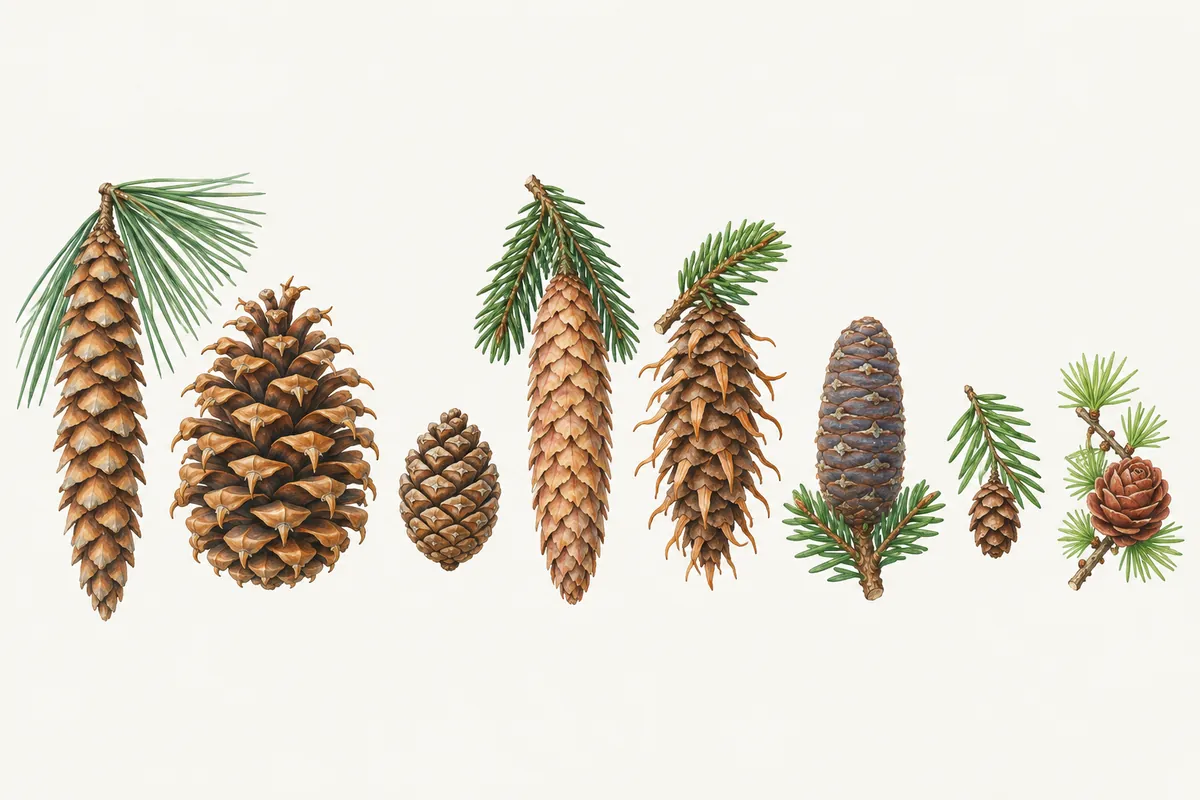
In short
Pine cone identification starts with the scales. Thick, woody scales with a raised knob at each tip mean a pine; many thin scales mean a spruce; three-pointed bracts between the scales mean a Douglas fir. Then measure: about 3/4 inch suggests a hemlock or larch, 1 1/2 to 2 1/2 inches a two-needle pine such as red or Scots pine, 4 inches or more eastern white pine, Norway spruce or a long-coned pine.
- Fir cones stand upright and fall apart on the branch, so a whole cone on the ground almost never comes from a true fir.
- Douglas fir cones are the easiest to name: a three-lobed bract sticks out from under every scale.
- Pine cones take two seasons to ripen, so small green first-year cones and full-size brown ones can hang on the same tree.
People call every conifer cone a pine cone, but the cone on your table may come from a pine, a spruce, a Douglas fir, a larch or a hemlock, and each group builds its cones differently. Three things tell them apart: the scales, the length and how the cone sat on the tree. This guide covers North American cones first, then the cones you will find in Britain.
Which conifer is it? Cones by tree group
Start here even if you are sure it is a pine cone. Cornell forester Peter Smallidge's guide to needle-bearing trees notes that pine cones have relatively few, thick scales compared with spruces, that fir cones stand upright and lose their scales at maturity, and that hemlock cones hang and keep theirs. Sizes below come from the fact sheet linked in each row.
| Tree group | Cone length | Shape and scales | On the tree |
|---|---|---|---|
| Pine (Pinus) | 1 to 22 in, depending on species | Thick, woody scales; each tip has a raised knob, often with a prickle | Varies; Scots pine cones ripen the season after flowering (Woodland Trust) |
| Spruce (Picea) | Norway spruce 4–6 in; white spruce 1 1/2–2 1/2 in | Many thin scales; Norway spruce's are stiff and irregularly toothed | Blue spruce cones turn from upright to hanging in about four weeks |
| True fir (Abies) | Balsam fir 2–3 1/2 in | Resinous, green tinged with purple | Stands upright; scales fall off on the branch |
| Douglas fir (Pseudotsuga) | 3–4 in | Rounded scales with a three-lobed bract sticking out beyond each one | Matures in late summer |
| Hemlock (Tsuga) | Eastern hemlock about 3/4 in | Egg-shaped, light brown, rounded scales | Hangs, "marble-sized" (Cornell) |
| Larch and tamarack (Larix) | Tamarack 3/4–1 in | Small, egg-shaped, light brown | Held upright (Cornell); stays on through winter |
| True cedar (Cedrus) | Atlas cedar 2–3 in (5–7.5 cm) | Barrel-shaped, glossy light brown | Stands upright on the branch; two years to mature |
| Arborvitae (Thuja) | Northern white cedar about 1/2 in | Oblong, leathery red-brown scales, each with a small spine | Upright; open like "miniature wooden roses" (Cornell) |
| Juniper | Eastern redcedar about 1/4 in | Berry-like, fleshy, dark blue with a whitish bloom | Female plants only |
| Cypress | Leyland cypress up to 3/4 in across; baldcypress 3/4–1 in | Round; Leyland has 8 scales; baldcypress is a woody ball | Baldcypress cones break apart into seeds |
The Douglas fir cone is the one people remember. Virginia Tech Dendrology describes three-lobed bracts that extend beyond the scales and "resemble mouse posteriors": the forked tongue and two legs sticking out from under each scale. No other common North American cone has them. The Douglas fir page covers the needles and buds that go with it.
Pine cone identification chart: common US pines
Once you know it is a pine, length, shape and the prickle at each scale tip narrow it down. Turn the cone over: the raised knob at the end of each scale is the umbo, and on most hard pines it carries a prickle you can feel. Rows come from Virginia Tech Dendrology unless the source column says otherwise.
| Pine | Cone length | Shape and color | Scale tip | Needles per bundle |
|---|---|---|---|---|
| Sugar pine | About 12 in, up to 22 in (USDA) | Long, among the largest of all conifers; Oregon Cascades to Baja California | Not given | Not given by the source |
| Longleaf pine | 6–10 in | Egg-shaped to conical, red-brown, no stalk; largest cone in the eastern US | Curved prickle | 3 |
| Eastern white pine | 4–7 in | Long, cylindrical, thick rounded scales | No prickle | 5 |
| Ponderosa pine | 3–6 in | Egg-shaped, red-brown, no stalk | Slender prickle | 3, sometimes 2 |
| Loblolly pine | 3–6 in | Egg-shaped to cylindrical, red-brown | Short spine | 3 |
| Austrian pine | 2–3 in | Egg-shaped, yellow-brown | Minute prickle | 2 |
| Red pine | 1 1/2–2 1/2 in | Egg-shaped, shiny chestnut brown | No prickle | 2 |
| Scots pine | 1 1/2–2 1/2 in | Egg-shaped, yellow-brown, slightly stalked | Blunt spine | 2 |
| Jack pine | 1 1/2–2 in | Curved, light brown graying with age; stays closed for years | Small prickle | 2 |
| Lodgepole pine | 1–2 in | Often lopsided, lumpy near the base; may stay closed | Short spine | 2 |
Two patterns help. Five-needle white pines have long, slender cones with no prickles. Two-needle pines have short, egg-shaped cones, and the prickle (or its absence) separates them: red pine is smooth, Scots pine blunt, Austrian pine barely prickly. For the needle counts and lengths of these and other US pines, see the pine identification page.
Fir tree cones: why you rarely find one
A whole cone picked up under a "fir tree" usually turns out to be a spruce or Douglas fir cone. True firs grow their cones upright on the top branches, and Virginia Tech's balsam fir sheet notes that the scales are deciduous: they drop off one by one as the seed is released in late summer. Cornell describes the bare central stalk left standing on the branch. So a whole, intact cone on the forest floor is almost never a true fir's. If it hangs, has thin scales and stays whole, it is a spruce; if it has forked bracts sticking out, a Douglas fir. The spruce vs fir page separates the two by their needles.
Pine cone identification in the UK
Britain has one native pine, so the cone story is mostly about planted trees.
- Scots pine: the only native pine. The Woodland Trust describes ripe cones as grey-brown with a raised, circular bump in the centre of each scale, developing over two seasons. Virginia Tech gives 4 to 6 cm, egg-shaped and slightly stalked. The Scots pine page covers its orange upper bark and blue-green needle pairs.
- Corsican and other black pines: Forest Research calls Corsican pine the dominant commercial pine in Britain. Virginia Tech gives black pine cones 5 to 8 cm, yellow-brown, with a minute prickle on each scale, on a tree with needles 10 to 15 cm long.
- European larch: the Woodland Trust gives cones about 3 to 4 cm with a hollow top, ripening brown, that can stay on the twigs for years, which makes larch easy to spot in winter after the needles have dropped. In spring, look for the pink, green or white female flowers it calls larch roses.
- Norway spruce: hanging, cylindrical cones 10 to 15 cm long with stiff, thin, irregularly toothed scales (Virginia Tech).
- Douglas fir: 8 to 10 cm, with the three-lobed bracts described above.
- Cedars: Atlas cedar and cedar of Lebanon carry upright barrel cones 5 to 7.5 cm on top of the branches, taking two years to mature; Oregon State University now treats Atlas cedar as a subspecies of cedar of Lebanon.
- Leyland cypress: round cones up to 2 cm across with 8 scales. NC State notes the hybrid arose by accident on Christopher Leyland's property in England.
Reading a cone: prickles, closed cones and green cones
Prickles. On a pine cone, the knob at each scale tip tells you a lot. Longleaf pine's prickle curves; ponderosa's is slender; Austrian pine's is minute; red and white pine have none.
Closed cones. Jack pine and lodgepole pine cones may stay closed on the branch for years. Jack pine's are serotinous over most of its range, opening after fire or strong heat. Virginia Tech notes that jack pine's retained cones give the whole tree a coarse look, so a short pine covered in old, gray, closed cones is often a jack pine.
Green cones. A pine cone is not finished in one season. The Woodland Trust says Scots pine's female flowers turn green after pollination and develop into cones that mature the following season, so in summer the same branch can carry small green first-year cones and full-size ones. Cones of first year and second year differ in size, not species: measure only ripe, brown cones against the chart.
When the cone is the only thing you can reach, photograph it next to a coin or your hand, ideally with a twig of the tree's needles, and Tree Identifier will suggest a name. The app shows common and scientific names and key traits, and you can ask follow-up questions about the result. Then check the cone against the tables above, and use the conifer identification guide for the needles.
What a photo can't settle
- Cone sizes overlap between species, and a cone that grew in shade or on a stressed tree can be smaller than the published range. Use the needles on the branch to confirm.
- Squirrels strip cones and carry them away from the tree, so a cone on the ground may not come from the tree right above it.
- Tree Identifier names the tree from one photo of a cone, needles or bark, with no list of alternatives. Put a hand or a coin next to the cone so the size is clear, or photograph the cone with a twig of needles.
Questions people ask
How do I identify a pine cone?
Measure it, feel the scale tips and look at the needles on the branch above. A pine cone has thick woody scales, each ending in a knob that may carry a prickle. Length then narrows it: red and Scots pine cones are 1 1/2 to 2 1/2 inches, eastern white pine 4 to 7, longleaf pine 6 to 10.
What do fir tree cones look like?
True fir cones stand upright on the branch. Balsam fir cones are 2 to 3 1/2 inches, green tinged with purple and resinous. The scales fall away when the seed ripens, leaving a bare spike on the branch, so you rarely find a whole fir cone on the ground.
Which tree has the biggest pine cones?
Sugar pine, which grows from the Oregon Cascades south to Baja California. The USDA Forest Service gives mature cones of roughly 30 cm (12 inches) and up to 56 cm (22 inches), among the largest of all conifers. In the eastern United States the largest is longleaf pine, at 6 to 10 inches.
What are the tiny cones on my tree?
Small cones under an inch usually come from a hemlock, a larch, an arborvitae or a cypress. Eastern hemlock cones are about 3/4 inch and hang; tamarack cones are 3/4 to 1 inch and stay through winter; arborvitae cones are about 1/2 inch and upright. On a pine, small green cones are often first-year cones.
Are spruce cones pine cones?
Not botanically, though people call every conifer cone a pine cone. Spruce cones are usually longer and slimmer than two-needle pine cones, with many thin scales. Norway spruce cones are 4 to 6 inches with stiff, thin, toothed scales; white spruce cones are 1 1/2 to 2 1/2 inches and cigar-shaped.
Sources
- Aren't They All Just Pines? How to ID Needle-Bearing Trees — Cornell Small Farms Program (Peter Smallidge, Cornell University)
- Eastern white pine fact sheet — Virginia Tech Dendrology
- Longleaf pine fact sheet — Virginia Tech Dendrology
- Sugar Pine, Silvics of North America — USDA Forest Service
- Douglas-fir fact sheet — Virginia Tech Dendrology
- Balsam fir fact sheet — Virginia Tech Dendrology
- European larch (Larix decidua) — Woodland Trust
- Scots pine (Pinus sylvestris) — Woodland Trust
Keep reading
- Field guideConifer identification: three questions about the needles, then the cone
- Tree profilePines (Pinus): how to identify a pine tree
- Tree profileDouglas-fir (Pseudotsuga menziesii): how to identify it
- Tree comparisonSpruce vs fir: how to tell them apart
- Tree profileLarch (Larix): how to identify a larch tree