Tree profile
Larch (Larix): how to identify a larch tree
A conifer that drops all its needles every autumn. Find the tufts on short knobby shoots, then turn a cone over to tell which larch it is.
In short
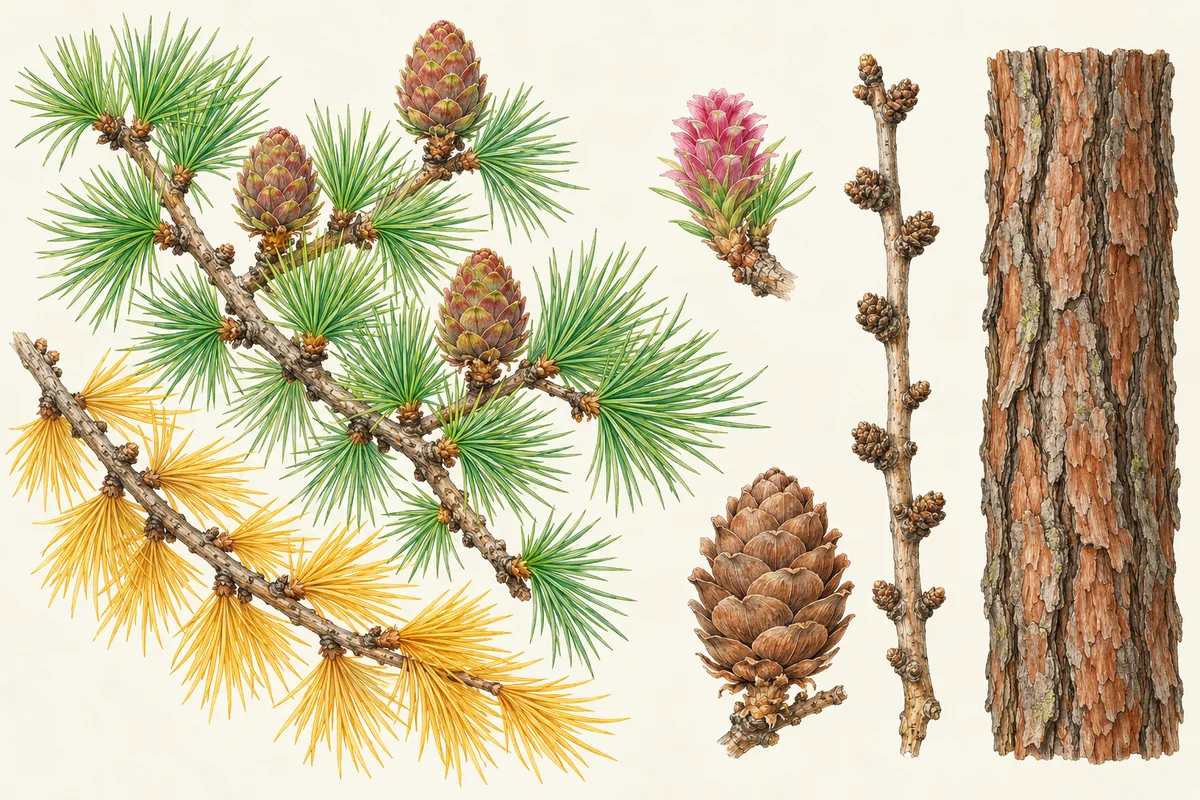
Larch tree identification rests on three marks. Soft, light green needles 2 to 4 cm long grow in tufts of 30 to 40 from short woody shoots. In autumn they turn golden yellow and fall, so the tree stands bare all winter. Small egg-shaped cones, 2 to 4 cm, stay on the twigs for years. Cone scales lying flat point to European larch; scales curled back like a rose point to Japanese larch.
- A conifer with needles in tufts that turns gold and goes bare in winter is a larch; no other common conifer in Britain does both.
- Cone scales pressed flat: European larch. Scale tips turned out and down like rose petals: Japanese larch. In between: probably the hybrid.
- In North America the native larches are tamarack in the North and East and western larch in the inland Northwest.
Field marks at a glance
- Scientific name
- Larix
- Family
- Pinaceae (pine family)
- Type
- Conifer, deciduous
- Needles
- Soft, light to bright green, 2 to 4 cm long, in tufts of 30 to 40 on short woody shoots; single along the new long shoots. Turn golden yellow and fall in autumn.
- Cones
- Small, egg-shaped, upright, 2 to 4 cm, green or red when young and brown when ripe. Old cones stay on the twigs for many years.
- Flowers
- In spring, before or with the new needles: female 'larch roses' in pink, red, green or white at the shoot tips; small creamy-yellow male clusters underneath.
- Twigs
- Covered in knobby short shoots, which make a bare winter twig look studded. Young shoots straw-coloured on European larch.
- Bark
- Pinkish-brown to reddish-brown, thick, with wide vertical fissures on old European larch; scaly and rusty-brown on Japanese larch.
- Size
- European larch reaches about 30 to 35 m in Britain (Woodland Trust); western larch normally 30 to 55 m in North America (USDA Forest Service).
- Where in Britain
- Not native. European larch was introduced over 400 years ago for timber; today hybrid and Japanese larch are more common in plantations.
- Leaf habit
- Deciduous. Woodland Trust calls European larch the only deciduous conifer in Europe.
Larch is the conifer that behaves like a broadleaf. It grows needles, cones and resinous wood like a pine, then turns gold in autumn and drops every needle. In Britain you meet it in plantations, shelterbelts and parks; in North America the native larches are tamarack and western larch. The tuft, the autumn gold and the small upright cone identify the genus, and the cone scales tell you which larch it is.
How to identify a larch: tufts, autumn gold, small cones
1. Look at how the needles grow. On a larch, most needles come in tufts, like small rosettes, from short woody shoots along the twig. The Woodland Trust's European larch profile gives them as 2 to 4 cm long, light green and soft. Its Nature's Calendar page counts 30 to 40 needles per tuft. On the new long shoots of the year, needles grow singly, so a fresh shoot looks different from the rest of the branch.
2. Check the season. Larch needles turn golden yellow before they fall in autumn, then the tree stands bare until spring. Woodland Trust calls European larch the only deciduous conifer in Europe. If a conifer is bare in January, and its twigs are covered in knobby short shoots, it is almost certainly a larch.
3. Find a cone. Larch cones are small, egg-shaped and upright on the twig, 3 to 4 cm on European larch (Woodland Trust). They open to release winged seeds, then often stay on the branch for years, so even a bare winter tree carries a scattering of small brown cones. That is the best winter clue.
4. Look at the bark on older trees. European larch bark is pinkish-brown and thick, with wide vertical fissures (Woodland Trust). Wisconsin Extension describes Japanese larch bark as scaly and rusty-brown.
If you see tufts, soft needles and small upright cones, you have a larch. The next question is which one.
European, Japanese or hybrid larch
In Britain, three larches cover nearly every tree you will see, and the cone separates them.
| Larch | Cone | Shoots and needles |
|---|---|---|
| European (Larix decidua) | Egg-shaped, 2.5 to 4 cm, scales pressed flat, tips never turned back | Shoots straw or blonde; needles bright green |
| Japanese (Larix kaempferi) | Flatter, bun-shaped, 2 to 3 cm, scale edges turned out and down like a rose | Needles grey- or blue-green, up to 6 cm on long shoots |
| Hybrid or Dunkeld (Larix × marschlinsii) | Conical, in between | Yellow, slightly waxy-bloomed shoots; mixed features |
European larch. Conifers of the British Isles (Larix decidua) describes upright, egg-shaped cones 3.5 to 4.5 cm long, with scales pressed flat, "never with reflexed tips," and young shoots the colour of fresh straw. The Gymnosperm Database's Larix decidua page counts 25 to 35 seed scales and gives a native range in the Alps and the Carpathians, at about 1,000 to 2,200 m. In spring the female flowers are, in the same source's words, a bright cerise pink.
Japanese larch. The Woodland Trust's quick test: Japanese larch cone scales "open out like the petals of a rose," while European larch scales don't open as widely. The Gymnosperm Database's Larix kaempferi page gives seed cones 2 to 3 cm long, with scale margins "usually strongly recurved," and grey- or blue-green foliage. Wisconsin Extension's European larch article calls the Japanese cone "flattened and bun-shaped."
Hybrid larch. Where European and Japanese larch grow near each other, they cross. Wisconsin describes the hybrid, Dunkeld larch, as differing mainly in its yellow, slightly waxy-bloomed shoots and conical cones. Conifers of the British Isles adds that hybrid and Japanese larch are more common in the British Isles today than European larch, and that hybrids can show any range of characters between the parents. On a plantation tree, check several cones before deciding.
Larch in Britain: history, plantations and disease
European larch is not native to Britain. The Woodland Trust says it was introduced over 400 years ago, one of the first trees brought in for timber, and is now widespread because it was planted so much. Mature trees reach about 30 m and live up to 250 years. The UK tree identification guide places it among the other planted conifers you meet in British woods.
Japanese larch has been hit hard in Britain by Phytophthora ramorum. The Gymnosperm Database reports that in 2010 the pathogen killed trees in a Japanese larch plantation in Great Britain, and that infection was found in 68 plantations in southwest England. That is why many larch plantations have been felled. When a larch looks brown in summer, while the trees around it are green, that is not the autumn change.
In winter, larch is one of the easiest conifers to spot from a distance: a pale, bare, conical crown among dark evergreens. The winter tree identification guide covers the bare broadleaves it grows with.
Larches in North America: tamarack and western larch
In Canada and the northern United States, the native larch you are most likely to meet is tamarack (Larix laricina), a tree of bogs and wet ground. Wisconsin Extension gives the simplest test against European larch: tamarack cones are small, blunt and shorter than the needles, while European larch cones are longer than the needles. Tamarack rarely grows taller than 60 feet. The tamarack page covers it in full, with its bog habitat and its range across Canada.
Western larch (Larix occidentalis) is the giant of the genus. The USDA Forest Service's Silvics of North America places it in the Upper Columbia River Basin of northwestern Montana, northern and west-central Idaho, northeastern Washington, southeastern British Columbia and the east slopes of the Cascades. It normally reaches 30 to 55 m (100 to 180 ft), occasionally over 61 m (200 ft), and trees over 900 years old have been found. Its cones are 2.5 to 4.5 cm long; Wisconsin describes them as rich purple in summer with orange and yellow bracts. Because it sheds its needles, the Forest Service notes, its branches seldom collect much snow or ice.
European larch is also planted in North America, in parks and as a timber tree, so a larch in a yard far from any bog can be either.
Photographing a larch for identification
Tree Identifier names a tree from one photo, and European larch is among the 138 species in the app's Collection. The most useful picture depends on the season. In summer, photograph a twig close up so the tufts and a cone are both in frame. In autumn, the gold crown is enough to say larch, but you still need a cone to name the species. In winter, a bare twig with its knobby short shoots and an old cone works better than a distant crown.
The app shows no confidence score and no look-alike list, so check a larch answer against the cone tests above, and use the follow-up chat to ask about hybrid larch or disease. For the other needle trees, the conifer identification key sorts pines, spruces, firs, hemlocks and larches with three questions.
Look-alikes and how to tell them apart
Cedar, such as Atlas cedar or deodar (Cedrus)
Cedars also carry needles in tufts on short shoots, but they keep them all winter, the needles are stiff, and the cones are big barrels that break apart on the branch. A larch is bare from late autumn to spring.
Dawn redwood and bald cypress
Both drop their needles in autumn too, but the needles are flat and set in two rows along slender side shoots that fall with them. There are no tufts and no knobby short shoots on the twigs.
Spruce and other evergreen conifers
Spruce needles grow singly on woody pegs and stay green through winter. A conifer that has turned gold or brown all over in October and November is far more likely a healthy larch than a dying spruce.
What a photo can't settle
- Hybrid larch blends the features of European and Japanese larch, and plantation trees can be any of the three. A single photo of foliage cannot separate them; you need ripe cones, ideally several.
- In winter a larch has no needles. A photo of a bare twig with knobby short shoots and old cones works better than a photo of the whole tree.
- Gold or bare in autumn is normal for a larch, but larch is also hit by disease in Britain. A photo cannot tell seasonal needle drop from dieback; report suspected disease to the forestry authority.
Questions people ask
Is a larch tree evergreen?
No. Larch is a conifer, but it is deciduous: its needles turn golden yellow in autumn and fall, and the tree stands bare until new tufts appear in spring. The Woodland Trust describes European larch as the only deciduous conifer in Europe. A bare larch in winter is not a dead tree.
How do you tell European larch from Japanese larch?
Look at a ripe cone. The Woodland Trust says Japanese larch cone scales open out like the petals of a rose, while European larch scales do not open as widely; Conifers of the British Isles describes European cones as egg-shaped with scales pressed flat, never with turned-back tips. Japanese larch cones are flatter and bun-shaped.
What is hybrid or Dunkeld larch?
The cross between European and Japanese larch, which forms where the two are planted near each other. Wisconsin Extension says it differs mainly in its yellow, slightly waxy-bloomed shoots and conical cones. Conifers of the British Isles notes that hybrids show a range of characters between the parents, so check several cones.
What are larch roses?
The female flowers of larch, which appear at the shoot tips in spring. The Woodland Trust describes them as clusters of flower-like scales in pink, green or white; on European larch they are often a bright cerise pink and open before the new needles. They grow into the small cones.
Is a tamarack a larch?
Yes. Tamarack (Larix laricina) is the native larch of Canada and the northern and eastern United States. Its cones are smaller and shorter than its needles, according to Wisconsin Extension, while European larch cones are longer than the needles.
Sources
- European larch (Larix decidua) — Woodland Trust
- European larch, Nature's Calendar species we record — Woodland Trust
- Larix decidua (Conifers of the British Isles) — Field Studies Council, FSC Biodiversity
- Larix decidua — The Gymnosperm Database
- Larix kaempferi — The Gymnosperm Database
- European Larch, Larix decidua — University of Wisconsin–Madison Division of Extension, Wisconsin Horticulture
- Western Larch, Silvics of North America — USDA Forest Service
Keep reading
- Tree profileTamarack (Larix laricina): how to identify it
- Field guideConifer identification: three questions about the needles, then the cone
- Field guideTree identification in the UK: British trees by leaf, bark and picture
- Winter field guideWinter tree identification, from buds to bark
- Tree profileSpruce trees (Picea): how to identify the species