Field guide
Christmas tree identification: which tree is in your living room
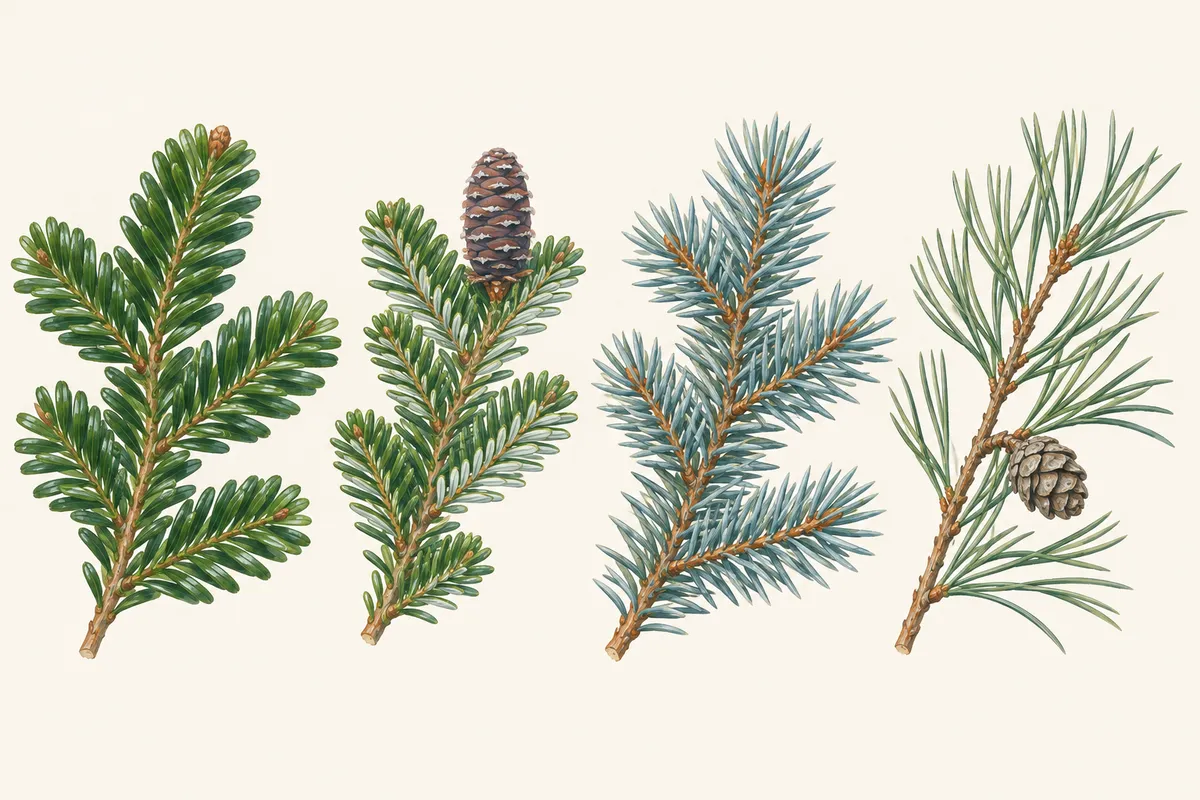
Many cut Christmas trees are firs, a few are spruces or pines, and in the South many are cedars and cypresses. One needle, a sniff and a look at the twig name almost all of them.
In short
Christmas tree identification starts with one needle. In bundles of 2 or 5, it is a pine: Scotch, Virginia or white pine. Single, four-sided and sharp, it is a spruce, such as blue spruce. Single, flat and soft, it is a fir, most often Fraser, balsam, noble, Nordmann or concolor, or a Douglas-fir if the buds are long and pointed. Tiny scales mean red cedar, Leyland or Arizona cypress.
- Fraser fir is the most used Christmas tree in NC State and Cornell Extension's guides; balsam fir is its northern look-alike.
- A sharp, square needle that rolls between your fingers means a spruce; blue spruce is the one with silvery-blue, prickly needles.
- Southern choose-and-cut farms sell scale-leaved trees too: eastern red cedar, Leyland cypress and Arizona cypress.
Most people buy a Christmas tree by its label, and the label is often just "fir" or "spruce". The tree itself tells you more. The key below works on a cut tree in a stand: you only need one twig, your fingers and your nose. For the full needle key to every North American conifer, use the conifer identification guide; this page goes deeper into the species sold on lots and choose-and-cut farms.
Identify your Christmas tree in four checks
1. Bundles, singles or scales? Look at where the needles meet the twig.
- Needles in bundles of two or five, wrapped at the base: a pine. Five soft needles is eastern white pine; two stiff, twisted needles is Scotch or Virginia pine.
- Tiny scales pressed to the twig, no real needles: a cedar or cypress, the southern choose-and-cut trees.
- Single needles along the twig: a fir, a spruce or a Douglas-fir. Go to check 2.
2. Roll one needle. A four-sided needle that rolls between your fingers, is stiff and often pricks, and sits on a tiny woody peg is a spruce. A flat needle that won't roll is a fir or a Douglas-fir.
3. Look at the bud and the needle base. Long, sharp, pointed red-brown buds at the twig tips, and needles with no peg, point to Douglas-fir (Virginia Tech). Rounded buds and needles that leave a flat, round scar when pulled mean a true fir.
4. Smell and color. Crush a few needles. Balsam scent, a citrus note, a resinous spruce smell or almost nothing each narrows the species, as the table shows.
| Tree | Needle | What gives it away |
|---|---|---|
| Fraser fir | Flat, 1/2–1 in, dark green, silvery-white bands below | Soft, fragrant; cone bracts curl down out of the scales |
| Balsam fir | Flat, dark green, shiny, soft, in a flat row | Balsam scent; flexible branches, narrow tree |
| Canaan fir | Flat, very like Fraser | Sold where root rot rules out Fraser (Cornell) |
| Noble fir | Flat, up to 1 in, blue-green on both sides | Needles curve upward from a J-shaped base; sturdy branches |
| Nordmann fir | Flat, up to about 1.3 in, glossy dark green, two white stripes below | Blunt, often notched tips; very dense |
| White (concolor) fir | Flat, 1/2–1 1/2 in, bluish green | Citrus scent when crushed; soft, blunt |
| Douglas-fir | Flat, 3/4–1 1/4 in, soft | Long, sharp, pointed buds; very fragrant |
| Blue spruce | Four-sided, 1–1 1/4 in, sharp | Silvery blue to bluish gray; stiff branches |
| White spruce | Four-sided, 1/2–3/4 in, blunt tip | Green to bluish green |
| Norway spruce | Four-sided, 1/2–1 in, sharp to blunt | Dark green; drops needles fast indoors |
| Eastern white pine | Bundles of 5, 2 1/2–5 in, soft | Blue-green, flexible branches, little scent |
| Scotch pine | Bundles of 2, 1 1/2–3 1/2 in, stiff, twisted | Blue-green to dark green |
| Virginia pine | Bundles of 2, 1 1/2–3 in, often twisted | Can yellow in late fall |
| Eastern red cedar | Scales under 1/10 in, prickly | Limber branches; dries fast |
| Leyland cypress | Scales | Dries quickly after cutting |
| Arizona cypress | Scales, silvery blue (cultivars) | Citrus-like scent in 'Carolina Sapphire' |
Needle sizes and notes come from NC State Extension's Christmas Tree Species publication and the Cornell Cooperative Extension Christmas Tree Guide, with the noble and Nordmann figures from NC State's plant profiles below.
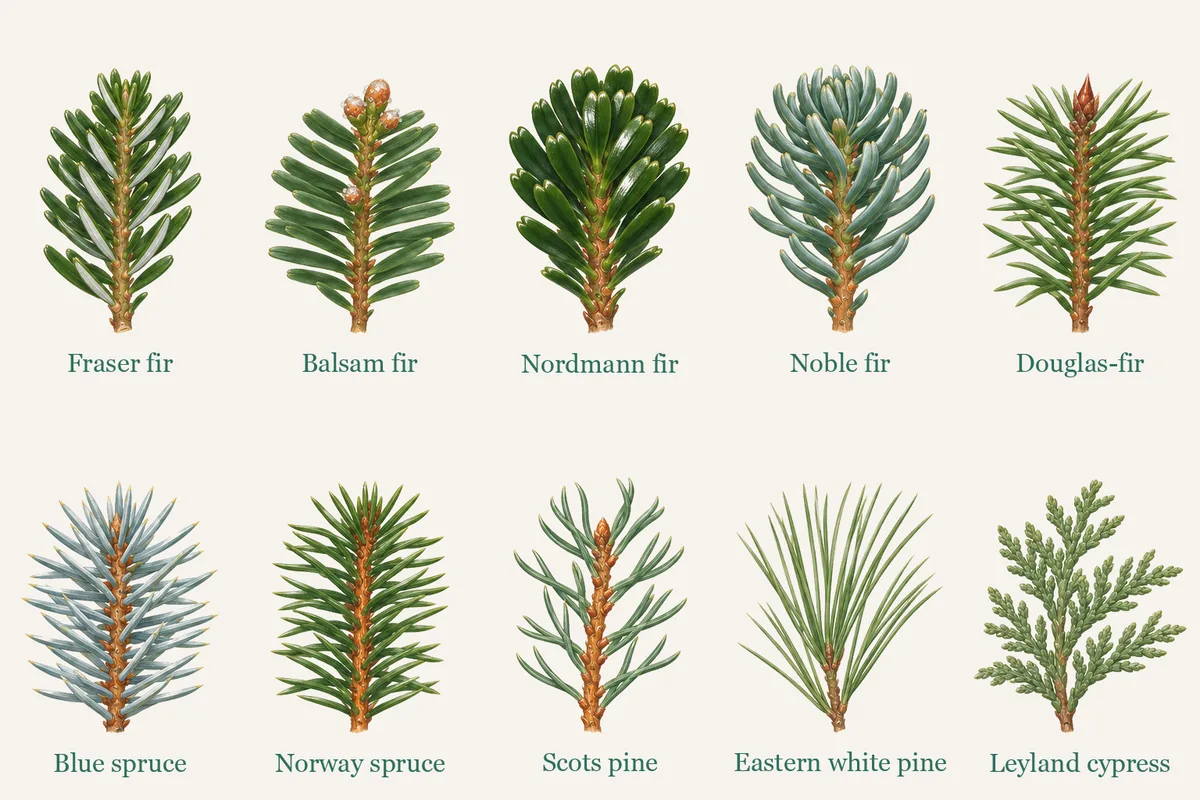
Firs: Fraser, balsam, Canaan, noble, Nordmann and concolor
Six of the trees in the table are true firs. All have flat, single needles that leave a round scar when pulled. The fir identification page covers the species in the wild; on a cut tree, use these details.
Fraser fir is the one you are most likely to bring home. Cornell calls it the most used, with soft needles, dark green on top with a silvery-green sheen below, fragrant scent, great needle retention and enough space between branches to decorate easily. NC State's Fraser fir profile ranks it the top Christmas tree species and places it wild in the southern Appalachians of North Carolina, Virginia and Tennessee, at about 4,000 to 6,700 feet.
Balsam fir is Fraser's closest look-alike. Cornell describes shiny, soft, dark green needles set flat along the branches, flexible branches that may not hold heavy ornaments, a narrower than average shape and a balsam scent. The reliable split from Fraser is the cone, which a cut tree rarely has: NC State says Fraser's cone bracts are long and curl downward, while balsam's are short and hidden by the scales. Canaan fir, Cornell notes, is very similar to Fraser fir; growers choose it for its resistance to root rot. The balsam fir page describes the tree in the wild.
Noble fir comes from the Pacific Northwest. NC State's noble fir profile describes needles up to 1 inch, blue-green on both sides with lengthwise stripes, blunt to notched, spiraling around the shoot and curving upward from a J-shaped base. It is native to the Cascade and Coast Ranges of extreme northwest California, western Oregon and Washington. Cornell praises its sturdy branches, needles that are not too sharp and its use in wreaths.
Nordmann fir, also called Caucasian fir, goes by a third name in NC State's profile: Christmas tree fir. NC State's Nordmann fir profile gives flattened, glossy dark green needles up to about 1.3 inches, with two white stripes beneath and blunt, often slightly notched tips, densely covering the stems, and says the needles stay on the branch even after they die. It is native to the Caucasus and northeastern Turkey.
White fir, or concolor fir, has bluish needles that make it look like a blue spruce from a distance. Cornell says the needles are softer and blunt at the end, so less spiky, with a citrusy scent some compare to grapefruit when crushed. NC State gives needles 1/2 to 1 1/2 inches, bluish green when young and dull green with age, and a native range in the western US. The white fir page covers the growing tree, bark and cones included.
Spruces and Douglas-fir
A spruce has single, four-sided needles on woody pegs. NC State's blue spruce profile describes stiff, sharp-tipped needles, dull green to bluish or silvery white, borne singly on pegs, on a tree native to the central Rocky Mountains from southern Montana and eastern Idaho to New Mexico. The NC State publication gives needles 1 to 1 1/4 inches on lower branches, a resinous odor when crushed and needle retention among the best of the spruces; Cornell rates it average and notes strong, stiff limbs that hold heavy ornaments. NC State adds that blue spruce is being replaced by Fraser fir in part because its sharp tips have injured toddlers.
White spruce has shorter needles, 1/2 to 3/4 inch, blunt at the tip. Norway spruce, with sharp to blunt needles 1/2 to 1 inch, is the one that sheds: NC State rates its retention poor unless the tree is cut fresh and kept watered, and Cornell suggests buying it only a week or so before Christmas. The spruce identification page separates the species in the wild.
Douglas-fir is not a true fir. Virginia Tech's Douglas-fir fact sheet describes single needles 3/4 to 1 1/4 inches, yellow-green to blue-green, blunt-tipped and very fragrant, without the woody pegs of spruce, and long, sharp-pointed red-brown buds. Those buds are the quickest check on a cut tree. Cornell describes its soft, shiny, sage-green needles and notes that it is native to the West Coast.
Pines, cedars and cypresses
Eastern white pine has five needles per bundle. The NC State publication gives them 2 1/2 to 5 inches, soft and flexible, blue-green, with very little aroma, though Cornell describes a pine-like forest scent. Cornell adds that its flexible branches struggle with heavy ornaments and that the tree can look empty inside because the needles grow at the branch ends.
Scotch pine, or Scots pine, has two needles per bundle, 1 1/2 to 3 1/2 inches, stiff, twisted and blue-green, according to NC State's Scots pine profile, which credits its form and good needle retention for its use as a Christmas tree. Virginia pine, grown in the Southeast, also has two needles per bundle, 1 1/2 to 3 inches and often twisted; NC State notes that the foliage can turn light green to yellow in late fall.
In the South, many choose-and-cut farms grow scale-leaved trees. Eastern red cedar, a juniper, has scales under 1/10 inch, prickly foliage and limber branches, and dries out quickly once cut unless the trunk stays in water (NC State); its full profile is on the eastern red cedar page. Leyland cypress also dries quickly, which is why NC State recommends it only for choose-and-cut farms. Arizona cypress is sold as cultivars such as 'Carolina Sapphire', silvery blue with a citrus-like fragrance, and 'Blue Ice', steel-blue and more columnar. NC State also lists arborvitae, mainly 'Green Giant', among the species grown.
When the label is missing
Bring the tree's own evidence to the key: a twig with needles, ideally from a branch tip with a bud, and one needle pulled off to see what it leaves behind. If you want a second opinion, Tree Identifier can name the tree from one photo of a twig held against a plain background. It shows one name, with no confidence score or list of look-alikes, so check the answer against the four checks above. The follow-up chat under the result can answer questions such as how to tell Fraser from balsam fir, and Tree Identifier's Care Guide gives watering tips for the species it names.
What a photo can't settle
- Christmas trees are sheared into cones for years, so the tree's natural shape and branching, useful clues in the wild, tell you little on a lot.
- A cut tree has no cones and no bark visible under the stand, so firs that are told apart mainly by their cones, such as Fraser, balsam and Canaan fir, can be impossible to separate in your living room.
- Farms grow cultivars such as Arizona cypress 'Carolina Sapphire' or Leyland cypress 'Leighton Green'; a photo app names the species at best, not the cultivar or the farm's trade name.
Questions people ask
What is the most popular type of Christmas tree?
Fraser fir. Cornell Cooperative Extension calls it the most used, for its soft needles, fragrance and needle retention, and NC State Extension ranks it the top Christmas tree species. It is grown commercially in North Carolina, where it is native to the high southern Appalachians.
How can I tell a Fraser fir from a balsam fir?
On a cut tree, the needles look much alike: flat, dark green, silvery below. The cone settles it: NC State Extension says Fraser fir's cone bracts are long and curl downward out of the scales, while balsam fir's are short and hidden. Cornell adds that balsam has flexible branches and a narrow shape.
Which Christmas tree has the sharpest needles?
Blue spruce. NC State Extension describes its four-sided needles as stiff and sharp-pointed, and notes it is being replaced by Fraser fir partly because the sharp tips have injured toddlers. Norway spruce needles are also sharp, according to Cornell Cooperative Extension.
Which Christmas tree smells the best?
Scent is personal, but the guides agree on some: balsam fir smells of balsam, Fraser fir and white fir have a pleasing aroma, Douglas-fir needles are very fragrant (Virginia Tech), concolor smells citrusy when crushed (Cornell), and Arizona cypress 'Carolina Sapphire' has a citrus-like scent. NC State gives white pine very little aroma.
Is a Christmas tree a pine tree?
Often not. Many cut Christmas trees are firs, such as Fraser, balsam, noble and Nordmann, or Douglas-fir, which is not a true fir. Pines are sold too, white, Scotch and Virginia pine, and you can recognize them because their needles grow in bundles of two or five.
Which Christmas tree holds its needles longest?
Firs generally do well: Cornell gives Fraser fir great needle retention and balsam good, and NC State says Nordmann fir needles stay on the branch even after they die. Norway spruce is the poor one unless cut fresh and kept watered. Every cut tree lasts longer with its trunk in water.
Sources
- Christmas Tree Species — NC State Extension (C. McKinley, D. Hazel, W. Kohlway)
- Christmas Tree Guide — Cornell Cooperative Extension of Monroe County
- Abies fraseri (Fraser Fir) — North Carolina Extension Gardener Plant Toolbox, NC State University
- Abies nordmanniana (Nordmann Fir) — North Carolina Extension Gardener Plant Toolbox, NC State University
- Abies procera (Noble Fir) — North Carolina Extension Gardener Plant Toolbox, NC State University
- Picea pungens (Blue Spruce) — North Carolina Extension Gardener Plant Toolbox, NC State University
- Douglas-fir fact sheet — Virginia Tech Dendrology
- Pinus sylvestris (Scots Pine) — North Carolina Extension Gardener Plant Toolbox, NC State University
Keep reading
- Field guideConifer identification: three questions about the needles, then the cone
- Tree profileFir (Abies): how to identify a fir tree
- Tree profileSpruce trees (Picea): how to identify the species
- Tree profileDouglas-fir (Pseudotsuga menziesii): how to identify it
- Tree profilePines (Pinus): how to identify a pine tree