Also in Deutsch
Tree profile
White fir (Abies concolor): how to identify concolor fir
A blue-grey conifer that looks like a blue spruce from a distance and feels nothing like one: long, soft, flat needles that curve upward, a lemon smell and cones standing on the top branches.
In short
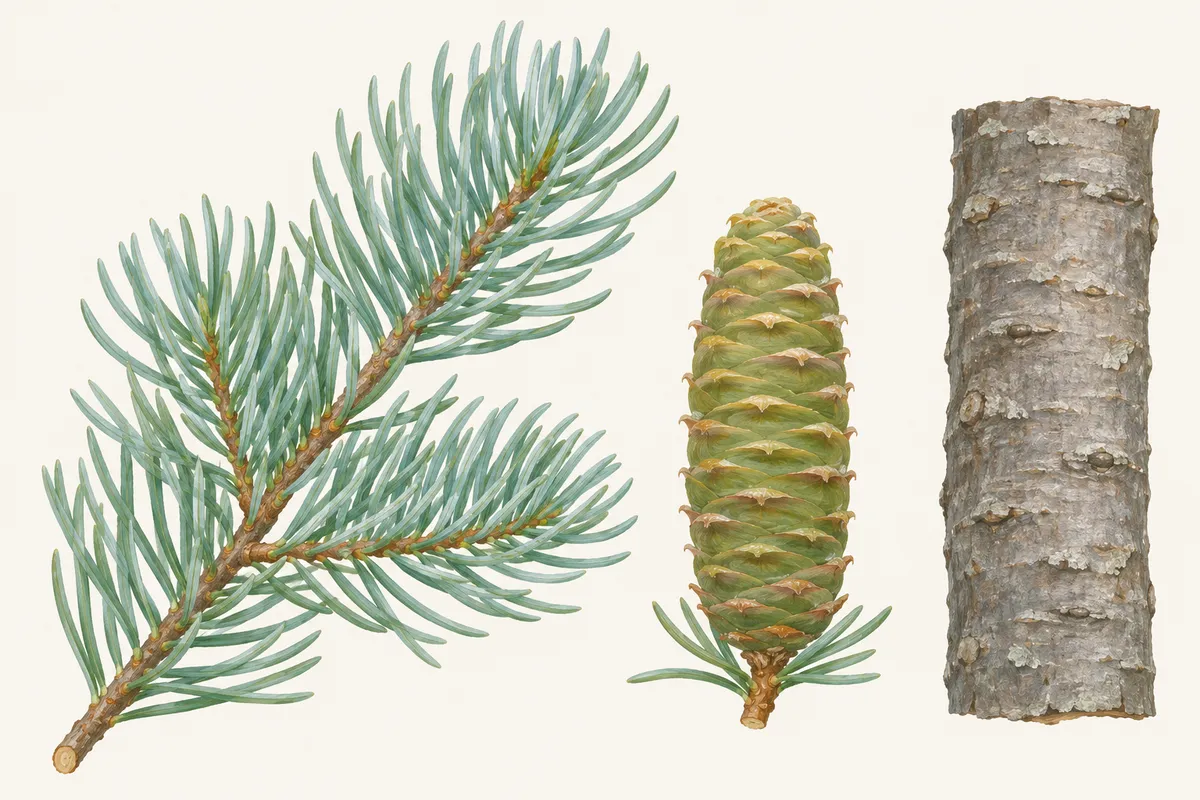
White fir identification, or concolor fir, comes down to the needles: flat, soft and long, 2 to 3 inches, silvery blue-green on both sides, sticking out from the twig and often curving upward, with a citrus smell when crushed. Young bark is smooth and grey with resin pockets; old bark is thick, ashy grey and deeply furrowed. Cones, 3 to 5 inches, stand upright and fall apart on the tree.
- White fir and concolor fir are the same tree, Abies concolor; the Morton Arboretum also lists the name Colorado fir.
- From a distance it passes for a blue spruce; touch a needle: soft, flat and blunt means fir, stiff, sharp and four-sided means spruce.
- Needles the same pale colour above and below set it apart from grand fir, which is dark green on top.
Field marks at a glance
- Scientific name
- Abies concolor
- Family
- Pinaceae (pine family)
- Type
- Conifer, evergreen
- Needles
- Single, flat, 2 to 3 inches long (Virginia Tech; about 2 inches, Morton Arboretum), blunt; silvery blue-green on both surfaces; stand out at right angles and often curve upward.
- Scent
- Crushed needles smell of citrus (Virginia Tech) or lemon (Morton Arboretum).
- Cones
- Upright in the top of the crown, oblong, 3 to 5 1/2 inches (VT); greenish or purplish turning brown; they fall apart at maturity in late summer and fall.
- Bark
- Young: thin, smooth and grey with resin pockets. Old: thick and ashy grey with deep, irregular furrows, or broad flat ridges.
- Twigs
- Dark orange when young, then grey-green and grey; circular leaf scars after the needles fall.
- Form
- Conical when young; old trees develop a dome-like crown.
- Size
- Wild trees in California and southwestern Oregon reach 131 to 180 ft; record 192 ft. Planted trees: 30 to 50 ft tall, 15 to 20 ft wide (Morton).
- Range
- Western mountains from the Pacific coast ranges to central Colorado, south to northern Mexico; 1,970 ft in central Oregon to about 11,150 ft in Colorado. Widely planted in the East and Midwest.
White fir is the pale, blue-grey fir of the western mountains, from the Sierra Nevada and southern Oregon to the Rockies of Colorado and New Mexico. It is also planted in yards far outside its native range, the Morton Arboretum near Chicago among them, where it gets mistaken for a blue spruce. It is often sold as concolor fir. In the Forest Service's inventory of live trees on US forest land (EVALIDator), it ranks 50th of all species. One touch of a needle tells you what you have.
How to identify a white fir
1. Touch the needles. Virginia Tech's white fir fact sheet describes flat, blunt needles 2 to 3 inches long; the Morton Arboretum gives about 2 inches. They are soft, not prickly, among the longest needles of any common fir.
2. Compare the top and bottom of a needle. Most firs are dark green above and white-banded below. White fir is silvery blue-green on both surfaces, with a white bloom spread evenly or in bands on both sides (VT). That is where the name concolor, one colour, comes from.
3. See how they stand. The needles stick out at right angles from the twig and often curve upward; Morton says they "curve outward and upward." A white fir twig looks loose and brushy, not flat like a grand fir spray.
4. Crush a needle. Virginia Tech notes a citrus smell, Morton a lemon scent.
5. Pull a needle and look at the twig. It leaves a circular scar on a smooth twig, dark orange on new growth, then grey-green and grey (VT). No woody peg, so not a spruce.
6. Look up for cones. They stand upright in the uppermost crown, oblong, 3 to 5 1/2 inches long (VT) or 3 to 5 inches (USDA Forest Service), turning from greenish or purplish to brown as they mature in late summer. Then they fall apart and shed their seeds in fall, leaving bare spikes on the branches.
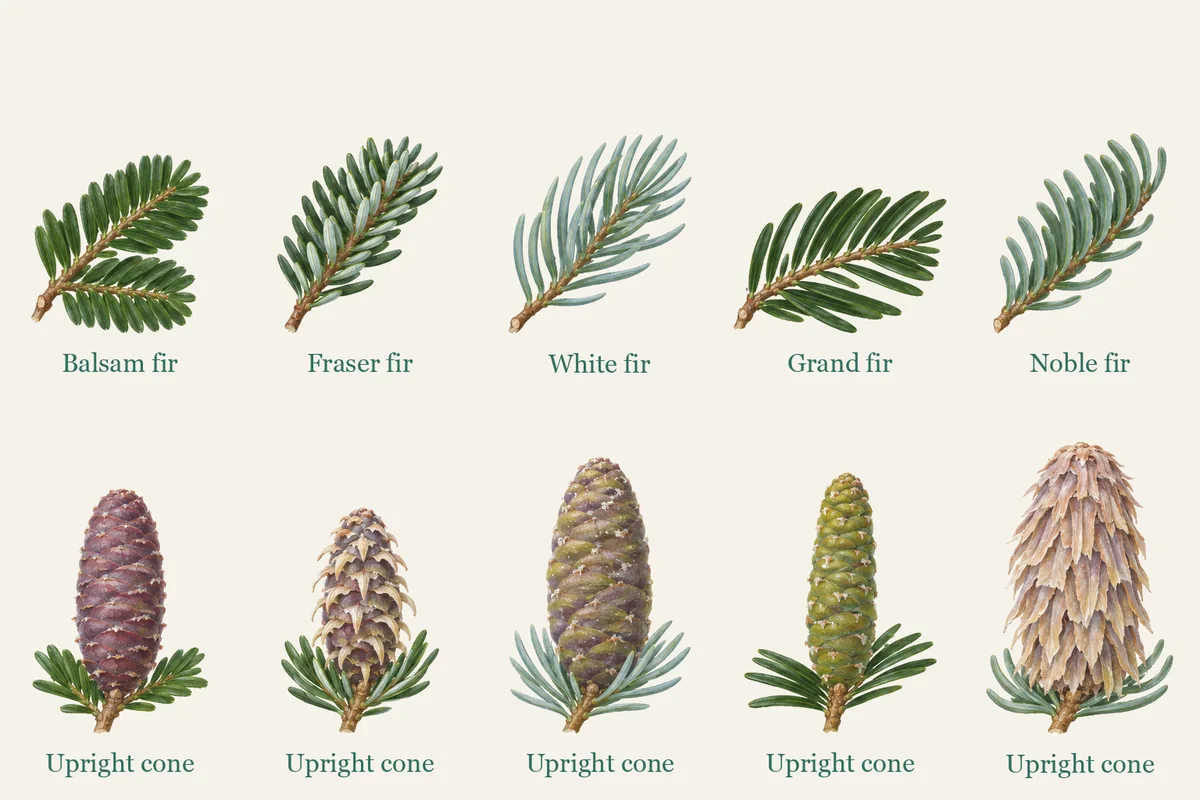
The fir identification page sets white fir beside the other firs of North America and Europe.
White fir vs blue spruce
This is the mix-up that sends most people looking. Both trees are blue-grey and conical, and both are planted in yards far east of their native range. The fix is tactile. Ohio State Extension's fact sheet Is It Pine, Spruce, or Fir? explains that fir needles are soft and flat and cannot be rolled between your fingers, and that they attach directly to the twig; it describes white fir's needle base as looking like a suction cup. Spruce needles are four-sided, roll easily and sit on woody pegs that stay behind on the twig.
| Check | White (concolor) fir | Blue spruce |
|---|---|---|
| Needle shape | Soft, flat, blunt; will not roll | Four-sided; rolls between fingers |
| Needle base | Like a suction cup, directly on the twig | On a woody peg |
| Bare twig | Smooth, round scars | Rough with woody pegs |
| Cones | Upright, fall apart on the tree | Hang down |
The blue spruce page has that tree's own needle and cone measurements, and the Christmas tree identification guide sets concolor fir beside the other cut trees.
Bark, shape and size
Young white fir bark is thin, smooth and grey, with resin pockets. On old trees it becomes thick and ashy grey with deep, irregular furrows (VT); Morton describes broad, flat ridges. Young trees are conical; older trees develop a dome-like crown.
Wild trees grow large. The USDA Forest Service's Silvics of North America gives 131 to 180 feet tall and 39 to 65 inches across for large trees on good sites in California and southwestern Oregon, and up to 134 feet in Arizona and New Mexico. The record tree, in the central Sierra Nevada, is 192 feet tall and 106.6 inches across. White fir can bear cones at about 40 years and keep bearing beyond 300. Planted in a yard, Morton expects a slow-growing, pyramidal tree 30 to 50 feet tall and 15 to 20 feet wide, hardy in zones 3 to 7.
Where white fir grows and its two varieties
The Forest Service describes a native range from the mountains of the Pacific coast to central Colorado and south to northern Mexico, from about 1,970 feet in the headwaters of the Willamette River in central Oregon to almost 11,150 feet in central Colorado. In the Sierra Nevada it grows mostly at 3,900 to 6,900 feet; Rocky Mountain white fir most often at 6,900 to 8,900 feet. Our California tree guide notes that Douglas-fir and white fir hold more of that state's wood than any other trees.
Two varieties are recognized:
- Rocky Mountain white fir (var. concolor), in the eastern and southwestern part of the range.
- California white fir (var. lowiana), in the western part.
The Forest Service separates them by needle form and terpene content rather than one easy field mark. In the north of its range, California white fir hybridizes freely with grand fir; from northwestern California through central Oregon into central Idaho the two are hard to tell apart, and foresters there call the population "grandicolor." Elsewhere, grand fir's dark green, flat sprays (see the grand fir page) are easy to separate from white fir's pale, upturned needles.
Photographing a white fir
Photograph a twig close up so the needle colour on both sides shows, and add a photo of the bark or the whole tree. Tree Identifier names a tree from one photo, and the follow-up chat can answer questions such as whether a blue conifer in your yard is a fir or a spruce. The app shows no confidence score and no list of look-alikes, so confirm with the needle roll and the citrus scent. With location turned on, the Tree Map pins each find, useful for planted trees, since a yard may hold a concolor fir and a blue spruce side by side.
Look-alikes and how to tell them apart
Colorado blue spruce (Picea pungens)
Same blue colour, opposite feel. Spruce needles are four-sided and roll between your fingers, and leave woody pegs on a rough twig; spruce cones hang down. White fir needles are flat, soft and blunt, and its cones stand upright.
Grand fir (Abies grandis)
Grand fir needles are shorter, 3/4 to 2 inches, dark glossy green above with white bands only beneath, and lie flat in two rows. White fir needles are pale blue-green on both sides and curve upward.
Subalpine fir (Abies lasiocarpa)
Subalpine fir needles are about 1 inch, with a bluish bloom, crowded and sweeping upward; the crown is a very narrow spire. White fir needles are twice as long or more, and old trees have dome-shaped crowns.
Noble fir and California red fir
Virginia Tech lists both as look-alikes. Noble fir needles are about 1 inch with a hockey-stick curve at the base, and its cones are almost covered by down-turned bracts. Long, flat, pale needles on both sides point to white fir.
What a photo can't settle
- Where white fir meets grand fir, from northwestern California through central Oregon into central Idaho, the USDA Forest Service says the two and their hybrids are hard to tell apart; no photo settles those trees.
- Needle form varies between the Rocky Mountain and California varieties, and garden cultivars range from silver-blue to yellow in winter, so colour is a clue, not proof.
- Cones sit at the very top of the tree and fall apart in late summer, so you usually identify white fir from needles and bark.
Questions people ask
Is white fir the same as concolor fir?
Yes. Both names refer to Abies concolor, and the Morton Arboretum lists white fir, concolor fir and Colorado fir as its common names. Concolor, Latin for one colour, fits the needles, which are the same silvery blue-green on both surfaces.
How do you tell white fir from blue spruce?
Touch it. Ohio State Extension explains that fir needles are soft, flat and cannot be rolled between your fingers, while spruce needles are four-sided and roll, and sit on woody pegs. White fir needles are also blunt (Virginia Tech). Fir cones stand upright, spruce cones hang.
What does white fir smell like?
Citrus. Virginia Tech says crushed needles have a citrus smell, and the Morton Arboretum describes a lemon scent. Grand fir, its close relative, also smells of citrus, so use needle colour to tell those two apart.
How big does a white fir get?
In the wild, the USDA Forest Service gives 131 to 180 feet for large trees on good sites in California and southwestern Oregon, with a record of 192 feet in the Sierra Nevada. Planted in a yard, the Morton Arboretum expects 30 to 50 feet tall and 15 to 20 feet wide, with slow growth.
Are there different kinds of white fir?
Two varieties: Rocky Mountain white fir (var. concolor) in the eastern and southwestern part of the range, and California white fir (var. lowiana) in the west, which differ in needle form and resin chemistry (USDA Forest Service). Garden cultivars such as 'Candicans', with intense silver-blue needles, are also planted.
Sources
- White Fir, Silvics of North America — USDA Forest Service
- White fir fact sheet — Virginia Tech Dendrology
- White fir — The Morton Arboretum
- Is It Pine, Spruce, or Fir? (Fact Sheet ANR-80) — Ohio State University Extension
- Grand fir fact sheet — Virginia Tech Dendrology
- Subalpine fir fact sheet — Virginia Tech Dendrology
- Noble fir fact sheet — Virginia Tech Dendrology
- EVALIDator (FIADB-API 2.0): number of live trees on forest land by species, 48 conterminous states — USDA Forest Service, Forest Inventory and Analysis
Keep reading
- Tree profileFir (Abies): how to identify a fir tree
- Tree profileBlue spruce (Picea pungens): how to identify a Colorado blue spruce
- Field guideChristmas tree identification: which tree is in your living room
- Regional guideCalifornia tree identification, from the redwood coast to the foothills
- Tree profileGrand fir (Abies grandis): how to identify it