Also in Deutsch
Tree profile
Grand fir (Abies grandis): how to identify it
The lowland fir of the Pacific Northwest and the northern Rockies: needles of two lengths laid out flat like a comb, a citrus smell when crushed and green cones standing on the top branches.
In short
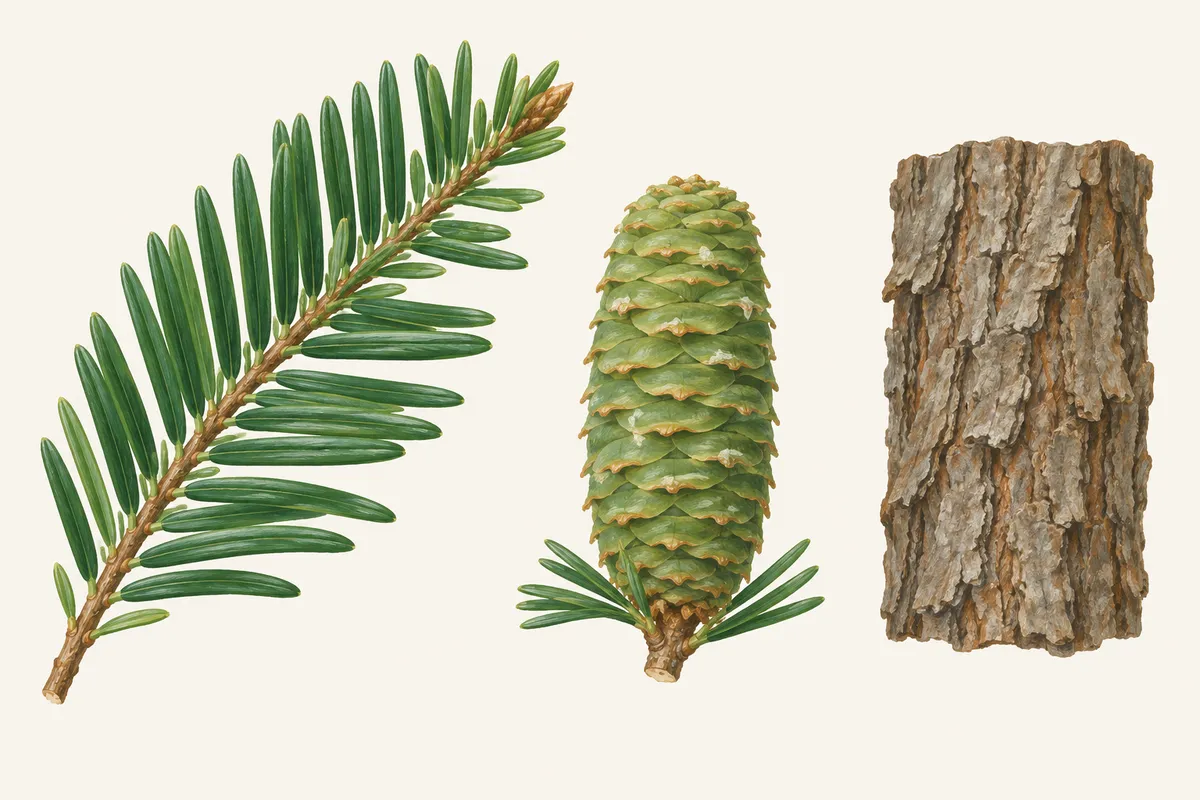
Grand fir identification is easiest on a low branch: the flat needles, 3/4 to 2 inches long, glossy dark green above with two white bands beneath, are spread in two neat flat rows, with long and short needles alternating, and they smell of oranges when crushed. The cones stand upright near the top, 2 to 4 inches long, green to purplish, and fall apart on the tree.
- A flat spray with needles of two lengths, notched at the tip, white below and dark glossy green above, is the classic grand fir sprig.
- Crush a needle: Natural Resources Canada says grand fir smells like oranges.
- Where grand fir meets white fir, from northern California to Idaho, the USDA Forest Service says hybrids cannot be told apart by eye.
Field marks at a glance
- Scientific name
- Abies grandis
- Family
- Pinaceae (pine family)
- Type
- Conifer, evergreen
- Needles
- Single, flat, 3/4 to 2 inches (Virginia Tech) or 20 to 35 mm (NRCan); shiny dark green above, two white bands beneath; tip notched or rounded; lengths alternate along the twig.
- Arrangement
- Spread horizontally in two flat, distinct rows, especially low in the crown, needles parallel to each other and at right angles to the twig.
- Scent
- Crushed needles smell like oranges (NRCan).
- Cones
- Upright near the top of the crown, barrel-shaped to cylindrical, 2 to 4 inches (VT) or 5 to 12 cm (NRCan), green to purplish green; scales fall off as the seeds ripen in August and September.
- Buds and twigs
- Buds rounded, blunt, resin-coated, about 5 mm, often three or more at the tip; twigs slender, olive-green to orange-brown, with round, flat scars.
- Bark
- Young: grey-green to greyish-brown, smooth with resin blisters and white blotches. Old: 2 to 3 inches thick, flat ridges and furrows; inner bark purple-red.
- Size
- Commonly 150 to 200 ft tall and 3 to 4 ft across; record tree 231 ft (70.4 m) on the Olympic Peninsula.
- Range
- Northwestern United States and southern British Columbia, roughly 39° to 51° N: from Vancouver Island and the coast south to northern California, and inland to the Inland Empire, including northern Idaho.
Grand fir is the fir of the lowland valleys and stream bottoms of the Pacific Northwest, and of the moist forests of northern Idaho. It is one of the easiest firs to recognize from a single low branch: flat, glossy sprays that look pressed in a book, and a citrus smell when you crush them. In the Forest Service's inventory of live trees on US forest land (EVALIDator) it ranks 37th of all species, the third most numerous true fir after balsam and subalpine fir.
How to identify a grand fir
1. Find a low, shaded branch. Virginia Tech's grand fir fact sheet says the needles grow in a spiral but flatten into two rows, especially lower in the crown. Natural Resources Canada's grand fir factsheet describes them spread horizontally in two distinct ranks. The result is a flat spray, as if the branch had been ironed.
2. Look at the needles closely. They are flat, 3/4 to 2 inches long (VT) or 20 to 35 mm (NRCan), shiny dark green and grooved above, with two white bands of dots beneath, and notched at the tip. Long and short needles alternate along the twig, and the ones on the upper side are shorter. Pull one: it leaves a round, flat scar on the twig, the mark of a true fir.
3. Crush a few needles. NRCan says they smell like oranges. The scent is a useful extra clue alongside the flat sprays.
4. Look at the buds. They are rounded, blunt and coated in resin, about 5 mm long, purple or bluish-brown (NRCan), and Virginia Tech notes that the terminal buds often come in clusters of three or more.
5. Look up for the cones. They stand upright near the top of the crown, barrel-shaped, 2 to 4 inches long and green to purplish green at maturity (VT); NRCan gives 5 to 12 cm. The USDA Forest Service's Silvics of North America describes them as mostly yellowish-green, occasionally greenish-purple, ripening in August and September of their first year. The scales then fall away with the seeds, leaving bare spikes.
For the traits shared by all true firs, see the fir identification page.
Bark, crown and size
Young bark is greyish-green to greyish-brown, smooth, with resin blisters and white blotches. With age it becomes 2 to 3 inches thick, greyish-brown and mottled, with flattened ridges and furrows, and Virginia Tech notes a purple-red inner bark. Open-grown young trees keep branches to the ground; old forest trees have a long, narrow, dense crown, rounded or flat-topped at the top, with horizontal main branches and lower branches that droop with upturned tips (NRCan).
Size depends enormously on the site. Virginia Tech gives a common height of 150 to 200 feet with trunks 3 to 4 feet across. The Forest Service records one tree on the Olympic Peninsula 231 feet (70.4 m) tall and 78.9 inches across, with mature coastal lowland trees in Washington at 140 to 200 feet. On exposed ridges of the Inland Empire, trees stay at 49 to 69 feet. Trees 250 years old are common and some pass 300.
Where grand fir grows
The Forest Service describes its home as the stream bottoms, valleys and mountain slopes of the northwestern United States and southern British Columbia, roughly 39° to 51° N. On Vancouver Island and the adjacent mainland it grows between sea level and 1,000 feet; in western Oregon up to about 3,000 feet; in northern California from near sea level to about 5,000 feet; in the Inland Empire, including northern Idaho, usually at 2,000 to 5,000 feet, occasionally 6,000.
West of the Cascades its neighbours include Sitka spruce, Pacific silver fir, western redcedar, western hemlock, Douglas-fir, bigleaf maple, red alder and black cottonwood. East of the Cascade crest it grows with western larch, ponderosa and lodgepole pine, Engelmann spruce and subalpine fir. The Pacific Northwest tree guide sorts these by forest zone, and the Douglas-fir page covers one of its most common neighbours.
Grand fir vs white fir and Pacific silver fir
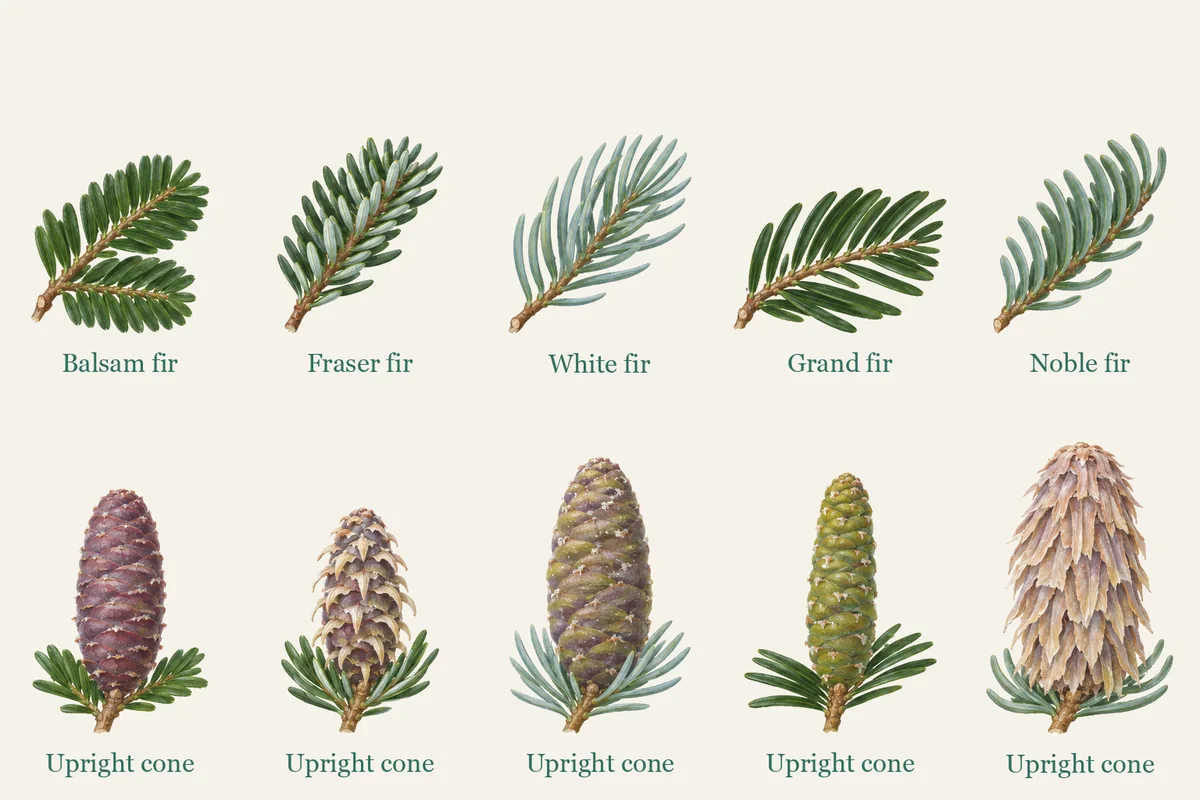
| Fir | Needles | Cones | Clue |
|---|---|---|---|
| Grand fir | 3/4–2 in, glossy dark green above, white bands below, flat in two rows | 2–4 in, green to purplish green | Long and short needles alternate; orange scent |
| White fir | 2–3 in, silvery blue-green on both sides, curving upward | 3–5 1/2 in, yellow-green to purple | Pale needles stand out from the twig |
| Pacific silver fir | About 1 in, dark green above, silvery white below | 3–6 in, purple to purplish brown | Buds coated in purple pitch |
White fir figures are from Virginia Tech's white fir fact sheet, Pacific silver fir from its Pacific silver fir fact sheet. The Pacific silver fir page shows the forward-pointing top needles that set that fir apart. On a typical tree, needle colour separates grand fir from white fir at a glance. In one zone it does not: the Forest Service's white fir silvics describes hybridization and introgression from northwestern California through central Oregon into central Idaho, where the trees are known regionally as "grandicolor" and cannot be told apart by eye.
Photographing a grand fir
A photo of a low spray from above, with a second of the underside, shows the two rows, the alternating lengths and the white bands. Tree Identifier names a tree from one photo of a twig, the bark or the whole tree. It shows no confidence score and no list of look-alikes, so check its answer with the scent and the needle arrangement, and use the follow-up chat to ask how grand fir differs from the other firs where you are. With location turned on, the Tree Map pins the find, which helps you return to the same tree when its cones are up.
Look-alikes and how to tell them apart
Pacific silver fir (Abies amabilis)
Both have flat needles, dark green above and white beneath. Virginia Tech gives Pacific silver fir needles about 1 inch long and cones 3 to 6 inches, purple to purplish brown; grand fir needles reach 2 inches and its cones, 2 to 4 inches, are green to purplish green.
White fir (Abies concolor)
White fir needles are longer, 2 to 3 inches, and silvery blue-green on both sides, curving upward. Grand fir needles are dark glossy green on top with white only beneath, and lie flat.
Douglas-fir (Pseudotsuga menziesii)
Douglas-fir buds are long, sharp and red-brown, and its cones, 3 to 4 inches, carry three-lobed bracts that stick out beyond the scales (Virginia Tech). Grand fir has blunt, resinous buds and upright cones that crumble.
Subalpine fir (Abies lasiocarpa)
Subalpine fir needles have a bluish-white bloom on all sides and sweep upward from the twig; its crown is a very narrow spire. Grand fir needles are green on top and spread flat in two rows.
What a photo can't settle
- Grand fir and white fir intergrade from the Klamath Mountains of northern California into northeastern Oregon and west-central Idaho, and the USDA Forest Service says the two and their hybrids cannot be separated visually there. No photo settles those trees.
- Cones grow only at the top of tall trees and break up in late summer, so a grand fir is usually identified from a fallen branch or the lowest sprays.
- Sprays high in the crown are less flat and less two-ranked than shaded lower branches, so photograph a low branch if you can.
Questions people ask
How do you tell grand fir from Douglas-fir?
Check the buds and cones. Virginia Tech describes Douglas-fir buds as long, sharp and red-brown, and its cones carry three-lobed bracts that stick out beyond the scales. Grand fir buds are rounded, blunt and coated in resin, and its cones stand upright and fall apart on the branch.
Why do grand fir needles have two lengths?
It is a trait of the species. Virginia Tech notes that needle lengths alternate along the twig, and NRCan that the needles on the upper side are shorter. Laid flat in two rows, long and short needles give the spray a slightly uneven edge, a good field clue.
What does grand fir smell like?
Citrus. Natural Resources Canada says the needles smell like oranges when crushed. White fir, its close relative, also has a citrus smell according to Virginia Tech, so the scent will not separate those two; needle colour and arrangement will.
How tall does grand fir grow?
Virginia Tech gives 150 to 200 feet and 3 to 4 feet in diameter. The USDA Forest Service records a tree 231 feet tall on the Olympic Peninsula, while trees on exposed inland ridges stay at 49 to 69 feet. NRCan gives up to 40 m on the BC coast, rarely that inland.
Where does grand fir grow?
In stream bottoms, valleys and mountain slopes of the northwestern United States and southern British Columbia (USDA Forest Service): near sea level on the coast, up to about 5,000 feet in northern California and the Inland Empire, occasionally 6,000 feet.
Sources
- Grand Fir, Silvics of North America — USDA Forest Service
- Grand fir fact sheet — Virginia Tech Dendrology
- Grand fir (Abies grandis), Trees, insects and diseases of Canada's forests — Natural Resources Canada, Canadian Forest Service
- Pacific silver fir fact sheet — Virginia Tech Dendrology
- White Fir, Silvics of North America — USDA Forest Service
- White fir fact sheet — Virginia Tech Dendrology
- Douglas-fir fact sheet — Virginia Tech Dendrology
- EVALIDator (FIADB-API 2.0): number of live trees on forest land by species, 48 conterminous states — USDA Forest Service, Forest Inventory and Analysis