Tree profile
Subalpine fir (Abies lasiocarpa): how to identify it
The narrow, dark spire near treeline in the western mountains: soft flat needles that curve upward, dark purple cones standing on the top branches and smooth bark that stays grey for decades.
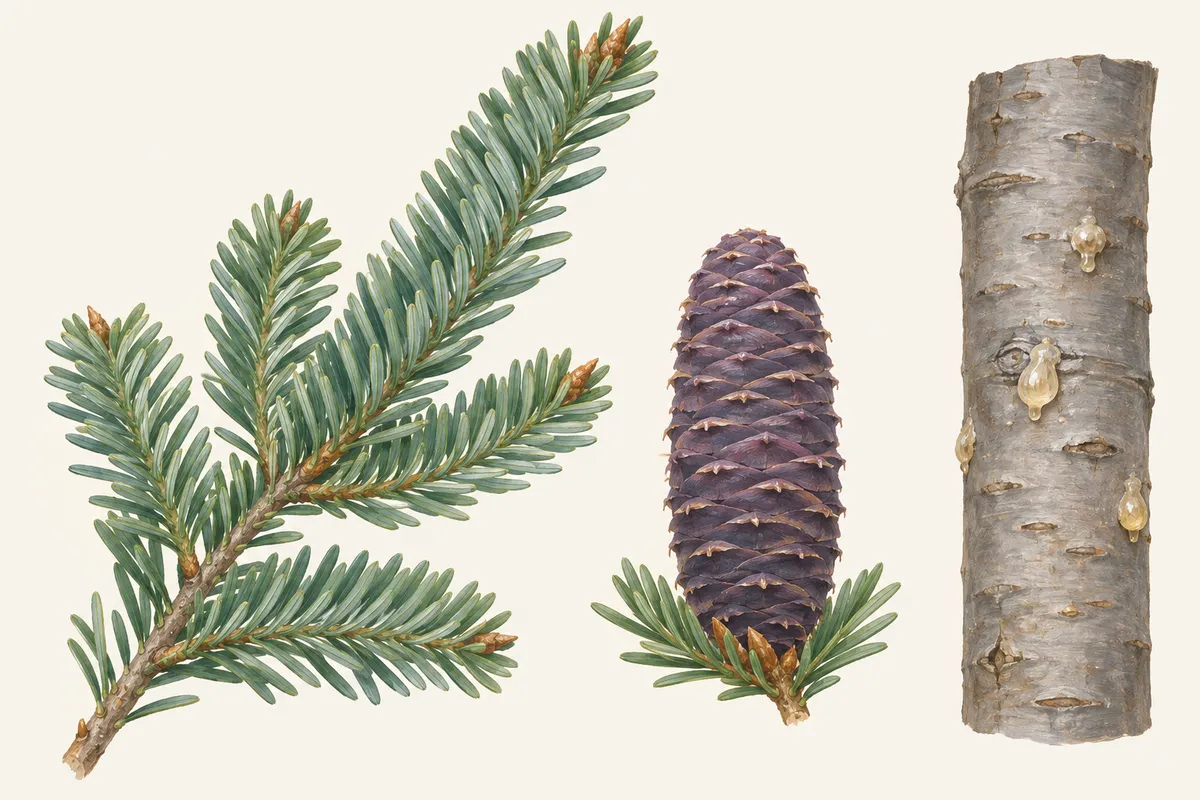
In short
Subalpine fir identification rests on three things: a very narrow, dense crown ending in a spike-like point; flat, soft needles about 1 to 1.5 inches long with a bluish-white bloom, crowded and curving upward on the twig; and cylindrical cones 2 to 4 inches long that stand upright, purple to indigo, and fall apart on the branch. Young bark is smooth, grey and dotted with resin blisters.
- In the Rocky Mountains, subalpine fir grows mostly with Engelmann spruce: roll a needle, and if it stays flat, it is the fir.
- Cones that stand upright like candles at the top of a narrow spire mean a true fir; spruce and Douglas-fir cones hang.
- Corkbark fir, a variety in southern Colorado and the Southwest, has whitish, corky bark.
Field marks at a glance
- Scientific name
- Abies lasiocarpa
- Family
- Pinaceae (pine family)
- Type
- Conifer, evergreen
- Needles
- Single, flat and soft, about 1 inch (Virginia Tech) or 25 to 40 mm (NRCan) long, varying on one twig; greyish to bluish green with a white bloom, rounded or notched at the tip; crowded and curving upward, rarely in two flat rows.
- Cones
- Upright, cylindrical and slender, 2 to 4 inches (VT) or 4 to 10 cm (NRCan); purple to indigo blue when they open, greyish-brown later; break up from early September and leave a bare spike.
- Crown
- Very narrow and dense, spire-like, ending in a conspicuous spike-like point; branches often reach the ground.
- Bark
- Smooth, grey to ash-grey with raised resin blisters; stays smooth for a long time, breaking into scales only near the base of old trees.
- Buds and twigs
- Buds small, rounded, resinous, 3 to 6 mm; twigs stout, orange-brown to ash-grey, hairy for several years, with round, flat needle scars.
- Size
- 14 to 30 m (45 to 100 ft) tall and 30 to 61 cm (12 to 24 in) across in closed forest; a low shrub or mat at treeline.
- Range
- Western mountains from Arizona and New Mexico (32° N) north to the Yukon (64° 30′ N), through the Rockies, the interior of British Columbia and western Alberta, and the Cascades.
- Elevation
- Near sea level in the far north, up to 12,000 ft (3,658 m) in the south; usually 9,000 to 11,000 ft in Wyoming, Utah and Colorado.
Subalpine fir is the tree that gives high western forests their dark spires. In the Rocky Mountains it grows with Engelmann spruce from the upper montane slopes to treeline, and from a distance the two look alike: dark, narrow, dense. Up close, the fir is easy to tell. It is also one of the most numerous trees in the United States: in the Forest Service's inventory of live trees on US forest land, subalpine fir ranks eleventh of all species, as our page on the most common trees in the US explains.
How to identify a subalpine fir
1. Look at the crown shape. The USDA Forest Service's Silvics of North America describes a long, narrow, conical crown that ends in a conspicuous spike-like point. Virginia Tech calls it very narrow and dense, often spire-like, with branches reaching the ground. On a slope full of conifers, the slim dark spires are usually subalpine fir.
2. Pull a needle. It is flat and soft and leaves a round, flat scar on the twig. Virginia Tech's subalpine fir fact sheet gives needles about 1 inch long, thickened in the middle, with a bluish-white bloom on all surfaces; Natural Resources Canada's factsheet gives 25 to 40 mm, varying on the same twig, greyish-green to light bluish-green. The tips are mostly rounded or notched, sometimes pointed near the top of the tree.
3. Look at how the needles lie. They spiral around the twig and sweep upward, standing almost erect, which Virginia Tech says gives the twig a neat, manicured look. Many other firs spread their needles flat in two rows; subalpine fir does so only occasionally (NRCan).
4. Check the bark. Young bark is smooth, grey-green to ash-grey, with raised resin blisters. Virginia Tech notes that it later turns grey to white and stays unbroken except near the base of large trees. Smooth, pale bark on a big trunk is a good fir clue.
5. Look up for the cones. They grow upright near the top of the crown, often in clusters: cylindrical and slender, 2 to 4 inches long and purple according to Virginia Tech, 4 to 10 cm according to NRCan. The Forest Service says they are indigo blue when they open, between mid-August and mid-October, and then fall apart on the branch, leaving a spike-like central axis. In the Rocky Mountain tree guide, subalpine fir is the only common conifer whose cones stand upright.
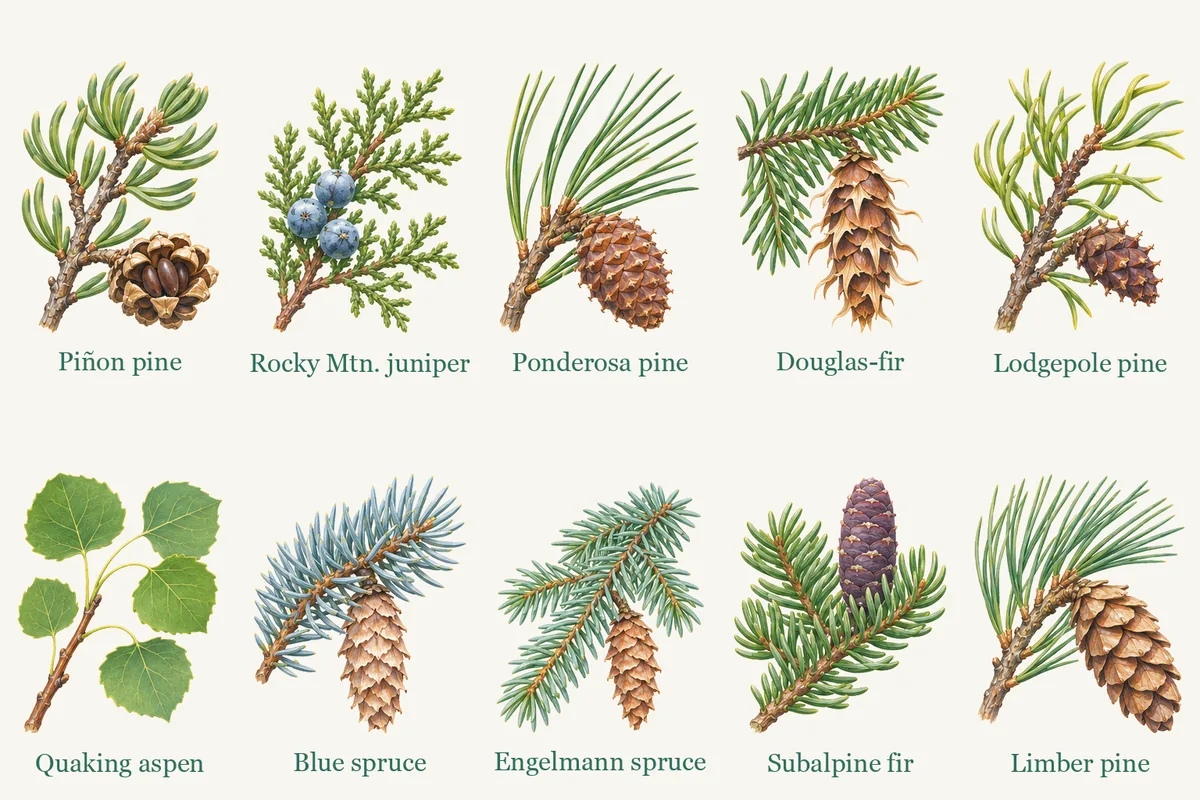
Subalpine fir vs Engelmann spruce
Engelmann spruce is the tree you will most often confuse it with. The Forest Service's Engelmann spruce silvics names subalpine fir its common associate at all elevations in the Rockies and Cascades, and the two form a forest type of their own, Engelmann spruce-subalpine fir.
| Check | Subalpine fir | Engelmann spruce |
|---|---|---|
| Needle | Flat, soft, will not roll | Four-sided, rolls between fingers |
| Bare twig | Smooth, round flat scars | Rough with woody pegs |
| Cones | Upright, crumble on the tree | Hang down, fall whole, 1 to 2.5 in |
| Young bark | Smooth, grey, resin blisters | Thin |
The needle and twig tests come from Ohio State Extension's fact sheet Is It Pine, Spruce, or Fir?, which explains that spruce needles sit on peg-like structures that stay on the branch, while fir needles leave a small circular scar. Our spruce vs fir page goes through the same tests with a comparison sheet. At timberline, the Forest Service notes that both species form wind-shaped krummholz only 3 to 7 feet high, so the crown shape no longer helps there; the needle does.
Where subalpine fir grows
The range is the largest of any western fir. The Forest Service gives 32° N in Arizona and New Mexico to 64° 30′ N in the Yukon. In Canada, NRCan describes it across central British Columbia and western Alberta north into the Yukon, uncommon near the Pacific coast. It grows near sea level in the far north and up to 12,000 feet in the south; in the Rocky Mountains of Wyoming, Utah and Colorado it usually grows at 9,000 to 11,000 feet. In the Pacific Northwest its common associates are mountain hemlock and Pacific silver fir, and our Pacific Northwest guide places it in the high forest zone there.
On harsh sites such as lava flows, talus slopes and treeline, it often reproduces by layering: low branches touching the ground take root and grow into new stems (Forest Service). The result is a clump of small firs around a parent tree.
Corkbark fir
In southern Colorado and the Southwest, a variety called corkbark fir (Abies lasiocarpa var. arizonica) replaces the typical form on some mountains. The Forest Service describes its peculiar, whitish, corky bark, and restricts it to scattered mountains in southwestern Colorado, New Mexico and the high mountains of Arizona. The needles and cones follow the species; the soft, pale bark is the tell.
Size and age
In closed forest, the Forest Service gives heights of 14 to 30 m (45 to 100 ft) and diameters of 30 to 61 cm (12 to 24 in); trees over 130 feet are exceptional. Virginia Tech gives 40 to 100 feet. Growth is slow: under favourable conditions trees take 20 to 40 years to reach 4 to 5 feet. Trees 10 to 20 inches across are often 150 to 200 years old, and trees older than 250 years are not uncommon, but heart rot is severe and kills many early.
Photographing a subalpine fir
Most of the year the cones are out of reach or gone, so take two photos: the whole tree, to show the narrow spire, and a twig from above, so the upward-curving needles and their bloom show. Tree Identifier names a tree from one photo of a twig, the bark or the whole tree, and its follow-up chat can answer a question such as how to tell the fir from the spruce growing beside it. The app shows no confidence score and no look-alike list, so check its answer with the needle roll and the cones. With location turned on, the Tree Map pins the find, so you can come back in August to see the purple cones. For the other firs of North America, including the eastern balsam fir, see the fir identification page.
Look-alikes and how to tell them apart
Engelmann spruce (Picea engelmannii)
Its constant neighbour. Roll a needle between your fingers: spruce needles are four-sided and roll, and leave woody pegs on a rough twig. Spruce cones hang down and drop whole; subalpine fir cones stand upright and crumble on the tree.
Grand fir (Abies grandis)
Grand fir needles are dark yellow-green with two white bands only beneath and lie in two flat, neat rows. Subalpine fir needles have a bluish-white bloom on all sides and sweep upward from the twig.
White fir (Abies concolor)
White fir needles are much longer, 2 to 3 inches, silvery blue-green on both sides, and stand out from the twig. Old white fir bark is thick, ashy grey and deeply furrowed; old subalpine fir bark stays mostly smooth.
Douglas-fir (Pseudotsuga menziesii)
Virginia Tech describes Douglas-fir cones 3 to 4 inches long with three-lobed bracts sticking out beyond the scales, and long, sharp, red-brown buds. Subalpine fir has upright cones that crumble on the tree and small, rounded, resinous buds.
What a photo can't settle
- Subalpine fir cones grow only at the top of the tree and break up in early fall, so most of the year you identify it from the crown, needles and bark.
- Where subalpine fir meets balsam fir in Alberta the two may hybridize, so trees there can show mixed traits.
- Needle colour varies, and the USDA Forest Service lists cultivars with intensely bluish or twisted needles; colour alone does not prove the species.
Questions people ask
How do you tell subalpine fir from Engelmann spruce?
Roll a needle. Ohio State Extension explains that fir needles are flat and will not roll, while spruce needles are four-sided and roll easily and sit on woody pegs. Then look up: subalpine fir cones stand upright and fall apart on the branch, spruce cones hang and drop whole.
What is corkbark fir?
A variety of subalpine fir, Abies lasiocarpa var. arizonica. The USDA Forest Service describes its peculiar whitish, corky bark and restricts it to the Rocky Mountains of southern Colorado, New Mexico and the high mountains of Arizona. It does not bear cones until about 50 years old.
What color are subalpine fir cones?
Purple to dark blue while they are on the tree. Virginia Tech describes mature cones as purple, and the USDA Forest Service says they are indigo blue when they open, in mid-August to mid-October. NRCan describes mature cones as greyish-brown, the colour they take as they dry and break up.
Why is subalpine fir so narrow?
The narrow, spire-shaped crown is the species' typical form: the USDA Forest Service describes a long, narrow conical crown ending in a spike-like point, and Virginia Tech calls the crown very narrow and dense. Near treeline, wind and snow reduce trees to low shrubs.
How old do subalpine firs get?
The USDA Forest Service says trees 10 to 20 inches across in closed forest are often 150 to 200 years old, and trees older than 250 years are not uncommon. Heart rot kills many earlier. NRCan gives a maximum age of 200 years.
Sources
- Subalpine Fir, Silvics of North America — USDA Forest Service
- Subalpine fir fact sheet — Virginia Tech Dendrology
- Subalpine fir (Abies lasiocarpa), Trees, insects and diseases of Canada's forests — Natural Resources Canada, Canadian Forest Service
- Engelmann Spruce, Silvics of North America — USDA Forest Service
- Is It Pine, Spruce, or Fir? (Fact Sheet ANR-80) — Ohio State University Extension
- Grand fir fact sheet — Virginia Tech Dendrology
- White fir fact sheet — Virginia Tech Dendrology
- Douglas-fir fact sheet — Virginia Tech Dendrology