Also in Français
Tree profile
Balsam fir (Abies balsamea): how to identify it
The fir of the northern forest and the Christmas tree lot: flat, fragrant needles in two rows, smooth bark full of resin blisters and upright cones that never reach the ground whole.
In short
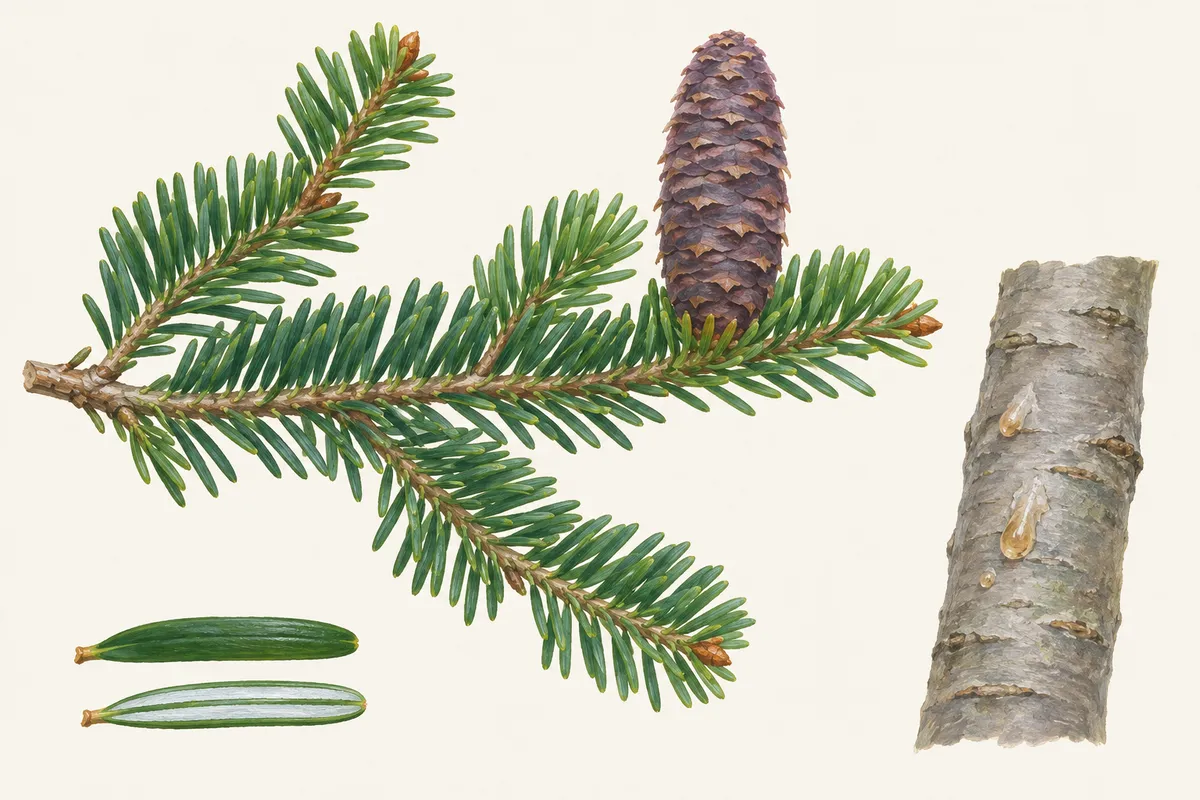
Balsam fir identification starts with the needles: single, flat, 15 to 25 mm long, shiny dark green with two pale bands of white dots beneath, spread in two rows and strongly fragrant when crushed. Young bark is smooth and grey with raised resin blisters. The cones, 4 to 10 cm long, stand upright near the top of the tree and fall apart there from early September.
- A flat needle that will not roll between your fingers and leaves a round scar on a smooth twig makes it a fir, not a spruce.
- Squeeze a resin blister on the bark of a young tree: balsam fir keeps its resin there.
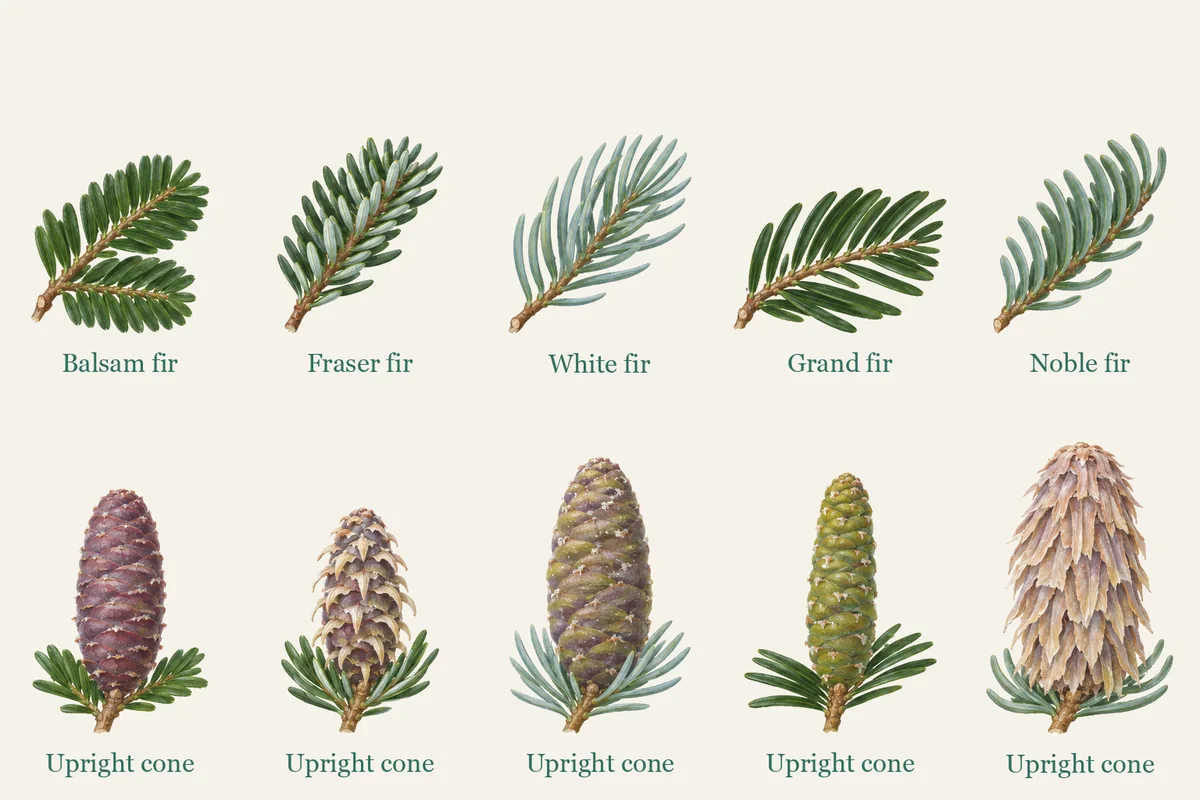
- Fraser fir looks almost the same; its cone bracts curl out over the scales, while balsam fir's mostly stay hidden.
Field marks at a glance
- Scientific name
- Abies balsamea
- Family
- Pinaceae (pine family)
- Type
- Conifer, evergreen
- Needles
- Single, flat, 15 to 25 mm long, rounded or notched at the tip; shiny dark green above, 10 to 12 lines of white dots beneath; in two ranks, shorter on the upper side of the twig; strong smell when crushed.
- Cones
- Upright, barrel-shaped and resinous, 4 to 10 cm long, greyish-brown when mature; they break up on the tree from early September and leave a bare spike for several years.
- Bark
- Grey and smooth with raised resin blisters when young; brownish and broken into irregular scales with age. Thin, so the tree is easily killed by fire.
- Buds
- Broadly egg-shaped, resinous, about 5 mm long.
- Twigs
- Greenish-grey, smooth, finely hairy; a pulled needle leaves a round, flat scar.
- Form
- Regular crown tapering to a spire-like top in the forest; open-grown trees keep green branches to the ground.
- Size
- Usually 12 to 18 m (40 to 60 ft) tall and 30 to 46 cm (12 to 18 in) across; NRCan gives up to 25 m.
- Range
- Newfoundland and Labrador west to northwestern Alberta; in the US from northern Minnesota and Wisconsin to Michigan, New York, Pennsylvania and New England, locally in Virginia and West Virginia.
Balsam fir is the fir most people in the northern US and eastern Canada meet: on the forest edge, in boreal spruce stands and on the Christmas tree lot. It is also one of the most numerous trees in the country. In the Forest Service's inventory of live trees on US forest land (EVALIDator), balsam fir ranks fourth of all species, with about 14 billion stems, as our page on the most common trees in the US explains. Its needles, bark and cones are easy to check once you know the order.
How to identify a balsam fir
Work through these four checks; three matching make a confident identification.
1. Pull a needle and roll it. Natural Resources Canada's balsam fir factsheet describes single needles 15 to 25 mm long, rounded or notched at the tip, shiny dark green above, often with a few white dots near the tip, and 10 to 12 lines of white dots beneath. The needle is flat, so it will not roll between your fingers, and it leaves a round, flat scar on a smooth twig. Ohio State Extension's fact sheet Is It Pine, Spruce, or Fir? uses exactly this test to separate firs from spruces.
2. Look at how the needles lie. On balsam fir they spread in two ranks along the twig, like the teeth of a comb, and the needles on the upper side are shorter than those on the sides. Crush a few: NRCan notes a strong smell, the balsam scent that gives the tree its name.
3. Check the bark of a young tree. It is grey, thin and smooth, dotted with raised resin blisters. Press one and sticky, fragrant resin comes out. The USDA Forest Service's Silvics of North America notes that balsam fir's oleoresin is found only in these bark blisters. On old trunks the bark turns brownish and breaks into irregular scales.
4. Look up for the cones. Balsam fir cones stand upright on the top branches, barrel-shaped, resinous and 4 to 10 cm long, greyish-brown when ripe (NRCan). They ripen in the first fall, from late August into early September, and then fall apart on the branch: scales, bracts and seeds drop and leave a bare central spike that can stay on the tree for years (USDA Forest Service). Whole balsam fir cones on the ground are rare.
Buds are a useful extra check in winter: broadly egg-shaped, coated in resin, about 5 mm long. For the general fir tests and the other species in the genus, see the fir identification page.
Shape, size and where it grows
A forest-grown balsam fir has a slightly tapered trunk and a regular, narrow crown that tapers to a spire-like top, with dead lower branches that persist for several years. Open-grown trees keep living branches all the way to the ground (NRCan). The Forest Service gives a usual height of 12 to 18 m (40 to 60 ft) and a trunk 30 to 46 cm (12 to 18 in) across; on the best sites, such as New Brunswick's Green River watershed, trees reach 27 m (90 ft). The root system is shallow.
The range covers most of the northern forest. In Canada it runs from Newfoundland and Labrador west through northern Quebec and Ontario to the Peace River Valley in northwestern Alberta. In the United States it grows from extreme northern Minnesota east through Wisconsin and Michigan into New York, central Pennsylvania and all of New England, with local stands in the mountains of Virginia and West Virginia. It goes from sea level almost to the summit of Mount Washington, where it grows as a low, prostrate shrub in sheltered spots.
In Canada's boreal forest it grows with black and white spruce, paper birch and quaking aspen. Farther south it mixes with red spruce, yellow birch, red and sugar maple, eastern hemlock and eastern white pine. Our New England tree identification guide sets it beside those neighbours.
Balsam fir vs Fraser fir, spruce and subalpine fir
| Tree | Needles | Cones | Bark and twig |
|---|---|---|---|
| Balsam fir | Flat, 15–25 mm, two rows, white dots beneath | Upright, 4–10 cm, greyish-brown, bracts mostly hidden | Smooth with resin blisters; round scars on a smooth twig |
| Fraser fir | Flat, about 1 in, silvery white beneath | Upright, about 2.5 in, purple-brown, bracts curl down over scales | Smooth, light grey, resin blisters |
| Spruces | Four-sided, roll between fingers | Hang down, fall whole | Woody pegs make a bare twig rough |
| Subalpine fir | Flat, 25–40 mm, greyish to bluish green, crowded upward | Upright, 4–10 cm | Smooth, ash-grey, resin blisters |
Fraser fir figures come from NC State Extension's Fraser fir profile, which separates the two by their cone bracts: Fraser fir's are long and curl downward, "unlike the short bracts on balsam fir cone that are hidden by the scales." In the wild, Fraser fir grows only at 4,000 to 6,700 feet in the southern Appalachians, so a fir in Maine or Ontario is not a Fraser. One complication: the Forest Service describes a bracted balsam fir (var. phanerolepis, sold as Canaan fir) whose bracts are longer than the scales, from Labrador and Newfoundland to Maine, the high peaks of New England and New York, and locally in Virginia and West Virginia.
Subalpine fir figures are from NRCan's subalpine fir factsheet; the two firs meet in Alberta. The spruce vs fir page covers the needle, cone and twig tests against spruce in more detail.
Balsam fir as a Christmas tree
NRCan lists Christmas trees among balsam fir's main uses, with wood pulp and lumber. On a cut tree there are usually no cones, so rely on the needles: flat, soft, two rows, white dots beneath and that strong balsam scent. If the needles are four-sided and roll between your fingers, the tree is a spruce; in bundles, a pine. The Christmas tree identification guide sorts balsam fir from Fraser, noble, Nordmann and the other firs sold beside it.
Tree Identifier can name a fir from one photo of a twig, the bark or the whole tree, and the follow-up chat answers questions such as how to tell it from a Fraser fir. The app shows no confidence score and no list of look-alikes, so confirm the answer with the needle and cone checks above.
Pests that change how balsam fir looks
The Forest Service calls the spruce budworm balsam fir's most important insect enemy: it prefers fir to spruce, and stands have been defoliated in as many as 11 outbreaks in eastern North America since 1704. The balsam woolly adelgid, an introduced insect, can kill trees within 3 years of a severe attack on the stem. A balsam fir with a thin or partly bare crown may be a damaged tree, not a different species. Tree Identifier's Diagnose tool rates the severity of visible symptoms from a photo, and with location turned on, the app's Tree Map pins the find so you can check the same tree next season.
Look-alikes and how to tell them apart
Fraser fir (Abies fraseri)
Look at a cone: NC State Extension says Fraser fir has long bracts that curl downward over the scales, unlike balsam fir's short, hidden bracts. Wild Fraser fir grows only at 4,000 to 6,700 feet in the southern Appalachians.
Spruces (white, black and red spruce)
Roll a needle between your fingers. Spruce needles are four-sided and roll; they sit on woody pegs that stay on the twig, which feels rough. Spruce cones hang down and fall whole.
Subalpine fir (Abies lasiocarpa)
Only an issue in Alberta, where the two meet and may hybridize. Subalpine fir needles are longer, 25 to 40 mm, greyish to bluish green and crowded upward, not spread flat in two rows.
What a photo can't settle
- Balsam fir cones grow at the very top of the tree and break up from early September, so for most of the year you identify it from needles, bark and buds.
- Balsam fir and Fraser fir are closely related, and the USDA Forest Service mentions a possible hybrid between them; a cut Christmas tree without cones may not be separable from one photo.
- Where balsam and subalpine fir meet in Alberta they may hybridize, so trees there can show mixed traits.
Questions people ask
How do you tell balsam fir from Fraser fir?
By the cone bracts. NC State Extension says Fraser fir cones have long bracts that curl downward over the scales, while balsam fir's short bracts are hidden by the scales. The USDA Forest Service notes a bracted variety of balsam fir in the Northeast whose bracts are longer than the scales, so range helps too.
How do you tell balsam fir from spruce?
Pull a needle. Ohio State Extension explains that fir needles are flat and cannot be rolled between your fingers, and leave a small circular scar on a smooth twig. Spruce needles are four-sided, roll easily and leave woody pegs behind. Balsam fir cones stand upright; spruce cones hang.
Why does balsam fir bark have bubbles?
They are resin blisters. NRCan describes young balsam fir bark as smooth with raised resin blisters, and the USDA Forest Service notes that the tree's oleoresin is found only in those blisters. The bark becomes scaly and brownish with age.
How tall does a balsam fir get?
The USDA Forest Service gives 12 to 18 m (40 to 60 ft) as typical, with trees up to 27 m (90 ft) on the best sites in New Brunswick. NRCan gives up to 25 m and 70 cm across, and a maximum age of about 150 years; the Forest Service gives about 200.
Where does balsam fir grow?
Across the boreal and northern forest: from Newfoundland and Labrador west to the Peace River Valley in Alberta, and in the US from northern Minnesota to New England, south to central Pennsylvania, with local stands in the mountains of Virginia and West Virginia (USDA Forest Service).
Sources
- Balsam Fir, Silvics of North America — USDA Forest Service
- Balsam fir (Abies balsamea), Trees, insects and diseases of Canada's forests — Natural Resources Canada, Canadian Forest Service
- Subalpine fir (Abies lasiocarpa), Trees, insects and diseases of Canada's forests — Natural Resources Canada, Canadian Forest Service
- Abies fraseri (Fraser fir) — NC State Extension, North Carolina Extension Gardener Plant Toolbox
- Is It Pine, Spruce, or Fir? (Fact Sheet ANR-80) — Ohio State University Extension
- EVALIDator (FIADB-API 2.0): number of live trees on forest land by species, 48 conterminous states — USDA Forest Service, Forest Inventory and Analysis