Tree profile
Pacific silver fir (Abies amabilis): how to identify it
The shade-loving fir of the wet Cascades and the coast from Alaska to Oregon: needles that brush forward over the top of the twig, bright silver beneath, and smooth gray bark.
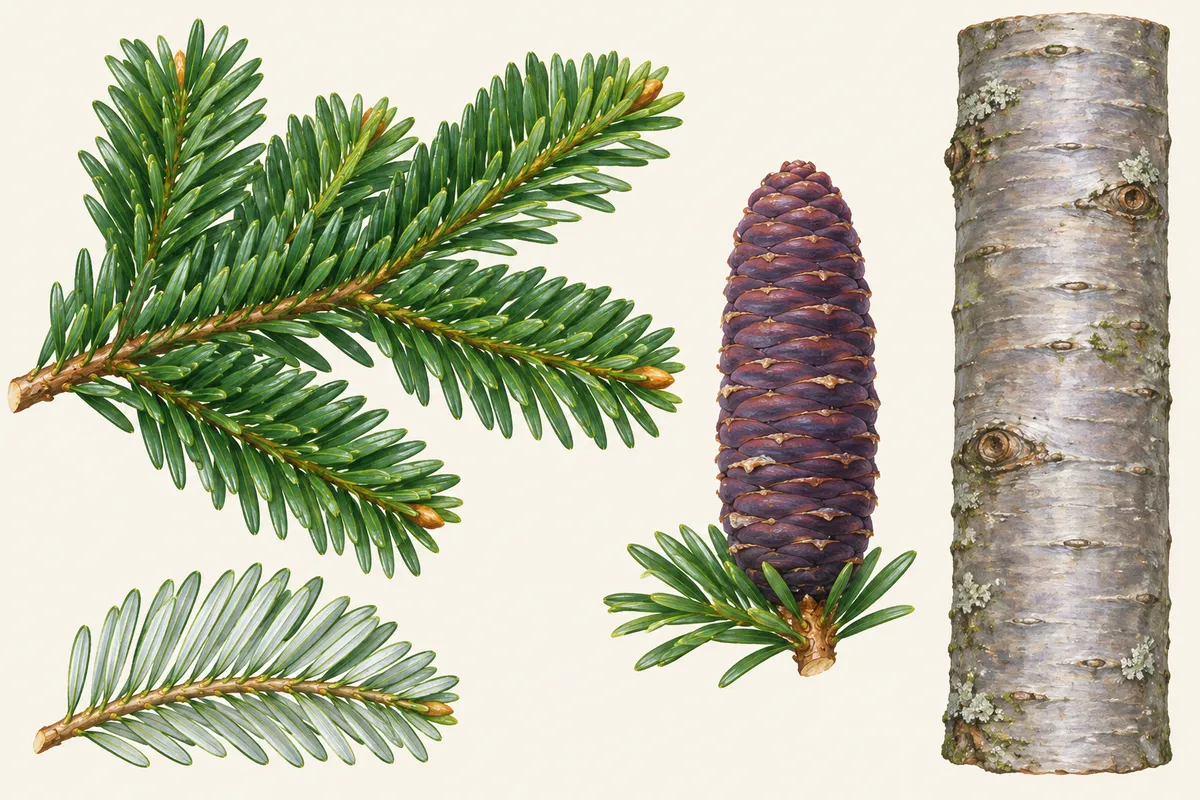
In short
Pacific silver fir identification rests on the twig: flat needles about 1 inch long, dark glossy green above and silvery white beneath, with the needles on top of the twig short, pressed flat and pointing forward, a pattern Virginia Tech compares to a ski jumper. Upright purple cones 3 to 6 inches long sit high in the crown, buds are coated in purple pitch, and young bark is smooth and gray.
- Look down on a twig: a top row of short needles brushed forward over it means Pacific silver fir; grand fir spreads its needles in two flat ranks.
- Turn a needle over: two bright white bands underneath give the tree its name.
- Crushed needles smell of oranges, according to Natural Resources Canada.
Field marks at a glance
- Scientific name
- Abies amabilis
- Family
- Pinaceae (pine family)
- Type
- Conifer, evergreen
- Needles
- Flat, about 1 inch (20 to 30 mm) long, tip usually notched; shiny dark green and grooved above, with two white bands beneath that look silvery.
- Arrangement
- Needles on the sides and underside spread sideways and curve up; those on top of the twig are shorter, pressed flat and point forward, like a ski jumper (Virginia Tech).
- Smell
- Crushed needles smell like oranges (Natural Resources Canada).
- Cones
- Upright, barrel-shaped, 3 to 6 inches (8 to 16 cm), purple to purplish brown, on the top branches; scales fall as the seeds ripen in late summer and fall.
- Buds
- Large, rounded, coated in purple pitch; NRCan gives 3 to 7 mm, dark bluish-brown. Terminal buds often in clusters of three or more.
- Bark
- Thin, smooth, light gray with whitish blotches and resin blisters when young; scaly and furrowed only near the base of old trees.
- Form
- Straight trunk, long, dense, symmetrical conical crown with branches at right angles to the stem.
- Size
- Old-growth trees commonly 180 to 200 feet; record 245 feet and 101 inches across (USDA Forest Service). NRCan gives up to 40 m.
- Range
- Southeastern Alaska, coastal British Columbia and Vancouver Island, the Olympic Mountains and the Cascades of Washington and Oregon; sporadic in the Coast Ranges and in the Klamath Mountains of northwestern California.
Pacific silver fir is the fir of the wet, shady forests of the Pacific Northwest: the Olympics, the Cascades and the coast north to Alaska, where snow lies late and summers are cool. The USDA Forest Service calls it one of the most shade-tolerant trees of the region, and it grows with western hemlock, Douglas-fir and western redcedar. Its name comes from the bright white undersides of its needles, but the surest mark is on top of the twig.
How to identify a Pacific silver fir
Work through these in order.
1. Look down on a twig. On the sides of the twig the needles spread out flat; on top, a row of shorter needles lies pressed flat and points forward, toward the tip. Virginia Tech's Pacific silver fir fact sheet says the topmost needles point upward and forward "like a ski jumper". Natural Resources Canada's amabilis fir factsheet describes the same: needles on the lower surface and sides spread horizontally and curve upward, those on the upper surface are shorter, flattened, grooved and directed forward.
2. Turn a needle over. Needles are flat, about 1 inch long (NRCan: 20 to 30 mm), notched at the tip, shiny dark green and grooved above. Beneath, Oregon State University's landscape plant page counts two white bands of 5 to 6 lines each, which make the underside look silver.
3. Crush a few needles. NRCan says the smell is like oranges.
4. Find a bud. Buds are large, rounded and coated in purple pitch (Virginia Tech); NRCan gives 3 to 7 mm and dark bluish-brown. End buds often sit in clusters of three or more.
5. Read the bark. Young bark is thin, smooth, light gray with whitish blotches and resin blisters. Even old trees keep fairly thin, gray bark, scaly and furrowed only near the base. Thick, deeply furrowed bark points to another conifer.
6. Look up. Cones stand upright on the top branches, barrel-shaped, 3 to 6 inches long and purple when ripe. They fall apart on the tree, so the ground holds loose scales, not whole cones.
Tree Identifier can name a fir from one photo of a twig, ideally taken from above so the forward-brushed top needles show. It gives one name without a confidence score or a list of look-alikes, so confirm with the twig test.
Pacific silver fir vs grand, noble and subalpine fir
Four true firs share the Cascades, and the fir page explains the genus marks they share: upright cones, flat needles, round leaf scars. Figures below come from Virginia Tech's fact sheets for Pacific silver, grand, noble and subalpine fir.
| Fir | Needles | Arrangement | Cones |
|---|---|---|---|
| Pacific silver | About 1 in, dark green above, silvery white below | Top needles short, pressed forward | 3–6 in, purple to purplish brown |
| Grand | 3/4–2 in, dark yellow-green, two white bands below | Two flat ranks | 2–4 in, green to purplish green |
| Noble | About 1 in, bluish-white on all sides, hockey-stick base | Needles sweep upward | 4–6 in, bracts fold down over the scales |
| Subalpine | About 1 in, bluish-white bloom | Needles swept upward, neat | 2–4 in, purple |
Grand fir is the most common confusion at low elevations; the grand fir page covers its flat sprays and orange scent. Noble fir is easiest when cones are present, because its bracts almost cover the cone. Subalpine fir, on the subalpine fir page, has a narrow spire crown at treeline that Pacific silver fir does not share.
Where Pacific silver fir grows
The USDA Forest Service's Pacific silver fir silvics gives the range: southeastern Alaska, coastal British Columbia and Vancouver Island, and the western and upper eastern slopes of the Cascades in Washington and Oregon, throughout the Olympic Mountains, sporadically in the Coast Ranges of Washington and northern Oregon, and in the Klamath Mountains of northwestern California. Elevations run from sea level to 1,000 feet in Alaska, 800 to 6,000 feet in the Washington Cascades and 2,000 to 6,000 feet in the Oregon Cascades.
It needs a maritime climate with cool summers and is most abundant where summer drought is minimal: heavy-rainfall areas, seepage sites and places where snow melts late. Its neighbors include western hemlock, mountain hemlock, Douglas-fir, noble fir, western redcedar, grand fir, Sitka spruce and Alaska-cedar. The Pacific Northwest tree guide sorts these by forest zone, and the hemlock comparison shows the western hemlock it so often grows under.
Size, age and shade tolerance
The Forest Service calls Pacific silver fir one of the most shade-tolerant trees in the Northwest. Old-growth trees are commonly 180 to 200 feet tall and more than 24 inches in diameter; the largest known, in Olympic National Park, was 245 feet tall and 101 inches across. Near timberline it grows in clumps only 60 to 80 feet tall. It begins bearing cones at 20 to 30 years. Trees of 500 to 550 years have been found and the maximum reported age is 590 years; NRCan gives a lower maximum of about 300 years and a height of up to 40 m.
The crown is rigid and symmetrical, with branches at right angles to the trunk (Forest Service). The species does not hybridize with the other true firs around it, and the Forest Service notes that apparent intermediates with subalpine fir proved not to be hybrids, so a confusing tree is more likely a shade form than a cross.
With location turned on, Tree Identifier's Tree Map pins each find, which helps when the same mountain trail holds three or four firs and you want to return to one when its cones are up.
Look-alikes and how to tell them apart
Grand fir (Abies grandis)
Grand fir needles, 3/4 to 2 inches, spread in two flat ranks with no forward-brushed top row; Pacific silver fir has a top row of short needles brushed forward. Grand fir cones are 2 to 4 inches and green to purplish green, not purple.
Noble fir (Abies procera)
Noble fir needles have a bluish-white coating on all surfaces and a hockey-stick curve at the base, and its 4 to 6 inch cones are covered by bracts that stick out and fold down. Pacific silver fir needles are dark green above, silver only beneath, and its cone bracts are hidden.
Subalpine fir (Abies lasiocarpa)
Subalpine fir needles carry a bluish-white bloom and sweep upward on all sides, and the crown is a very narrow spire. Pacific silver fir needles are glossy dark green above, and its crown is broader and conical.
What a photo can't settle
- Shade needles low on the tree and needles on cone-bearing branches look different: Oregon State University describes stout, curved, sharp needles on cone-bearing branches. Compare a lower, shaded twig.
- Cones grow only on the upper branches and fall apart there, so most people never see a whole one; a photo app has to work from the twig, the bark or the crown.
- Grand fir, noble fir and Pacific silver fir grow together in the Cascades; one photo may not settle a young tree, and checking the top of the twig by hand does.
Questions people ask
Why is it called silver fir?
For the underside of the needles. Virginia Tech describes them as dark green above and silvery white below, and Oregon State University counts two white bands of 5 to 6 lines each beneath, which give the foliage a silvery look when the wind turns the branches.
Is Pacific silver fir the same as amabilis fir?
Yes. Amabilis fir is the name Natural Resources Canada uses for Abies amabilis, and the USDA Forest Service also lists silver fir and Cascades fir. It is a different tree from the European silver fir, Abies alba.
How old can a Pacific silver fir get?
The USDA Forest Service reports trees of 500 to 550 years, with a maximum reported age of 590 years. Natural Resources Canada gives a lower maximum of about 300 years, so sources differ.
Where does Pacific silver fir grow?
In wet, maritime mountains from southeastern Alaska through coastal British Columbia to the Olympics and the Cascades of Washington and Oregon, with a few groves in northwestern California. The USDA Forest Service gives elevations from sea level in Alaska to about 6,000 feet in the Cascades.
Sources
- Pacific Silver Fir (Abies amabilis), Silvics of North America — USDA Forest Service
- Pacific silver fir fact sheet — Virginia Tech Dendrology
- Amabilis fir (Abies amabilis), Trees, insects and diseases of Canada's forests — Natural Resources Canada
- Abies amabilis (Pacific silver fir) — Oregon State University, Landscape Plants
- Grand fir fact sheet — Virginia Tech Dendrology
- Noble fir fact sheet — Virginia Tech Dendrology