Tree comparison
Eastern vs western hemlock: how to tell them apart
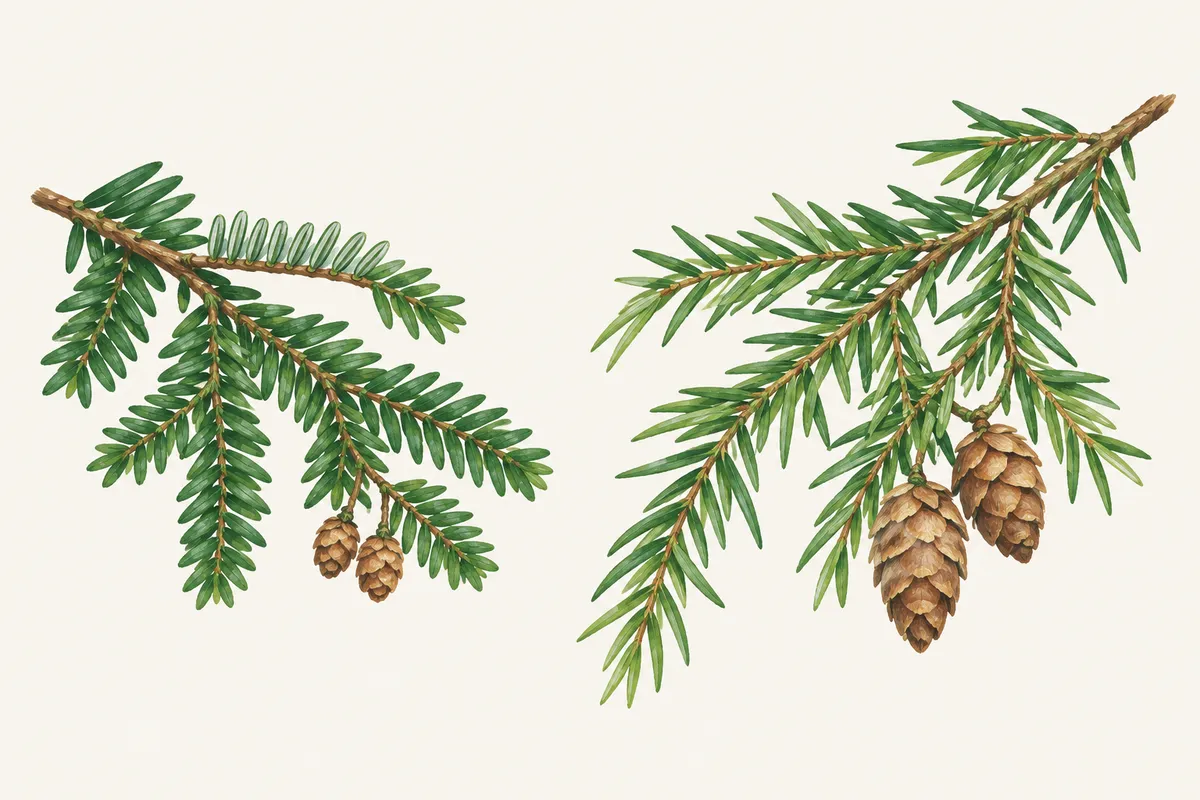
Two hemlocks with short flat needles and tiny hanging cones, one in the East and one on the Pacific side. Range settles most trees; the needle tips and the cones settle the rest.
In short
Eastern vs western hemlock is first a question of where you stand: eastern hemlock grows from Nova Scotia and Minnesota to the southern Appalachians, western hemlock from coastal Alaska to California and inland to Idaho and Montana. Up close, eastern hemlock needles taper toward the tip and its cones are 1/2 to 3/4 inch long; western hemlock needles have rounded tips, come in two sizes, and its cones are 3/4 to 1 1/4 inches.
- The two ranges do not meet: eastern hemlock stops in Minnesota and Wisconsin, western hemlock starts in the northern Rockies of Montana and Idaho.
- Eastern hemlock has the smallest cones of its genus, 13 to 19 mm (1/2 to 3/4 inch); western hemlock's run 19 to 32 mm (3/4 to 1 1/4 inches).
- Western hemlock is the giant: 165 to 200 feet is not uncommon on good sites, against a little over 100 feet in typical old eastern stands.
Field marks at a glance
- Scientific name
- Tsuga canadensis and Tsuga heterophylla
- Family
- Pinaceae (pine family)
- Type
- Conifer, evergreen
- Needle shape
- Eastern: flat, about 1/2 inch (10 to 20 mm), tapering toward a dull point. Western: flat, 1/4 to 3/4 inch, with rounded tips, long and short needles mixed along the twig.
- Needle underside
- Both: two white lines beneath. Eastern: a clear green margin around the white bands (NRCan). Western: upper side yellow-green to green.
- Needles on top of the twig
- Eastern: mostly in two rows, with a few shorter needles lying along the top of the twig. Western: spirally arranged, the two sizes alternating.
- Cones
- Eastern: egg-shaped, 13 to 19 mm (1/2 to 3/4 inch), the smallest in the genus, on a hairy stalk 2 to 3 mm long. Western: egg-shaped, reddish brown, 19 to 32 mm (3/4 to 1 1/4 inches), often abundant at the branch tips.
- Twigs
- Eastern: slender, hairy, yellowish brown, in flat sprays. Western: slender, flexible, minutely hairy, rough from raised leaf scars.
- Bark
- Both become furrowed with broad ridges and show purple or reddish-purple streaks in cut or broken bark.
- Size
- Eastern: typical old trees over 100 ft (30 m), records about 160 to 175 ft. Western: 165 to 200 ft (50 to 61 m) not uncommon, maximum reported 259 ft (79 m).
- Age
- Eastern: recorded maximum 988 years. Western: usually under 500 years, oldest recorded over 700 years.
- Range
- Eastern: Nova Scotia and southern Quebec to northeastern Minnesota and western Wisconsin, south in the Appalachians to northern Georgia and Alabama. Western: Pacific coast from central California to Alaska's Kenai Peninsula, inland to the northern Rockies of Idaho and Montana.
Eastern hemlock (Tsuga canadensis) and western hemlock (Tsuga heterophylla) look alike from a few feet away: short flat needles with two white lines beneath, small hanging cones, soft, drooping foliage. They never meet in the wild, so the map answers most questions. When it doesn't, for a planted tree or a photo of unknown origin, the needle tips and the cone size do.
Eastern vs western hemlock: the four checks
1. Where is the tree? The USDA Forest Service's eastern hemlock silvics draws its northern limit from northeastern Minnesota and western Wisconsin through northern Michigan, south-central Ontario and southern Quebec to New Brunswick and all of Nova Scotia, then south through New England, New York, Pennsylvania and the Appalachians into northern Georgia and Alabama. The western hemlock silvics runs it 2,000 miles along the Pacific coast, from central California to the Kenai Peninsula in Alaska, and inland along the Cascades and the northern Rockies of Montana and Idaho, north to Prince George, British Columbia. The Great Plains lie between them.
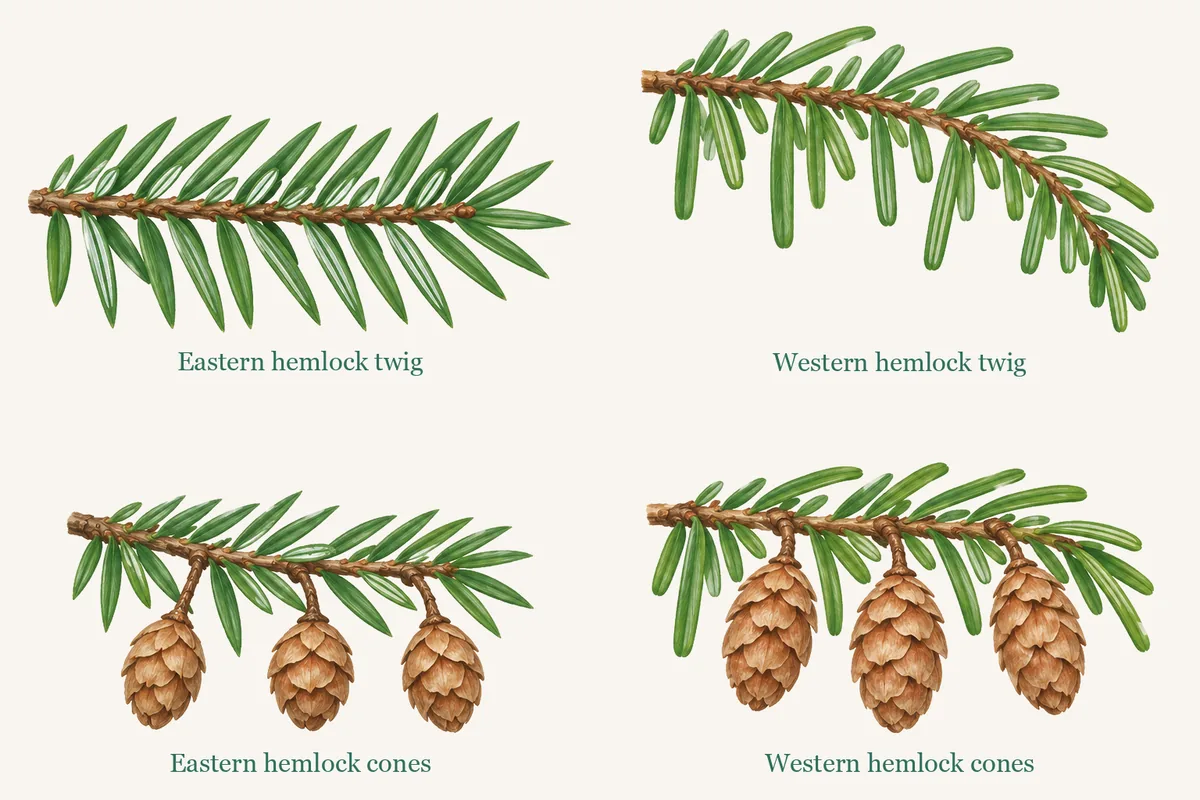
2. Look at the needle tips. Virginia Tech's eastern hemlock fact sheet describes needles about 1/2 inch long "tapering to a dull point", mostly in two rows. Its western hemlock fact sheet gives needles 1/4 to 3/4 inch with rounded tips, two sizes alternating along the twig. A western sprig looks ragged, with short and long needles mixed; an eastern sprig looks neater, the needles narrowing toward the end.
3. Look along the top of the twig. Natural Resources Canada's eastern hemlock factsheet notes a few shorter needles on the upper side of the twig, in addition to the two side rows. On eastern hemlock they lie flat along the twig and show their white undersides, a detail you can see with the sprig in your hand.
4. Measure a cone. This is the most reliable single test. The Forest Service gives eastern hemlock cones as 13 to 19 mm (0.5 to 0.75 inch), the smallest in the genus, and western hemlock cones as 19 to 32 mm (0.75 to 1.25 inches). The ranges touch at 3/4 inch, so a cone of an inch or more points to western hemlock and one of half an inch to eastern. Eastern cones hang on hairy stalks 2 to 3 mm long and stay on the tree into the next season (NRCan), so you can usually find one in winter.
The sheet below shows both: eastern hemlock on the left, western on the right.
Size, age and form
The two trees differ most in scale. Eastern hemlock is a medium-sized tree: Virginia Tech gives up to 80 feet, and the Forest Service describes typical old stands of trees 35 to 40 inches in diameter and over 100 feet tall, with records near 160 to 175 feet. Its crown is dense and conical with fine branches and a drooping terminal shoot (Virginia Tech).
Western hemlock is one of the big trees of the Pacific coast. The Forest Service calls heights of 165 to 200 feet (50 to 61 m) not uncommon on the best sites, with diameters often over 39 inches and a reported maximum height of 259 feet (79 m). Virginia Tech describes a pyramidal crown with lacy foliage drooping at the branch ends.
Age runs the other way. Eastern hemlock is slow: the Forest Service says it takes 250 to 300 years to reach maturity, can live 800 years or more, and has a recorded maximum of 988 years. Western hemlock usually reaches its maximum age between 400 and 500 years, with the oldest recorded tree, from the Queen Charlotte Islands, over 700.
Where each one grows
Both are among the most shade-tolerant trees on their continent. The Forest Service calls eastern hemlock the most shade-tolerant tree species it describes, able to survive in as little as 5 percent of full sunlight and to wait under a canopy for as long as 400 years. It grows on moist, well-drained soils, on benches, flats and swamp borders, and in the southern Appalachians mostly on north- and east-facing slopes, coves and cool, moist valleys, from 2,000 to 5,000 feet. Its companions are eastern white pine, red spruce and yellow birch; NRCan adds sugar maple and American beech.
Western hemlock prefers a mild, humid climate with frequent fog and rain. The Forest Service gives it from sea level to 7,000 feet, at its best on the coast below 2,000 feet, and confined to north slopes, moist stream bottoms and seepage sites where the climate dries. It grows with Douglas-fir, western redcedar, Sitka spruce, Pacific silver fir and red alder, over an understory of vine maple, salal, devilsclub and swordfern. The Pacific Northwest tree guide shows how to tell it from those neighbors, and the cedar that most often grows beside it has its own page, western redcedar.
The other hemlocks and the trees that pass for one
Western hemlock shares the mountains with mountain hemlock (Tsuga mertensiana). NRCan's mountain hemlock factsheet describes blunt needles 20 to 30 mm long, rounded in cross-section and dark bluish green on both sides, crowded around the twig, and cones 30 to 80 mm long. It grows in the wetter parts of subalpine forests at 750 to 1,800 m and becomes a low shrub on exposed ridges. A hemlock with blue-green needles crowded all around the twig and cones up to about 3 inches long is mountain hemlock, not western. Its full profile is on the mountain hemlock page.
Douglas-fir grows beside western hemlock almost everywhere on the coast. Its needles are longer and all of one length, and its cones are far bigger, with three-pointed bracts between the scales; the Douglas-fir page shows them. Yews have flat needles in two rows too, but no white lines beneath and no woody cones.
For everything the two hemlocks share, from the drooping top to the difference with poison hemlock, read the hemlock tree page. Tree Identifier names a tree from one photo; eastern hemlock is in the app's 138-species Collection. The app shows no confidence score and no look-alike list, so photograph the underside of a sprig with a cone attached and check the answer against the cone length above.
Look-alikes and how to tell them apart
Mountain hemlock (Tsuga mertensiana)
The other western hemlock, higher up. Its needles are 20 to 30 mm, rounded in cross-section and bluish green on both sides, crowded all around the twig, and its cones are much longer, 30 to 80 mm. Western hemlock needles are flat, in rough rows, green above with white lines below.
Douglas-fir (Pseudotsuga menziesii)
Grows beside western hemlock along the Pacific coast. Its needles are all one length and longer than a hemlock's, and its cones, several times bigger than any hemlock cone, carry three-pointed bracts sticking out between the scales.
Pacific yew and English yew (Taxus)
Turn the sprig over: yew needles have no white lines beneath, and a yew bears a red fleshy cup around a seed instead of a woody cone. Virginia Tech lists Pacific yew among western hemlock's look-alikes and English yew among eastern hemlock's.
What a photo can't settle
- A planted hemlock outside its native range breaks the range rule, and a single sprig photo may not separate the two. Check the needle tips and measure a cone.
- Carolina hemlock and mountain hemlock also grow inside these ranges; this page compares only eastern and western hemlock.
- A thinning or graying hemlock is a health question for a certified arborist or your state forestry agency, not something a photo comparison can answer.
Questions people ask
Do eastern and western hemlock grow in the same place?
Not in the wild. The USDA Forest Service puts the western edge of eastern hemlock in northeastern Minnesota and western Wisconsin, and the eastern edge of western hemlock in the northern Rockies of Idaho and Montana. A hemlock growing wild in Oregon is western; one in Pennsylvania is eastern. Planted trees are the only exception.
Which hemlock has bigger cones?
Western hemlock. The Forest Service gives its cones as 19 to 32 mm (3/4 to 1 1/4 inches) and calls eastern hemlock's, at 13 to 19 mm (1/2 to 3/4 inch), the smallest in the genus.
Which hemlock is more shade tolerant?
Both are near the top of their forests. The USDA Forest Service calls eastern hemlock the most shade-tolerant tree it describes, surviving in as little as 5 percent of full sunlight, and rates western hemlock very tolerant, with only Pacific yew and Pacific silver fir equal or greater.
Is western hemlock just a bigger eastern hemlock?
No, they are separate species of Tsuga. Western hemlock is far taller, often 165 to 200 feet, and its needles have rounded tips and come in two lengths. Eastern hemlock needles taper toward the tip, a few small ones lie along the top of the twig, and its cones are shorter.
Sources
- Eastern Hemlock, Silvics of North America — USDA Forest Service
- Western Hemlock, Silvics of North America — USDA Forest Service
- Eastern hemlock fact sheet — Virginia Tech Dendrology
- Western hemlock fact sheet — Virginia Tech Dendrology
- Eastern hemlock (Tsuga canadensis), Trees, insects and diseases of Canada's forests — Natural Resources Canada, Canadian Forest Service
- Mountain hemlock (Tsuga mertensiana), Trees, insects and diseases of Canada's forests — Natural Resources Canada, Canadian Forest Service
Keep reading
- Tree profileHemlock trees (Tsuga): how to identify them
- Tree profileDouglas-fir (Pseudotsuga menziesii): how to identify it
- Tree profileYew (Taxus): how to identify it
- Regional guideTrees of the Pacific Northwest, by region
- Field guideConifer identification: three questions about the needles, then the cone