Tree profile
Mountain hemlock (Tsuga mertensiana): how to identify it
The hemlock of deep snow and timberline, from the Sierra Nevada to Alaska: short blue-green needles that sit all around the twig like small stars, and cones far longer than any other hemlock's.
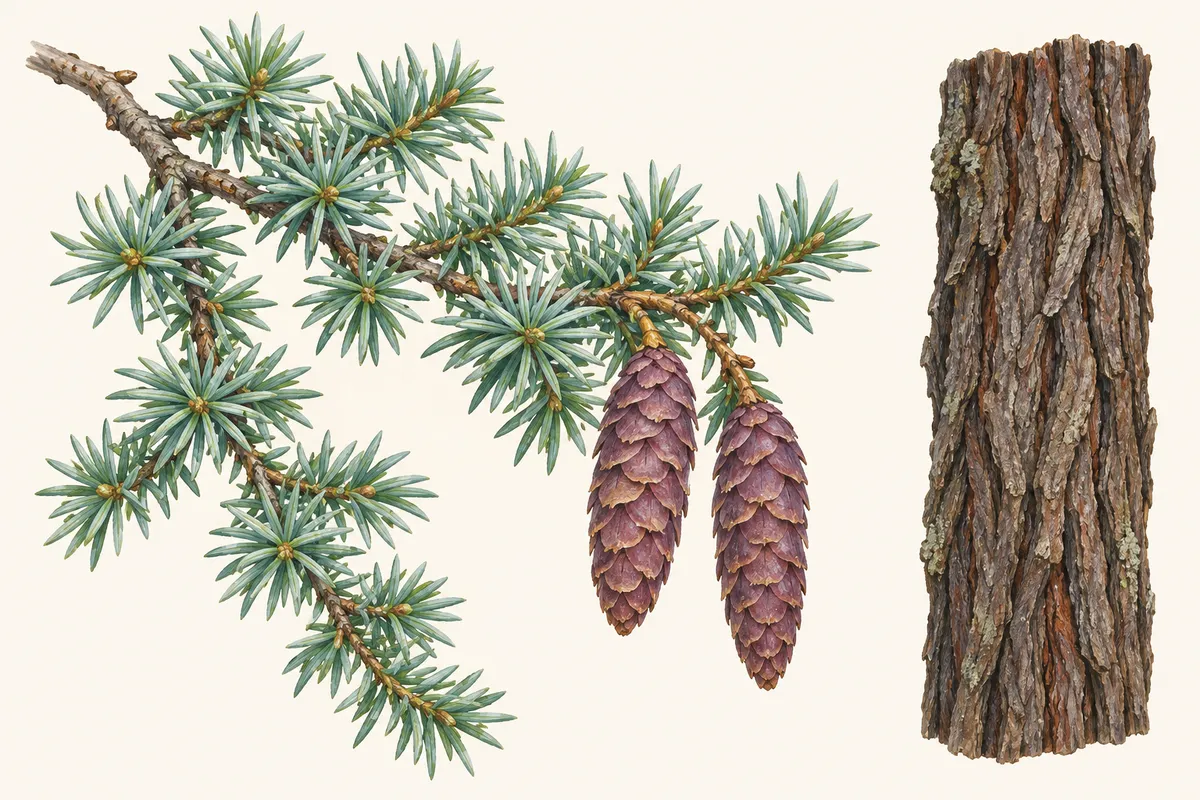
In short
Mountain hemlock identification rests on three checks: blunt needles about 1/2 to 1 inch long, blue-green and the same color on all sides, crowded all around the twig in star-like tufts rather than in flat rows; purplish-brown cones 1 to 3 inches long, two or three times a western hemlock's; and a high-mountain home, from mid elevations to timberline, often in deep snow.
- Look at a twig from above: needles bunched all around it like small stars mean mountain hemlock; a flat, two-ranked spray with white lines beneath means western hemlock.
- Mountain hemlock cones are 1 to 3 inches long, much longer than western hemlock's 1-inch cones, and purple when young.
- At treeline it shrinks to a low, sprawling shrub (krummholz); in sheltered forest it can pass 100 feet.
Field marks at a glance
- Scientific name
- Tsuga mertensiana
- Family
- Pinaceae (pine family)
- Type
- Conifer, evergreen
- Needles
- Single, blunt, rounded in cross-section rather than flat; 20 to 30 mm (NRCan) or 1/2 to 1 inch (Oregon State). Dark bluish green on both sides, with faint lines of white dots, not two bright white bands.
- Needle arrangement
- Crowded and spreading all around the twig, especially on the upper side, giving a star-like look on short side shoots; not the flat, two-ranked spray of western hemlock.
- Cones
- Oblong-cylindrical, purplish when young, brown later; 30 to 80 mm (NRCan), 1 to 3 inches (Oregon State). Scales thin, broad and fan-shaped. Ripen from late September to November and fall in spring or early summer.
- Twigs and buds
- Twigs slender to stoutish, hairy, reddish brown, side branches of unequal length forming a tufted spray. Buds egg-shaped, reddish brown, about 5 mm.
- Crown and top
- Narrowly conical, with slender branches that turn up at the tips and often reach the ground. The leader leans or droops like western hemlock's; old trees become irregular, bent or twisted.
- Bark
- Dark reddish brown, scaly, divided into hard, narrow, flat-topped ridges.
- Size and age
- Usually to about 50 ft (15 m), up to 150 ft (46 m) on the best sites; a low shrub at treeline. Trees of 700 to 800 years and more are reported in British Columbia and Mount Rainier National Park.
- Range
- Western mountains from Sequoia National Park, California (36°38′ N), along the Sierra Nevada and the Cascades, the Olympic Mountains and the northern Rockies of Idaho and western Montana, through British Columbia to Cook Inlet, Alaska (61°25′ N).
- Elevation
- Sea level to 3,500 ft in Alaska, about 4,300 to 5,600 ft in northern Washington, 5,200 to 7,500 ft in southern Oregon, about 9,000 to 10,000 ft in the southern Sierra Nevada (Forest Service).
- In the app's Collection
- Not in Tree Identifier's 138-species Collection, which lists eastern hemlock (Tsuga canadensis); a result lands in History and Wild Discoveries.
Mountain hemlock is the hemlock you meet high up: in the snowy forests below timberline in the Cascades, the Sierra Nevada, the northern Rockies, British Columbia and Alaska. It shares the genus with western hemlock, which grows lower down, and the two often meet at middle elevations. The twig, the cone and the altitude settle which one you are looking at.
How to identify mountain hemlock: the three checks
- Look at a twig from above. On mountain hemlock the needles are crowded and spread all around the twig, especially on the upper side. Oregon State University calls the look star-like on the short side shoots. The National Park Service at Mount Rainier puts it plainly: short needles of equal length that are bushy around the twig rather than the two-ranked flat spray of western hemlock.
- Turn a needle over. Mountain hemlock needles are blue-green and the same color on every side. Natural Resources Canada describes them as dark bluish green on both surfaces with faint lines of white dots, blunt-tipped and rounded in cross-section. A western hemlock needle is flat, green above, with two clear white bands beneath.
- Find a cone. Mountain hemlock cones are oblong, purplish when young and brown when ripe, and long for a hemlock: 1 to 3 inches by Oregon State's measure, 30 to 80 mm by NRCan's. The National Park Service says they are twice as long as a western hemlock's.
If all three point the same way and you are in a western mountain range, you have mountain hemlock.
Needles, cones, twigs and bark in detail
Needles. NRCan measures them at 20 to 30 mm; Oregon State gives 1/2 to 1 inch, blunt and green to blue-green. Because they are rounded rather than flat and the same color all round, the foliage looks bluish and bushy from a few steps away, more like a small spruce or fir twig than a hemlock's flat lace.
Cones. The USDA Forest Service's Silvics of North America gives mature cones 2 to 9 cm (0.75 to 3.5 in) long, purple or brownish purple. They ripen from late September to November, and NRCan says they open in autumn and fall in spring or early summer. The scales are thin, broad and fan-shaped. Trees in the Siskiyou Mountains south of the Oregon-California border are classed as a subspecies, grandicona, named for its larger cones.
Twigs and buds. Twigs are slender to stoutish, hairy and reddish brown, with side branches of unequal length that form a tufted spray. Buds are egg-shaped, reddish brown and about 5 mm long, according to NRCan.
Bark. Dark reddish brown and scaly, divided into hard, narrow, flat-topped ridges.
Crown. Forest-grown trees at lower elevations have a strongly tapered trunk and slender branches with upturned tips that reach almost to the ground; the crown is narrowly conical and becomes irregular, bent or twisted on old trees. The leader leans to one side; the National Park Service says the tips droop like western hemlock's.
Mountain hemlock vs western hemlock
The two meet where the lowland forest gives way to the subalpine zone, so this is the comparison most people need.
| Feature | Mountain hemlock | Western hemlock |
|---|---|---|
| Needle color | Blue-green, the same on all sides | Green above, two white bands beneath |
| Needle shape | Blunt, rounded in cross-section | Flat, of two different lengths |
| Arrangement | Bunched all around the twig, star-like | Flat spray from the sides of the twig |
| Cone length | About 1 to 3 in | About 1 in |
| Elevation | Subalpine to treeline, up to about 11,000 ft | Sea level to about 7,400 ft |
Figures come from Oregon State's hemlock page, which lists western hemlock needles as under 3/4 inch and western hemlock cones as about 1 inch. The Forest Service notes that trees intermediate between the two are occasionally found and have been named Tsuga × jeffreyi, but chemical tests and failed crosses suggest true hybrids are probably rare or absent. The eastern vs western hemlock page covers western hemlock in full, and the hemlock page covers the genus and the poison-hemlock confusion.
Where it grows: deep snow and timberline
The Forest Service maps mountain hemlock from Sequoia National Park in California (36°38′ N) to Cook Inlet in Alaska (61°25′ N): along the crest of the Sierra Nevada, the Cascades of Oregon and Washington, the Olympic Mountains, the northern Rockies of Idaho and western Montana, British Columbia, and southeast and south-central Alaska.
It grows in a band 300 to 1,000 m wide that climbs from north to south. The Forest Service gives 0 to 1,067 m (0 to 3,500 ft) in Alaska, 1,300 to 1,700 m in northern Washington, 1,550 to 2,100 m in the Rocky Mountains, 1,600 to 2,300 m in southern Oregon and 2,750 to 3,050 m (9,050 to 10,000 ft) in the southern Sierra Nevada. NRCan places it at 750 to 1,800 m in the wetter subalpine areas of British Columbia.
This is a snow tree. The Forest Service reports annual snowfall that can exceed 2,200 cm (866 in) in its range, with snowpacks up to 750 cm and snow lying until August or September. Its common companions are Pacific silver fir, subalpine fir, Engelmann spruce, lodgepole pine, Shasta red fir, western white pine, Alaska-cedar and whitebark pine. The subalpine fir page covers the fir it grows beside most often, and the Pacific Northwest tree guide places both in the forest zones of the region.
Size, age and the timberline form
On good sites mountain hemlock is a real forest tree: the Forest Service gives mature heights from 15 m (50 ft) on poor sites to 46 m (150 ft) on the best, trunks of 30 to 150 cm, and trees of 700 to 800 years or more in British Columbia and at Mount Rainier. NRCan describes the usual height as about 15 m.
At and above treeline it changes shape completely. On exposed high ridges it becomes a low, spreading shrub, and above treeline it grows as prostrate krummholz, also called elfinwood. In Alaska, branches pressed to the ground by snow can root and form new stems, which the Forest Service calls layering. A low mat of blue-green, bushy foliage at timberline in the Cascades is often mountain hemlock.
The Forest Service names laminated root rot as the most striking damage agent, especially in the high Cascades of central Oregon, where mountain hemlock is the most susceptible tree.
Using a photo
Tree Identifier names a tree from one photo. For mountain hemlock, the most useful shot is a twig seen from above, close enough to show the needles bunched around it, with a cone in the frame if one is within reach. Mountain hemlock is not in the app's 138-species Collection, so a result lands in History and Wild Discoveries. The app shows no confidence score or list of look-alikes, so confirm the answer with the twig and cone checks above, and note the elevation: a hemlock near treeline is far more likely to be mountain than western. With location turned on, Tree Identifier's Tree Map pins a tree you want to revisit when the cones are out, and the conifer identification guide explains how to separate hemlocks from firs, spruces and pines in general.
Look-alikes and how to tell them apart
Western hemlock (Tsuga heterophylla)
Turn a sprig over. Western hemlock needles are flat, under 3/4 inch, of two lengths, green above with two white bands beneath, and spread in a flat spray from the sides of the twig. Its cones are about 1 inch long. Mountain hemlock's needles are blue-green all round and bunched around the twig.
Subalpine fir (Abies lasiocarpa)
Shares the same high slopes. Fir needles are flat and longer, curve upward with blunt tips, and its purplish cones stand upright on the top branches and fall apart there. Mountain hemlock cones hang down and drop whole.
Engelmann spruce (Picea engelmannii)
Also a subalpine neighbor. Spruce needles are stiff, square in cross-section and sharp, and each sits on a small woody peg that leaves the bare twig rough. Mountain hemlock needles are blunt and rounded.
Eastern hemlock (Tsuga canadensis)
Eastern North America only. Its flat needles are about 1/2 inch with two white lines beneath, mostly in two rows, and its cones are only about 3/4 inch. A hemlock in a western mountain forest is never this one unless it was planted.
What a photo can't settle
- Close-up photos of needles separate mountain from western hemlock better than a whole-tree shot; a photo should show the twig from above and, if possible, a cone.
- Sources give different measurements for the same parts: needles 1/2 to 1 inch (Oregon State) or 20 to 30 mm (NRCan), cones 1 to 2 inches (National Park Service) up to 30 to 80 mm (NRCan). Treat any single figure as a guide.
- Trees that look halfway between mountain and western hemlock occur occasionally; the Forest Service says true hybrids are probably rare or absent, so a photo app cannot settle such a tree.
Questions people ask
How do you tell mountain hemlock from western hemlock?
By the twig and the cone. Western hemlock needles lie in a flat spray, green above with two white bands below; mountain hemlock needles are blue-green on all sides and bunched all around the twig. Mountain hemlock cones are 1 to 3 inches long; western hemlock cones are about 1 inch.
Where does mountain hemlock grow?
In the high mountains of the West: the Sierra Nevada, the Cascades, the Olympic Mountains, the northern Rockies of Idaho and western Montana, British Columbia and coastal Alaska. It grows in a band near treeline that is higher in the south, around 9,000 to 10,000 feet in the southern Sierra, and reaches sea level in Alaska.
How tall does mountain hemlock get?
The USDA Forest Service gives mature heights from about 50 feet on poor sites to 150 feet on the best. Natural Resources Canada says it usually reaches about 15 m (50 ft). Above treeline it grows as a low, sprawling shrub called krummholz.
Why is mountain hemlock called black hemlock?
Black hemlock is a synonym Natural Resources Canada lists for Tsuga mertensiana; its French name is pruche subalpine. The tree's dark bluish-green foliage and dark reddish-brown bark make it look dark from a distance, but the source does not explain the name.
Is mountain hemlock poisonous like poison hemlock?
They are unrelated. Mountain hemlock is a conifer in the pine family. Poison hemlock (Conium maculatum) is an herb of the carrot family with lacy leaves and umbrella-shaped white flower clusters. If the plant has needles and woody cones, it is not poison hemlock.
Sources
- Mountain Hemlock, Silvics of North America — USDA Forest Service
- Mountain hemlock (Tsuga mertensiana), Trees, insects and diseases of Canada's forests — Natural Resources Canada, Canadian Forest Service
- Hemlock species, Trees of the Pacific Northwest — Oregon State University, College of Forestry
- Conifer Trees, Mount Rainier National Park — National Park Service
Keep reading
- Tree profileHemlock trees (Tsuga): how to identify them
- Tree comparisonEastern vs western hemlock: how to tell them apart
- Tree profileSubalpine fir (Abies lasiocarpa): how to identify it
- Regional guideTrees of the Pacific Northwest, by region
- Field guideConifer identification: three questions about the needles, then the cone