Tree profile
Western redcedar (Thuja plicata): how to identify it
The giant arborvitae of the Pacific Northwest. Turn a spray over, look for the small cones turned up on the branch, then step back and look at the base of the trunk.
In short
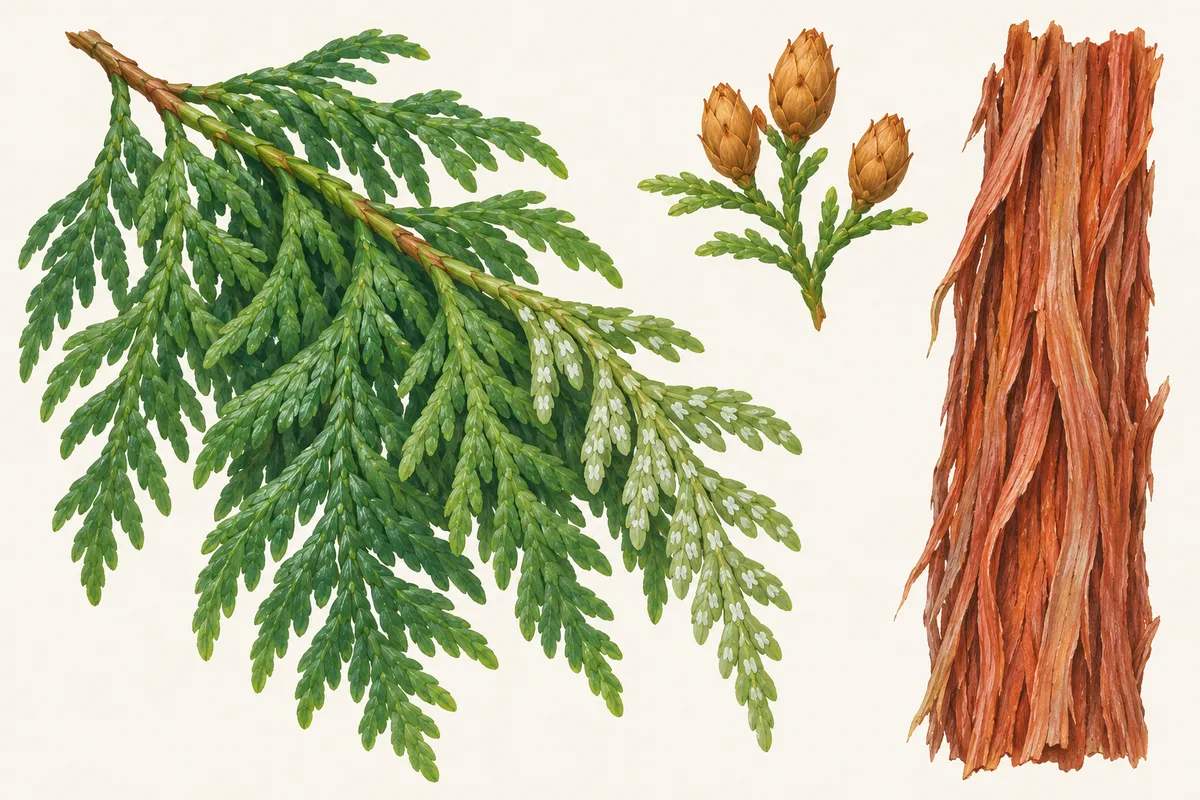
Western red cedar identification rests on three marks: flat, drooping sprays of tiny yellow-green scale leaves with a white, butterfly-shaped pattern on the underside; small woody cones about 1/2 inch long with 5 or 6 pairs of thin scales, turned up on the branches; and thin, stringy, reddish-brown bark peeling in long strips above a swollen, fluted trunk base. It grows from northern California to southeastern Alaska.
- Western redcedar is a Thuja, a giant relative of the garden arborvitae, not a true cedar and not a juniper: it has no berries.
- The white butterfly or bow-tie pattern under each set of scales is the quickest way to separate it from the other cedars of the coast.
- Old trees often live 800 to 1,000 years, and a measured Washington tree is 233 inches across.
Field marks at a glance
- Scientific name
- Thuja plicata
- Family
- Cupressaceae (cypress family)
- Type
- Conifer, evergreen
- Leaves
- Tiny scale leaves, 1/16 to 1/8 inch, in opposite pairs; sets of four form rough squares along the shoot. Yellow-green above, with a white butterfly-shaped pattern beneath.
- Sprays
- Flat, frond-like sprays hanging from drooping branches; dead foliage falls as whole sprays.
- Cones
- Woody, about 1/2 inch long, with thin scales in 5 to 6 opposite pairs, usually turned up on the branches. Small reddish male cones; female cones reddish purple near the branch tips.
- Bark
- Thin, 1/2 to 3/4 inch, fibrous and stringy, reddish brown, with fine intertwined ridges, peeling in long strips.
- Trunk and form
- Base often swollen and fluted; tops of old trees often forked. Open, pyramidal crown with drooping branches.
- Size
- Up to 200 ft (61 m) tall and 10 ft (3 m) across (Virginia Tech); a Washington tree measures 178 ft and 233 in (592 cm) in diameter.
- Age
- Often 800 to 1,000 years (USDA Forest Service).
- Range
- Pacific coast from Humboldt County, California, to southeastern Alaska; inland from British Columbia into northern Idaho and western Montana, east to Glacier National Park.
- Other names
- Pacific redcedar, giant-cedar, arborvitae, canoe-cedar, shinglewood.
- In the app's Collection
- Western red cedar (Thuja plicata) is one of the 138 species in Tree Identifier's Collection.
Western redcedar (Thuja plicata) is the cedar of the Pacific Northwest rainforest: the tree with drooping, fern-like sprays, stringy red bark and a trunk that flares at the base like a buttress. It is a giant arborvitae, not a true cedar, and it shares the coast with three other scale-leaved trees called cedar. A spray in your hand and a cone are enough to name it.
How to identify western redcedar: the spray, the cone, the trunk
1. Turn a spray over. Virginia Tech's western redcedar fact sheet describes scale leaves 1/16 to 1/8 inch long in opposite pairs, sets of four forming rough squares along the shoot, yellow-green on top and marked underneath with a butterfly-shaped bloom. That white pattern, like a row of tiny bow ties, is the single best field mark. The sprays are flat and hang from drooping branches, and dead leaves fall as whole sprays, so the ground beneath an old tree is littered with brown fronds.
2. Find a cone. The cones are small and woody, about 1/2 inch long, with thin scales in 5 or 6 opposite pairs, and they are usually turned up on the branches (Virginia Tech). They look like tiny opened rosebuds pointing upward. There is no fleshy berry: a scale-leaved tree with blue, berry-like cones is a juniper.
3. Look at the trunk. The bark is thin, 1/2 to 3/4 inch, fibrous and reddish brown, with fine intertwined ridges, and it peels off in long strips (Virginia Tech). The USDA Forest Service's Silvics of North America describes mature trees with tapered, often fluted bases and often forked tops. A broad trunk flaring and ribbed at the foot, with stringy bark you can pull in a long ribbon, is western redcedar.
The crown completes the picture: open and pyramidal, with drooping, frond-like branches (Virginia Tech).
Size, age and range
Virginia Tech gives western redcedar up to 200 feet tall and 10 feet in diameter, sometimes larger. The Forest Service describes a large Washington specimen 178 feet (54.3 m) tall with a trunk 233 inches (592 cm) across and a crown 54 feet wide, and says trees often reach 800 to 1,000 years.
The Forest Service calls it the only Thuja native to western North America and lists Pacific redcedar, giant-cedar, arborvitae, canoe-cedar and shinglewood among its names. Its range has two parts:
- The coast, from Humboldt County, California, north to Sumner Strait in southeastern Alaska. In California it is common only in the lower Mad River drainage and the wet region south of Ferndale; in Oregon and Washington it extends up the western slopes of the Cascades north of Crater Lake.
- The interior, from the western slope of the Continental Divide in British Columbia, through the Selkirk Mountains, into northern Idaho and western Montana, south to Ravalli County and east to Lake McDonald in Glacier National Park.
It grows from sea level to 3,000 feet in southeastern Alaska and up to 7,500 feet at the rim of Crater Lake (Forest Service). It is abundant in forested swamps and tolerates a winter water table less than 6 inches below the surface on the Olympic Peninsula, yet also grows on sites too dry for western hemlock. Only Pacific silver fir, western hemlock and Pacific yew are more shade-tolerant.
Neighbors in the forest
On the coast the Forest Service lists western hemlock, Sitka spruce, Douglas-fir, grand fir, Pacific silver fir, red alder, bigleaf maple, Pacific yew and three other "cedars", Port-Orford-cedar, Alaska-cedar and incense-cedar, among its associates. Inland it adds western larch, Engelmann spruce, subalpine fir and lodgepole and ponderosa pines. The Pacific Northwest tree guide sorts these by zone, and western hemlock, the tree most often standing beside it, is on the hemlock page: short flat needles, not scales.
Western redcedar vs the other Pacific cedars
Virginia Tech names four look-alikes: northern white-cedar, Port-Orford-cedar, Alaska yellow-cedar and incense-cedar. All four have scale leaves in flat sprays, so check the underside of the spray and the cone.
- Incense-cedar (Calocedrus decurrens): Virginia Tech's incense-cedar fact sheet gives longer scales, 1/4 to 1/2 inch, forming goblet shapes, yellow-green with no bloom, and cones about 1 inch long that resemble a duck's bill. It grows mainly in southern Oregon and California; see the incense-cedar page.
- Port-Orford-cedar (Chamaecyparis lawsoniana): blue-green scales in well-organized sprays with obvious white X marks beneath, and round cones about 1/4 inch across with wrinkled scales (Virginia Tech).
- Alaska yellow-cedar (Callitropsis nootkatensis): scale tips that spread from the twig and feel rough, no bloom on either side, distinctly drooping branchlets and round cones about 1/4 inch with pointed scales (Virginia Tech).
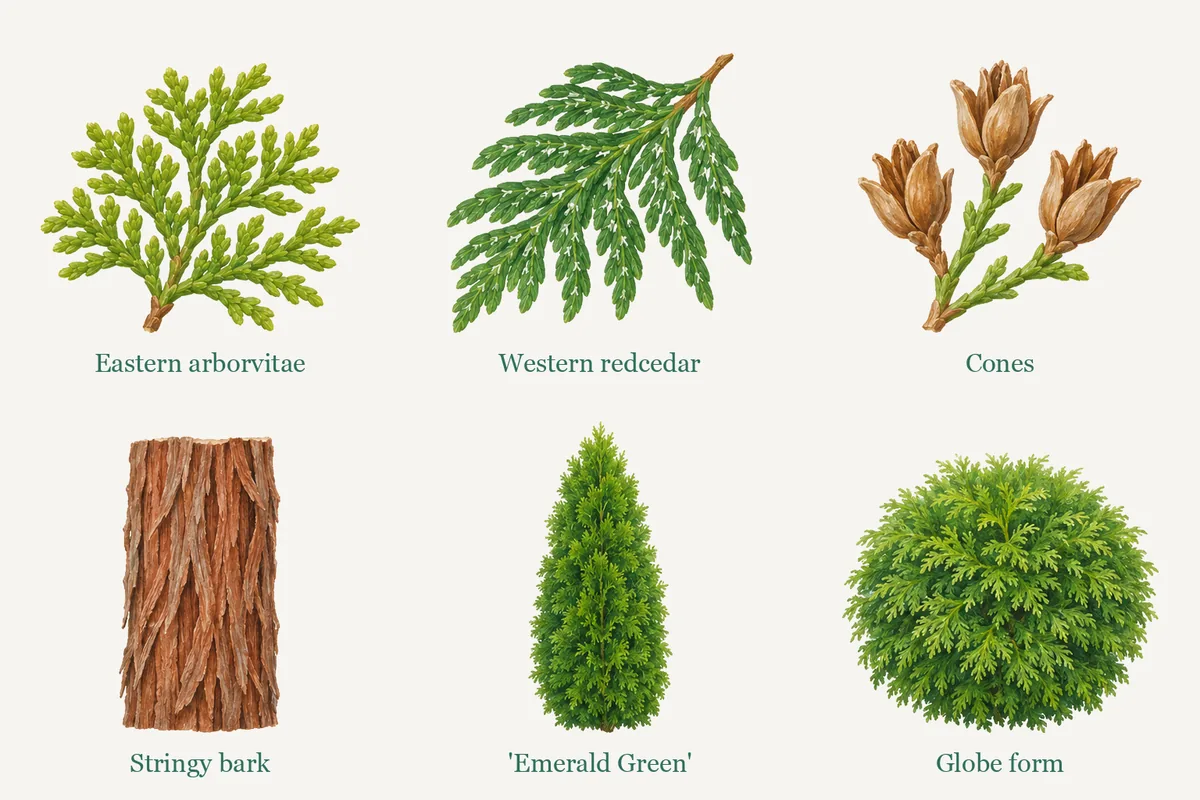
- Northern white cedar (Thuja occidentalis): the eastern arborvitae. Natural Resources Canada's eastern white-cedar factsheet describes the same kind of flat fans, dull yellowish green and turning bronze in winter, with cones 7 to 12 mm. The USDA Forest Service's northern white-cedar silvics gives its native range from Nova Scotia and Maine to Manitoba and Minnesota, so a wild Thuja in the West is western redcedar; a planted one in a hedge may be either.
The name causes one more mix-up: Rocky Mountain juniper is also called western redcedar in parts of its range. It carries blue, berry-like cones, which a Thuja never does. The cedar tree identification page sorts every tree called cedar in North America.
Tree Identifier names a tree from one photo, and western red cedar is among the 138 species in its Collection. The most useful picture is the underside of one spray, with a cone in the frame; the follow-up chat can then answer a question such as how it differs from the Port-Orford-cedar next to it.
Look-alikes and how to tell them apart
Incense-cedar (Calocedrus decurrens)
Its scales are longer, 1/4 to 1/2 inch, forming elongated goblet shapes, with no white pattern beneath. Its cones are about 1 inch and hang down, looking like a duck's bill. Western redcedar's are about 1/2 inch and point up.
Port-Orford-cedar (Chamaecyparis lawsoniana)
Turn a spray over: Port-Orford-cedar shows white X-shaped marks, not a butterfly, and its scales are blue-green. Its cones are round, about 1/4 inch across, with wrinkled scales, unlike the elongated, upturned cones of western redcedar.
Alaska yellow-cedar (Callitropsis nootkatensis)
Its scale tips spread from the twig so the foliage feels rough when stroked the wrong way, there is no white bloom on either side, and its branchlets hang straight down. Its cones are round, about 1/4 inch, each scale with a point.
Northern white cedar, arborvitae (Thuja occidentalis)
Its close relative of the East and of garden hedges. Natural Resources Canada describes dull yellowish-green fans that turn bronze in winter and cones 7 to 12 mm; the USDA Forest Service gives its native range from Nova Scotia and Maine to Manitoba and Minnesota, so a wild Thuja in the West is western redcedar.
What a photo can't settle
- Young planted trees can be hard to tell from cultivated arborvitae and other Thuja hybrids from a single photo; check the white pattern under a spray, the cone and the range.
- The white butterfly pattern is clearest on fresh shade foliage; on dusty or sun-bleached sprays it can be faint, so check several sprays and look for cones.
- Tree Identifier gives one name from one photo, with no confidence score and no look-alike list. For the coastal cedars, photograph the underside of a spray with a cone attached.
Questions people ask
Is western red cedar a real cedar?
No. It is Thuja plicata, a member of the cypress family and the only Thuja native to western North America, according to the USDA Forest Service, which lists arborvitae among its names. True cedars (Cedrus) are pine-family trees with needles in tufts and big upright cones.
How do you tell western red cedar from Rocky Mountain juniper?
Look for berries. Rocky Mountain juniper, which the Forest Service notes is also called western redcedar in places, carries round, bluish, berry-like cones. Western redcedar has small woody cones about 1/2 inch long that open, and its foliage hangs in flat sprays rather than on rounded, cord-like twigs.
How big do western red cedars get?
Virginia Tech gives up to 200 feet tall and 10 feet in diameter, sometimes more. The Forest Service describes a large Washington tree 178 feet tall with a trunk 233 inches (592 cm) across and a crown 54 feet wide, and says trees often reach 800 to 1,000 years.
Where does western red cedar grow?
On the coast from Humboldt County, California, to southeastern Alaska, and inland from British Columbia through the Selkirk Mountains into northern Idaho and western Montana. The Forest Service gives elevations from sea level up to 7,500 feet at the rim of Crater Lake in Oregon. It thrives on wet sites and forested swamps.
Sources
- Rocky Mountain Juniper, Silvics of North America — USDA Forest Service
- Western Redcedar, Silvics of North America — USDA Forest Service
- Western redcedar fact sheet — Virginia Tech Dendrology
- Incense-cedar fact sheet — Virginia Tech Dendrology
- Port-Orford-cedar fact sheet — Virginia Tech Dendrology
- Alaska yellow-cedar fact sheet — Virginia Tech Dendrology
- Northern White-Cedar, Silvics of North America — USDA Forest Service
- Eastern white-cedar (Thuja occidentalis), Trees, insects and diseases of Canada's forests — Natural Resources Canada, Canadian Forest Service
Keep reading
- Tree profileCedar trees: how to identify red, white and true cedars
- Tree profileArborvitae: how to identify it and tell the hedge types apart
- Tree profileHemlock trees (Tsuga): how to identify them
- Regional guideTrees of the Pacific Northwest, by region
- Tree profileIncense-cedar (Calocedrus decurrens): how to identify it