Tree profile
Incense-cedar (Calocedrus decurrens): how to identify it
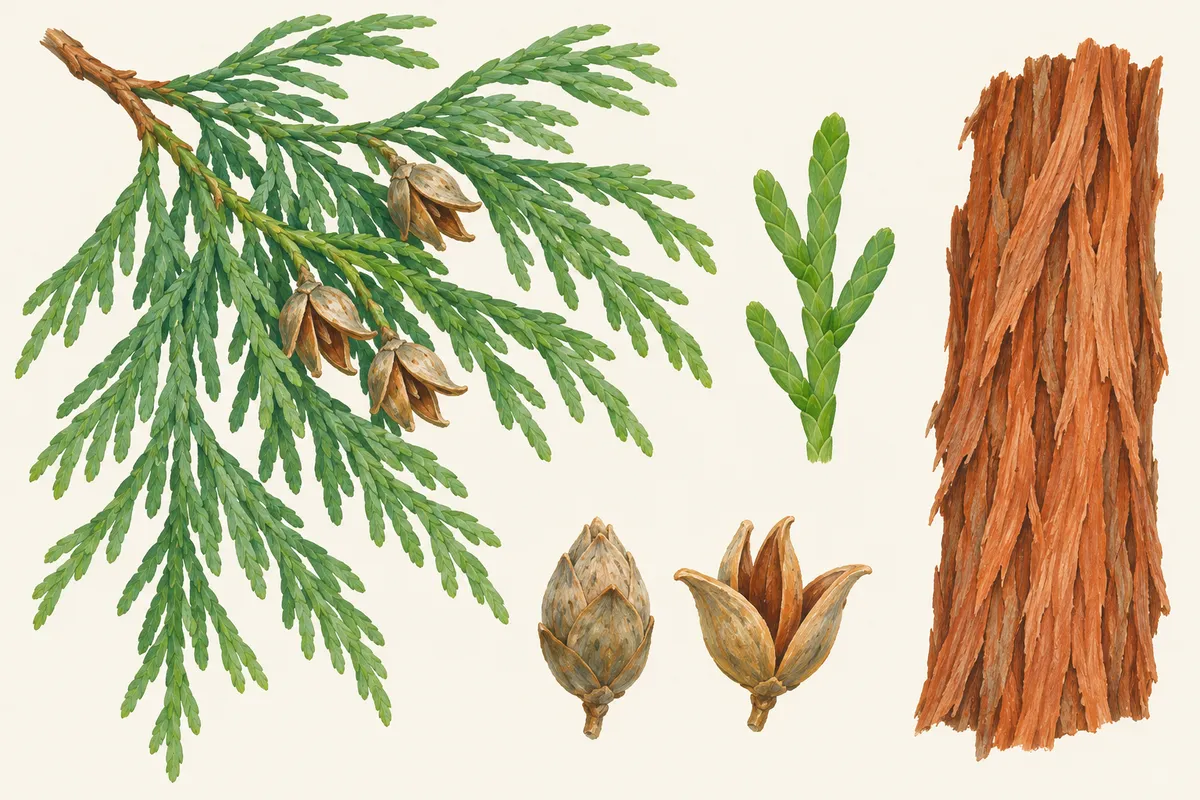
A scale-leaved conifer of the Sierra Nevada and the Oregon and California mountains. Its cone looks like a duck's bill when closed and a goose in flight when open, which no other cedar copies.
In short
Incense cedar tree identification rests on three marks: yellow-green scale leaves 1/4 to 1/2 inch long, much longer than other cedars', overlapping in goblet shapes along flat, rumpled sprays; hanging cones about 1 inch long that look like a duck's bill when closed; and thick, reddish-brown bark deeply furrowed into long, interlacing ridges. It grows from Oregon's Mount Hood south through California into Baja California.
- Incense-cedar's scales are the longest of the western cedars, 1/4 to 1/2 inch, and form elongated goblet shapes along the twig.
- The cone has six scales but looks as if it has three; open, it spreads like a goose in flight.
- It grows best in the Sierra Nevada at 2,000 to 6,900 feet, beside ponderosa and sugar pine, white fir and Douglas-fir.
Field marks at a glance
- Scientific name
- Calocedrus decurrens (syn. Libocedrus decurrens)
- Family
- Cupressaceae (cypress family)
- Type
- Conifer, evergreen
- Leaves
- Scale leaves in opposite pairs, yellow-green with no waxy bloom, 1/4 to 1/2 inch long; overlapping pairs form elongated goblet shapes along the shoot.
- Sprays
- Flattened but rumpled sprays; dead foliage falls as whole sprays.
- Cones
- About 1 inch (20 to 40 mm), hanging, yellowish brown when ripe. Six scales that look like three; closed it resembles a duck's bill, open a goose in flight.
- Bark
- Young: thin, scaly, purplish red. Old: several inches thick, reddish brown, deeply furrowed with long, interlacing ridges.
- Twigs
- Moderately stout, flattened when young and round later, reddish brown to grayish brown.
- Size
- Commonly 70 to 100 ft tall and 3 to 5 ft across (Virginia Tech); in the Sierra Nevada often near 150 ft, with one tree reported at 225 ft in southern Oregon.
- Age
- Large trees often over 500 years; oldest recorded 542 years (USDA Forest Service).
- Range
- From the south slope of Mount Hood, Oregon, through the Siskiyou, Klamath, Cascade and Coast Ranges and the Sierra Nevada to northern Baja California; also west-central Nevada.
- Pollen
- Small yellow pollen cones release pollen in mid-winter to early spring, when most conifers are dormant.
Incense-cedar (Calocedrus decurrens) is the scale-leaved conifer of the dry western mountains and one of the common trees of the Sierra Nevada mixed conifer forest. It is not a true cedar and not a Thuja. Two things separate it from every other tree called cedar: unusually long scale leaves, and a small hanging cone shaped like a duck's bill.
How to identify incense-cedar: scales, cone, bark
1. Measure the scales. Virginia Tech's incense-cedar fact sheet gives scale leaves 1/4 to 1/2 inch long, in opposite pairs, yellow-green with no waxy bloom. Overlapping pairs form elongated, goblet-like shapes along the shoot, and the sprays are flattened but rumpled. On western redcedar and Port-Orford-cedar the scales are 1/16 to 1/8 inch, so incense-cedar's look stretched, like a chain of tiny vases.
2. Find a cone. The cones are about 1 inch long and turn yellowish brown when mature. Virginia Tech notes that they appear to have three woody scales but actually have six, and resemble a duck's bill when closed and a goose in flight when open. The USDA Forest Service's incense-cedar silvics gives them as pendent, 20 to 40 mm (0.8 to 1.5 inches) long, with three pairs of leathery scales of which two enlarge to cover the seed-bearing pair. Each seed carries two wings of unequal length (Forest Service).
3. Look at the bark. Young bark is thin, scaly and purplish red. With age it becomes several inches thick, reddish brown and deeply furrowed, with long, interlacing ridges (Virginia Tech). The Forest Service adds that this thick bark protects mature trees considerably from fire. From a distance, a straight trunk with deeply ridged reddish-brown bark and a narrow crown of flat, yellow-green sprays is worth checking for incense-cedar.
A fourth clue comes in winter: the small yellow pollen cones release their pollen in mid-winter (Virginia Tech), late winter to early spring according to the Forest Service, when other conifers around it are dormant.
Size, age and range
Virginia Tech calls incense-cedar a moderate-sized tree, commonly 70 to 100 feet tall and 3 to 5 feet in diameter. The Forest Service gives a wider picture: the largest trees of the Coast Ranges and southern California are generally 60 to 80 feet, while in the Sierra Nevada they are frequently near 150 feet tall and 84 inches in diameter, the biggest measured at 148 inches across, and one tree in southern Oregon was reported at 225 feet. Large trees are often more than 500 years old; the oldest recorded was 542.
The range spans about 15 degrees of latitude. It runs from the southern slope of Mount Hood in Oregon south through the Siskiyou, Klamath and Warner Mountains, the Cascade and Coast Ranges and the Sierra Nevada, to the Hanson Laguna and Sierra de San Pedro Martir ranges of Baja California, and from the coastal fog belt to the edge of the desert, with an outpost in the Washoe Mountains of west-central Nevada (Forest Service). It grows from 165 to 6,600 feet in the north and from 3,000 to 9,700 feet at its southern limits, and does best in the Sierra Nevada at 2,000 to 6,900 feet. Summers there are dry, often under an inch of rain a month.
In the Sierra Nevada it grows with ponderosa, sugar and Jeffrey pine, white fir, Douglas-fir and giant sequoia; in the north with western redcedar, western hemlock and Port-Orford-cedar; in the south with Coulter pine, bigcone Douglas-fir and California black oak (Forest Service). The California tree identification guide covers those neighbors region by region, and the ponderosa pine page the pine you will most often see beside it.
Incense-cedar vs western redcedar and the other cedars
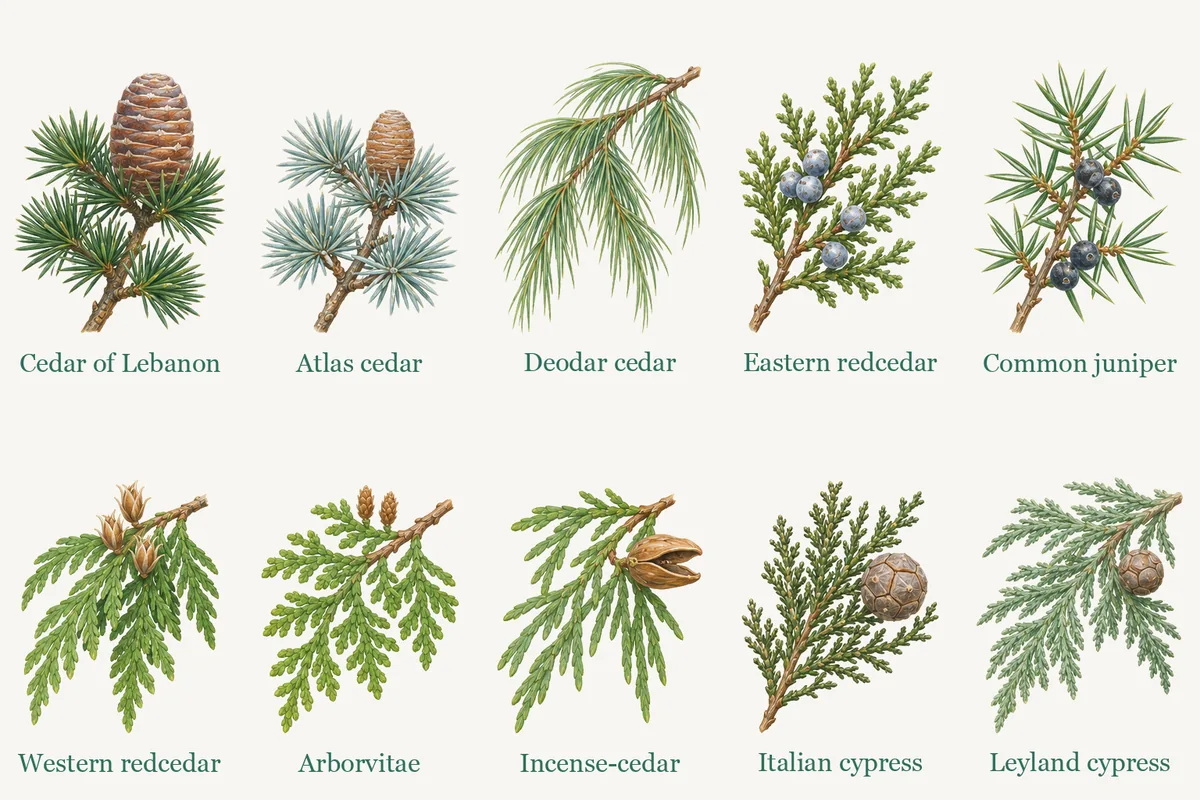
Virginia Tech lists western redcedar, Port-Orford-cedar and Alaska yellow-cedar as its look-alikes. All have scale leaves in flat sprays, and all are cypress-family trees called cedar.
| Tree | Scale length | Underside | Cone |
|---|---|---|---|
| Incense-cedar | 1/4 to 1/2 in, goblet-shaped pairs | Yellow-green, no bloom | About 1 in, hanging, duck's-bill shape |
| Western redcedar | 1/16 to 1/8 in | White butterfly pattern | About 1/2 in, 5 to 6 pairs of thin scales, turned up |
| Port-Orford-cedar | 1/16 to 1/8 in, blue-green | White X marks | Round, about 1/4 in, wrinkled scales |
| Alaska yellow-cedar | 1/16 to 1/8 in, tips spreading | No bloom on either side | Round, about 1/4 in, a point on each scale |
The rows come from Virginia Tech's fact sheets for western redcedar, Port-Orford-cedar and Alaska yellow-cedar. Of the four, incense-cedar's scales are the only ones longer than 1/8 inch. Western redcedar has its own page, western redcedar, and the cedar tree identification page sorts junipers, arborvitae and the true cedars of the Old World.
Witches' brooms and other field signs
The Forest Service names a rust fungus, Gymnosporangium libocedri, that causes witches' brooms on incense-cedar: dense, broom-like tangles of twigs in the crown. Once you know them, they help pick the tree out of a mixed conifer forest. It also notes that incense-cedar has no distinct spring flush of new growth, unlike the pines and firs around it, and that seedlings endure dense shade though older trees need more light.
Incense-cedar is not among the 138 species in Tree Identifier's Collection. If you photograph one for the app, frame a spray with a cone, close enough to show the length of the scales, then check the name it gives against the table above and use the follow-up chat to ask how that tree differs from incense-cedar.
Look-alikes and how to tell them apart
Western redcedar (Thuja plicata)
Its scales are tiny, 1/16 to 1/8 inch, with a white butterfly pattern beneath, and its 1/2-inch cones have 5 or 6 pairs of thin scales and point up on the branch. Incense-cedar scales are much longer, unmarked, and its 1-inch duck-bill cones hang down.
Port-Orford-cedar (Chamaecyparis lawsoniana)
Its scales are short, 1/16 to 1/8 inch, blue-green, with white X marks underneath, and its cones are round, about 1/4 inch across. Incense-cedar's longer yellow-green scales carry no white marks and its hanging cones are about 1 inch long.
Alaska yellow-cedar (Callitropsis nootkatensis)
Its short scales spread at the tips and feel rough, its branchlets hang straight down, and its cones are round, about 1/4 inch, with a point on each scale. It grows mainly on the coast north of incense-cedar's range.
What a photo can't settle
- Garden and street trees of other scale-leaved conifers can resemble a young incense-cedar in a photo; include a cone and the length of the scales.
- Cone crops come at intervals of 3 to 6 years and sometimes fail entirely, so many trees carry no cones in a given year. Rely on the scales and bark then.
- Tree Identifier gives one name from one photo, with no confidence score and no look-alike list; incense-cedar is not among the 138 species in its Collection, so check any answer against the marks above.
Questions people ask
Is incense-cedar a true cedar?
No. It is Calocedrus decurrens, a member of the cypress family with scale leaves. True cedars (Cedrus) are pine-family trees with needles in tufts. The USDA Forest Service files it under the older name Libocedrus decurrens and notes it is increasingly placed in the genus Calocedrus.
What does an incense-cedar cone look like?
A small hanging cone about 1 inch long that turns yellowish brown when ripe. Virginia Tech notes it appears to have three woody scales but actually has six, looks like a duck's bill when closed and like a goose in flight when open. The Forest Service gives 20 to 40 mm at maturity.
Where does incense-cedar grow?
From the south slope of Mount Hood in Oregon south through the Siskiyou, Klamath, Cascade and Coast Ranges and the Sierra Nevada into the mountains of Baja California, plus the Washoe Mountains of west-central Nevada. The Forest Service says it grows best in the Sierra Nevada, between 2,000 and 6,900 feet.
Why do some incense-cedars have bushy clumps in the branches?
The USDA Forest Service names a rust fungus, Gymnosporangium libocedri, that causes witches' brooms on incense-cedar: dense, broom-like clusters of twigs. They are a common sight on the tree and help confirm the species, but a health question about a particular tree belongs with an arborist.
Sources
- Incense-Cedar, Silvics of North America — USDA Forest Service
- Incense-cedar fact sheet — Virginia Tech Dendrology
- Western redcedar fact sheet — Virginia Tech Dendrology
- Port-Orford-cedar fact sheet — Virginia Tech Dendrology
- Alaska yellow-cedar fact sheet — Virginia Tech Dendrology
Keep reading
- Tree profileCedar trees: how to identify red, white and true cedars
- Tree profileWestern redcedar (Thuja plicata): how to identify it
- Regional guideCalifornia tree identification, from the redwood coast to the foothills
- Tree profilePonderosa pine (Pinus ponderosa): how to identify it
- Field guideConifer identification: three questions about the needles, then the cone