Regional guide
California tree identification, from the redwood coast to the foothills
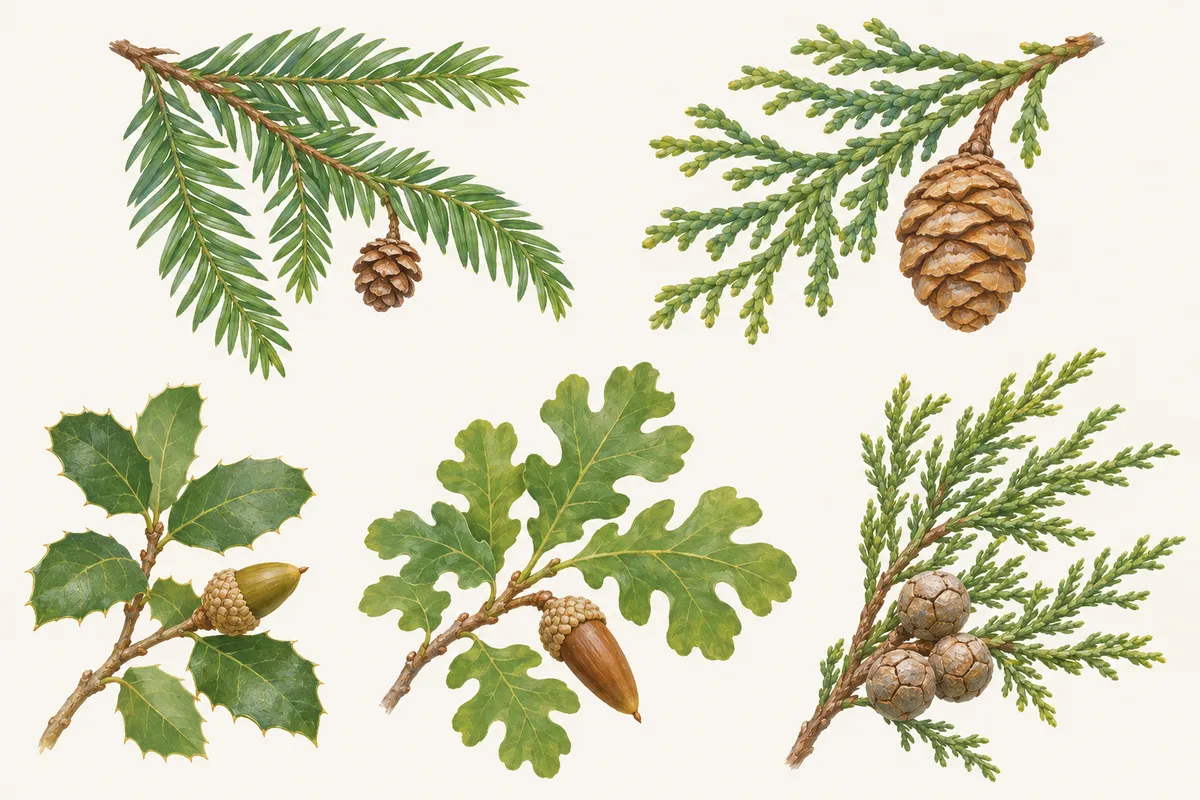
Oaks cover more of California's forest land than any other trees, while conifers hold the most wood. Sort oaks by leaf and acorn, conifers by needles and cones.
In short
California tree identification usually starts with the oaks. Spiny, cupped evergreen leaves mean coast live oak; deeply lobed leaves with 9 to 11 rounded lobes mean valley oak; small, wavy, blue-green leaves mean blue oak. Then the conifers: gray pine has gray-green needles 8 to 12 inches long in threes, sugar pine cones 10 to 18 inches. Redwood and giant sequoia share the title of state tree.
- Tanoak, canyon live oak and Douglas-fir are the three most numerous trees on California forest land, each about 11 to 12% of live trees (USDA Forest Service, Forests of California, 2023).
- The western oak group covers 28.8% of California's 31.5 million acres of forest land, the largest forest type.
- California has two state trees: the coast redwood and the giant sequoia (California State Capitol Museum).
California holds more forest than most people expect: the USDA Forest Service's Forests of California, 2023 counts about 31.5 million acres of forest land, 32% of the state, and about 10.1 billion live trees. The largest forest type is not conifer but the western oak group, 28.8% of forest land, ahead of California mixed conifer (23.6%) and ponderosa pine (7.2%). So start with the oaks, then the conifers. The far north coast shares its Douglas-fir, redwood and madrone with Oregon, covered in trees of the Pacific Northwest; the deserts of the southeast are covered in desert tree identification.
The California trees to learn first
| Tree | Leaf or needle | The feature that settles it |
|---|---|---|
| Coast live oak | Evergreen, 1 to 2 1/2 in, spiny, cupped | Edges turn down like a holly leaf; tufts of fuzz in the vein angles below |
| Canyon live oak | Evergreen, 1 to 3 1/2 in | Spiny and smooth leaves on one branch; bluish-white underside |
| Valley oak | Deciduous, 2 to 4 in | 9 to 11 deep, rounded lobes; bullet-shaped acorns 1 to 2 in |
| Blue oak | Deciduous, 1 to 3 in | Wavy edges; bluish-green upper side; light gray checkered bark |
| Tanoak | Evergreen, 3 to 5 in, leathery | Bluish-white underneath; bristly acorn caps |
| California-laurel (bay) | Evergreen, 3 to 5 in, smooth-edged | Strong bay smell when crushed |
| Gray pine | Needles 8 to 12 in, three per bundle | Gray-green, drooping; cones 6 to 10 in with hooked spines |
| Coast redwood | Flat needles in two rows | Grows within 50 miles of the Pacific, Oregon to Monterey |
By number of trees, the Forest Service ranks tanoak first at 12.0% of live trees, then canyon live oak at 11.3% and Douglas-fir at 11.1%. By wood volume the order changes to Douglas-fir (24.5%), white fir (13.8%) and coast redwood (10.1%), because the big conifers hold far more wood per tree.
The oaks: evergreen or deciduous first
Turn a leaf over and check whether the tree keeps its leaves in winter.
- Coast live oak (Quercus agrifolia): evergreen leaves 1 to 2 1/2 inches long, thick and leathery, convex with edges turning down and spiny, holly-like margins, shiny green above, duller below with tufts of fuzz in the vein angles. Acorns are narrow, pointed and light brown, 1 to 1 1/2 inches long, and ripen in one year. A tree up to 100 feet with crooked, spreading limbs, its crown often wider than it is tall (Virginia Tech Dendrology). Interior live oak, Engelmann oak and canyon live oak are its look-alikes.
- Canyon live oak (Quercus chrysolepis): evergreen, thick leaves 1 to 3 1/2 inches long, with smooth and spiny edges on the same branch and a smooth, bluish-white underside. Acorns sit in a shallow, scaly cap and take two seasons to ripen. It grows as a tree to 80 feet or a dense shrub (Virginia Tech Dendrology).
- Valley oak (Quercus lobata): deciduous leaves 2 to 4 inches long with 9 to 11 deep, rounded lobes; acorns usually conical or bullet-shaped, 1 to 2 inches long, in caps that often carry warty knobs. Old bark is thick, dark gray and deeply fissured. A large tree with massive limbs whose branch tips often droop to the ground (Virginia Tech Dendrology).
- Blue oak (Quercus douglasii): deciduous leaves only 1 to 3 inches long with wavy or shallowly lobed edges, distinctly bluish-green on top, especially late in summer; acorns 3/4 to 1 1/2 inches long in shallow, warty caps; light gray, checkered bark. Seldom over 60 feet (Virginia Tech Dendrology). The USDA Forest Service calls it a California endemic of open savannas and woodlands in the interior foothills, from about 165 to 5,900 feet, with a range about 460 miles long.
In the mountains, the deciduous oak with bristle-tipped, deeply lobed leaves is the California black oak. The oak page explains the white oak and red oak groups, and the live oak page separates coast live oak from the southern live oak of the Gulf states.
Tanoak and California-laurel
Two evergreen broadleaves of the coast ranges are easy to mistake for oaks.
- Tanoak (Notholithocarpus densiflorus, formerly Lithocarpus): leathery leaves 3 to 5 inches long, entire or coarsely toothed, dark green above and bluish white beneath; acorns about 1 inch long in shallow caps covered with dense bristles, taking two seasons to ripen. It often grows in clumps of stems sprouting from burls, 60 to 100 feet tall (Virginia Tech Dendrology). The USDA Forest Service traces its range from southwestern Oregon south through California's Coast Ranges, inland to Mount Shasta and the western Sierra Nevada, usually mixed with Douglas-fir and redwood. The tanoak page compares its bristly acorn caps and leaves with canyon live oak, coast live oak and California-laurel.
- California-laurel (Umbellularia californica), the California bay: smooth-edged leaves 3 to 5 inches long, shiny dark green, very aromatic when crushed; Virginia Tech warns the crushed leaves may irritate the eyes and nose. The fruit is a bluish-black, olive-like drupe about 3/4 inch across on a stalk shaped like a golf tee. Up to 100 feet, often with several stems (Virginia Tech Dendrology).
Never eat an acorn, berry, nut or seed on the strength of a web page or an app; check with a local expert.
Conifers: redwoods, pines and firs
The state tree is two trees. The California State Capitol Museum lists both the coast redwood (Sequoia sempervirens), which grows best within 50 miles of the Pacific from Oregon to Monterey, and the giant sequoia (Sequoiadendron giganteum), found along a 250-mile stretch of the western Sierra Nevada at 4,000 to 8,000 feet. Coast redwood has flat needles in two rows; giant sequoia has short, awl-like leaves pressed along the shoot. The redwood vs sequoia page compares needles, cones and bark.
- Gray pine (Pinus sabiniana): needles 8 to 12 inches long, three per bundle, distinctly gray-green and drooping, on a crooked, often forked trunk with a thin, open crown. The heavy cones are 6 to 10 inches long, each scale tipped with a large, thick spine, and they stay on the tree for years (Virginia Tech Dendrology).
- Sugar pine (Pinus lambertiana): blue-green needles 2 to 4 inches long in bundles of five, and cylindrical cones 10 to 18 inches long, sometimes longer, hanging from the branch tips of a straight tree up to 200 feet (Virginia Tech Dendrology).
Douglas-fir and white fir hold more of California's wood than any other trees. The Douglas-fir page shows its three-pointed cone bracts; the conifer guide explains how to read needles and cones on the rest.
California sycamore and California black walnut
- California sycamore (Platanus racemosa): deciduous leaves 5 to 10 inches long with 3 to 5 lobes cut about halfway in; 3 to 7 bristly seed balls the size of golf balls hang on one long stalk. The bark is its most striking feature: greenish-gray patches peel away to show almost white inner bark (Virginia Tech Dendrology). Virginia Tech lists Arizona sycamore, American sycamore and London plane as look-alikes; the sycamore page covers the eastern American sycamore.
- California black walnut (Juglans californica): compound leaves with 9 to 15 leaflets, round nuts 1 to 1 1/2 inches across, and a small tree of 20 to 40 feet that usually forks into several trunks near the ground, giving a V shape (Virginia Tech Dendrology). Virginia Tech lists Hinds' black walnut and the planted English walnut as look-alikes.
Using a photo in California
California's oaks overlap, and many yards and streets are planted with trees from other continents. Photograph the feature that settles it: a leaf turned over to show its underside, an acorn in its cap, a cone. Tree Identifier names a tree from one photo, and its follow-up chat can answer "coast live oak or interior live oak?". It shows no confidence score, so check the answer against the table above, and finds outside the app's 138-species Collection are kept under Wild Discoveries. With location turned on, its Tree Map pins where each tree grew. For planted blue gums along the coast, see the eucalyptus page; for fan palms, the palm page.
What a photo can't settle
- California yards and streets are full of planted trees from other continents, such as eucalyptus and Mexican fan palm, that a list of native trees does not cover.
- California oaks hybridize, and live oak leaves vary from spiny to smooth on one tree; check the acorn, the leaf underside and the habitat before settling on a name.
- Desert trees of southeastern California, such as mesquite, palo verde and Joshua tree, are covered in a separate guide, not here.
Questions people ask
What is the most common tree in California?
By number of trees, tanoak: 12.0% of the 10.1 billion live trees on California forest land, just ahead of canyon live oak (11.3%) and Douglas-fir (11.1%), in the USDA Forest Service's Forests of California, 2023. By wood volume, Douglas-fir leads with 24.5%, then white fir and coast redwood.
What is the state tree of California?
Two trees share it: the coast redwood (Sequoia sempervirens) and the giant sequoia (Sequoiadendron giganteum). The California State Capitol Museum describes the coast redwood growing within 50 miles of the Pacific from Oregon to Monterey, and the giant sequoia along a 250-mile stretch of the western Sierra Nevada at 4,000 to 8,000 feet.
How do I identify California oaks?
Decide first whether the leaves stay green in winter. Evergreen with spiny, cupped leaves: coast live oak. Evergreen with leaves spiny and smooth on the same branch and bluish-white beneath: canyon live oak. Deciduous with deep rounded lobes: valley oak. Deciduous, small, wavy and blue-green: blue oak.
Is tanoak an oak?
Not a true oak. The USDA Forest Service places it in the beech family but not in the oak genus Quercus, describing it as a link between chestnut and oak: chestnut-like flowers and oak-like acorns. Its acorn caps are covered in dense bristles, and its leaves are bluish white underneath.
What tree has leaves that smell like bay in California?
California-laurel, also called California bay, Oregon-myrtle or pepperwood. Virginia Tech describes smooth-edged leaves 3 to 5 inches long that are very aromatic when crushed and may irritate the eyes and nose, and an olive-like fruit about 3/4 inch across. Crush one leaf gently and smell from a distance.
Sources
- Forests of California, 2023: FIA Annual Snapshot (Resource Update FS-1153) — USDA Forest Service, Forest Inventory and Analysis
- Tree: Coast Redwood and Giant Sequoia — California State Capitol Museum
- Blue oak (Quercus douglasii), Silvics of North America — USDA Forest Service
- Tanoak (Lithocarpus densiflorus), Silvics of North America — USDA Forest Service
- Coast live oak (Quercus agrifolia) fact sheet — Virginia Tech Dendrology
- Valley oak (Quercus lobata) fact sheet — Virginia Tech Dendrology
- Fact sheets: blue oak, canyon live oak, tanoak, California-laurel, gray pine, sugar pine, California sycamore, California black walnut — Virginia Tech Dendrology
Keep reading
- Regional guideDesert tree identification in the American Southwest
- Regional guideTrees of the Pacific Northwest, by region
- Tree comparisonRedwood vs sequoia: coast redwood, giant sequoia and dawn redwood
- Tree profileOak trees (Quercus): how to identify them
- Tree profileLive oak (Quercus virginiana): how to identify it