Tree profile
Canyon live oak (Quercus chrysolepis): how to identify it
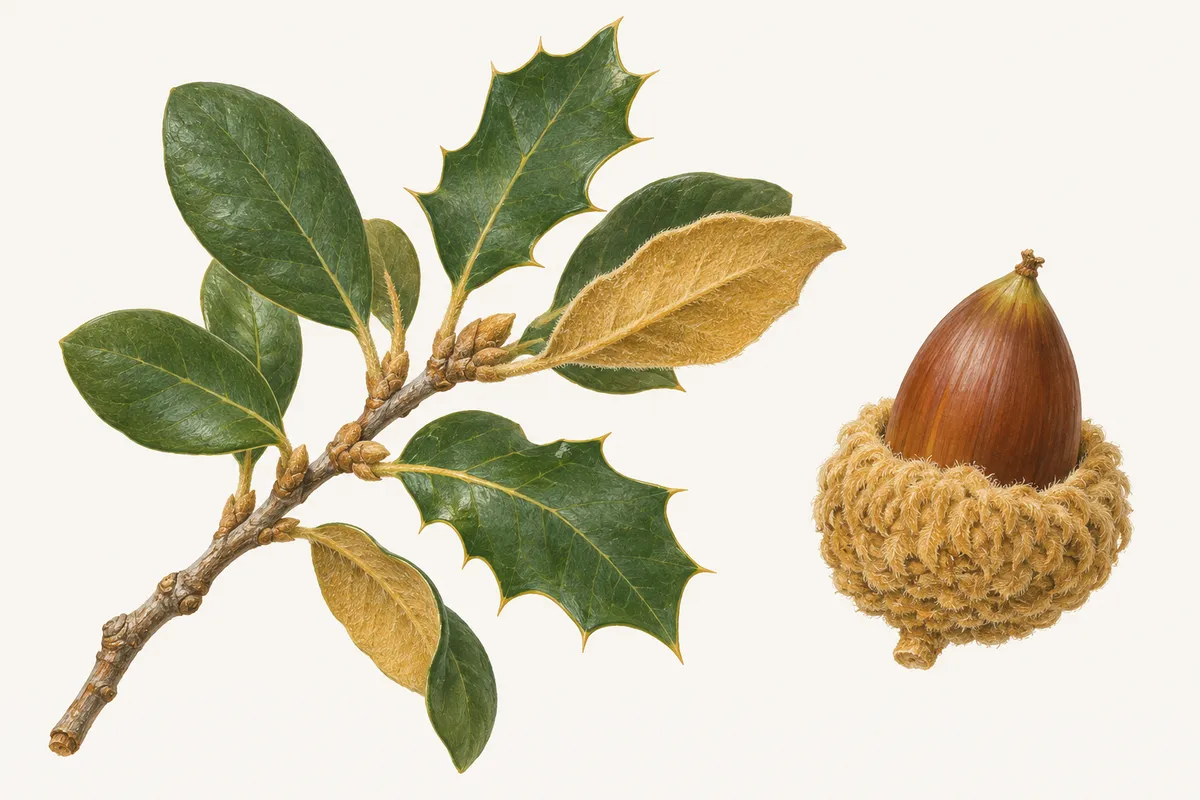
Spiny and smooth leaves on one twig, a pale underside that starts out golden, and an acorn cup that looks dusted with gold: the most numerous true oak on California forest land.
In short
Canyon live oak identification rests on three checks: thick evergreen leaves 1 to 4 inches long with spiny and smooth edges on the same branch, a bluish-white or gray underside that is golden and woolly on young leaves, and a large acorn, up to 2 inches long, in a thick, shallow cup covered with golden fuzz. It grows from southwest Oregon to Baja California and Arizona.
- Spiny young leaves and smooth mature leaves on one tree are normal for canyon live oak; the golden-fuzzy acorn cup gives it the name goldcup oak.
- Coast live oak leaves are cupped and spiny with tufts of hairs under the veins; interior live oak leaves are yellow-green, not bluish-white, beneath.
- It is the second most numerous tree on California forest land, 11.3% of live trees (USDA Forest Service, 2023).
Field marks at a glance
- Scientific name
- Quercus chrysolepis
- Family
- Fagaceae (beech family)
- Type
- Broadleaf, evergreen
- Leaves
- Alternate, evergreen, thick and leathery, oblong to elliptic, 1 to 4 inches long; shiny dark green above.
- Leaf edges
- Spiny like holly on young leaves and sprouts, usually smooth on mature leaves, often both on one branch.
- Leaf underside
- Bluish-white or gray on mature leaves; golden and woolly on young leaves.
- Acorns
- Chestnut brown, ellipsoid, 1/2 to 2 inches long; take two seasons to ripen (Virginia Tech, NC State; one season per the USDA Forest Service), falling in October.
- Acorn cup
- Thick, shallow and scaly, covered with golden fuzz; holds only the base of the nut.
- Bark
- Thin (about 1 inch), smooth and gray-brown, later with tight small scales and narrow furrows.
- Twigs
- Slender, with orange glandular hairs when young, becoming smooth and reddish to grayish brown.
- Size and form
- A tree up to 80 feet (to 100 feet in dense stands) in sheltered canyons; a dense shrub up to 15 feet on exposed slopes and ridges.
- Range
- Southwest Oregon through California's mountains to Baja California; scattered in Nevada, Arizona, New Mexico and northern Mexico.
Canyon live oak is one of the most common trees in the mountains of California, and one of the most confusing. A single tree can carry spiny leaves like holly and smooth-edged leaves like an olive, sometimes on the same twig. It can be a straight-trunked tree 80 feet tall in a shaded canyon, or a waist-high thicket on a windy ridge. Two features hold steady: a pale underside that starts out golden, and an acorn cup that looks dusted with gold dust, which gave it the name goldcup oak.
How to identify a canyon live oak
Check in this order; the acorn cup settles it when you can find one.
1. Leaves: thick, evergreen, mixed edges. Virginia Tech Dendrology describes alternate, persistent leaves, oblong to elliptical, thick and leathery, about 1 to 3 1/2 inches long, with smooth or spiny margins, even on one branch. NC State Extension gives 1 to 4 inches and adds that the margins are "usually entire on mature leaves" while young leaves are spiny like holly. Look at the whole branch, not one leaf.
2. Underside: golden, then bluish-white. NC State describes the undersides of young leaves as golden and woolly, and mature undersides as bluish-white or gray, with some star-shaped and glandular hairs. Turn over a fresh leaf near the twig tip and an older one farther back: gold on one, pale on the other is typical.
3. Acorn and golden cup. The acorns are large, chestnut brown and ellipsoid, 1/2 to 2 inches long (NC State; Virginia Tech gives 1/2 to 1 1/2 inches). The USDA Forest Service describes the cup as thick and shallow, enclosing only the base of the nut and covered with golden tomentum, a fine golden fuzz. Virginia Tech and NC State say the acorns take two seasons to ripen; the Forest Service says one, with the fall in October. Look under the tree for old cups if the branches are out of reach.
4. Bark: thin and smooth to scaly. Virginia Tech describes thin bark, about 1 inch, mostly smooth and gray-brown; NC State adds tight small scales and narrow furrows with age. The Forest Service notes that this thin, flaky bark leaves the tree sensitive to fire.
5. Twigs. Young twigs carry orange glandular hairs and become smooth and reddish to grayish brown with age (NC State).
Tree Identifier can name a canyon live oak from a photo of a branch, a leaf or the acorns. Because it gives one name and no alternatives, photograph a branch that shows both spiny and smooth leaves, plus a leaf turned over, to give it the best chance.
Canyon live oak vs coast live oak, interior live oak and tanoak
| Tree | Leaf | Underside | Acorn and cup |
|---|---|---|---|
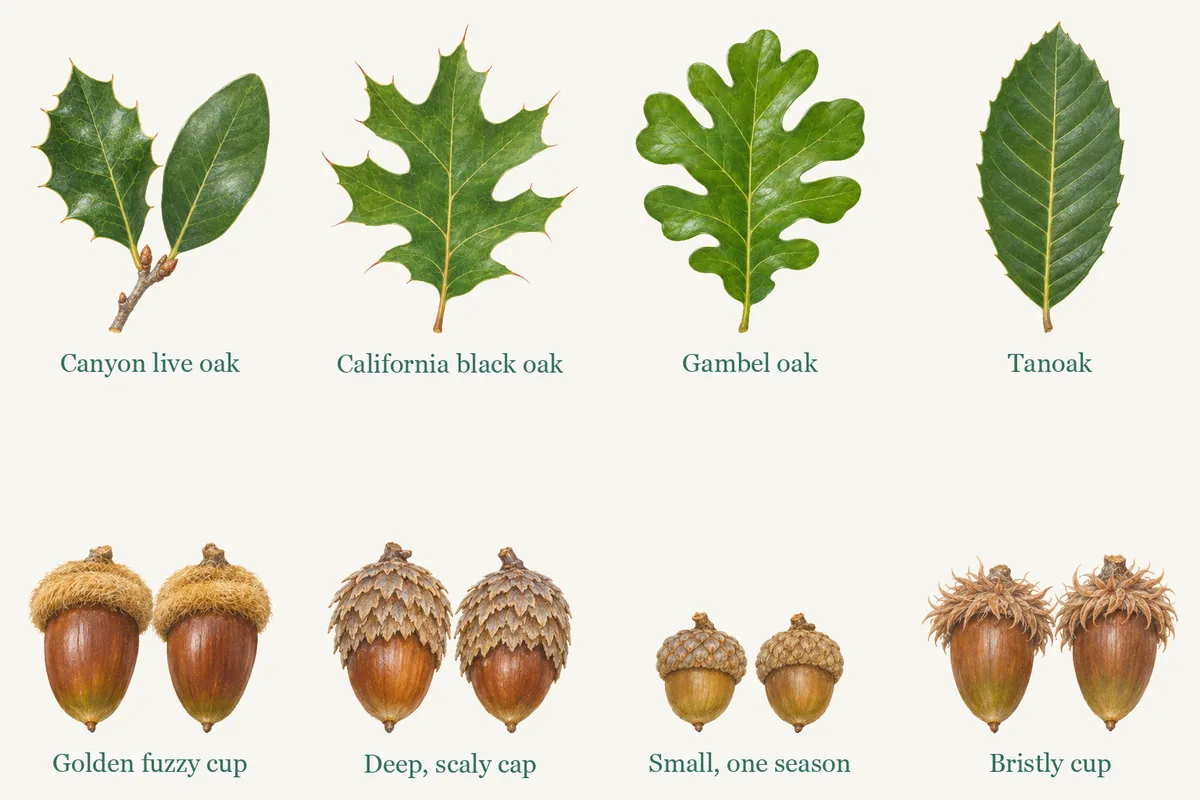
| Canyon live oak | 1–4 in, spiny and smooth on one branch | Golden when young, then bluish-white or gray | Up to 2 in, thick shallow cup with golden fuzz; 2 seasons |
| Coast live oak | 1–2 1/2 in, convex, spiny all around | Tufts of hairs in the vein angles | Narrow, pointed, light brown; 1 season |
| Interior live oak | 1 1/2–2 in, smooth or sharply toothed | Yellow-green | 1–1 1/2 in, narrow, cone-shaped; 2 seasons |
| Tanoak | 3–5 in, stiff, leathery | No golden wool | About 1 in, shallow cup with dense bristles |
Coast live oak is the oak of coastal valleys. Virginia Tech's coast live oak sheet describes convex leaves 1 to 2 1/2 inches long with edges turning down and holly-like spines, and narrow, pointed acorns that ripen in one year. Our live oak page covers it beside the southern live oak.
Interior live oak grows in the foothills. The Virginia Tech interior live oak sheet gives leaves 1 1/2 to 2 inches long, smooth or sharply toothed, shiny green above and yellow-green below, and a narrow, cone-shaped acorn with a pointed end that matures in two seasons. Its older bark is dark, rough and irregularly furrowed. The yellow-green underside separates it from canyon live oak's bluish-white one.
Tanoak is not a true oak, though it bears acorns. Virginia Tech's tanoak sheet describes stiff, leathery leaves 3 to 5 inches long and acorns about 1 inch long in shallow cups covered with dense bristles.
Where canyon live oak grows
The Forest Service gives a long, mountainous range: the Coast Ranges and Cascades of southwestern Oregon, the Sierra Nevada, Coast Ranges, Klamath Mountains and mountains of southern California, with scattered populations in southern Nevada and Arizona, and south into Baja California and northwestern Chihuahua. NC State also lists New Mexico. Elevations run from 1,600 to 5,000 feet in southwestern Oregon, 300 to 4,500 feet in northern California, and up to 9,000 feet in southern California.
As the name says, it is a tree of canyons. The Forest Service describes it as often the dominant tree on steep canyon walls, on many soil types, on south-facing slopes in moist areas and north-facing slopes in drier ones. By number, it is one of California's most common trees: the Forest Service's Forests of California, 2023 snapshot ranks it second on the state's forest land, at 11.3% of about 10.1 billion live trees, behind tanoak (12.0%) and ahead of Douglas-fir (11.1%). Our California tree identification guide places it among the state's other oaks and conifers.
Size, form and fire
Size depends on shelter. In canyons the Forest Service describes trees with straight trunks free of branches for 20 to 40 feet, 60 to 100 feet tall in dense mature stands and up to 60 inches in diameter, with a broad, dome-shaped crown when grown in the open. On exposed slopes it becomes a dense shrub, and Virginia Tech gives a shrub form up to 15 feet. Repeated fires tend to convert trees to shrubs, because the thin, flaky bark gives the stems little protection.
NC State reports that it grows very slowly and can live up to 300 years. Its hard wood once made the heads of splitting mauls, the origin of the name maul oak, according to the Forest Service. Flowers appear in April and May as catkins, wind-pollinated, and good acorn crops come every 2 to 4 years.
For the general oak key, from leaf lobes to the two acorn groups, see our oak identification page. With location turned on, Tree Identifier's Tree Map pins a canyon live oak you identify, a simple way to come back in fall and look for the golden cups.
Look-alikes and how to tell them apart
Coast live oak (Quercus agrifolia)
Coast live oak leaves are 1 to 2 1/2 inches, convex with the edges turning down like an upturned spoon, spiny all around, with tufts of hairs where the veins meet underneath. Its narrow, pointed acorns ripen in one year.
Interior live oak (Quercus wislizeni)
Interior live oak leaves are 1 1/2 to 2 inches, smooth or sharply toothed, and shiny green above but yellow-green below, not bluish-white. Its acorn is narrow and cone-shaped with a pointed end, and the bark of older trees is dark and rough.
Tanoak (Notholithocarpus densiflorus)
Tanoak leaves are longer, 3 to 5 inches, stiff and leathery, and its acorn cup is shallow and covered with dense bristles rather than golden fuzz. Canyon live oak leaves are 1 to 4 inches and often spiny on young growth.
What a photo can't settle
- A photo of one spiny leaf can match coast live oak, interior live oak or even holly; the mix of spiny and smooth leaves and the golden cup need to be in view.
- Golden hairs fade as leaves age, so the underside of an older leaf is gray or bluish-white, and a photo of it shows no gold.
- A scrubby, shrub-form canyon live oak on a burned or exposed ridge, without acorns, can be hard to name from photos.
Questions people ask
Why does canyon live oak have spiny and smooth leaves?
NC State Extension describes mature leaves with usually smooth edges and young leaves with spiny, holly-like margins, and Virginia Tech notes that both can grow on the same branch. One tree can look like two species.
Why is it called goldcup oak or maul oak?
Goldcup refers to the acorn cup, covered with golden fuzz, which the USDA Forest Service calls golden tomentum. Maul oak comes from its hard wood, once used to make the heads of splitting mauls, according to the Forest Service.
How long do canyon live oak acorns take to ripen?
Two seasons, according to Virginia Tech Dendrology and NC State Extension; the USDA Forest Service says one season. All agree the acorns fall in October. The Forest Service adds that good seed crops come every 2 to 4 years, so a bare tree one autumn proves little.
Is canyon live oak a shrub or a tree?
Both. In sheltered canyons it is a tree up to 80 feet (Virginia Tech), and the USDA Forest Service reports 60 to 100 feet in dense mature stands. On exposed mountain slopes and ridges it grows as a dense shrub up to about 15 feet, and repeated fires tend to turn trees into shrubs.
Sources
- Canyon Live Oak (Quercus chrysolepis), Silvics of North America — USDA Forest Service
- Canyon live oak (Quercus chrysolepis) fact sheet — Virginia Tech Dendrology
- Quercus chrysolepis (canyon live oak) — North Carolina Extension Gardener Plant Toolbox, NC State University
- Coast live oak (Quercus agrifolia) fact sheet — Virginia Tech Dendrology
- Interior live oak (Quercus wislizeni) fact sheet — Virginia Tech Dendrology
- Tanoak (Notholithocarpus densiflorus) fact sheet — Virginia Tech Dendrology
- Forests of California, 2023: FIA Annual Snapshot (Resource Update FS-1153) — USDA Forest Service, Forest Inventory and Analysis
Keep reading
- Tree profileLive oak (Quercus virginiana): how to identify it
- Tree profileOak trees (Quercus): how to identify them
- Regional guideCalifornia tree identification, from the redwood coast to the foothills
- Tree profileDouglas-fir (Pseudotsuga menziesii): how to identify it
- Tree comparisonRed oak vs white oak trees: how to tell the living trees apart