Tree profile
California black oak (Quercus kelloggii): how to identify it
The one deciduous red oak of the western mountains: sharply lobed, bristle-tipped leaves on a tree of the Sierra Nevada, the Coast Ranges and southern Oregon.
In short
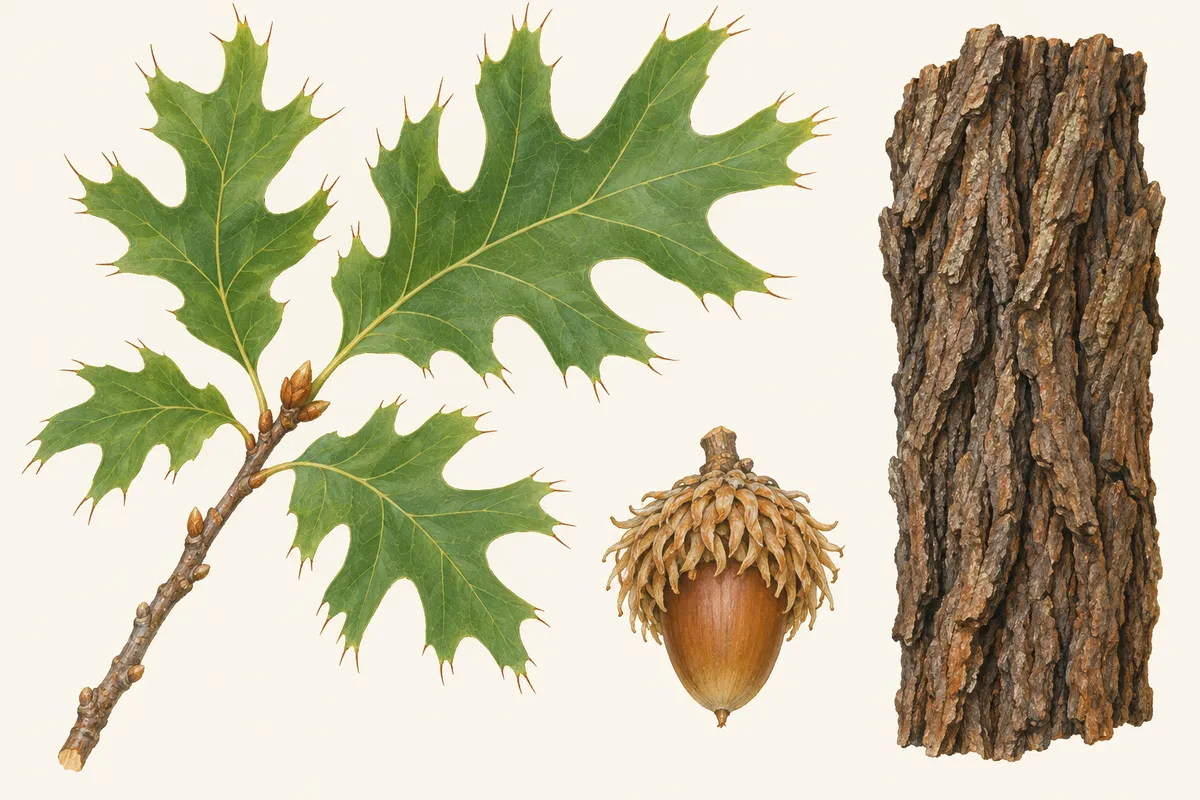
California black oak identification starts with the leaf: deciduous, 3 to 6 inches long, usually with 7 deep lobes, each lobe ending in about three bristle-tipped teeth. New leaves open dusty rose or pink in spring. Acorns are large, 1 to 2 1/2 inches long, in a deep thin-scaled cap covering about half the nut, and take two years to ripen. Old bark is dark, in broad plated ridges.
- Its deciduous, deeply lobed leaves end in bristle-tipped teeth, the look of an eastern red oak in western mountains.
- Oregon white oak and valley oak also have lobed leaves, but their lobes are rounded with no bristles, and their acorns ripen in one season.
- A black oak that keeps sparse green leaves in winter may be the hybrid with interior live oak, Quercus × moreha.
Field marks at a glance
- Scientific name
- Quercus kelloggii
- Family
- Fagaceae (beech family)
- Type
- Broadleaf, deciduous
- Leaves
- Alternate, simple, 3 to 6 inches (8 to 15 cm) long, oblong to obovate, usually 7 lobes (Oregon State: 7 to 11), each lobe with about three bristle-tipped teeth; sinuses shallow to deep; glossy yellow-green above, paler below.
- Seasonal color
- New leaves dusty rose or soft pink in spring, sometimes hairy; fall color yellow to yellow-orange. Completely deciduous.
- Acorns
- 1 to 2 1/2 inches long, reddish-brown, single or in clusters of 2 to 6, in a deep, thin-scaled cap covering about half (1/2 to 3/4) of the nut; ripen in the second year, falling late September to early November.
- Bark
- Smooth and dark gray or black on young trees; older trees dark brown to black with broad, irregular plated ridges, about 1 to 2 inches thick.
- Twigs and buds
- Reddish-brown, ridged twigs, smooth or very finely hairy; large, pointed end buds clustered at the tip.
- Size and form
- 40 to 80 ft tall, 1 to 2 1/2 ft across, open rounded crown; at high elevations sometimes a large shrub. Can live nearly 500 years.
- Range
- From just north of Eugene, Oregon, south through western Oregon valleys, the California Coast Ranges and the west side of the Sierra Nevada to the mountains of southern California and Baja California; never near the coast.
- Habitat
- Mountain slopes with hot, dry summers and cool, moist winters; deep, well-drained soils; most often with ponderosa pine.
California black oak is the oak that looks like it belongs in Pennsylvania. Its leaves are deeply lobed with bristle-tipped teeth, like an eastern red oak's, and they turn yellow and fall each autumn, while most of the oaks around it in California stay green. It grows on the mountain slopes of the Sierra Nevada, the Coast Ranges and southwestern Oregon, usually with ponderosa pine, and the USDA Forest Service ranks it above all other California oaks in volume, distribution and elevation range.
How to identify a California black oak
1. Lobed leaves with bristle tips. The Virginia Tech fact sheet describes alternate leaves 3 to 6 inches long, oblong to obovate, usually with 7 lobes, each lobe with three bristle-tipped teeth, and sinuses that may be shallow or deep. The upper surface is glossy yellow-green, the lower paler. Oregon State University gives 8 to 15 cm, sharply cut into 7 to 11 lobes, each tooth ending in a bristle.
2. Spring and fall color. Oregon State describes new spring leaves as dusty rose or soft pink, sometimes somewhat hairy, and fall color as yellow to yellow-orange. In winter the tree is bare: the Forest Service's Silvics of North America calls it completely deciduous.
3. A big acorn in a deep cap. Virginia Tech gives a reddish-brown acorn 1 to 2 1/2 inches long, with a deep cap covering about half the nut, taking two growing seasons to ripen. The Forest Service gives a light brown, thin-scaled cup enclosing half to three quarters of the nut, acorns single or in clusters of 2 to 6.
4. Dark bark. Young trunks are smooth and dark gray or black. Older bark turns dark brown to black with broad, irregular plated ridges about an inch thick (Virginia Tech); the Forest Service gives 1 to 2 inches on mature trees.
5. Twigs and buds. Twigs are reddish-brown and ridged, smooth or very finely hairy, with large, pointed buds clustered at the tips.
Tree Identifier can name a California black oak from one photo of a leaf, an acorn or the bark. It shows one name, without a confidence score or a list of look-alikes, so check for the bristle tips before accepting it.
California black oak vs Oregon white oak and valley oak
California has several deciduous oaks with lobed leaves, but California black oak is the one in the red oak group. The other two, Oregon white oak and valley oak, are white oaks: rounded lobes, no bristles, acorns that ripen in one year. Figures are from the Virginia Tech fact sheets for Oregon white oak, valley oak and California black oak.
| Mark | California black oak | Oregon white oak | Valley oak |
|---|---|---|---|
| Leaf | 3–6 in, usually 7 lobes, bristle-tipped teeth | 3–6 in, 5–9 irregular rounded lobes | 2–4 in, 9–11 deep rounded lobes |
| Bristles | Yes | No | No |
| Acorn | 1–2 1/2 in, deep cap over about half | About 1 in, shallow cap over about 1/3 | 1–2 in, conical or bullet-shaped |
| Ripens | Two seasons | One season | One year |
| Bark | Dark brown to black, broad plated ridges | Thin, light gray to gray-brown | Dark gray, deeply fissured, thick |
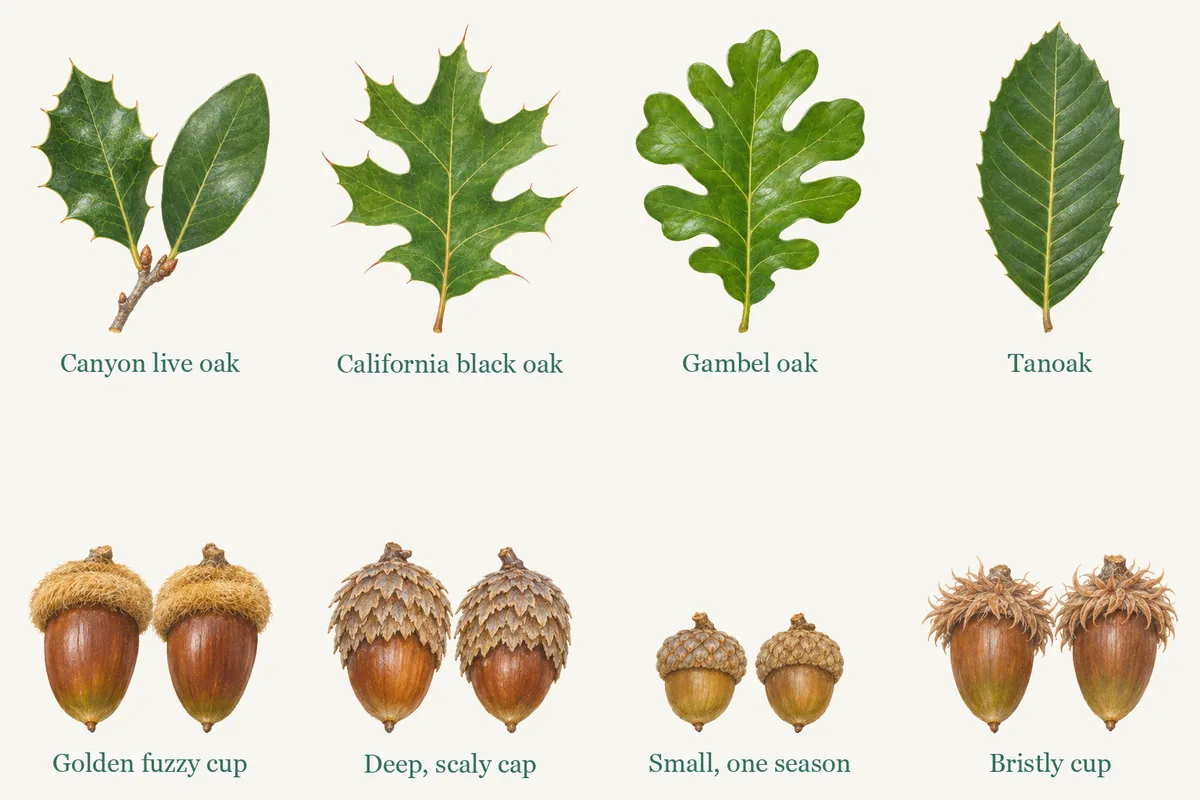
The bristle test settles it in seconds: touch the tip of each lobe. The California tree identification guide covers valley, blue, coast live and canyon live oak, and the live oak page the evergreen oaks.
Hybrids with the live oaks
California black oak crosses with two evergreen red oaks. The Forest Service names Quercus × moreha, with interior live oak, as the most widespread hybrid, found throughout California and rarely in south-central Oregon; in winter it keeps sparse evergreen foliage, and its new spring leaves form dense, shiny green foliage. It also lists Q. × ganderi and Q. × chasei, both with coast live oak.
So a tree with lobed, bristle-tipped leaves that are thicker than usual and partly green in January deserves a second look. True California black oak is bare in winter.
Where California black oak grows
The Forest Service range runs about 780 miles north to south. In Oregon it grows from just north of Eugene south through the valleys west of the Cascade Range. In California it follows the Coast Ranges from the Oregon line to Marin County, with scattered stands in the Santa Cruz and Santa Lucia Mountains, and the west side of the Sierra Nevada from near Lassen Peak to near Kings Canyon, reaching the mountains of southern California and Baja California. It never grows near the ocean.
Elevations range widely: about 200 feet in the Napa and Santa Rosa Valleys, 600 to 6,250 feet in the Cascade Range, a lower limit of 1,500 feet in the northern Sierra Nevada rising to 4,000 feet in the south, an upper limit of 6,500 to 7,800 feet, and up to 8,000 feet in the San Jacinto Mountains. It needs well-drained soil; the Forest Service says it does not grow "with its feet wet". Ponderosa pine is its most common associate, with incense-cedar, Douglas-fir, sugar pine, tanoak, Pacific madrone and canyon live oak among many others.
Acorns, size and age
The Forest Service gives acorns 1.9 to 4.4 cm (0.7 to 1.7 inches) long. They take two years to mature. Early drops from mid-August are mostly hollow or insect-infested; sound acorns fall from late September to early November. At least 14 species of birds, many small mammals and mule deer eat them, and western gray squirrels and scrub jays bury and spread them. The acorn identification guide keys loose acorns by cap and size.
Virginia Tech gives a height of 40 to 80 feet and a trunk 1 to 2 1/2 feet across. The Forest Service says trees seldom exceed 5 feet in diameter or 130 feet in height, can live nearly 500 years, and sprout vigorously from the root collar after fire or cutting. For the two oak groups and the eastern black oak, see the oak identification page; with location turned on, Tree Identifier's Tree Map pins a find so you can come back in spring for the pink new leaves.
Look-alikes and how to tell them apart
Oregon white oak (Quercus garryana)
Virginia Tech lists the two as look-alikes. Oregon white oak has 5 to 9 rounded lobes with no bristle tips, an acorn about 1 inch long in a shallow cap covering a third of the nut, and acorns that ripen in one season. Black oak's lobes end in bristles.
Valley oak (Quercus lobata)
Valley oak leaves are smaller, 2 to 4 inches, with 9 to 11 deep, rounded lobes and no bristles; its acorns are long and bullet-shaped, 1 to 2 inches, ripening in one year. It is a white oak of valleys, with drooping branch tips.
Quercus × moreha (black oak × interior live oak)
The USDA Forest Service calls this the most widespread California black oak hybrid. It keeps sparse evergreen foliage through winter, while true California black oak is completely deciduous. Check the tree in January.
What a photo can't settle
- California black oak hybridizes with interior live oak and coast live oak (USDA Forest Service), and hybrids mix deciduous and evergreen traits; one photo of one leaf cannot settle a hybrid.
- At high elevations it can grow as a large shrub, and leaves on sprouts and shaded branches are often less typical than sun leaves; check several leaves from the sunny side of the crown.
- Tree Identifier shows one name per photo with no confidence score and no list of alternatives, so confirm the bristle tips and the acorn cap yourself.
Questions people ask
Is California black oak the same as black oak?
No. The black oak of the eastern US is Quercus velutina. California black oak is Quercus kelloggii, a separate red oak of the West Coast mountains, named in 1857 for the botanist Albert Kellogg, according to the USDA Forest Service. Locally it is often just called black oak.
Is California black oak evergreen?
No. The USDA Forest Service calls it completely deciduous, unlike California's live oaks. A black oak-like tree that keeps sparse green leaves in winter may be its hybrid with interior live oak, Quercus × moreha.
How long do California black oak acorns take to ripen?
Two years, the mark of the red oak group. The USDA Forest Service says early drops from mid-August are mostly hollow or insect-damaged, and sound acorns fall from late September to early November, ending by mid-November at low elevations and early December higher up.
How old can a California black oak get?
The USDA Forest Service says it can live nearly 500 years, and that heart rot becomes common after about 85 years. The largest known tree, in the Siskiyou National Forest in Oregon, measured 108 inches in diameter and 124 feet tall.
Sources
- California Black Oak, Silvics of North America — USDA Forest Service
- California black oak (Quercus kelloggii) fact sheet — Virginia Tech Dendrology
- Quercus kelloggii — Landscape Plants, Oregon State University
- Oregon white oak (Quercus garryana) fact sheet — Virginia Tech Dendrology
- Valley oak (Quercus lobata) fact sheet — Virginia Tech Dendrology
Keep reading
- Tree profileOak trees (Quercus): how to identify them
- Tree profileLive oak (Quercus virginiana): how to identify it
- Tree profileNorthern red oak (Quercus rubra): how to identify it
- Regional guideCalifornia tree identification, from the redwood coast to the foothills
- Clue guideAcorn identification: which oak dropped this acorn?