Tree profile
Tanoak (Notholithocarpus densiflorus): how to identify it
An evergreen of the coast redwood and Douglas-fir forests that bears acorns like an oak and flowers like a chestnut, and is neither.
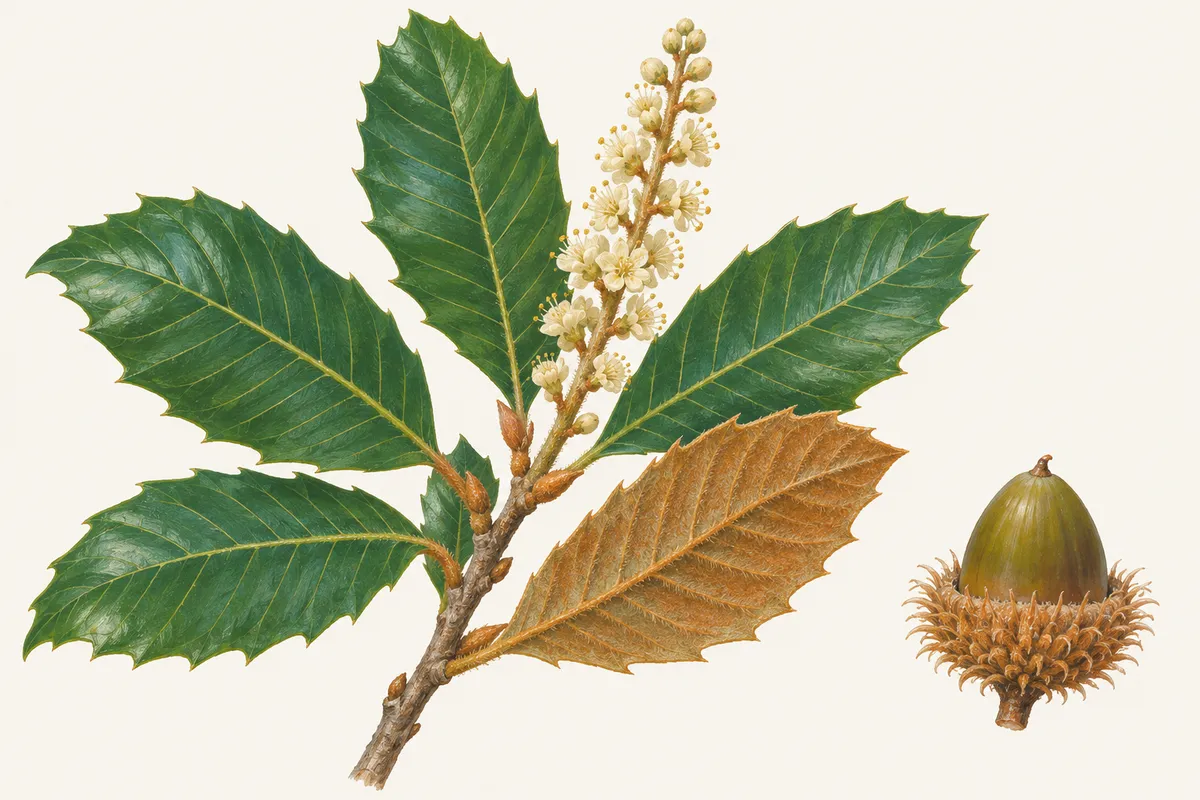
In short
Tanoak tree identification: look for stiff, leathery evergreen leaves 3 to 5 inches long, smooth or coarsely toothed and often rolled under, dark green above and bluish white beneath; acorns about 1 inch long in shallow caps covered with dense bristles; upright catkins in summer; and clumps of stems sprouting from burls, in coastal forests of California and southwestern Oregon.
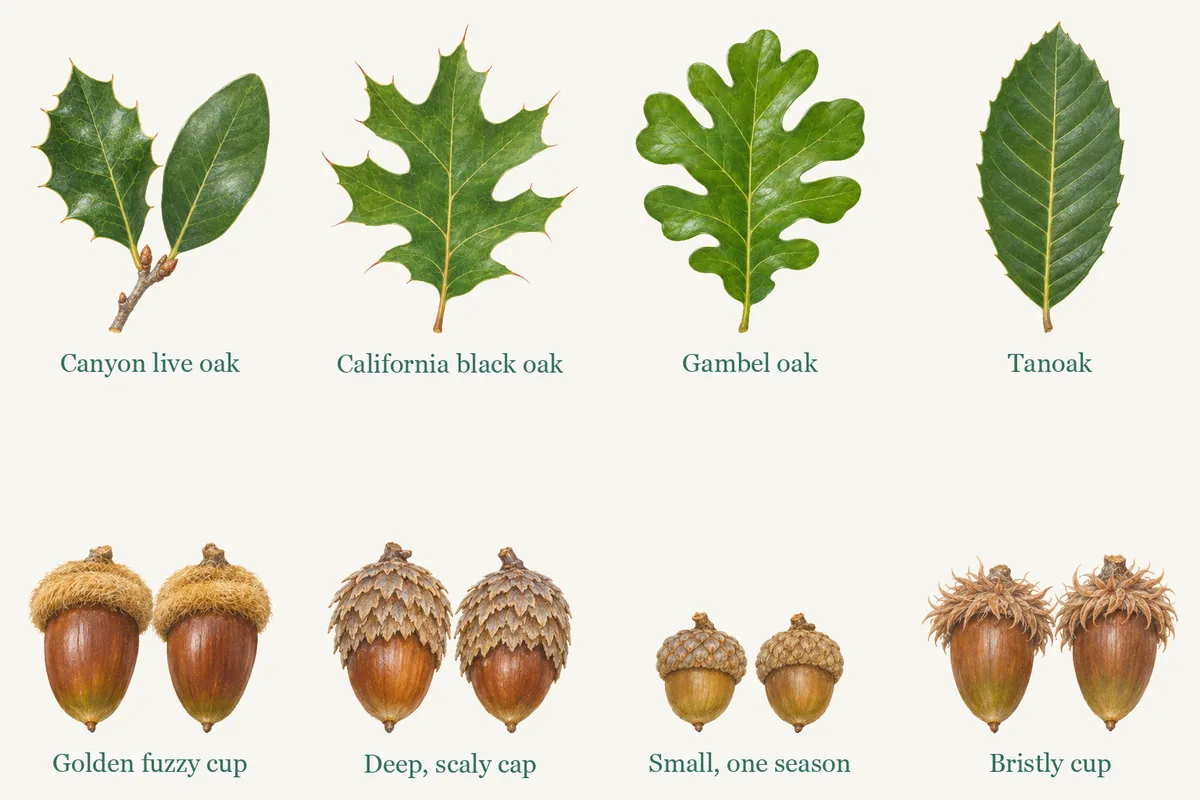
- A shallow acorn cap covered with dense bristles marks tanoak; canyon live oak and coast live oak, which share its forests, have scaly caps.
- Tanoak flowers on upright catkins 2 to 4 inches long, like a chestnut, mostly in June, July or August.
- Tanoak is highly susceptible to sudden oak death, which only a laboratory test can confirm.
Field marks at a glance
- Scientific name
- Notholithocarpus densiflorus (formerly Lithocarpus densiflorus)
- Family
- Fagaceae (beech family)
- Type
- Broadleaf, evergreen
- Leaves
- Alternate, simple, oblong, 3 to 5 inches long, stiff and leathery, kept 3 to 4 years; edges smooth or coarsely toothed, often rolled under; dark green above, bluish white beneath; young leaves densely hairy.
- Acorns
- About 1 inch long (USDA Forest Service: 1 to 2 inches), single or paired, in a shallow cap covered with dense bristles; nut and inside of the cap hairy; two seasons to ripen, falling from late September to mid November.
- Flowers
- Erect catkins 2 to 4 inches long, mostly June to August; female flowers at the base of the male catkins, on new shoots.
- Twigs
- Stout, round, reddish brown, with dense rust-colored hairs in the first year or two; pith star-shaped.
- Bark
- Moderately thick, reddish brown to gray-brown, with narrow furrows and rounded, flattened ridges that sometimes break into square plates.
- Form
- Usually 50 to 90 feet tall (Forest Service), 60 to 100 feet (Virginia Tech); often in clumps of stems sprouting from burls; a narrow spire in shade, a dense rounded crown in the open.
- Range
- Southwestern Oregon south through California's Coast Ranges to the Santa Ynez Mountains, inland to Mount Shasta and the western Sierra Nevada; sea level to about 5,000 feet.
- Companions
- Douglas-fir and coast redwood most often; Pacific madrone is its most common broadleaf associate.
Tanoak is the evergreen with acorns that grows under the coast redwoods and Douglas-firs of northern California and southwestern Oregon. It looks like an oak and is often called one, but its flowers are those of a chestnut, and its acorn caps are bristly rather than scaly. It is also one of the most numerous trees in the West: the USDA Forest Service's inventory (EVALIDator) counts about 1.5 billion live tanoaks on US forest land, 56th of all species.
How to identify tanoak
Start with an acorn if you can find one, then check the leaves, twigs and the base of the tree.
1. A bristly acorn cap. Virginia Tech's tanoak fact sheet describes single or paired acorns about 1 inch long in a shallow cap covered with dense bristles, with the inside of the cap and the exposed nut densely hairy. The USDA Forest Service's Silvics of North America gives acorns 1 to 2 inches long and 0.6 to 0.7 inch across, ripening in the second autumn after flowering and falling from about September 20 to November 15. The live oaks that share its forests carry acorns in caps of scales, so the cap is the single best clue.
2. Stiff, leathery leaves, bluish white beneath. The leaves are alternate, simple, oblong and 3 to 5 inches long, stiff and leathery, and stay on the tree 3 to 4 years. The edges are smooth or coarsely toothed and often rolled under. Mature leaves are dark green above and bluish white below, and young leaves are densely hairy (Virginia Tech).
3. Rusty, hairy twigs. Twigs are stout, round and reddish brown, with dense rust-colored hairs during their first year or two; cut one across and the pith is star-shaped.
4. Upright catkins in summer. Tanoak is monoecious. The Forest Service describes erect male catkins 2 to 4 inches long with the female flowers at their base, almost all on new shoots, blooming in June, July or August, earlier on the coast and at low elevations. The Forest Service compares these flowers to a chestnut's.
5. Clumps of stems from burls. Virginia Tech notes that tanoak often grows in clumps of several stems sprouting from underground burls. After fire or logging the Forest Service describes vigorous sprouting, with one large stump recorded producing as many as 1,400 sprouts.
Tanoak vs canyon live oak, coast live oak and California-laurel
| Tree | Leaf | Fruit | Bark |
|---|---|---|---|
| Tanoak | 3–5 in, leathery, smooth or coarsely toothed, bluish white beneath | Acorn about 1 in, bristly cap, 2 seasons | Reddish brown, narrow furrows, sometimes square plates |
| Canyon live oak | 1–3 1/2 in, smooth or holly-spiny on the same branch, bluish white beneath | Acorn 1/2–1 1/2 in, shallow scaly cap, 2 seasons | Thin, gray-brown, mostly smooth |
| Coast live oak | 1–2 1/2 in, cupped, spiny, hair tufts in vein angles | Acorn 1–1 1/2 in, slim and pointed, scaly cap, 1 season | Smooth gray-brown, broad gray ridges with age |
| California-laurel | 3–5 in, smooth-edged, shiny, very aromatic | Olive-like bluish-black drupe about 3/4 in | Thin, reddish brown, somewhat scaly |
Sources: Virginia Tech's fact sheets for canyon live oak, coast live oak and California-laurel.
Canyon live oak is the most likely mix-up, because both have leathery leaves that are pale beneath, both grow in the same mountains, and both take two seasons to ripen acorns. Leaf size and the acorn cap separate them: canyon live oak's leaves are smaller and often spiny, and its cap is scaly. Coast live oak's small, cupped, spiny leaves are distinct once you hold one. California-laurel is the tree with the same leaf size, but crush a leaf and the strong smell gives it away; Virginia Tech warns that crushed leaves may irritate the eyes and nose. Our California tree guide sets all four in their regions, and the live oak page covers coast live oak beside the southern live oak.
Where tanoak grows
The Forest Service traces tanoak from a disjunct stand just north of the Umpqua River in southwestern Oregon south through California's Coast Ranges to the Santa Ynez Mountains near Santa Barbara, northeast from Humboldt Bay to the lower slopes of Mount Shasta, and along the Sierra Nevada as far south as Mariposa County, most commonly between the Feather and American Rivers. It grows from sea level to about 4,000 to 5,000 feet in the Coast Ranges and between about 1,900 and 5,000 feet in the Sierra Nevada.
It favors a humid climate with 40 to 100 inches of precipitation a year, most of it from November through February, and deep, well-drained soils, though it also grows on shallow, stony ground and, as a shrub, on serpentine. Its most frequent conifer companions are Douglas-fir and coast redwood; Pacific madrone is its most common broadleaf associate, with giant chinkapin, canyon live oak, California black oak and California-laurel. Tanoak is shade tolerant: in a dense conifer forest it grows a single trunk and a narrow crown, and in the open it branches low into a broad crown.
Size, sprouts and sudden oak death
Mature tanoaks are typically 50 to 90 feet tall, occasionally 150 feet, according to the Forest Service, which records the tallest at 208 feet on the North Fork of the Little Sur River in Monterey County. Virginia Tech gives 60 to 100 feet and 1 to 5 feet through the trunk. Heavy acorn crops usually start after 30 to 40 years and come almost every other year.
Tanoak is highly susceptible to sudden oak death, caused by Phytophthora ramorum. UC IPM's sudden oak death Pest Notes describe browning leaves, either sudden or gradual, wilting shoot tips and trunk cankers like those on red oaks, and note that some tanoaks are infected with no cankers or bleeding at all. The disease thrives in coastal tanoak and redwood forests and oak woodlands in the fog belt, and it can kill seedlings, saplings and mature trees. Infection must be confirmed by a laboratory using culture or DNA analysis; it cannot be identified from symptoms. Our tree disease guide covers other common tree diseases and their signs.
Never eat an acorn, nut or seed on the strength of a web page or an app; check with a local expert.
Photographing a tanoak
The most useful photo is an acorn in its cap, held so the bristles show. Next best is a leaf turned over to show the bluish-white underside, and a shot of the base if the tree grows as a clump of stems. Tree Identifier names a tree from one photo of a leaf, the acorn, the bark or the whole tree, with common and scientific names but no confidence score and no list of look-alikes, so check the cap yourself. Its Diagnose tool rates visible damage on a leaf or branch by severity, but for sudden oak death only a laboratory test settles it. The oak page and the acorn identification guide cover the true oaks.
Look-alikes and how to tell them apart
Canyon live oak (Quercus chrysolepis)
Canyon live oak's leaves are smaller, 1 to 3 1/2 inches, often spiny like holly on the same branch as smooth ones, and its acorn sits in a shallow cap of scales, not bristles. Its bark is thin, gray-brown and mostly smooth.
Coast live oak (Quercus agrifolia)
Coast live oak's leaves are only 1 to 2 1/2 inches long, cupped downward with spiny edges and tufts of hair in the vein angles beneath. Its slim, pointed acorns ripen in one year in a scaly cap.
California-laurel (Umbellularia californica)
California-laurel leaves are smooth-edged, shiny and strongly aromatic when crushed, and the tree carries olive-like bluish-black fruit on a stalk shaped like a golf tee, never acorns.
What a photo can't settle
- Tanoak's leaves vary from smooth-edged to coarsely toothed, and a single leaf photo can look like several evergreen oaks; an acorn with its cap is much stronger evidence.
- On serpentine soils tanoak can grow as a shrub, which the USDA Forest Service notes, and shrubby forms look different from forest trees.
- No photo can confirm sudden oak death: UC IPM says it must be confirmed by a laboratory.
Questions people ask
Is tanoak an oak?
Not a true oak. Tanoak is in the beech family with the oaks, but in its own genus, Notholithocarpus (long called Lithocarpus). The USDA Forest Service describes it as a link between chestnuts and oaks: chestnut-like flowers on upright catkins, and oak-like acorns.
Why is it called tanoak?
For its bark. The USDA Forest Service says tanoak bark tannin was considered the best known for making heavy leathers such as sole and saddle leather, hence the older name tanbark-oak.
How do I tell a tanoak acorn from an oak acorn?
Look at the cap. Virginia Tech describes tanoak's cap as shallow and covered in dense bristles, with the inside of the cap and the nut densely hairy. Oak acorns in the same forests, such as canyon live oak and coast live oak, sit in caps of scales.
Does tanoak get sudden oak death?
Yes. UC IPM describes tanoak as highly susceptible to Phytophthora ramorum, able to kill seedlings, saplings and mature trees. Symptoms include browning leaves, wilted shoot tips and trunk cankers, but some trees show none, and the disease can only be confirmed by a laboratory.
Can tanoak acorns be eaten?
The USDA Forest Service records that Indigenous communities of California's North Coast Range relied on tanoak acorns as a staple food, leaching them before use. This page is not a foraging guide: never eat an acorn or nut on the strength of a web page or an app.
Sources
- Tanoak (Lithocarpus densiflorus), Silvics of North America — USDA Forest Service
- Tanoak fact sheet — Virginia Tech Dendrology
- Sudden Oak Death (Pest Notes, Publication 74151) — University of California Statewide IPM Program
- Canyon live oak fact sheet — Virginia Tech Dendrology
- Coast live oak fact sheet — Virginia Tech Dendrology
- California-laurel fact sheet — Virginia Tech Dendrology
- EVALIDator (FIADB-API 2.0): number of live trees on forest land by species, 48 conterminous states — USDA Forest Service, Forest Inventory and Analysis
Keep reading
- Regional guideCalifornia tree identification, from the redwood coast to the foothills
- Tree profileOak trees (Quercus): how to identify them
- Clue guideAcorn identification: which oak dropped this acorn?
- Tree profileLive oak (Quercus virginiana): how to identify it
- Tree healthTree disease identification, symptom by symptom