Tree profile
Ponderosa pine (Pinus ponderosa): how to identify it
The big orange-barked pine of the West. Long needles in threes and jigsaw bark plates name it; in California and Nevada, the cone and twig rule out Jeffrey pine.
In short
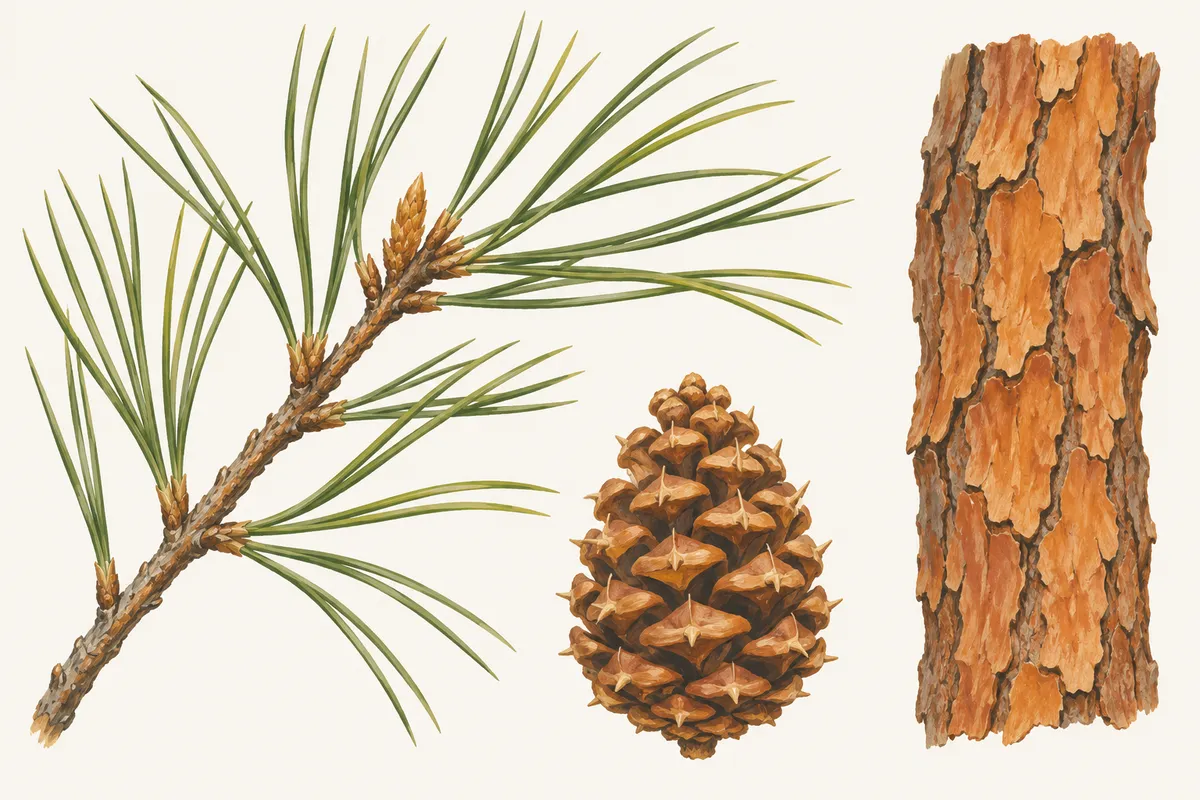
Ponderosa pine identification starts with the needles and the bark. The needles are long, 5 to 10 inches, tough and yellow-green, usually three per bundle (sometimes two), and smell of turpentine when crushed. Mature trees have thick cinnamon to orange bark in large plates, and the cones are 3 to 6 inches with a slender prickle on each scale. Jeffrey pine has larger cones, 5 to 9 inches.
- Young ponderosa pines have nearly black bark; the cinnamon to orange plates come with age.
- In the Rockies, three long needles per bundle in the montane zone usually mean ponderosa; lodgepole has two short needles.
- Where Jeffrey pine grows (mostly California, western Nevada, southwestern Oregon), use cone size, twig bloom and needle color, not bark smell.
Field marks at a glance
- Scientific name
- Pinus ponderosa
- Family
- Pinaceae (pine family)
- Type
- Conifer, evergreen
- Needles
- Three per bundle (sometimes two), tough, yellow-green, 5 to 10 inches (Virginia Tech); 3 to 7 inches in Colorado and Rocky Mountain National Park. Crushed needles smell of turpentine, sometimes of citrus.
- Cones
- Egg-shaped, 3 to 6 inches, stalkless, red-brown, each scale tipped with a slender prickle or short hook.
- Cone timing
- Full size in late July and early August of the second year; open in early September and shed seed until November (USDA Forest Service, northern Rockies and eastern Oregon).
- Bark
- Nearly black on young trees; on mature trees thick, cinnamon to red-orange, in large flat plates like a jigsaw puzzle, separated by deep furrows.
- Twigs and buds
- Stout, orange turning black; buds often covered with resin.
- Form
- Large tree, commonly 90 to 130 ft tall and 30 to 50 in across; self-pruned clear trunk, crown irregular, rounded or flat-topped with age.
- Native range
- Southern Canada to Mexico, and from Nebraska and Oklahoma west to the Pacific Coast; sea level to about 10,000 ft.
- Age
- Trees often reach 300 to 600 years; thick bark protects big trees from frequent ground fires (USDA Forest Service).
- In the app's Collection
- Yes: ponderosa pine (Pinus ponderosa) is one of the 138 species in Tree Identifier's Collection.
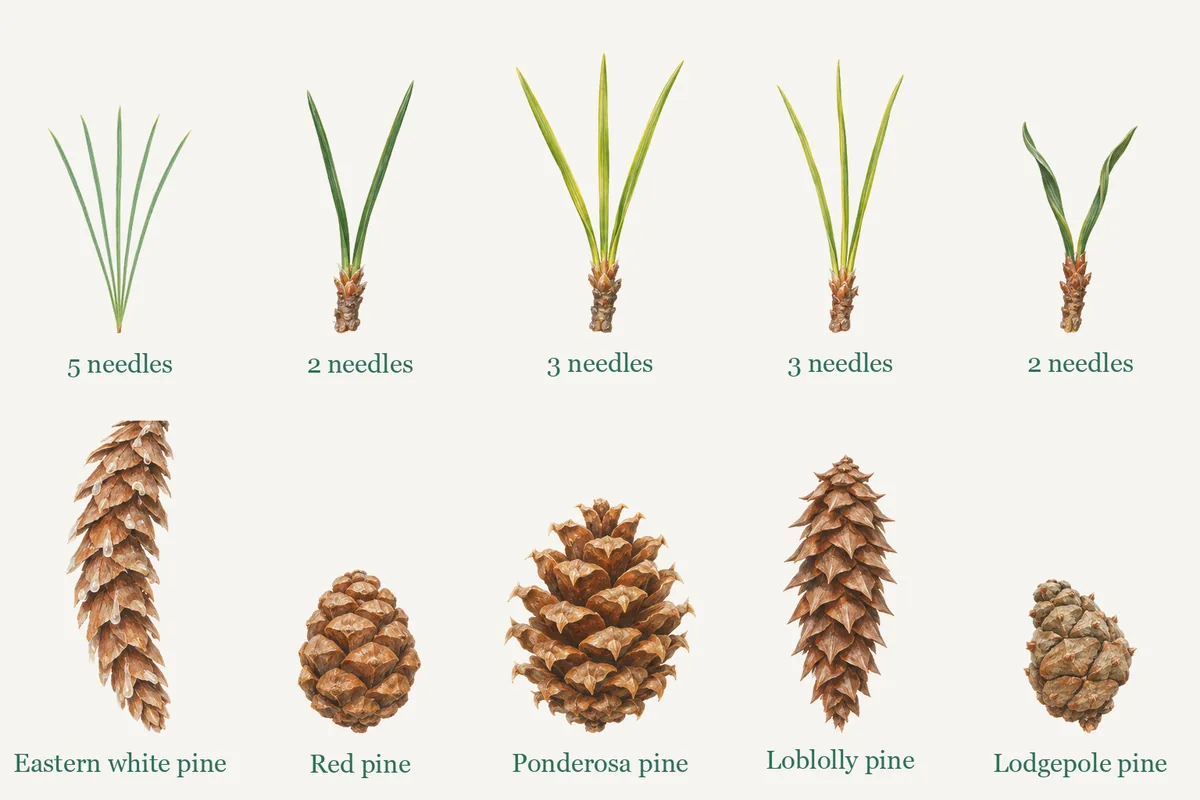
Ponderosa pine (Pinus ponderosa) is the tall, orange-barked pine of dry Western forests, from the Great Plains to the Pacific Coast. On our pine identification page it is one row of a 14-pine chart: three long needles per bundle. This page goes further, into the bark at each age, the twig and bud, the cone by season, and the hardest call in the West, ponderosa against Jeffrey pine.
How to identify a ponderosa pine
Four checks, from the ground.
1. Count and smell the needles. Virginia Tech's ponderosa pine fact sheet gives evergreen needles 5 to 10 inches long, three (sometimes two) per bundle, tough and yellow-green. Crush a few: they have a turpentine odor, sometimes reminiscent of citrus. In Colorado the needles run shorter: the Colorado State Forest Service gives 3 to 7 inches, typically three per bundle, forming tufts near the branch ends, and Rocky Mountain National Park gives bundles of two or three.
2. Read the bark. Virginia Tech describes very dark, nearly black bark on young trees, developing cinnamon-colored plates and deep furrows. The Colorado State Forest Service gives nearly 3 inches thick on mature trees, red-orange and furrowed into large, flat, scaly plates. Rocky Mountain National Park's conifer guide says the bark changes from gray-black to cinnamon or red as it ages and takes on a jigsaw-like pattern as it thickens, and that on warm days it smells like vanilla or butterscotch. Put your nose to a sunny trunk.
3. Pick up a cone. Ovoid, 3 to 6 inches long, stalkless and red-brown, armed with a slender prickle (Virginia Tech). The park service describes a short hook on each scale.
4. Check the twig. Stout, orange turning black, with buds often covered in resin (Virginia Tech). This matters only where Jeffrey pine grows, whose new twigs carry a purplish-white bloom.
When the needles are out of reach, Tree Identifier can name a ponderosa pine from one photo of the bark, a cone or a fallen bundle; it is one of the 138 species in the app's Collection. It gives one name with no confidence score or look-alike list, so in California check the cone size yourself before trusting a ponderosa answer.
Ponderosa pine vs Jeffrey pine
Jeffrey pine is the look-alike that matters. The USDA Forest Service's Jeffrey pine silvics calls it primarily a California species, reaching into southwestern Oregon, western Nevada and northern Baja California, often at 6,000 to 9,500 feet in the central and southern Sierra Nevada. The Forest Service says it is readily distinguished on bark, leader, needle, bud and cone morphology. Outside that area, Jeffrey pine is rarely the question.
| Trait | Ponderosa pine | Jeffrey pine |
|---|---|---|
| Needles | 5–10 in, yellow-green, three (sometimes two) | 5–11 in, dark blue-green without bloom, often twisted, three (occasionally two) |
| New twigs | Orange, turning black; resinous buds | Purplish-white bloom that fades |
| Cut twig smell | Needles smell of turpentine, sometimes citrus | Sweet and fruity |
| Cone | 3–6 in, ovoid, slender prickle | 5–9 in, broadly egg-shaped, prickle distinctly bent back |
| Bark | Cinnamon to red-orange plates | Orange-red to cinnamon-red plates, often a bit redder; cut bark smells of pineapple |
Ponderosa from Virginia Tech's fact sheet; Jeffrey from Virginia Tech's Jeffrey pine fact sheet and the Forest Service, which gives Jeffrey cones as usually 5 to 9 inches. The bent-back prickles are behind the popular rule "gentle Jeffrey, prickly ponderosa": a closed Jeffrey cone is gentler to hold. Cone size is the more dependable test; the two ranges overlap only between 5 and 6 inches. The Forest Service says natural hybrids are rare, because the two flower at different times, but may be locally common on ultramafic soils in the western Sierra Nevada.
Seasons, size and fire
Cones over two years. In western Montana, central Idaho and eastern Oregon, the USDA Forest Service's ponderosa pine silvics records flowering in early May, cones reaching full size of 3 to 6 inches in late July and early August of the following year, seed ripening in late August, cones opening in early September, and seed shed until November. A tree in summer can carry small first-year cones and full-size second-year cones together.
Size and age. The Forest Service gives common diameters of 30 to 50 inches and heights of 90 to 130 feet, with a recorded maximum of 232 feet and 103.5 inches, and ages that often reach 300 to 600 years. Virginia Tech describes an irregular crown that eventually becomes flat-topped or short and conical, over a trunk that self-prunes into a long clear bole.
Fire. Big trees have thick bark that protects them from fire damage. The Forest Service reports historical fires burning every 1 to 47 years, mostly every 5 to 20, and says survival and growth suffer little if half or less of the crown is scorched.
Where ponderosa pine grows, and its neighbors
The Forest Service gives a range from southern Canada into Mexico and from Nebraska and Oklahoma west to the Pacific Coast, from sea level to 10,000 feet. In Colorado, the State Forest Service places it at 6,300 to 9,500 feet; Rocky Mountain National Park gives 5,600 to 9,500 feet, mainly in the montane zone. The Rocky Mountain tree guide stacks it with the other trees by elevation, and the Pacific Northwest guide places it east of the Cascades.
In the Rockies, the trees beside it are easy to separate:
- Lodgepole pine: two needles per bundle, 1 to 2 inches long, and cones up to 2 inches that often stay closed for years (park service), at 7,800 to 11,500 feet.
- Limber pine: needles in bundles of four or five, 1 to 2 inches, with gray, plate-like old bark.
- Douglas-fir: single, soft, flat needles and cones with three-pointed bracts.
For cones of all of these side by side, see the pine cone identification chart.
Look-alikes and how to tell them apart
Jeffrey pine (Pinus jeffreyi)
Jeffrey cones are 5 to 9 inches, broadly egg-shaped, with prickles bent back; its needles are dark blue-green, its new twigs carry a purplish-white bloom, and cut twigs smell sweet and fruity. Ponderosa cones are 3 to 6 inches, needles yellow-green, twigs orange to black.
Lodgepole pine (Pinus contorta)
Two needles per bundle, only 1 to 2 inches long in Rocky Mountain National Park, and cones up to 2 inches that often stay closed on the tree for years. Ponderosa needles are three to a bundle and several times longer.
Limber pine (Pinus flexilis)
A Rocky Mountain pine with needles in bundles of four or five, 1 to 2 inches long, and gray, plate-like bark on old trees. Ponderosa has two or three long needles per bundle and orange bark.
Douglas-fir (Pseudotsuga menziesii)
Its neighbor in the montane forest, but not a pine: needles grow one at a time, soft and flat, and its cones carry three-pointed bracts between the scales. Any needles in bundles rule Douglas-fir out.
What a photo can't settle
- Needle length varies widely across the range: Virginia Tech gives 5 to 10 inches, the Colorado State Forest Service 3 to 7 inches. Compare needle count, bark and cone together rather than one measurement.
- Ponderosa and Jeffrey pine are separated by small features (cone size, twig bloom, needle color) that a single photo of a distant crown cannot show; get a twig and a cone.
- Young trees lack the orange bark plates, so a black-barked young ponderosa is easy to misjudge from bark alone.
Questions people ask
How do you identify a ponderosa pine?
Count the needles: usually three per bundle, sometimes two, long, tough and yellow-green. Then look at the bark: on mature trees it is cinnamon to red-orange, in large flat plates like a jigsaw puzzle. The cones are 3 to 6 inches with a slender prickle on each scale. Crushed needles smell of turpentine.
How do you tell a ponderosa pine from a Jeffrey pine?
Use the cone first: Jeffrey cones are 5 to 9 inches, ponderosa cones 3 to 6. Virginia Tech describes Jeffrey needles as dark blue-green without bloom, new Jeffrey twigs as covered in a purplish-white bloom, and cut Jeffrey twigs as sweet and fruity. Ponderosa needles are yellow-green and its twigs orange turning black.
Does ponderosa pine bark smell like vanilla?
Often, yes. Rocky Mountain National Park says that on warm days ponderosa bark smells like vanilla or butterscotch. Virginia Tech describes cut Jeffrey pine bark as smelling like pineapple, so in California, where both grow, smell is a weaker test than the cone and the twig.
Why is a young ponderosa pine's bark black?
Young ponderosa bark is very dark, nearly black, according to Virginia Tech Dendrology, and develops cinnamon-colored plates and deep furrows only as the tree ages. Rocky Mountain National Park describes the change from gray-black to a cinnamon or red shade and a jigsaw-like pattern as the bark thickens.
How big and old do ponderosa pines get?
The USDA Forest Service gives common sizes of 90 to 130 feet tall and 30 to 50 inches across, a recorded maximum of 232 feet and 103.5 inches, and ages that often reach 300 to 600 years.
Sources
- Ponderosa pine fact sheet — Virginia Tech Dendrology
- Ponderosa Pine (Pinus ponderosa), Silvics of North America — USDA Forest Service
- Jeffrey pine fact sheet — Virginia Tech Dendrology
- Jeffrey Pine (Pinus jeffreyi), Silvics of North America — USDA Forest Service
- Conifers, Rocky Mountain National Park — National Park Service
- Colorado's Major Tree Species — Colorado State Forest Service
Keep reading
- Tree profilePines (Pinus): how to identify a pine tree
- Regional guideRocky Mountain tree identification, from foothills to treeline
- Field guidePine cone identification: what tree a cone came from
- Regional guideTrees of the Pacific Northwest, by region
- Tree profileDouglas-fir (Pseudotsuga menziesii): how to identify it