Also in Deutsch
Tree profile
Blue spruce (Picea pungens): how to identify a Colorado blue spruce
Silver-blue color is the clue everyone sees and the one that misleads most. A sharp needle, a hairless twig and a cone longer than 2 inches confirm a blue spruce.
In short
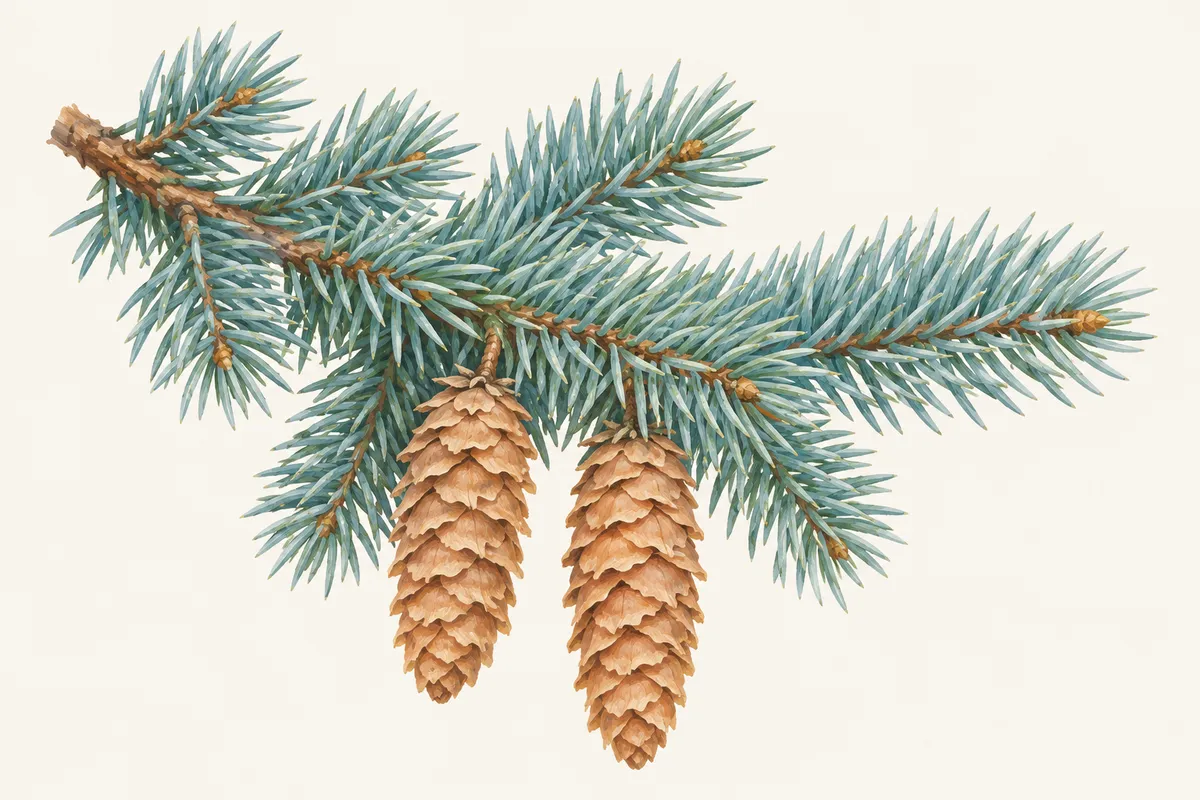
Blue spruce tree identification rests on three checks. The needles are single, four-sided, 3/4 to 1 1/4 inches long and stiff enough to prick, standing straight out all around the twig. The twigs are stout and hairless, and the papery, light brown cones are 2 to 4 inches long. Color varies from silvery blue to dark green, so never rely on blue alone.
- Grab a branch: blue spruce needles are spine-sharp. Engelmann spruce, its mountain neighbor, is less sharp and has finely hairy young twigs.
- The blue is a surface wax, under strong genetic control, so green blue spruces are common and some Engelmann spruces look just as blue.
- Native to the central and southern Rockies; planted in yards across the northern United States and Europe.
Field marks at a glance
- Scientific name
- Picea pungens
- Family
- Pinaceae (pine family)
- Type
- Conifer, evergreen
- Needles
- Single, four-sided, 3/4 to 1 1/4 inches long, stiff and very sharp (spine-like), standing nearly straight out from the twig all around it; silvery blue to dark green (Virginia Tech).
- Needle color
- Bluish or silvery from surface waxes on some trees, green on others; the wax color intensifies with age and varies even among seedlings from one seed source (USDA Forest Service).
- Twigs
- Stout for a spruce, hairless, tan, rough with the woody pegs left by fallen needles (Virginia Tech, Utah State University Extension).
- Buds
- Brown, with bud scales noticeably bent back (reflexed), often opening into a small rosette in spring.
- Cones
- Hang down, cylindrical, 2 to 4 inches, light brown; thin, flexible, pointed scales with jagged, irregularly toothed edges. Measured at 1.8 to 4.2 in (4.5 to 10.7 cm) in northern Colorado.
- Bark
- Gray to red-brown; thin scales on young trees, shallow furrows or thick scaly ridges on old trees.
- Form
- Narrow, dense pyramid with whorled, horizontal branches down to the ground; layered with age. 30 to 60 ft in landscapes, up to 80 ft in the wild.
- Native range
- Central and southern Rocky Mountains: Wyoming, Idaho, Utah, Colorado, Arizona and New Mexico, local in north-central Montana; about 6,000 to 10,000 ft, often along streams.
- In the app's Collection
- Yes: Colorado blue spruce (Picea pungens) is one of the 138 species in Tree Identifier's Collection.
Blue spruce (Picea pungens) is the stiff, silver-blue Christmas-tree shape of front yards across the northern United States, and a wild tree of streamsides in the central and southern Rockies. Its color draws the eye, but color is the least reliable clue: the spruce genus page puts it among seven common spruces, and two of them, Engelmann and white spruce, can be just as blue. This page goes one level deeper, to the needle tip, the twig, the bud and the cone.
How to identify a blue spruce in four checks
Do these in order, on a branch you can reach.
1. Confirm it is a spruce. Pull a needle and roll it between your fingers: a spruce needle is four-sided and rolls, and it leaves a small woody peg on the twig. A bluish tree whose needles are flat and soft is a fir, often a concolor fir; the spruce vs fir guide runs that test in detail.
2. Feel the needle tip. Virginia Tech's blue spruce fact sheet describes needles 3/4 to 1 1/4 inches long, stiff and "very sharp (spine-like)", held nearly straight out all around the twig, with a strong acidic taste. Close your hand around a branch tip: a blue spruce hurts. NC State Extension notes that its leaf tips have injured toddlers, which is one reason Fraser fir is replacing it as a Christmas tree.
3. Look at the twig and buds. Virginia Tech calls the twig stout compared with other spruces, hairless and tan, with brown bud scales that are noticeably bent back. Utah State University Extension adds that the bud scales often open into a rosette in spring. A hand lens on this year's twig is the single best test against Engelmann spruce, whose young twigs carry minute hairs.
4. Measure a cone. Blue spruce cones hang down and are cylindrical, 2 to 4 inches long and light brown, with thin, flexible scales that end in a point with jagged edges (Virginia Tech). Utah State gives 2 1/2 to 4 inches and describes them as papery. The USDA Forest Service's Silvics of North America measured 1.8 to 4.2 inches (4.5 to 10.7 cm) in northern Colorado and notes that cones mature in August of their first year. On a yard tree, look under it: whole cones drop to the ground.
If the tree is too tall to reach, Tree Identifier can name it from one photo of a branch, a cone or the whole tree. Colorado blue spruce is one of the 138 species in the app's Collection. The app gives one name, with no confidence score and no list of look-alikes, so confirm it with the needle and twig checks above.
Why some blue spruces are green
The blue is wax, not pigment in the needle. The USDA Forest Service describes wild trees whose foliage may be glaucous (bluish) or not (greenish), with the coloring intensifying as the tree ages. Color appears to be under strong genetic control, yet there is no consistency in blue color from any one seed source: in one test, a self-pollinated tree produced 94 percent blue seedlings.
That has two practical consequences:
- A green tree can still be a blue spruce. Rocky Mountain National Park's conifer guide notes that the needles of older branches are a rich dark green while new needles are the striking silver-blue that gives the tree its name. Look at this year's growth for the bluest color.
- A blue tree is not necessarily a blue spruce. The same park guide warns that some Engelmann spruces are just as blue. Nurseries sell the bluest selections as named cultivars: NC State lists 'Glauca' (waxy blue-gray foliage), 'Hoopsii' (extremely glaucous) and 'Fat Albert' (steel blue, perfect cone), and the Forest Service counts at least 38 named cultivars based mainly on color and crown form.
Blue spruce vs Engelmann spruce in the mountains
In the wild, the hard call is between blue spruce and Engelmann spruce, two native Rocky Mountain spruces that share needle length and color. Use the twig first, then the cone and where the tree grows; the Engelmann spruce page covers the higher-elevation tree on its own.
| Trait | Blue spruce | Engelmann spruce |
|---|---|---|
| Needle tip | Very sharp, spine-like | Pointed but less sharp |
| Young twig | Hairless, stout | Minute hairs |
| Bud scales | Bent back, often a rosette | Lie fairly flat |
| Cone length | 2 to 4 in | About 1 to 2 1/2 in, very papery |
| Bark | Gray to red-brown, thick scaly ridges when old | Thinner, red to purple-brown, in loose scales |
| Elevation in Rocky Mountain NP | 7,000 to 9,500 ft, moist soils by streams | 9,000 to 11,500 ft, up to treeline |
Sources: Virginia Tech, Utah State on Engelmann spruce and the National Park Service. The Colorado State Forest Service gives a wider elevation band for blue spruce, 6,700 to 11,500 feet, so the zones overlap; elevation is a hint, not a test. The Forest Service adds that morphology alone does not absolutely separate the two, because cone sizes overlap, so use two or three traits together. The Rocky Mountain tree guide places both spruces among the region's other conifers by elevation.
Where blue spruce grows, and how big it gets
The USDA Forest Service places the native range in Wyoming, Idaho, Utah, Arizona, New Mexico and Colorado, with isolated stands in north-central Montana, at 6,000 to 9,000 feet in the north and 7,000 to 10,000 feet in the south. It is seldom abundant, but along streams it is often the only conifer present. Everywhere else, from New England to the Midwest and in Europe, the blue spruce you meet was planted.
Size depends on where it grows. NC State gives 30 to 60 feet tall and 10 to 20 feet wide in landscapes, with a narrow, dense pyramid of horizontal, whorled branches that reach the ground and droop with age. Virginia Tech gives up to 80 feet and notes the branches look layered on older trees. The largest tree on record in the Forest Service silvics was 126 feet tall and 60.8 inches in diameter, and wild trees may live 600 years or more.
Bark changes with age: Virginia Tech describes gray to red-brown bark in small, thin scales on young trees and shallow furrows on older ones, and NC State describes purplish-gray to dark gray bark forming thick scales. Bark is a supporting clue for blue spruce, not a first one.
Blue spruce in yards: Norway spruce, white spruce and firs
In a yard, three other conifers are mistaken for blue spruce.
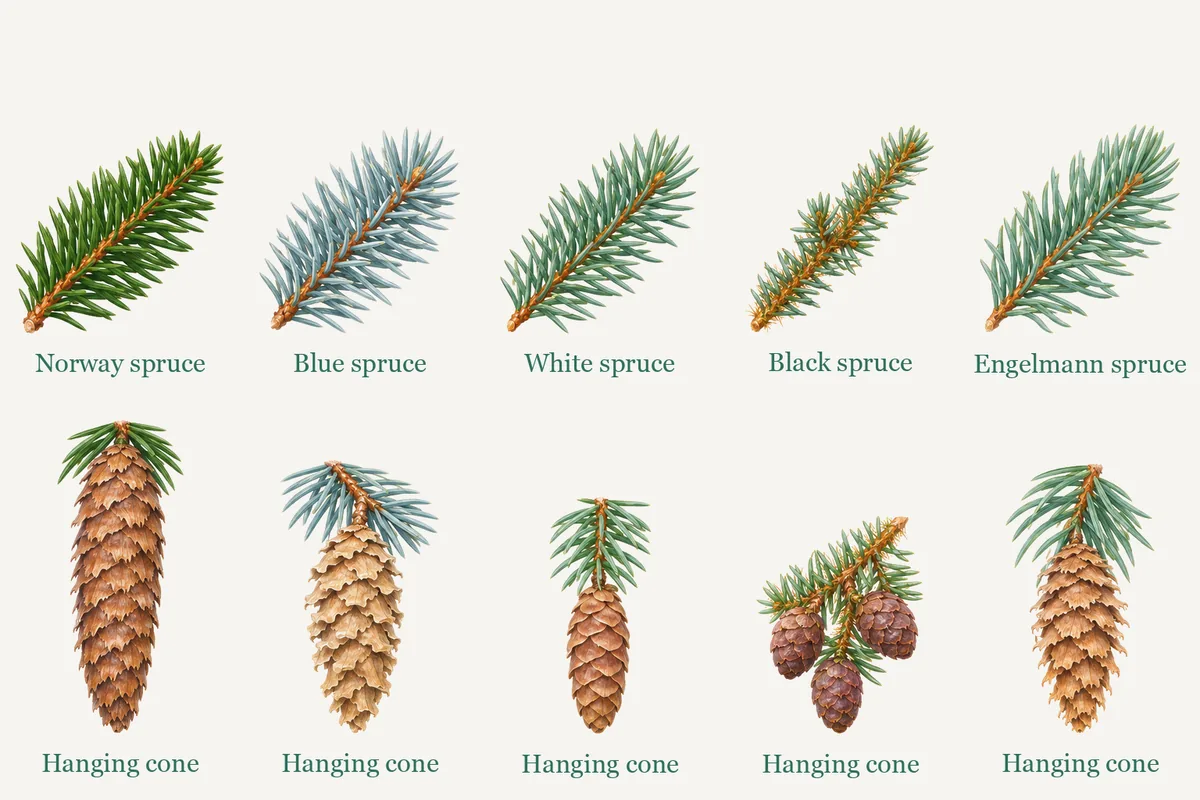
- Norway spruce has dark, shiny green needles, long branchlets hanging from the main limbs and cones 4 to 6 inches long; the Norway spruce page covers it in full.
- White spruce, planted in the North and native across Canada, has bluish-green needles too. Natural Resources Canada's white spruce factsheet gives needles 15 to 22 mm that smell unpleasant when crushed and cones 3 to 6 cm with smooth, rounded scale edges; blue spruce needles are longer and far sharper, and its cone scales are jagged.
- Concolor (white) fir is blue-gray but soft to the touch, with flat needles and upright cones.
Tree Identifier's follow-up chat is useful here for questions a photo cannot settle, such as whether a compact globe-shaped tree is a dwarf cultivar of blue spruce. For the other evergreens in a yard, the conifer identification guide sorts pines, firs, hemlocks, cedars and junipers.
Look-alikes and how to tell them apart
Engelmann spruce (Picea engelmannii)
Utah State University Extension describes Engelmann needles as less sharp than blue spruce, young twigs with minute hairs, flat-lying bud scales and smaller cones, about 1 to 2 1/2 inches. Check a twig tip with a hand lens: hairs mean Engelmann, a smooth twig points to blue spruce.
Norway spruce (Picea abies)
Norway spruce needles are dark, shiny green, and its branchlets hang down from the main branches like curtains. Its cones are much longer, about 4 to 6 inches, while blue spruce cones stay at 2 to 4 inches.
White spruce (Picea glauca)
White spruce also has hairless twigs and bluish-green needles, but they are shorter, 15 to 22 mm, pointed without being sharp, and smell unpleasant when crushed. Its cones are only 3 to 6 cm, with smooth, rounded scale edges, not the jagged scales of blue spruce.
Concolor or white fir (Abies concolor)
A bluish fir also planted in yards. Its needles are flat, soft and blunt, do not roll between the fingers and leave a smooth round scar, not a woody peg. Fir cones stand upright on the branch and fall apart there.
What a photo can't settle
- Needle color is not proof: green blue spruces exist, and the National Park Service notes that some Engelmann spruces are just as blue. A photo of a bluish branch alone can point to the wrong species.
- Blue and Engelmann spruce overlap in cone size, and the USDA Forest Service says morphology alone does not absolutely separate them; where both grow, a twig hair check and the cone together are needed.
- Dwarf, weeping and globe cultivars (at least 38 named) do not match the wild tree's shape, so judge them by needle and twig, not form.
Questions people ask
How do I know if my tree is a blue spruce?
Squeeze a branch tip. Blue spruce needles are four-sided, about 1 inch long and sharp enough to hurt, standing out all around a stout, hairless twig. Then find a cone: blue spruce cones hang down and are 2 to 4 inches long, with thin, jagged-edged scales. A bluish tree with soft, flat needles is a fir instead.
Can a blue spruce be green?
Yes. The blue comes from wax on the needle surface. The USDA Forest Service describes both bluish and greenish trees in the wild and says color is under strong genetic control but inconsistent from one seed source. Seed-grown blue spruces range from green to silvery blue; named cultivars such as 'Hoopsii' are selected for intense blue.
What is the difference between blue spruce and Engelmann spruce?
Check the twig and the cone. Blue spruce twigs are hairless and its needles very sharp; Engelmann twigs carry minute hairs and its needles are less sharp, per Utah State University Extension. Blue spruce cones are 2 to 4 inches, Engelmann cones about 1 to 2 1/2 inches. In the mountains, Engelmann also grows higher, near treeline.
Is a Colorado spruce the same as a blue spruce?
Yes. Colorado blue spruce, Colorado spruce, blue spruce and silver spruce are all names for Picea pungens, according to the USDA Forest Service and NC State Extension. 'Glauca' on a nursery label refers to the bluish-needled forms.
How big does a blue spruce get?
NC State Extension gives 30 to 60 feet tall and 10 to 20 feet wide for planted trees, and Virginia Tech up to 80 feet. The USDA Forest Service records a largest tree of 126 feet and says wild trees may live 600 years or more.
Sources
- Blue spruce fact sheet — Virginia Tech Dendrology
- Blue Spruce (Picea pungens), Silvics of North America — USDA Forest Service
- Blue or Colorado Spruce — Utah State University Extension, Forestry
- Engelmann Spruce — Utah State University Extension, Forestry
- Conifers, Rocky Mountain National Park — National Park Service
- Colorado's Major Tree Species — Colorado State Forest Service
- Picea pungens (Blue Spruce, Colorado Spruce) — North Carolina Extension Gardener Plant Toolbox, NC State University
- White spruce (Picea glauca), Trees, insects and diseases of Canada's forests — Natural Resources Canada, Canadian Forest Service
Keep reading
- Tree profileSpruce trees (Picea): how to identify the species
- Tree comparisonSpruce vs fir: how to tell them apart
- Regional guideRocky Mountain tree identification, from foothills to treeline
- Field guideConifer identification: three questions about the needles, then the cone
- Tree profileDouglas-fir (Pseudotsuga menziesii): how to identify it