Tree profile
Norway spruce (Picea abies): how to identify it
Huge cones and curtains of hanging branchlets make a mature Norway spruce easy to spot from a distance. Up close, the twig, bud and needle confirm it.
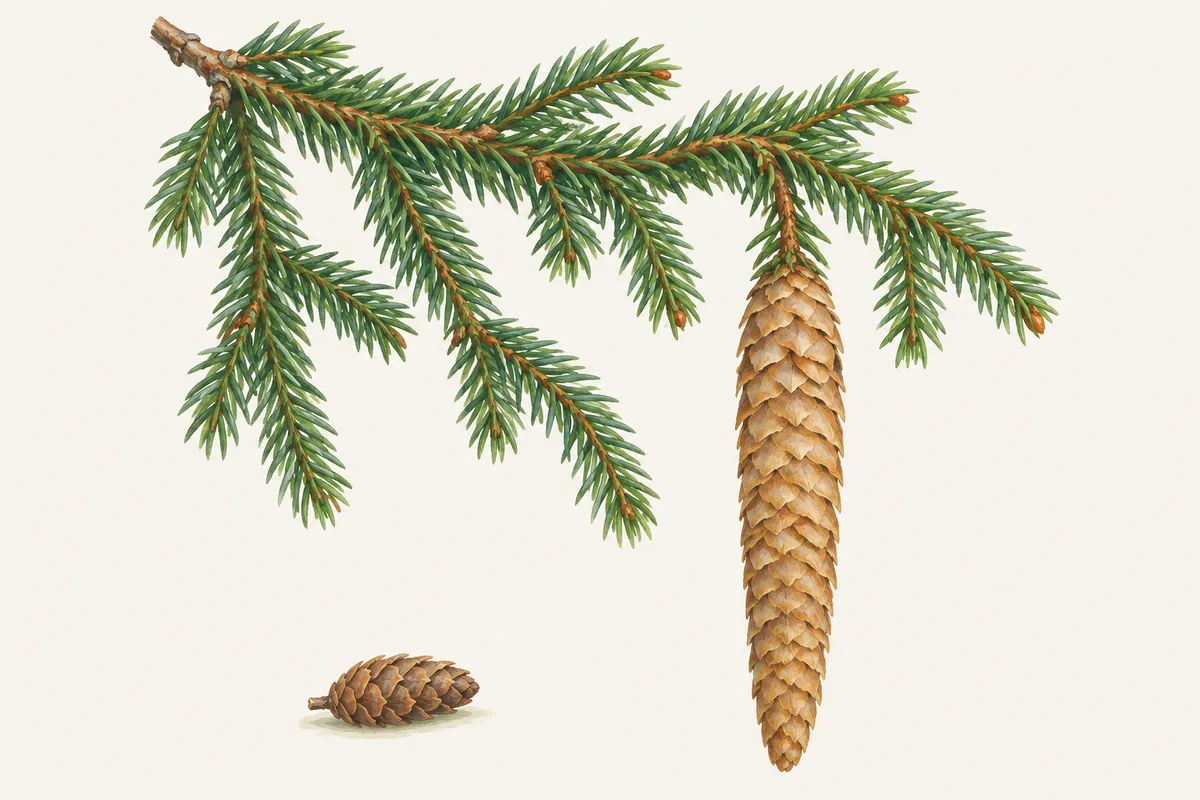
In short
Norway spruce identification starts with two features no other common spruce shares: cones 4 to 6 inches long, the largest of any common spruce, and side branchlets that hang down from horizontal or upswept limbs. Up close, the needles are single, four-sided, shiny dark green and 1/2 to 1 inch long, on hairless, shiny orange-brown twigs with rose-like buds.
- A spruce cone longer than your hand, 4 to 6 inches, under a planted spruce is almost always Norway spruce.
- From a distance, look for long branchlets hanging like curtains from the main branches.
- Native to the mountains of northern and central Europe; planted across North America and in British forestry.
Field marks at a glance
- Scientific name
- Picea abies
- Family
- Pinaceae (pine family)
- Type
- Conifer, evergreen
- Needles
- Single, stiff, 1/2 to 1 inch, four-angled but somewhat flattened, sharp-tipped, shiny deep green, each on a woody peg; arranged along the branch like a hairbrush (Virginia Tech, NC State).
- Cones
- Hanging, cylindrical, 4 to 6 inches long and 1 to 2 inches wide; green to violet when young, chestnut to light brown when ripe; stiff, thin scales, irregularly toothed at the tip.
- Branchlets
- Side branchlets droop from horizontal or upward-sweeping main branches, more so with age.
- Twigs and buds
- Slender to medium, hairless, shiny orange-brown; buds with loose orange-brown scales that Virginia Tech compares to a rose.
- Bark
- Red-brown or coppery gray-brown and finely scaly when young; gray to dark purple-brown, flaking in small scales or plates, on old trees.
- Size
- 40 to 60 ft tall and 25 to 30 ft wide in landscapes (Morton Arboretum, NC State); can exceed 120 ft (Virginia Tech); up to 40 m (130 ft) in Britain (Woodland Trust).
- Native range
- Mountains of northern and central Europe; widely planted in North America, where it may seed into the landscape.
- In the app's Collection
- Yes: Norway spruce (Picea abies) is one of the 138 species in Tree Identifier's Collection.
Norway spruce (Picea abies) is the big European spruce planted in parks and yards across the northern United States and Canada, and in forestry plantations in Britain. Among the seven spruces on our spruce identification page, it has the largest cones and the most distinctive outline. This page covers what that table leaves out: the twig and bud, the bark through a tree's life, the cultivars, and the four spruces it is most often confused with.
How to identify a Norway spruce
Work from a distance inward. Three matches make a confident identification.
1. The silhouette: hanging branchlets. Virginia Tech's Norway spruce fact sheet describes a conical tree with horizontal to upward-sweeping branches whose branchlets often droop. On a mature tree they hang like curtains or tinsel from each limb, a look no native spruce has. The NC State Extension profile adds that branches are upright when young and become more pendulous with age, so a 10-foot sapling will not show it yet.
2. The cone: 4 to 6 inches. Look under the tree. Virginia Tech gives very large, cylindrical cones 4 to 6 inches long, with stiff, thin, irregularly toothed scales, chestnut brown and ripening in fall. NC State adds a width of 1 to 2 inches and notes that young cones are greenish to violet. No other common spruce comes close: blue spruce cones are 2 to 4 inches, and red and white spruce cones 6 cm (about 2 1/2 inches) or less.
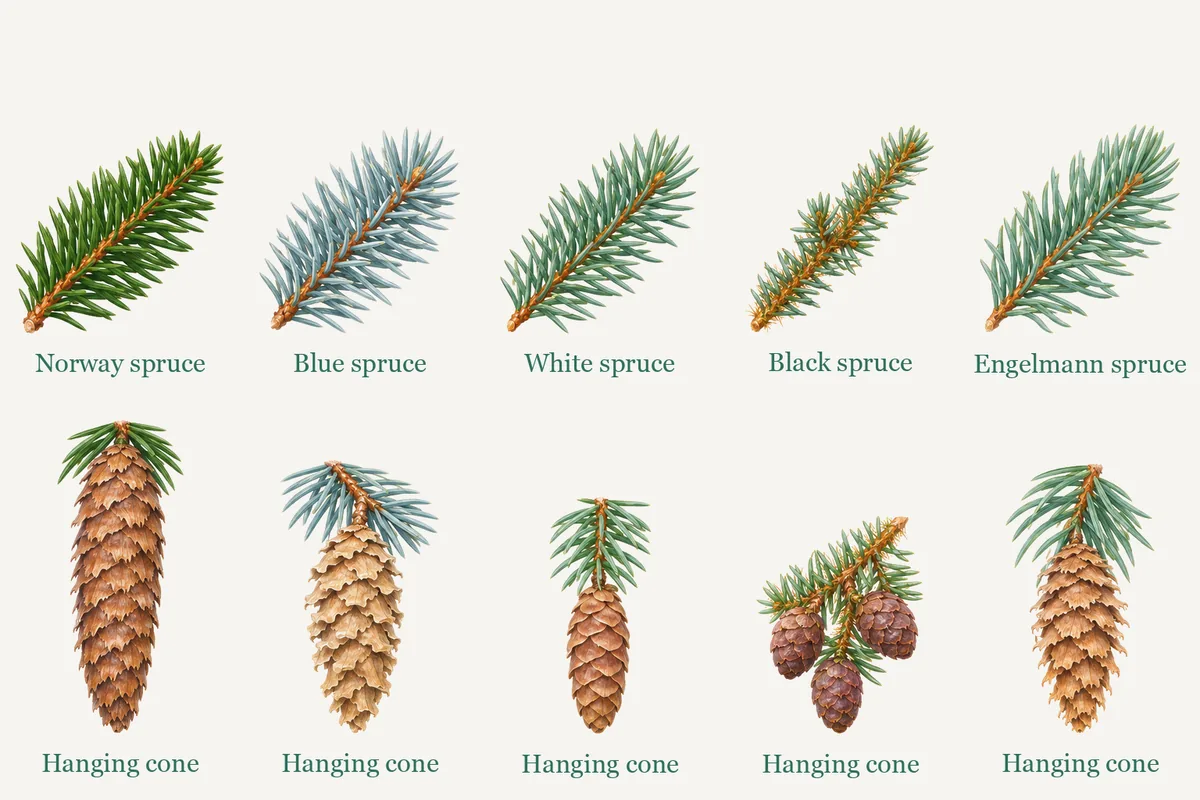
3. The needles. Single, stiff, 1/2 to 1 inch long, four-angled but somewhat flattened, with a sharp tip and a shiny deep green color (Virginia Tech). NC State describes them as saber-shaped and arranged in rows along the branch like a hairbrush. Each sits on a small woody peg; roll one between your fingers to confirm it is a spruce, not a fir (the spruce vs fir guide explains the test).
4. The twig and bud. Virginia Tech gives slender to medium twigs, hairless and shiny orangish brown, with very loose orange-brown bud scales that resemble a rose. A hairless orange twig rules out red spruce, whose twigs are hairy.
When the cones are out of reach, Tree Identifier can name a Norway spruce from one photo of a branch, a fallen cone or the whole tree; it is one of the 138 species in the app's Collection. The app gives a single name with no confidence score or list of look-alikes, so confirm it with the cone and branchlets.
Bark, flowers and age
Bark. The Woodland Trust's Norway spruce profile describes young bark as coppery gray-brown, smooth-looking but rough to the touch with papery scales, and the bark of trees over 80 years old as dark purple-brown, cracked into small plates. Virginia Tech gives red-brown and scaly bark that later turns gray with flaking scales or plates.
Flowers. Male and female cones grow on the same tree. The Morton Arboretum describes pinkish-red male flowers clustered along the stems and reddish-pink female flowers standing upright at the branch tips. The Woodland Trust notes the male flowers turn from red to yellow when full of pollen in spring.
Size and age. Morton and NC State give 40 to 60 feet tall and 25 to 30 feet wide in landscapes, a fast to moderate grower with shallow roots. Virginia Tech says it can exceed 120 feet. The Woodland Trust gives up to 40 m in Britain and a lifespan of up to 1,000 years.
Norway spruce vs blue, red, white and Sitka spruce
| Spruce | Needles | Twig | Cone | Shape |
|---|---|---|---|---|
| Norway | 1/2–1 in, shiny dark green | Hairless, shiny orange-brown | 4–6 in, the largest | Branchlets hang from the limbs |
| Blue | 3/4–1 1/4 in, spine-sharp, often bluish | Hairless, stout, tan | 2–4 in | Stiff horizontal branches |
| Red | 10–16 mm, curved, shiny yellow-green | Hairy, shiny yellow to orange | 3–5 cm, chocolate-brown | Native, East and Appalachians |
| White | 15–22 mm, bluish-green, smells bad crushed | Hairless | 3–6 cm, smooth rounded scale edges | Native, Canada and northern US |
| Sitka | Flat, sharp, two blue-white bands below | — | Crinkled, toothed scale edges | Plantations in upland Britain |
Red and white spruce figures come from Natural Resources Canada's factsheets for red spruce and white spruce. In a North American yard, the usual question is Norway or blue spruce; the blue spruce page covers that tree's twig, bud and color in detail. In Britain, the Woodland Trust says Sitka spruce makes up around half of commercial plantations and has harsher, more prickly needles than Norway spruce; grab a shoot and the difference is obvious.
Where Norway spruce grows
Morton and NC State give the native range as northern and central Europe, with NC State naming Norway, Sweden, Poland, Germany, Ukraine and Turkey; the Woodland Trust describes it as a tree of mountainous parts of Europe that was planted for forestry in Britain in the 1800s. In North America it is a planted tree. Virginia Tech notes it may seed into the landscape where planted, so a young spruce at a woodland edge near an old planting can be a Norway spruce too.
NC State lists zones 2a to 7b and says it prefers cool summers, performing poorly in zone 7 in the southern United States and disliking heat and wet feet. Morton lists Cytospora canker and Rhizosphaera needle cast among its problems; a thin, damaged spruce is still identifiable by its cones and twigs.
Cultivars: when it does not look like a Norway spruce
Norway spruce has many garden forms, and several look nothing like the forest tree. Morton and NC State list:
- 'Nidiformis' (Bird's Nest): a dwarf 3 to 6 feet high and wide with a nest-like hollow in the top, needles about 1/2 inch, rarely coning.
- 'Pumila': a rounded dwarf 3 to 4 feet tall and 4 to 5 feet wide.
- 'Pendula': 12 to 15 feet, narrow and weeping; it appears in our weeping trees guide.
- 'Cupressina': narrow, 25 to 30 feet tall and 6 feet wide.
- 'Acrocona': broad and spreading, about 20 feet, with bright red female cones.
On a dwarf, check the needle (four-sided, shiny green, on a peg) and the hairless orange-brown twig; the cone test only works on full-size trees. To narrow down which garden form a shrub-sized spruce might be, ask Tree Identifier's follow-up chat under the result, then compare the size and shape with the list above.
Look-alikes and how to tell them apart
Blue spruce (Picea pungens)
Blue spruce needles are often bluish and spine-sharp, its branches stay stiff and horizontal without hanging curtains of branchlets, and its cones are 2 to 4 inches long, about half the length of a Norway spruce cone.
Red spruce (Picea rubens)
A native eastern spruce that NC State lists as the native alternative. Its needles are shorter, 10 to 16 mm, curved and shiny yellowish-green, its twigs carry fine hairs, and its chocolate-brown cones are only 3 to 5 cm (1 1/4 to 2 in) long.
White spruce (Picea glauca)
White spruce needles are bluish-green, 15 to 22 mm, and smell unpleasant when crushed; its cones are slender, 3 to 6 cm, with smooth, rounded scale edges, and its branchlets do not hang.
Sitka spruce (Picea sitchensis)
The other big plantation spruce in Britain. The Woodland Trust describes Sitka needles as straight, flattened, sharp and harsher to the touch, with two blue-white bands underneath; Norway spruce needles are softer, without the two bands, and diamond-shaped in cross-section.
What a photo can't settle
- Young trees have neither the hanging branchlets nor cones, and their needles overlap in length with red and white spruce; check twig hairs and needle smell before deciding.
- Dozens of cultivars, from the 3-foot 'Bird's Nest' to the weeping 'Pendula', do not look like the forest tree; a photo app names the species, not the cultivar.
- Cones grow high in the crown; without a fallen cone the strongest clue is missing.
Questions people ask
How do you identify a Norway spruce?
Look for its cones first: hanging, cylindrical and 4 to 6 inches long, much larger than other common spruces. Then check the shape, with branchlets hanging from the main branches. Up close, needles are single, four-sided, shiny dark green and 1/2 to 1 inch long, on hairless orange-brown twigs.
What is the difference between Norway spruce and blue spruce?
Norway spruce has dark green needles, hanging branchlets and cones 4 to 6 inches long. Blue spruce is often bluish, with very sharp needles, stiff horizontal branches and cones 2 to 4 inches long, according to Virginia Tech Dendrology. Both are planted in yards across the northern United States.
Is Norway spruce native to North America?
No. The Morton Arboretum and NC State Extension give its native range as northern and central Europe, from Norway and Sweden to Germany, Poland, Ukraine and Turkey. Virginia Tech notes that in North America it is planted and may seed into the landscape.
How big does a Norway spruce get?
In yards, the Morton Arboretum and NC State give 40 to 60 feet tall and 25 to 30 feet wide. Virginia Tech says it can exceed 120 feet, and the Woodland Trust gives up to 40 m in Britain, with a lifespan of up to 1,000 years.
Why are the branches of my Norway spruce hanging down?
That is the species' normal form: Virginia Tech describes horizontal to upward-sweeping branches whose branchlets often droop, and NC State says branches become more pendulous with age. A small, narrow tree that weeps all over may be the cultivar 'Pendula', 12 to 15 feet tall and wide.
Sources
- Norway spruce fact sheet — Virginia Tech Dendrology
- Norway spruce — The Morton Arboretum
- Picea abies (Norway Spruce) — North Carolina Extension Gardener Plant Toolbox, NC State University
- Norway spruce (Picea abies) — Woodland Trust
- Sitka spruce (Picea sitchensis) — Woodland Trust
- Red spruce (Picea rubens), Trees, insects and diseases of Canada's forests — Natural Resources Canada, Canadian Forest Service
- White spruce (Picea glauca), Trees, insects and diseases of Canada's forests — Natural Resources Canada, Canadian Forest Service
Keep reading
- Tree profileSpruce trees (Picea): how to identify the species
- Tree profileBlue spruce (Picea pungens): how to identify a Colorado blue spruce
- Tree comparisonSpruce vs fir: how to tell them apart
- Clue guideWeeping tree identification, from the leaf, the bark and the graft
- Field guideConifer identification: three questions about the needles, then the cone