Clue guide
Weeping tree identification, from the leaf, the bark and the graft
A weeping shape is shared by a dozen unrelated trees, so it never names the tree on its own. Look at the leaf or needle, then at the trunk for a graft line.
In short
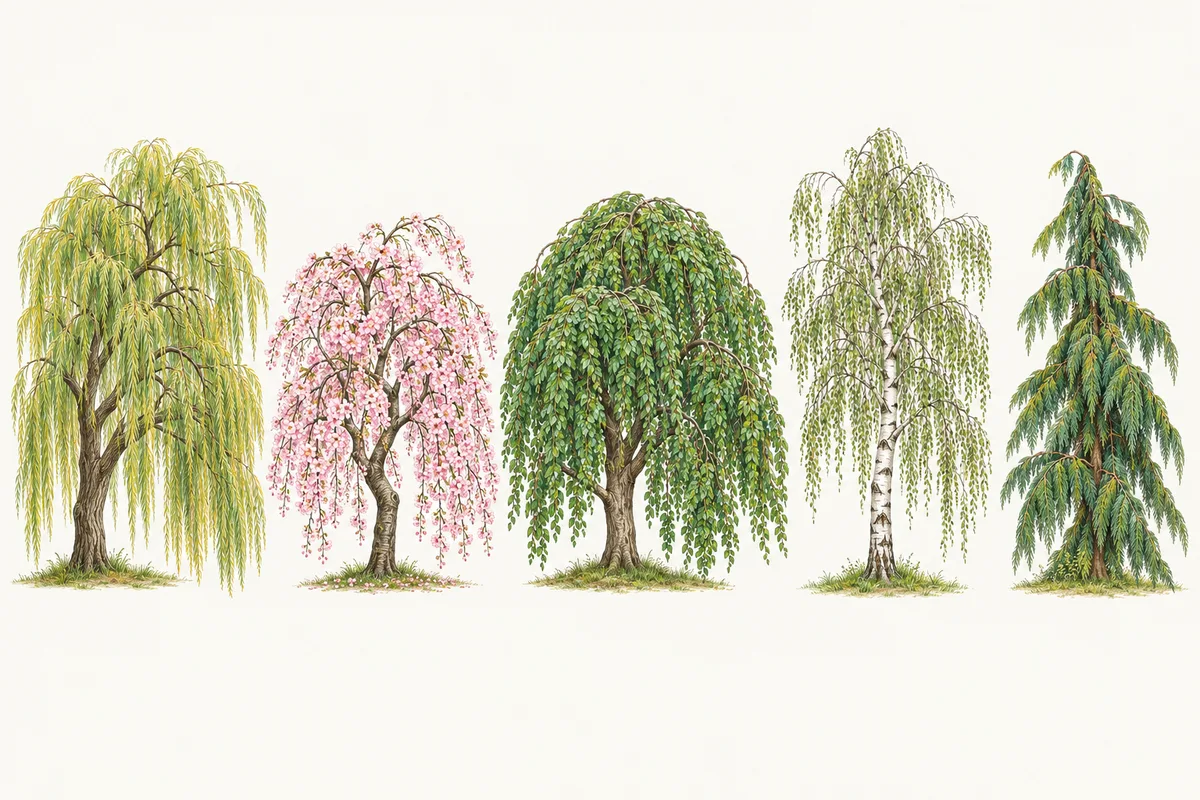
Weeping tree identification starts with the leaf, because the drooping shape occurs in many unrelated trees. Long, narrow, finely toothed leaves on a big tree by water mean weeping willow; pink blossom before the leaves on a trunk grafted at 4 to 5 feet means weeping cherry; glossy oval leaves with wavy edges over smooth gray bark mean weeping beech.
- Narrow leaves 3–6 in, big tree near water: weeping willow. Pink spring blossom on a grafted trunk: weeping cherry.
- Smooth gray bark, glossy wavy-edged leaves, branches sweeping the ground: weeping beech. Half-inch needles with two pale bands: weeping hemlock.
- A weeping head on a straight, bare stem is usually top-grafted: shoots below the graft grow upright and are not the weeping tree.
Weeping is a growth habit, not a species. Willows, cherries, beeches, birches, hemlocks, spruces, mulberries, maples and katsuras all have weeping forms, and most garden weepers are named cultivars of ordinary upright trees. So the drooping outline tells you to look closer, not what the tree is. Read the leaf or needle first, then the bark, then the base of the crown: a weeping head perched on a straight, bare stem is usually grafted, and that tells you you are looking at a garden cultivar.
Weeping trees by leaf and bark
| Weeping tree | Leaf or needle | Bark, size, other clue | Our page |
|---|---|---|---|
| Weeping willow (Salix babylonica) | Narrow, 3–6 in, finely toothed | 30–40 ft; reddish to yellowish twigs | Willow |
| Kilmarnock willow (Salix caprea 'Kilmarnock') | Oval | 1.5–2.5 m; grey catkins before leaves; top-grafted | Willow |
| Japanese weeping cherry (Prunus × subhirtella 'Pendula') | Glossy, doubly toothed | Pink blossom before leaves; copper bark with lenticels; grafted at 4–5 ft | Cherry |
| Weeping European beech (Fagus sylvatica f. pendula) | Glossy, oval, wavy edge, 3–6 in | Smooth dark gray bark; branches reach the ground | Beech |
| Silver birch (Betula pendula) | Small, triangular, toothed | White bark; drooping branches; up to 30 m | Birch |
| Weeping hemlock (Tsuga canadensis 'Sargentii') | Needles ½ in, two pale bands below | 10–12 ft tall, 20–30 ft wide | Hemlock |
| Weeping Norway spruce (Picea abies 'Pendula') | Four-sided needles up to 1 in | 12–15 ft, narrow | Spruce |
| Laceleaf or threadleaf maple (Acer palmatum subsp. matsumurae) | Opposite, 5–7 lobes cut to the base | 6–12 ft, low and spreading | Japanese maple |
| Weeping mulberry (Morus alba 'Pendula') | Glossy, unlobed, mitten or 3-lobed | 6–10 ft | Mulberry |
| Weeping katsura (Cercidiphyllum japonicum 'Pendulum') | Heart- or kidney-shaped | Fall leaves smell of caramel | none yet |
Data come from NC State Extension, the Woodland Trust and the RHS pages linked below.
Big weeping tree by water: weeping willow
The large, round, curtain-like tree on a pond bank is almost always a weeping willow. The NC State weeping willow profile describes a broad, rounded, weeping tree 30 to 40 feet tall and as wide, with linear to lance-shaped leaves 3 to 6 inches long and ½ to ¾ inch wide, finely toothed, light green above and grayish-green beneath, and smooth reddish-brown to yellowish-brown twigs. It comes from China and has naturalized in North Carolina. No other common weeper combines that size with such narrow leaves.
Kilmarnock willow is the small one. The RHS Kilmarnock willow page describes a weeping form of goat willow only 1.5 to 2.5 m tall and wide, usually top-grafted onto a straight stem, with large grey catkins carrying yellow anthers that open before the leaves, and oval rather than narrow leaves. A small dome of hanging shoots on a bare stem, with grey catkins in early spring, is this tree. The willow page covers the other willows.
Weeping with spring blossom: weeping cherry
A weeping tree covered in pale pink flowers before any leaves appear is a weeping cherry. The NC State Japanese weeping cherry profile describes light pink single or double flowers in hanging clusters in early spring, lasting about a week, on a tree 15 to 40 feet tall with slender pendulous branches. The bark is coppery and marked with lenticels, and gray plates peel away as it ages. NC State notes that it is grafted onto sweet cherry (Prunus avium) rootstock at 4 to 5 feet and that growth below the graft does not weep. Look for a change in bark or a swelling at that height. The cherry page separates the main cherries.
Smooth gray bark or white bark: weeping beech and silver birch
Weeping beech builds a dark, tent-like mound. The NC State weeping beech profile describes a tree 35 to 50 feet tall whose main branches either run out sideways and then drop sharply, sometimes to the ground, or spread from a broad crown with drooping side branches. Leaves are glossy, hairless, 3 to 6 inches long with a wavy edge; the bark is thin, smooth and dark gray, wrinkling like elephant hide on old trunks; and the slender zigzag twigs carry narrow, pointed buds. Smooth gray bark under a weeping crown settles it. See the beech page.
Silver birch weeps in a lighter way. Its scientific name, Betula pendula, refers to it, and the Woodland Trust's silver birch page describes elegant, drooping branches on a tree up to 30 m, small triangular toothed leaves, and white bark that peels like tissue paper and turns black and rugged at the base. White bark plus hanging twigs means silver birch, wild or planted; the birch page covers the other birches.
Weeping conifers: hemlock and Norway spruce
Weeping evergreens are usually cultivars of hemlock or spruce. The NC State eastern hemlock profile describes glossy needles about ½ inch long, each on a slender stalk, with two pale bands underneath and small cones about ¾ inch long at the twig tips. It lists the weeping 'Sargentii' at 10 to 12 feet tall and 20 to 30 feet wide, and 'Pendula' as a low shrub about 2 feet tall. Weeping Norway spruce has stiff, four-sided needles up to an inch long and cones 4 to 6 inches long; the NC State Norway spruce profile lists 'Pendula' at 12 to 15 feet, narrow and weeping. Half-inch needles on little stalks with two pale bands beneath mean hemlock; four-sided needles up to an inch long mean spruce. The hemlock page covers the wild trees. For upright firs, see fir tree identification.
Small garden weepers: laceleaf maple, mulberry and katsura
Laceleaf Japanese maple forms a low mound of finely cut foliage. The NC State threadleaf maple profile describes a shrub or small tree 6 to 12 feet tall and 9 to 15 feet wide, with opposite leaves of five to seven toothed lobes cut to the base; it was formerly called Acer palmatum var. dissectum. Lacy, opposite leaves on a low weeping mound mean this maple. See the Japanese maple page.
Weeping mulberry is a small, umbrella-shaped tree. The NC State white mulberry profile lists 'Pendula' as dwarf and weeping, 6 to 10 feet high, and describes white mulberry leaves as glossy, toothed and unlobed, mitten-shaped or three-lobed, often on the same plant. Never eat a fruit on the strength of a web page or an app.
Weeping katsura is rarer. The NC State katsura profile lists 'Pendulum' and 'Morioka Weeping' as weeping forms of a tree with heart- or kidney-shaped leaves whose fallen leaves smell of caramel or burnt sugar in autumn.
Using a photo
Take two photos: the whole tree, to show the weeping shape and any graft on the stem, then a close shot of a leaf or needle spray. Tree Identifier names a tree from one photo, and weeping willow, silver birch, European beech, eastern hemlock, Norway spruce, Japanese maple and white mulberry are in its Collection. It names the species, not the weeping cultivar, and shows no confidence score or alternatives, so check its answer against the leaf and bark in the table above. You can ask the follow-up chat how the weeping form differs from the upright species. For other crown shapes, see how to identify trees by shape.
What a photo can't settle
- A photo of the whole drooping crown shows shape but rarely the leaf detail that separates species; add a close photo of a leaf or needle spray.
- Weeping trees are mostly named cultivars. An app may name the species, such as Japanese maple or eastern hemlock, but not the cultivar on a nursery label.
- A grafted tree can carry two plants: rootstock shoots below the graft may be a different species from the weeping head.
Questions people ask
How do I know if my tree is a weeping willow?
Check the leaves and the size. NC State describes weeping willow leaves as narrow, 3 to 6 inches long and about half an inch wide, finely toothed, light green above and grayish-green below, on a broad tree 30 to 40 feet tall and wide with smooth reddish-brown to yellowish-brown twigs.
What is a small weeping tree with catkins?
Kilmarnock willow, a form of goat willow. The RHS describes a small weeping tree 1.5 to 2.5 m tall and wide, usually top-grafted onto a straight stem, with large grey catkins carrying yellow anthers that open before the leaves. Its leaves are oval, not narrow like weeping willow's.
What weeping tree has pink flowers in spring?
Usually Japanese weeping cherry. NC State describes light pink single or double flowers in hanging clusters before the leaves in early spring, lasting about a week, on a tree grafted onto sweet cherry rootstock at 4 to 5 feet, with coppery bark marked by lenticels.
Is there a weeping evergreen tree?
Yes. Weeping forms of eastern hemlock and Norway spruce are common. NC State lists hemlock 'Sargentii' at 10 to 12 feet tall and 20 to 30 feet wide, with half-inch needles carrying two pale bands beneath, and Norway spruce 'Pendula' at 12 to 15 feet tall, a narrow tree with a weeping habit.
Why does my weeping tree have upright branches?
Many weeping trees are a weeping variety grafted onto an ordinary upright rootstock. NC State notes that weeping cherry is grafted at 4 to 5 feet and that growth below the graft lacks the weeping form. Shoots coming from below the graft line belong to the rootstock, not the weeping tree.
Sources
- Salix babylonica (Babylon Weeping Willow, Weeping Willow) — North Carolina Extension Gardener Plant Toolbox, NC State University
- Japanese Weeping Cherry, Prunus x subhirtella 'Pendula' — North Carolina Extension Gardener Plant Toolbox, NC State University
- Fagus sylvatica f. pendula (Weeping European Beech) — North Carolina Extension Gardener Plant Toolbox, NC State University
- Tsuga canadensis (Eastern Hemlock) — North Carolina Extension Gardener Plant Toolbox, NC State University
- Silver birch (Betula pendula) — Woodland Trust
- Salix caprea 'Kilmarnock' (m), Kilmarnock willow — Royal Horticultural Society
- Threadleaf Maple, Acer palmatum subsp. matsumurae — North Carolina Extension Gardener Plant Toolbox, NC State University
- Morus alba (White Mulberry) — North Carolina Extension Gardener Plant Toolbox, NC State University