Tree profile
Japanese maple identification: the species, then the leaf group
Hundreds of cultivars, one species. Confirm Acer palmatum from the leaf, twig and seeds, then read how deeply the lobes are cut to place your tree in a cultivar group. Naming the exact cultivar is a job for its label.
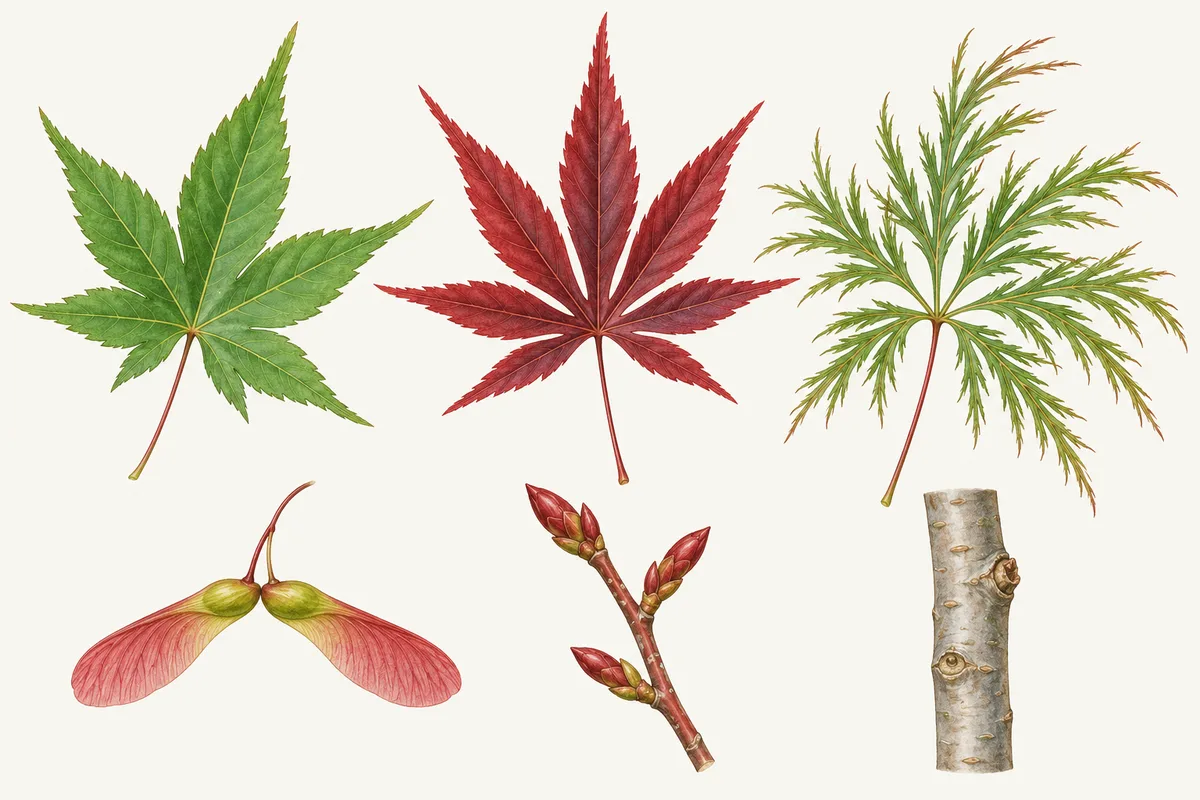
In short
Japanese maple identification takes two steps. First confirm the species, Acer palmatum: opposite leaves 2 to 5 inches long, nearly round in outline, with 5 to 7 (up to 9) deep, toothed lobes, on a small tree 10 to 25 feet tall with smooth gray bark and paired samaras. Then count the lobes and see how deeply they are cut: that places it in a cultivar group, from palmatum to lacy dissectum.
- Opposite leaves, deep pointed lobes with fine teeth, and paired winged seeds: that combination on a small tree is a Japanese maple.
- The cultivar groups are read from the leaf: lobes cut about halfway (amoenum), nearly to the base (matsumurae), to the base and feathery (dissectum) or thin as straps (linearilobum).
- Leaf color, red or green, is a cultivar trait and does not identify the species or the group on its own.
Field marks at a glance
- Scientific name
- Acer palmatum
- Family
- Sapindaceae (soapberry family; formerly Aceraceae)
- Type
- Broadleaf, deciduous
- Leaves
- Opposite, simple, nearly round in outline, 2 to 5 inches long; usually 5 to 7 deep lobes (up to 9 and more in some cultivars), each cut more than halfway to the base, the middle lobe longest.
- Leaf edge
- Finely toothed to doubly toothed; in dissected cultivars the lobes are cut again into fine, fern-like segments.
- Leaf stalk
- About 1 1/4 to 1 1/2 inches (3 to 4 cm), slightly swollen at the base, often red.
- Color
- Green, red, purple, bronze or variegated depending on cultivar; fall color gold, orange, red or purple.
- Twigs and buds
- Slender, hairless, green or red; buds cone-shaped, green or red, with a tan, fuzzy fringe hiding the base; end buds often in pairs.
- Flowers
- Small, red to purple, in hanging clusters at the branch tips in mid to late spring; showy only close up.
- Seeds
- Paired samaras 3/4 to 1 inch long, wings spread about 90 degrees, turning reddish; ripen in late summer.
- Bark
- Smooth and light gray on older branches, green to reddish on young stems; trunk often somewhat fluted.
- Form and size
- Small tree, 10 to 25 feet, rounded and layered, often multi-stemmed or low-branched; dissected cultivars are mounded shrubs under about 13 feet (4 m).
- Origin
- Native to Japan, Korea, eastern China and Taiwan; planted across the US in USDA zones 5 to 8.
Japanese maple is one species, Acer palmatum, sold in hundreds of cultivars: red and green, upright and weeping, broad-lobed and lace-fine. That is why identification has two levels. Confirming that a tree is a Japanese maple is quick. Placing it in a cultivar group is possible from the leaf. Naming the exact cultivar of an unlabeled tree usually is not, and this page says so where it matters.
Step 1: confirm it is a Japanese maple
Check five things, in this order:
- Opposite leaves. Leaves grow in pairs, one across from the other on the twig, like every maple. If they alternate, it is not a maple.
- The leaf shape. Nearly round in outline, 2 to 5 inches long, with 5 to 7 deep lobes and serrated edges, according to the Virginia Tech Dendrology fact sheet. NC State Extension gives 5 to 9 deeply cut lobes. Each lobe ends in a sharp point, and the middle one is the longest.
- The twig and bud. Slender, hairless twigs, red or green. Virginia Tech describes cone-shaped buds whose base is hidden by a tan, fuzzy fringe; NC State notes that end buds often come in pairs.
- The seeds. Paired winged samaras, 3/4 to 1 inch long, with wings spread at about 90 degrees, turning reddish in late summer.
- The tree. A small tree, 10 to 25 feet, usually with several stems or low branches and a rounded, layered crown; smooth light gray bark on older wood.
Tree Identifier can confirm Acer palmatum from a photo of a leaf or the whole plant. It names the species, not the cultivar, and shows no confidence score, so use the five checks above to confirm, then the next section to place the tree in a group.
Step 2: read the leaf to find the cultivar group
Japanese maple cultivars are sorted into groups mainly by how deeply the leaf lobes are cut. The Royal Botanic Gardens Victoria HortFlora entry uses six groups, following the standard Japanese maple references by Vertrees and by van Gelderen and colleagues:
| Group | Lobes | How deep the cut | Plant shape | Example look |
|---|---|---|---|---|
| Palmatum | 5, sometimes 7 | Like the wild species, more than halfway | Upright shrub or small tree | The classic garden tree; green, red or variegated |
| Amoenum | 7, sometimes 9 | About halfway | Upright shrub or small tree; seeds often red, in clusters | Broader lobes, larger leaves |
| Matsumurae | 7, rarely 9 | Almost to the base; edges saw-toothed or cut | Mostly broad shrubs | Deeply split but not lacy |
| Dissectum | 7 | To the base, then cut again into fine segments | Mounded, "mushroom-shaped," under 4 m (13 ft) | Laceleaf; fern-like, often weeping |
| Linearilobum | 7 | To the base, lobes narrowed to thin straps | Slow, upright, to about 4 m | Leaves like splayed fingers or ribbons |
| Dwarf | Small, crowded leaves | Varies | Under 1 m (3 ft) | Bonsai and container plants |
The boundaries between neighboring groups are not sharp, and a cultivar can sit between two of them, so treat the groups as a guide rather than a hard key. To read your leaf, take one from the middle of a branch, lay it flat, count the main lobes and look at how far each cut runs toward the stalk.
Why the cultivar itself is hard to name
Within a group, cultivars differ mostly in leaf color through the season, size and habit, and many look nearly alike. NC State's list alone mixes upright reds ('Bloodgood', 'Osakazuki'), weeping laceleafs ('Crimson Queen', 'Red Dragon'), and thread-leaved forms ('Koto no ito'). Three practical routes work better than a photo:
- The label or receipt. Nurseries sell grafted, named plants; the tag is the most reliable record.
- Rootstock shoots. Many Japanese maples are grafted onto a plain green seedling. A shoot from below the graft has the species' five- to seven-lobed green leaf, which is a clue to the rootstock, not the cultivar.
- A specialist. Arboreta and Japanese maple nurseries can sometimes narrow a cultivar from a branch through the seasons.
Japanese maple in the garden and the wild
Japanese maple is native to Japan, Korea, eastern China and Taiwan, according to HortFlora, and NC State lists it for USDA zones 5 to 8. Its young leaves are tender: NC State notes they are sensitive to late frost and that the tree may scorch in strong sun, wind or drought, which shows as brown, crisp leaf edges in summer.
Its fall color varies by cultivar from gold to red and purple. The guide to trees with red leaves in fall sorts red fall trees by leaf, and trees with purple leaves covers the summer-purple cultivars and their look-alikes.
Japanese maple can also escape gardens. NC State notes that it self-seeds readily and spreads into weedy growth, and that a Mid-Atlantic council lists it as invasive in Virginia and Washington, D.C.; check your state's list for local status.
Japanese maple and its look-alikes
- Full moon maple (Acer japonicum): larger, roundish leaves with 7 to 9 or more lobes cut only about halfway, per Oregon State University.
- Vine maple (Acer circinatum): the wild Pacific Northwest cousin, with nearly round, shallowly lobed leaves 6 to 12 cm across, per Oregon State University.
- Sweetgum: star-shaped leaves that turn red, but alternate on the twig, with spiky seed balls. See the sweetgum page.
- Other maples: our maple identification page separates sugar, red, silver, Norway and Japanese maple by leaf, bud and bark.
Japanese maple (Acer palmatum) is one of the species in Tree Identifier's Collection, the 138-species catalog that fills in as you identify. The app's follow-up chat under each result is a good place to ask which group a leaf shape suggests.
Look-alikes and how to tell them apart
Full moon maple (Acer japonicum)
Count the lobes and check the cut. Full moon maple leaves are larger, about 8 to 15 cm (3 to 6 in) wide, roundish, with 7 to 9 (up to 11) lobes cut only about halfway to the stalk. A typical Japanese maple has 5 to 7 lobes cut deeper.
Vine maple (Acer circinatum)
Vine maple grows wild in moist woods from British Columbia to northern California, with nearly round leaves 6 to 12 cm across and 7 to 9 shallow lobes. A Japanese maple is a planted garden tree with deeper, narrower lobes.
Sweetgum (Liquidambar styraciflua)
Sweetgum also has star-shaped, five-pointed leaves that turn red, but they sit one at a time (alternate), not in opposite pairs, and the tree drops spiky seed balls instead of paired winged seeds.
Red maple seedlings (Acer rubrum)
A young red maple in a bed can look like a green Japanese maple, but its leaves have three main lobes cut shallowly, with a broad, flat-sided middle lobe; Japanese maple leaves have five or more deep, pointed lobes.
What a photo can't settle
- There are hundreds of Japanese maple cultivars and many look alike; neither a photo app nor a field guide can reliably name the cultivar of an unlabeled tree.
- Grafted trees can send up shoots from the rootstock with plain, green, species-type leaves; a photo of those shoots shows the rootstock, not the cultivar.
- Leaf color shifts with sun, shade and season, so a red cultivar in shade or in late summer may photograph green.
Questions people ask
How can I tell what kind of Japanese maple I have?
Read the leaf group yourself: count the lobes, see how far down they are cut, and note the plant's shape. That narrows it to a group such as dissectum or amoenum. The exact cultivar, such as 'Bloodgood' or 'Crimson Queen', is best confirmed from the nursery label, because many cultivars look alike.
What is the difference between a Japanese maple and a regular maple?
Size and leaf. Japanese maple is a small tree, 10 to 25 feet according to Virginia Tech, with leaves 2 to 5 inches long and 5 to 7 or more deep, pointed lobes. Sugar, red and Norway maples are large shade trees with mostly three- to five-lobed, shallower leaves. All maples share opposite leaves and paired winged seeds.
Is a red-leaved maple always a Japanese maple?
No. Red or purple leaves all summer point to a cultivar, and Japanese maple is the most common one, but purple-leaved forms of larger maples, Norway maple among them, are planted too. Those grow into big shade trees with broader, shallower lobes; a Japanese maple stays small, with leaves 2 to 5 inches long and deep, pointed lobes.
What is a laceleaf Japanese maple?
Laceleaf is the common name for the dissectum group: leaves with about seven lobes cut right to the base and divided again into fine, fern-like segments, on a low, mounded, often weeping plant. Royal Botanic Gardens Victoria describes the group as mostly mushroom-shaped shrubs under 4 m (13 ft).
Is Japanese maple invasive?
In parts of the US it can be. NC State Extension notes that Japanese maple self-seeds readily and spreads into weedy growth, and that a Mid-Atlantic council lists it as invasive in Virginia and Washington, D.C. Check your state's invasive species list for local status.
Sources
- Acer palmatum (Japanese Maple) — NC State Extension Gardener Plant Toolbox
- Japanese maple fact sheet — Virginia Tech Dendrology
- Acer palmatum Thunb., Japanese Maple — Royal Botanic Gardens Victoria, HortFlora
- Acer japonicum — Oregon State University, Landscape Plants
- Acer circinatum — Oregon State University, Landscape Plants
Keep reading
- Tree profileMaple trees (Acer): how to identify them
- Clue guideWhich trees have purple leaves? Tell the cultivars apart
- Clue guideWhich trees have red leaves in fall? Sort them by leaf shape
- Tree profileSweetgum tree (Liquidambar styraciflua): how to identify it
- Yard guideHow to identify the trees in your yard