Field guide
How to identify trees by their shape
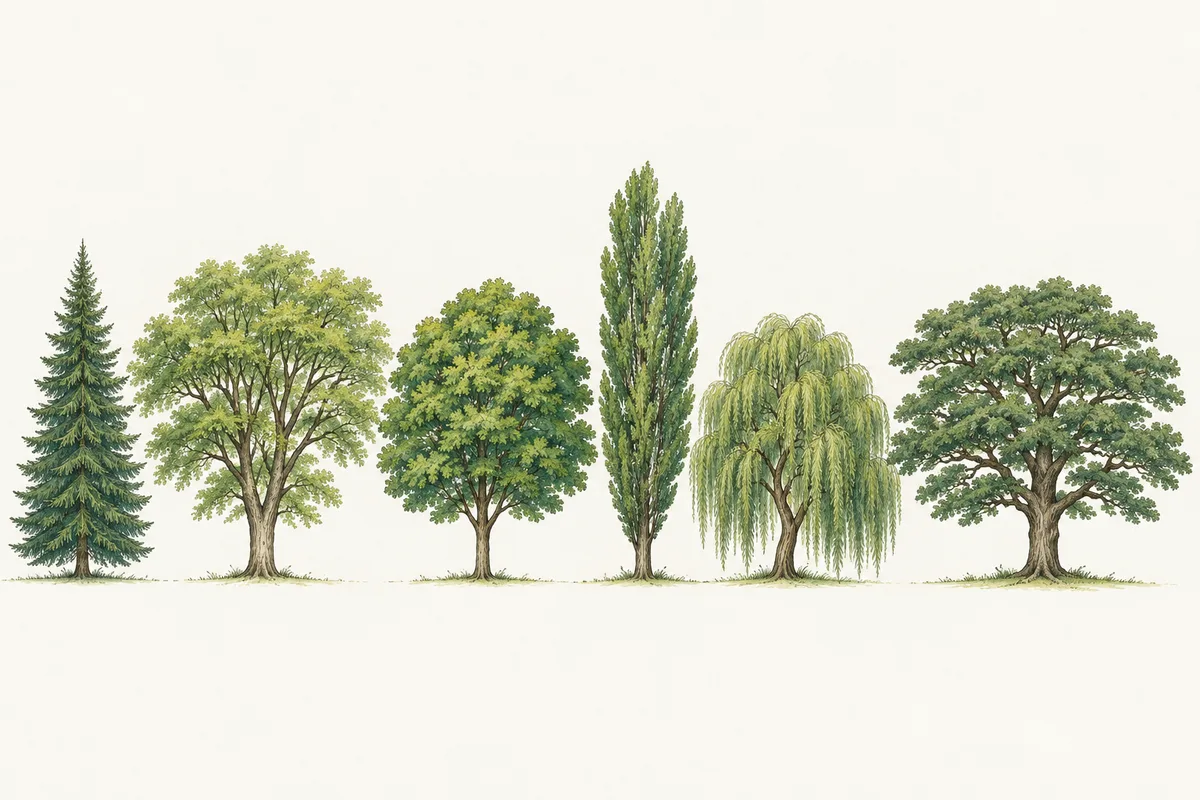
Nine crown forms, the common trees that wear each one, and the reasons a silhouette can fool you, so shape narrows the list before leaves and bark settle it.
In short
To identify trees by shape, step back far enough to see the whole crown and name its outline: cone (pyramidal), column, vase, weeping, round, oval or broad. A tall spire with one straight leader is almost always a conifer such as a pine, spruce, fir or Douglas-fir. A vase of arching limbs points to American elm. Drooping lower limbs under level middle limbs point to pin oak. Confirm with leaves, bark or fruit.
- A narrow cone with one leader to the tip usually means a conifer; most broadleaf trees lose a clear leader and spread.
- American elm's vase, pin oak's three tiers of limbs and Lombardy poplar's column are the silhouettes worth learning first.
- The same species is spreading in the open and narrow in a forest, so shape narrows the list but never settles the name.
A tree's shape is the first clue you can read, often from a car window or across a field, long before you can reach a leaf. It will rarely give you the species on its own, but it sorts trees into groups quickly: conifer spire or broadleaf dome, upright column or weeping curtain. This guide gives the nine crown forms used in extension tree catalogs, the common North American trees filed under each, and the reasons a silhouette can mislead you.
Nine crown shapes and the trees that wear them
Stand far enough back to see the whole tree, ideally one growing in the open, and trace its outline. Utah State University Extension's TreeBrowser files every tree in its catalog under one crown shape. The table below uses its categories and its examples.
| Crown shape | What you see | Examples (USU TreeBrowser) | Check next |
|---|---|---|---|
| Pyramidal (cone) | Wide base, tapering to a single top | Eastern white pine, Douglas-fir, subalpine fir, Norway spruce, giant sequoia, eastern redcedar, sweetgum, southern magnolia, Callery pear | Needles or leaves; cones or fruit |
| Columnar | Tall and narrow, sides nearly parallel | Lombardy poplar | Triangular poplar leaves |
| Vase | Limbs rise steeply from a short trunk, then arch outward | American elm, Yoshino cherry | Lopsided leaf base (elm); bark lenticels (cherry) |
| Weeping | Long branchlets hanging toward the ground | Weeping willow | Narrow willow leaves, catkins |
| Rounded | A dome about as wide as tall | White oak, crabapple, horse chestnut, Norway maple, honeylocust, saucer magnolia | Leaf type and arrangement |
| Oval | Taller than wide, rounded at the top | Sugar maple, silver maple, northern red oak, black walnut, tulip tree, American sycamore, eastern cottonwood, black locust | Leaf lobes; bark |
| Broad | Wider than tall, often flat-topped or irregular | Bur oak, eastern redbud, mimosa, Washington hawthorn | Leaf shape; pods or fruit |
| Layered | Branches in flat, horizontal tiers | Flowering dogwood | Opposite leaves, square bark blocks |
| Irregular | No consistent outline | Downy serviceberry | Flowers in early spring |
Two things stand out. First, nearly every conifer in the catalog is pyramidal; among broadleaf trees the cone is the exception. Second, the rounded, oval and broad groups hold most of the familiar shade trees, which is why shape alone will not separate a maple from an oak. Use it to choose which clue to check next.
Cone or dome: the growth habit behind the shape
The split between spires and domes comes from how the tree grows. Iowa State University Extension explains that a tree's final form is set by the dominant growth of some buds and shoots at the expense of others, called apical dominance. In pines and most conifers the trunk grows more each year than the side branches, and that strong apical dominance "results in a very orderly growth habit that forms a conical tree". Foresters call it excurrent growth.
Most deciduous trees do not show strong apical dominance. Their many shoots and branches make the main stem hard to follow, and Iowa State describes them as decurrent or deliquescent growers that "usually have large spreading crowns".
In the field this gives a fast first sort:
- One straight leader to the tip, side branches shorter toward the top: probably a conifer. The conifer identification guide takes you from there to the needles and cones.
- No single leader, the trunk dividing into several big limbs: probably a broadleaf tree. Go to the leaves, or in winter to the buds.
- A broadleaf tree with a cone shape: sweetgum, southern magnolia and Callery pear are all filed as pyramidal by USU, so a cone-shaped broadleaf tree narrows the field quickly.
Five silhouettes worth learning first
A few trees have shapes so distinct that they can be named from a distance with some confidence, then confirmed close up.
American elm: the vase. USU TreeBrowser describes American elm as once "widely planted as a street tree throughout the U.S. and prized for its graceful, vase-like canopy shape". The trunk splits low into several limbs that rise steeply and then arch outward, so the crown is widest at the top. Dutch elm disease has removed most of the old street trees, so a big vase-shaped elm is now an uncommon sight.
Pin oak: three tiers. Virginia Cooperative Extension's pin oak fact sheet calls its branching habit, in about the first thirty years, "truly unique": the upper branches ascend, the middle ones are horizontal and the lower ones droop. It describes the shape as upright pyramidal in youth and oval at maturity. Those drooping lower limbs are the tell, and the reason the fact sheet calls pin oak a poor street tree.
Lombardy poplar: the column. USU lists it as columnar and notes it was once popular "because of its narrow canopy and upright form". It is a sterile clone of black poplar (Populus nigra): every Lombardy poplar is a copy of one tree, which is why they look so alike.
Weeping willow: the curtain. USU describes its twigs as very long and flexible, "hanging or drooping (hence, the name 'weeping willow')". Weeping cultivars of other trees can share the outline, so check the leaves: willow leaves are long and narrow.
Flowering dogwood: layers. USU files flowering dogwood as layered, with branches in flat tiers. It is a small understory tree, and the USDA Forest Service's Silvics of North America notes it grows as a many-branched shrub near the northern edge of its range.
Why the same tree takes different shapes
Shape depends on where and how long a tree has grown, not only on its species.
- Open-grown or forest-grown. The Virginia Tech Dendrology fact sheet for white oak describes open-grown white oaks with rugged, irregular, wide-spreading crowns on a stocky trunk, while forest trees have upright, oval crowns and reach up to 100 feet (30 m). A lawn oak and a woodland oak of the same species can look like two different trees.
- Age. Pin oak changes from upright pyramidal to oval as it matures (Virginia Cooperative Extension). A young tree may not show the adult shape yet, so judge shape on mature trees where you can.
- Cultivars. Nurseries select for shape. Virginia Cooperative Extension lists the pin oak cultivar 'Sovereign', whose lower branches do not droop, and 'Crownright', narrower and more upright. USU notes that Norway spruce is "highly variable depending on cultivar", and the Forest Service mentions a weeping flowering dogwood propagated as an ornamental.
- Pruning and damage. Street trees are often limbed up, topped or cut back from wires, and storms remove leaders. A tree under a power line tells you nothing about its natural shape.
Reading silhouettes in winter
Winter is the best season for shape, because bare branches show the framework that leaves hide. Look at three things against the sky:
- The leader. Does one trunk run to the top, or does it break into several big limbs?
- The angle of the main limbs. Steeply upward (vase), level (layers), drooping (pin oak's lower limbs, weeping trees).
- The fine twigs. Long and hanging, short and stiff, or dense and fine at the crown's edge.
Then walk up to the tree and switch to close-range clues. The winter tree identification guide shows how to read buds, twigs and bark once the silhouette has given you a short list. In summer, the same short list goes to the leaves; the general field method puts shape in its place as step eight, a check rather than a starting answer.
Where a photo app helps with shape
A whole-tree photo is a reasonable first shot, especially for a tree you can't walk up to. Tree Identifier, an iPhone app, identifies trees from one photo of the whole tree, a leaf, the bark, flowers or fruit, and returns the common and scientific names with key traits. It uses a cloud AI model, so it needs an internet connection.
A silhouette alone often isn't enough to separate oaks or maples with similar oval crowns, and the app shows no confidence score or list of look-alikes. If you can, add a second photo of a leaf or the bark, and use the follow-up chat under the result to ask which features would confirm the name. The Tree Map in Tree Identifier pins located finds, so you can return to a distant tree when it has leaves or fruit you can reach.
What a photo can't settle
- A photo of a whole tree from a distance rarely shows leaves, buds or fruit clearly enough to separate close relatives, such as the oaks with oval crowns.
- Pruning, storm damage, crowding and cultivars (columnar, weeping or dwarf forms) can give a tree a shape its wild species never has.
- Young trees often have a narrower, more conical form than mature trees of the same species, as pin oak shows.
Questions people ask
Can you identify a tree by its shape alone?
Rarely to the species. Shape sorts trees into groups: a spire is usually a conifer, a vase of arching limbs suggests American elm, a narrow column suggests Lombardy poplar. Open-grown and forest-grown trees of one species look different, and cultivars change the outline, so confirm with leaves, bark, buds or fruit.
What are the main tree shapes?
Extension catalogs use about nine: pyramidal (cone), columnar, vase, weeping, rounded, oval, broad, layered and irregular. Utah State University's TreeBrowser files every tree in its catalog under one of these crown shapes, for example sweetgum as pyramidal, American elm as vase and bur oak as broad.
Why are conifers shaped like cones?
Iowa State University Extension explains that in pines and most conifers the main stem grows more each year than the side branches. This strong apical dominance gives an orderly, conical tree. Most deciduous trees have weaker apical dominance, lose a clear main stem and form large spreading crowns.
Is it easier to identify trees by shape in winter?
Often, yes. Without leaves you see the branch pattern itself: the arching limbs of an elm, the drooping lower limbs of a pin oak, the spire of a conifer against bare hardwoods. Pair the silhouette with winter clues such as bud arrangement, bark and fruit left hanging on the tree.
Sources
- Tree Anatomy 101 — Iowa State University Extension and Outreach, Natural Resources
- TreeBrowser (species catalog with crown shapes) — Utah State University Extension
- Pin Oak (Quercus palustris) — Virginia Cooperative Extension (Alex X. Niemiera, Virginia Tech)
- White oak fact sheet — Virginia Tech Dendrology
- Flowering Dogwood (Cornus florida), Silvics of North America — USDA Forest Service