Tree profile
Engelmann spruce (Picea engelmannii): how to identify it
The spruce of high Rocky Mountain forests, standing with subalpine fir up to treeline. A rolling needle, a finely hairy twig and a papery cone separate it from the fir beside it and from blue spruce below.
In short
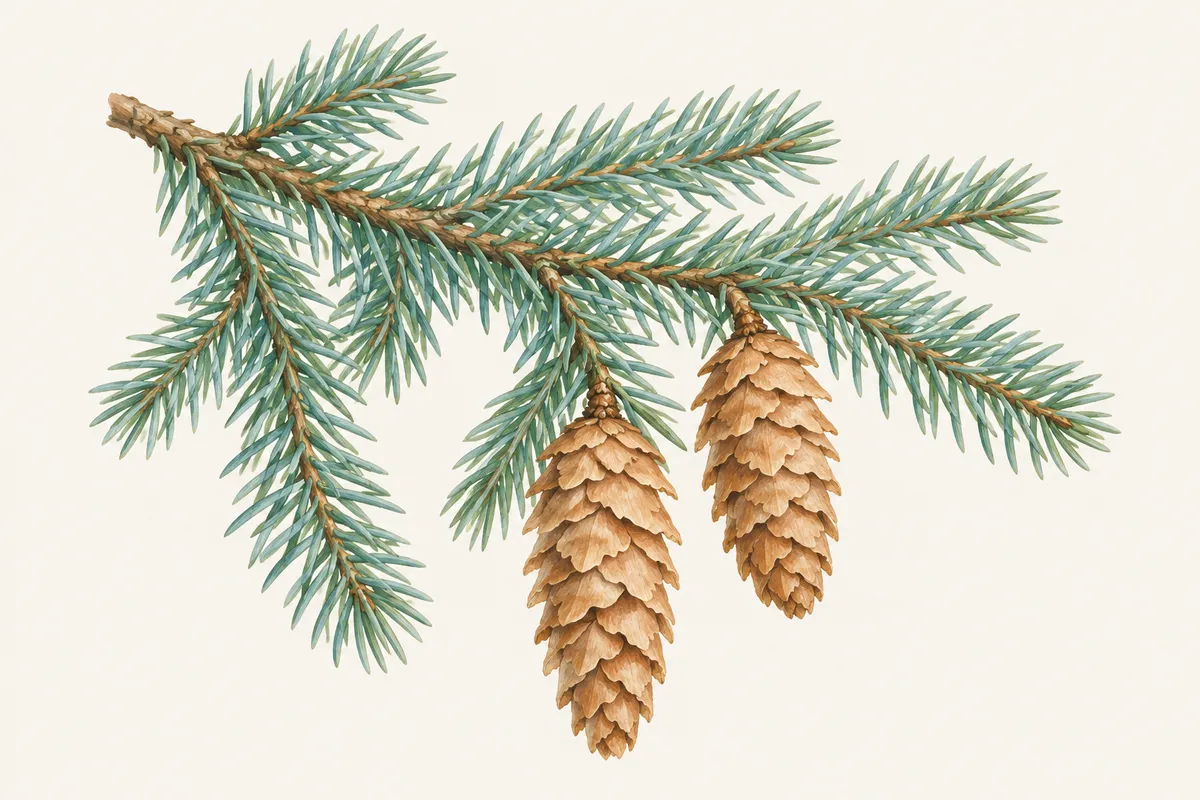
Engelmann spruce identification takes three checks. The needles are four-sided, about 1 inch (15 to 25 mm) long, bluish-green, somewhat flexible and aromatic when crushed, and they roll between your fingers. Young twigs carry minute hairs. The hanging cones are papery, about 1 to 2 1/2 inches long, light chestnut-brown, with thin scales whose tips are irregularly toothed.
- Roll a needle: Engelmann spruce needles are square and roll; subalpine fir, its constant neighbor, has flat, soft needles and upright cones.
- A hand lens on the youngest twig separates it from blue spruce: Engelmann twigs have minute hairs, blue spruce twigs are hairless.
- In the central and southern Rockies it grows mostly between about 9,000 and 11,500 feet, up to treeline.
Field marks at a glance
- Scientific name
- Picea engelmannii
- Family
- Pinaceae (pine family)
- Type
- Conifer, evergreen
- Needles
- Single, four-sided, 15 to 25 mm (about 1 inch), bluish-green often with a whitish powder, curved and somewhat flexible, aromatic when crushed (NRCan); not as sharp as blue spruce (Utah State).
- Twigs
- Grayish to light brown, somewhat hairy: young twigs carry minute hairs (Utah State, NRCan); rough with woody pegs where needles fell.
- Cones
- Hang down, papery, cylindrical, 1 to 2 1/2 inches (2.5 to 6.3 cm, USDA; NRCan gives 3 to 7 cm), light chestnut to yellowish-brown; thin, flexible scales with irregularly toothed tips that often split. Clustered in the upper third of the tree.
- Bark
- Thin, red to purple-brown or gray, breaking into large, loose, rounded scales; freshly exposed bark is resinous and silvery-white.
- Form
- Straight trunk, dense, narrow, tapering crown; dwarfed or prostrate near timberline, where wind-shaped krummholz forms.
- Size
- Typically 45 to 130 ft tall and 15 to 30 in across; individual trees over 160 ft and 40 in (USDA Forest Service).
- Elevation
- About 9,000 to 11,000 ft in Utah, Wyoming and Colorado, reaching timberline at 11,500 ft; 4,000 to 6,000 ft in the Cascades; 1,000 to 2,000 m on Canadian mountain slopes (NRCan).
- Range
- Interior British Columbia and Alberta south through the Rocky Mountains to Arizona and New Mexico, and in the Cascades of Washington and Oregon.
Engelmann spruce (Picea engelmannii) forms the dark, dense forests just below treeline across the Rocky Mountains, almost always beside subalpine fir. It is one of the most common trees of the West: the USDA Forest Service inventory of live trees on US forest land ranks it 25th of 431 species. Telling it apart takes one close look at a needle and a twig, because at a distance the spruce and the fir beside it share the same narrow shape. The spruce genus page compares seven common spruces; this page goes deeper on Engelmann spruce.
How to identify Engelmann spruce in four checks
1. Roll a needle. Rocky Mountain National Park's conifer guide says Engelmann needles are single, about 1 inch long and four-sided, so you can roll one between thumb and finger, which does not work with the flat needles of subalpine fir or Douglas-fir. Pull one off and a small woody peg stays on the twig.
2. Look at and smell the needle. Natural Resources Canada's Engelmann spruce factsheet gives needles 15 to 25 mm long, curved and somewhat flexible, with a pointed or blunt tip, bluish-green and often coated with a whitish powder, and aromatic when crushed. Utah State University Extension describes them as blue-green to dark green and not as sharp-pointed as blue spruce. The National Park Service calls them sharply pointed, so judge sharpness only side by side with a blue spruce.
3. Check the twig with a hand lens. Utah State notes minute hairs on young twigs, and NRCan calls the twigs somewhat hairy, grayish to light brown. This is the clearest test against blue spruce and white spruce, which both have hairless twigs.
4. Find a cone. The cones hang down, papery and light chestnut-brown, about 1 to 2 1/2 inches long (Utah State), with scales slightly round-toothed at the tip. NRCan describes thin, flexible, loose-fitting yellowish-brown scales with irregularly toothed tips that often split, and says the cones open in autumn and fall during winter or the following spring. The National Park Service notes that the cones cluster in the upper third of the tree, so look on the ground for fallen ones.
If you are on a trail without a hand lens, Tree Identifier can name the tree from one photo of a branch, a cone or the bark. Engelmann spruce is not one of the 138 species in the app's Collection, and the app shows one name with no confidence score or look-alike list, so confirm it with the needle and twig checks.
Engelmann spruce vs subalpine fir
These two trees make up the Engelmann spruce-subalpine fir forest type, and the USDA Forest Service's Silvics of North America names subalpine fir as the spruce's most common associate. They grow mixed together, so you will often need to identify the tree in front of you rather than the stand.
| Trait | Engelmann spruce | Subalpine fir |
|---|---|---|
| Needle | Four-sided, rolls, stiff-ish, on a woody peg | Flat, soft, round-tipped, no peg |
| Cone | Hangs down, papery, tan to reddish | Stands upright, purple-blue, falls apart on the tree |
| Winter top | Cones still hanging | Bare upright spikes where cones were |
| Crown | Narrow, tapering, dense | Narrower, more spire-like, very dense |
Traits come from Rocky Mountain National Park. The fir page covers subalpine fir among the other firs. The spruce vs fir guide explains the needle and cone tests for any spruce and fir.
Engelmann spruce vs blue spruce and white spruce
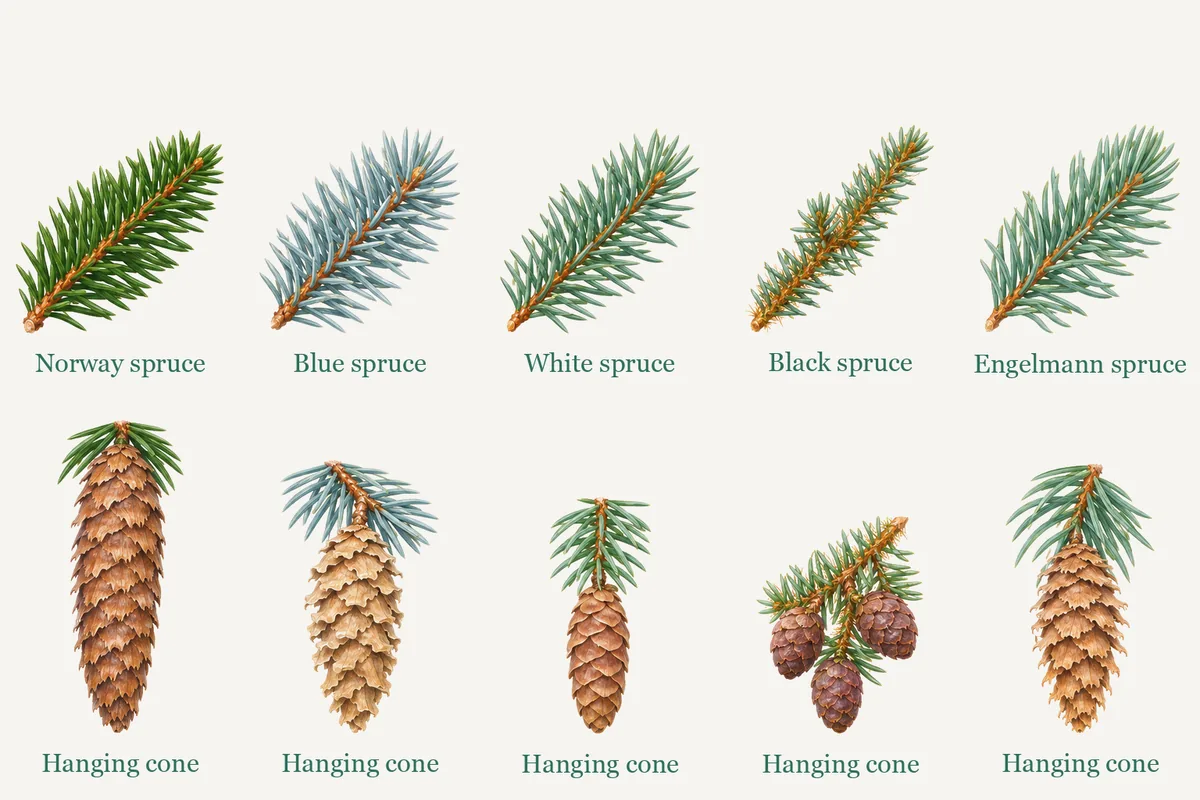
Lower on the mountain, Engelmann spruce meets blue spruce. Utah State gives blue spruce very sharp needles, hairless twigs, bud scales bent back and cones 2 1/2 to 4 inches; Engelmann has minute twig hairs, flatter bud scales and cones about 1 to 2 1/2 inches. In Rocky Mountain National Park, blue spruce grows at 7,000 to 9,500 feet in moist soil near streams, and Engelmann from 9,000 to 11,500 feet. The park adds that needle color varies and some Engelmann spruces look as blue as blue spruce. The blue spruce page has a full side-by-side table.
Farther north, Engelmann meets white spruce. The USDA Forest Service reports natural introgressive hybridization with white spruce, especially around Glacier National Park in Montana, and the white spruce silvics describe white spruce predominating up to about 5,000 feet and Engelmann above about 6,000 feet, with a hybrid swarm on the slopes between. White spruce has hairless twigs and cone scales with smooth, rounded edges. The white spruce page covers it in detail.
Where Engelmann spruce grows
The USDA Forest Service gives a range from British Columbia and Alberta south through the western United States to New Mexico and Arizona. Elevations shift with latitude:
- Utah, Wyoming and Colorado: 9,000 to 11,000 feet, reaching timberline at 11,500 feet.
- New Mexico and Arizona: 9,500 to 11,000 feet.
- Cascades of Washington and Oregon: generally 4,000 to 6,000 feet.
- British Columbia and Alberta: NRCan gives mountain slopes between 1,000 and 2,000 m (3,300 to 6,600 ft) for its Canadian range, and along streams at lower elevations; the USDA Forest Service gives 2,500 to 3,500 ft in the interior valleys of southwestern British Columbia.
It needs cold, humid sites with heavy snowfall; the Forest Service says low tolerance to heat and drought restricts it to them. NRCan lists subalpine fir, western hemlock, western larch, lodgepole pine, birches and aspen among its companions. The Rocky Mountain tree guide places it among the region's other trees by elevation band.
Bark, size, age and treeline forms
Engelmann bark is thin and brownish, breaking into large, loose, coarse, rounded scales; newly exposed bark is resinous and silvery-white (NRCan). Utah State calls it red to purple-brown, and the National Park Service gray, reddish on the sheltered side.
Under good conditions, the USDA Forest Service gives average stand diameters of 15 to 30 inches and dominant heights of 45 to 130 feet, with individual trees over 40 inches and 160 feet. The species matures in about 300 years; dominant spruces are often 250 to 450 years old and trees of 500 to 600 years are not uncommon. Near timberline it most often reproduces by layering and takes a dwarfed or prostrate form. The National Park Service calls these wind-shaped tree islands krummholz, "crooked wood", and notes trees that stay around 15 feet tall on windy sites.
The spruce beetle is its most serious insect pest (USDA Forest Service). With location turned on, Tree Identifier's Tree Map pins the find, an easy way to come back to the same tree when its cones have fallen, and the follow-up chat can answer questions such as whether a stunted treeline spruce is the same species as the tall ones below.
Look-alikes and how to tell them apart
Subalpine fir (Abies lasiocarpa)
Subalpine fir needles are flat, soft and round-tipped and will not roll between your fingers. Its purple-blue cones stand upright on the top branches and fall apart there, leaving bare spikes. Its crown is narrower and more spire-like than Engelmann spruce.
Blue spruce (Picea pungens)
Blue spruce twigs are hairless, its needles very sharp, and its cones longer, 2 to 4 inches. It usually grows lower, near streams. Engelmann spruce has finely hairy young twigs, less sharp needles and cones about 1 to 2 1/2 inches.
White spruce (Picea glauca)
White spruce has hairless twigs, needles that smell unpleasant when crushed, and cones with smooth, rounded scale edges. Engelmann scale tips are irregularly toothed. In the northern Rockies the two hybridize, with white spruce lower on the slope.
Douglas-fir (Pseudotsuga menziesii)
Douglas-fir needles are flat and soft, with no woody peg, and its cones carry three-pointed bracts sticking out between the scales. Engelmann spruce needles are square and roll, and its cone bracts stay hidden.
What a photo can't settle
- Engelmann and blue spruce overlap in cone size and needle color, and Engelmann hybridizes with white spruce in Montana, Wyoming and British Columbia; where the ranges meet, a photo of foliage alone cannot settle the species.
- Sources disagree on needle sharpness and cone size (cones 1 to 2 inches in Rocky Mountain National Park, 3 to 7 cm for NRCan), so use these numbers as ranges, not thresholds.
- Near treeline, wind-dwarfed krummholz spruce may stay around 15 feet tall (National Park Service) or grow prostrate; check needles and twigs rather than the shape.
Questions people ask
How do you tell Engelmann spruce from subalpine fir?
Roll a needle. Engelmann spruce needles are four-sided and roll between finger and thumb; subalpine fir needles are flat and soft and will not. Then look up: subalpine fir cones stand upright on the top branches and fall apart there, while Engelmann cones hang down, according to Rocky Mountain National Park.
How do you tell Engelmann spruce from blue spruce?
Check the twig, the cone and the elevation. Utah State Extension says Engelmann twigs have minute hairs and its needles are less sharp than blue spruce. Engelmann cones are about 1 to 2 1/2 inches, blue spruce cones 2 to 4 inches. In Rocky Mountain National Park, Engelmann grows higher, from 9,000 feet to treeline.
Can an Engelmann spruce be blue?
Yes. Natural Resources Canada describes bluish-green needles often coated with a whitish powder, and the National Park Service notes that some Engelmann spruces look as blue as Colorado blue spruce. Color does not separate the two; twig hairs and cone length do.
How old do Engelmann spruces get?
The USDA Forest Service says the species matures in about 300 years, dominant trees are often 250 to 450 years old, and trees of 500 to 600 years are not uncommon. Rocky Mountain National Park reports some trees over 1,000 years old.
What kills Engelmann spruce?
The USDA Forest Service names the spruce beetle, Dendroctonus rufipennis, as its most serious insect pest. Colorado outbreaks from 1939 to 1951 killed nearly 6 billion board feet of standing spruce.
Sources
- Engelmann Spruce (Picea engelmannii), Silvics of North America — USDA Forest Service
- Engelmann spruce (Picea engelmannii), Trees, insects and diseases of Canada's forests — Natural Resources Canada, Canadian Forest Service
- Engelmann Spruce — Utah State University Extension, Forestry
- Conifers, Rocky Mountain National Park — National Park Service
- White Spruce (Picea glauca), Silvics of North America — USDA Forest Service
Keep reading
- Tree profileSpruce trees (Picea): how to identify the species
- Tree profileBlue spruce (Picea pungens): how to identify a Colorado blue spruce
- Regional guideRocky Mountain tree identification, from foothills to treeline
- Tree profileFir (Abies): how to identify a fir tree
- Tree profileWhite spruce (Picea glauca): how to identify it