Tree profile
White spruce (Picea glauca): how to identify it
Crush a needle and sniff. The skunky smell that earned white spruce the names cat spruce and skunk spruce, a hairless twig and a slender cone with smooth scale edges confirm it.
In short
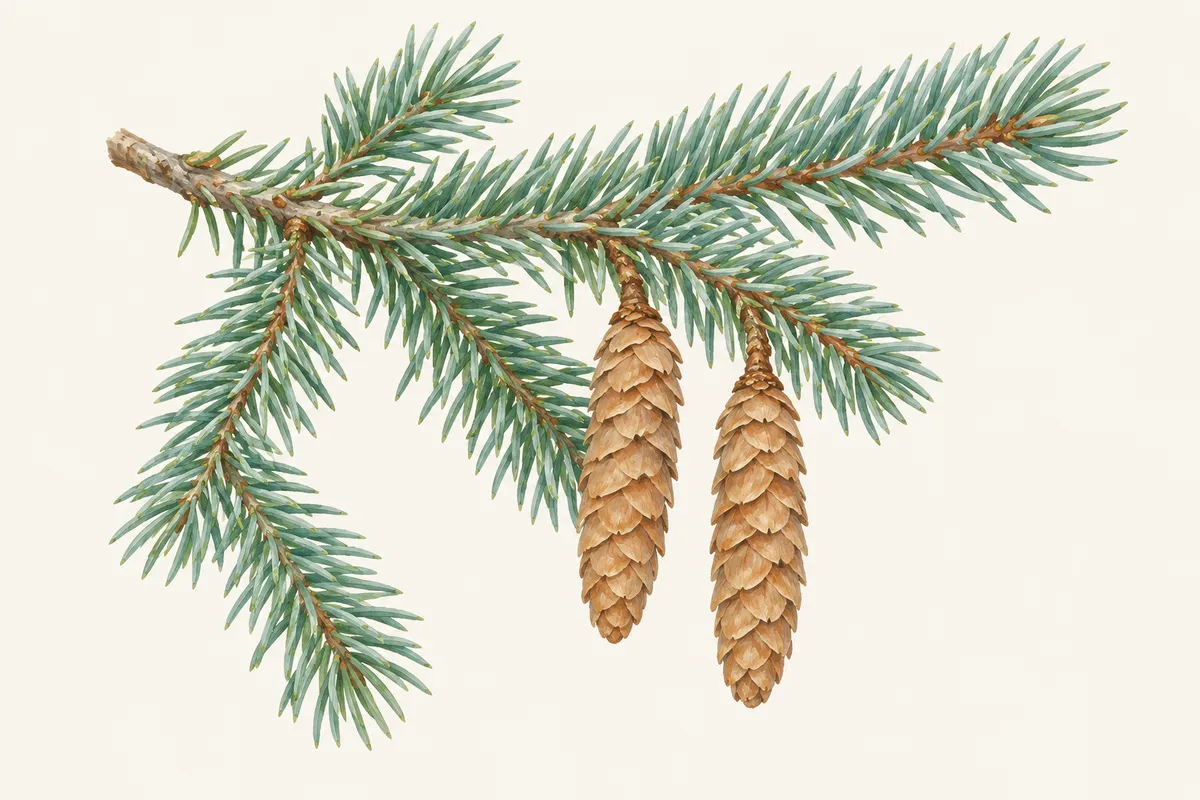
White spruce identification rests on a smell, a twig and a cone. The four-sided needles, 15 to 22 mm (about 1/2 to 3/4 inch) long and green to bluish-green, smell unpleasantly pungent when crushed. The young twigs are hairless and shiny. The hanging cones are slender cylinders 3 to 6 cm (1 1/2 to 2 1/2 inches) long, light brown, with thin scales whose edges are smooth and rounded.
- A crushed needle that smells like cat urine or skunk points to white spruce; the names cat spruce and skunk spruce come from it.
- Hairless twigs separate white spruce from black and red spruce, which have hairy ones.
- It grows across Canada and Alaska, dipping into the US only in the northern Great Lakes states, northern New England and New York, plus outliers in the Black Hills.
Field marks at a glance
- Scientific name
- Picea glauca
- Family
- Pinaceae (pine family)
- Type
- Conifer, evergreen
- Needles
- Single, four-sided, straight and stiff, 15 to 22 mm (NRCan) or 1/3 to 3/4 inch (Virginia Tech), pointed but not sharp, green to bluish-green with white lines on all sides; unpleasantly pungent when crushed.
- Twigs
- Hairless, shiny, light greenish-gray often tinged orange or purple (NRCan), sometimes with a whitish waxy bloom (Virginia Tech); seedling twigs may be hairy.
- Buds
- About 6 mm, egg-shaped, blunt, not resinous; the tight bud scales have ragged edges that curl outward (NRCan).
- Cones
- Hang down, slender, cylindrical, blunt-tipped, 3 to 6 cm (1 1/2 to 2 1/2 in), light brown; scales thin and tough with smooth, rounded edges that bend without breaking. Open in late summer.
- Bark
- Thin, light gray and smooth when young, becoming scaly and darker with age; salmon pink and silvery where a scale has just come off (NRCan).
- Form
- Conical, densely foliated, often ragged crown, becoming spire-like in the far North; up to about 80 to 90 ft on most sites.
- Range
- Newfoundland and Labrador to Alaska and the Yukon; south to northern Minnesota, Wisconsin, central Michigan, northeastern New York and Maine; outliers in the Black Hills.
- Habitat
- Many soils and climates; old fields and pastures in eastern Canada, river flats in the North, and the arctic tree line.
White spruce (Picea glauca) is the most widespread spruce of the northern forest, running from Newfoundland to Alaska. It reaches the United States only along its northern edge, which is why it ranks just 88th of 431 species in the USDA Forest Service inventory of live trees on US forest land, while in Canada it is everywhere. It is also planted in northern yards and windbreaks. The quickest clue is your nose. The spruce genus page compares seven common spruces; this page covers white spruce in detail.
How to identify white spruce in four checks
1. Confirm it is a spruce. Roll a needle between your fingers: a spruce needle is four-sided and rolls, and it leaves a small woody peg on the twig when it falls. A flat needle that leaves a round scar belongs to a fir; the spruce vs fir guide covers that test.
2. Crush a needle and smell it. Natural Resources Canada's white spruce factsheet describes the needles as unpleasantly pungent when crushed, and lists cat spruce and skunk spruce among the tree's names. The needles themselves are straight and stiff, 15 to 22 mm long, pointed but not sharp, green to bluish-green with lines of white dots on all sides. Virginia Tech's white spruce fact sheet gives 1/3 to 3/4 inch and also notes the pungent odor.
3. Check the twig for hairs. NRCan describes hairless, shiny twigs, light greenish-gray and often tinged with orange or purple; Virginia Tech calls them slender, light brown or pale, sometimes glaucous with a whitish bloom. Black and red spruce, white spruce's eastern neighbors, both have hairy twigs, so a smooth twig under a hand lens narrows the choice at once. The buds help too: about 6 mm, blunt, not resinous, with scales whose ragged edges curl outward (NRCan).
4. Find a cone. White spruce cones hang down and are slender, cylindrical and blunt-tipped, 3 to 6 cm long (NRCan); Virginia Tech gives 1 1/2 to 2 1/2 inches and calls them cigar-shaped. The scales are light brown, thin and tough, with smooth, rounded outer edges, and you can squeeze a cone without the scales breaking. Cones open in late summer and release seed from then until spring (NRCan).
When the cones are high, Tree Identifier can name a spruce from one photo of a branch, a cone or the whole tree. White spruce is not one of the 138 species in the app's Collection, and the app shows one name with no confidence score or look-alike list, so finish with the smell and twig tests.
White spruce vs black, red and Engelmann spruce
| Trait | White spruce | Black spruce | Red spruce | Engelmann spruce |
|---|---|---|---|---|
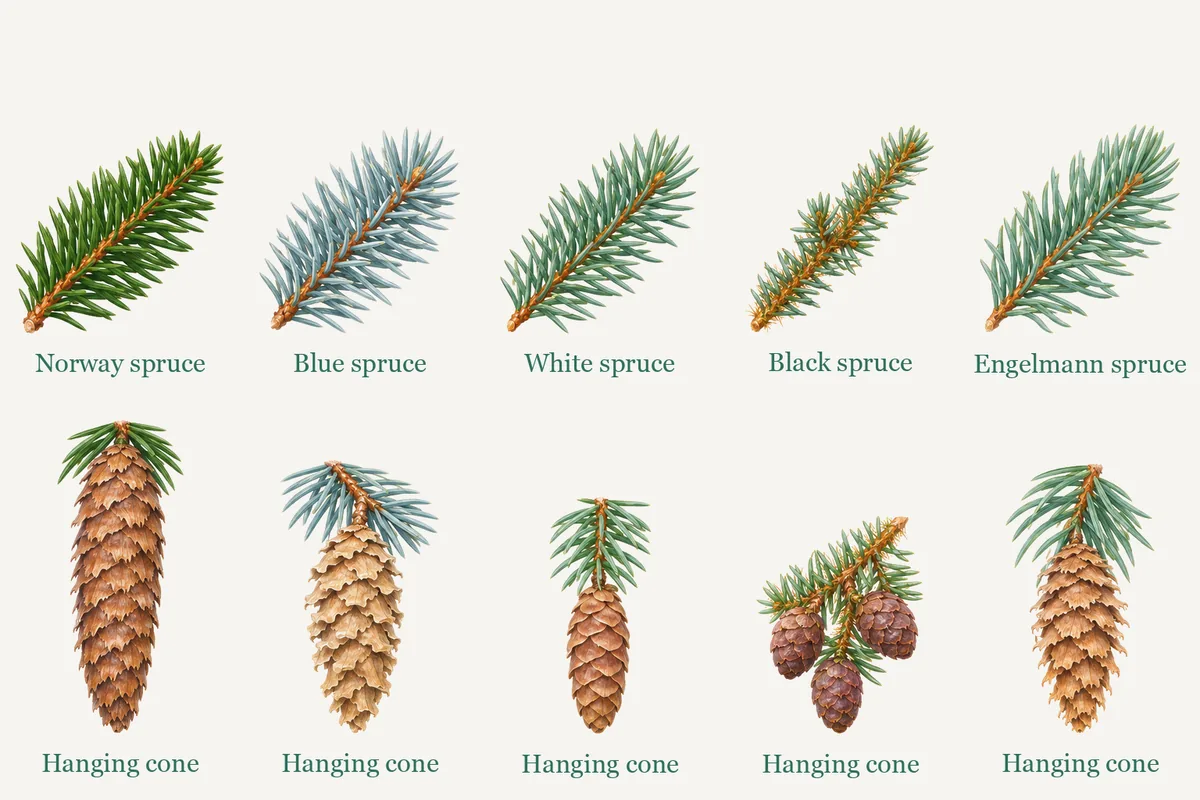
| Needles | 15–22 mm, straight, pungent when crushed | 8–15 mm, dull grayish-green | 10–16 mm, curved, shiny yellow-green | 15–25 mm, flexible, aromatic |
| Young twig | Hairless | Short brown hairs | Hairy, shiny orange | Somewhat hairy |
| Cone | 3–6 cm, slender cylinder | About 1 in, round when open | 3–5 cm, egg-shaped, chocolate-brown | 3–7 cm, thin papery scales |
| Scale edge | Smooth, rounded | Finely toothed | — | Irregularly toothed, often split |
| Where | Canada, Alaska, northern US edge | Bogs, boreal Canada | Maritimes, Appalachians | Rockies, interior BC |
Sources: NRCan factsheets for white, black, red and Engelmann spruce.
In the East, the choice is mostly white versus black spruce: white spruce on drier uplands and old fields, black spruce in bogs, with plenty of overlap in the North. In the Maritimes and northern New England, red spruce is the third option. In the West, white spruce meets Engelmann spruce, and the two can be impossible to separate on the same slope (see below). In yards, blue spruce is the common confusion: its needles are longer and much sharper, and its cone scales are jagged.
Where white spruce grows
The USDA Forest Service's Silvics of North America describes a transcontinental range from Newfoundland and Labrador west across Canada to Hudson Bay, the Northwest Territories and the Yukon, nearly reaching the Arctic Ocean at 69° N in the Mackenzie District. In Alaska it reaches the Bering Sea at Norton Bay and the Gulf of Alaska at Cook Inlet, and in British Columbia it comes within about 60 miles of the Pacific in the Skeena Valley. In the United States it extends south through northern Minnesota, Wisconsin, central Michigan, northeastern New York and Maine, with isolated outliers in the Black Hills of South Dakota and Wyoming. It grows from sea level to about 5,000 feet.
It tolerates a wide range of soils and climates (NRCan). Best growth is on moist alluvial soils along northern rivers and on south-facing uplands in the North (USDA). In eastern Canada it invades abandoned farmland (one of its other names is pasture spruce), and it is often found at the arctic tree line. Common companions are black spruce, paper birch, quaking aspen and balsam fir in the East, and subalpine fir, Douglas-fir and lodgepole pine in western Canada. The most common trees in Canada guide shows how white spruce fits among them.
Hybrids: Engelmann, Sitka and black spruce
White spruce crosses with three other spruces, which matters wherever their ranges meet.
- Engelmann spruce. The USDA Forest Service says the two share large areas of British Columbia, Montana and Wyoming. White spruce predominates at lower elevations, up to about 5,000 feet, and Engelmann above about 6,000 feet, with a hybrid swarm on the slopes between.
- Sitka spruce. In northwestern British Columbia and Alaska the two form the natural hybrid Lutz spruce, Picea × lutzii.
- Black spruce. Natural hybrids are rare along the southern edge of the range but more common north of 57° N along the Alaska Highway in British Columbia (USDA).
Four varieties have been named, including var. albertiana and var. densata, but the Forest Service authors consider them unnecessary to distinguish. For field identification, treat a spruce with mixed traits in hybrid country as "white or Engelmann" rather than forcing a name.
Crown, bark and size
From a distance, NRCan describes a broadly conical, ragged, densely foliated crown that becomes spire-like in the far North. Bark is thin, light gray and smooth on young trees, scaly and darker with age; flick off a scale and the fresh bark underneath is salmon pink and silvery.
Size varies more than in most trees. NRCan gives up to 25 m (82 ft) and 60 cm in diameter, and Virginia Tech up to 90 feet. The USDA Forest Service reports trees more than 100 feet tall on good sites and the tallest over 180 feet. Near tree line, harsh conditions produce shrub-like trees. Age is just as variable: 100 to 250 years is common on good sites, and stress sites hold the oldest, with nearly 1,000-year-old trees above the Arctic Circle.
Tree Identifier's Tree Map keeps a pin on each located find, which helps when you want to return to the same tree to collect a cone in late summer. For the other conifers of the northern forest, the Canada tree guide lists them region by region.
Look-alikes and how to tell them apart
Black spruce (Picea mariana)
Black spruce twigs carry short brown hairs, its needles are shorter (8 to 15 mm) and dull grayish-green, and its cones are about 1 inch, nearly round when open, and stay on the tree for years. White spruce twigs are hairless and its cones are longer, slender cylinders.
Red spruce (Picea rubens)
Red spruce needles are shorter, curved and shiny yellowish-green, on hairy, shiny orange twigs, and its cones are egg-shaped and chocolate-brown. White spruce needles are straight, smell pungent, and sit on hairless twigs.
Engelmann spruce (Picea engelmannii)
In the northern Rockies the two meet and hybridize. Engelmann spruce has somewhat hairy twigs and thin, flexible cone scales with irregularly toothed, often split tips; white spruce has hairless twigs and smooth, rounded scale edges. Engelmann usually grows higher on the slope.
Blue spruce (Picea pungens)
Planted blue spruce has stiffer needles, 3/4 to 1 1/4 inches, sharp enough to hurt, and longer cones, 2 to 4 inches, with jagged scale edges. White spruce needles are pointed but not sharp and its scale edges are smooth.
What a photo can't settle
- White spruce hybridizes with Engelmann spruce in British Columbia, Montana and Wyoming, with Sitka spruce in northwestern British Columbia and Alaska, and rarely with black spruce; on those slopes a photo cannot settle the species.
- Very young white spruces can have hairy twigs (NRCan), so the twig test works on older trees, not seedlings.
- Planted white spruces include named cultivars with dwarf, weeping or blue forms that do not match the wild tree's shape; judge them by needle smell, twig and cone.
Questions people ask
Why does white spruce smell like cat urine?
Natural Resources Canada describes white spruce needles as unpleasantly pungent when crushed, and lists cat spruce and skunk spruce among its common names.
How do you tell white spruce from black spruce?
Use a hand lens on the youngest twig: white spruce is hairless, black spruce has short brown hairs. Then check the cone. White spruce cones are slender cylinders 3 to 6 cm long; black spruce cones are about 1 inch, nearly round when open, and can stay on the tree for up to 30 years.
Where does white spruce grow?
Across Canada from Newfoundland and Labrador to Alaska and the Yukon, almost to the Arctic Ocean, according to the USDA Forest Service. In the United States it reaches northern Minnesota, Wisconsin, central Michigan, northeastern New York and Maine, with isolated stands in the Black Hills of South Dakota and Wyoming.
How old can a white spruce get?
On good sites, trees 100 to 250 years old are common, according to the USDA Forest Service. The oldest grow on harsh sites: a small tree on the Mackenzie River Delta had a 589-year ring sequence, and trees nearly 1,000 years old occur above the Arctic Circle. NRCan gives a typical maximum of about 200 years.
Sources
- White spruce (Picea glauca), Trees, insects and diseases of Canada's forests — Natural Resources Canada, Canadian Forest Service
- White Spruce (Picea glauca), Silvics of North America — USDA Forest Service
- White spruce fact sheet — Virginia Tech Dendrology
- Black spruce (Picea mariana), Trees, insects and diseases of Canada's forests — Natural Resources Canada, Canadian Forest Service
- Engelmann spruce (Picea engelmannii), Trees, insects and diseases of Canada's forests — Natural Resources Canada, Canadian Forest Service
Keep reading
- Tree profileSpruce trees (Picea): how to identify the species
- Tree profileBlack spruce (Picea mariana): how to identify the bog spruce
- Tree profileBlue spruce (Picea pungens): how to identify a Colorado blue spruce
- Canada by the numbersThe most common trees in Canada, ranked by forest area
- Canada field guideTree identification in Canada, region by region