Tree profile
Black spruce (Picea mariana): how to identify the bog spruce
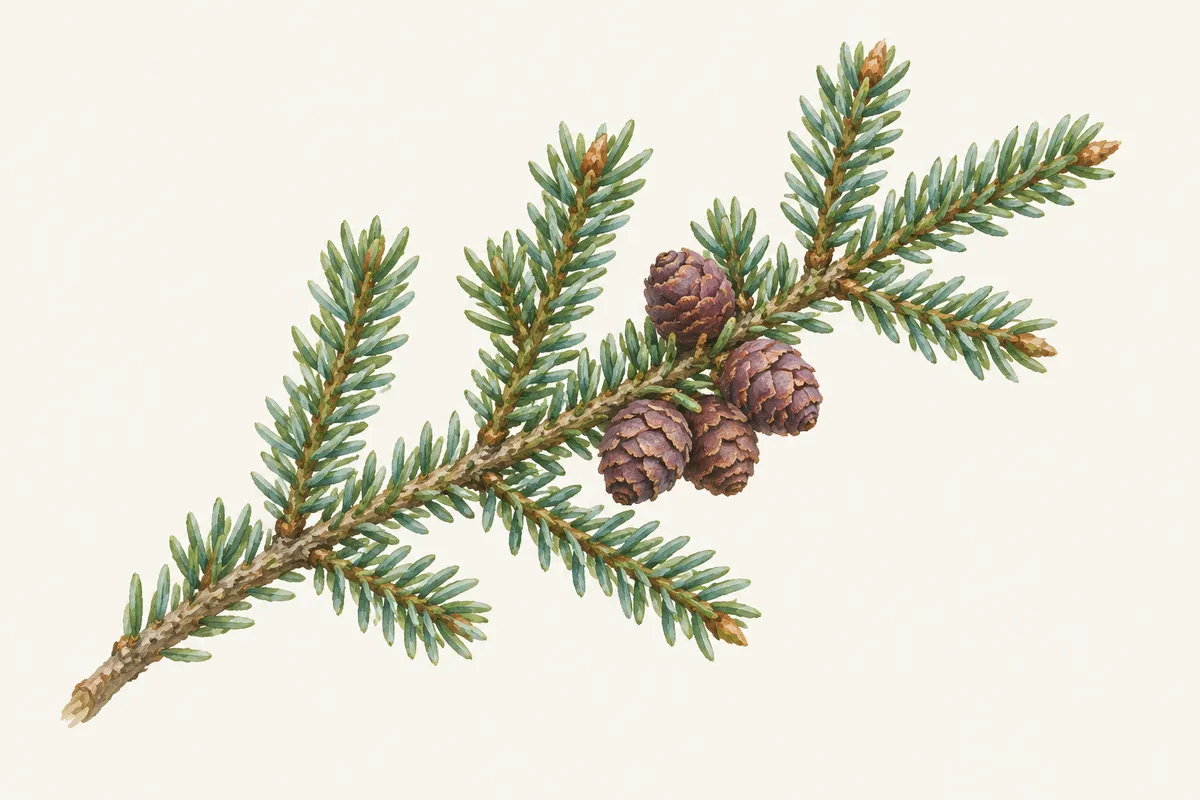
A narrow, ragged spire in a bog, with a dense knot of small cones at the top: black spruce is the spruce of wet northern ground, and its cones and twig hairs confirm it.
In short
Black spruce identification starts with the smallest spruce parts in North America. The needles are four-sided, only 1/4 to 1/2 inch (8 to 15 mm) long, dull bluish or grayish green with blunt tips. Young twigs carry short brown hairs. The cones are about 1 inch, egg-shaped to nearly round, often clustered near the top, and can stay on the tree for up to 30 years.
- Tiny cones that stay on the tree for years, crowded in the upper crown, are the best single sign of black spruce.
- Use a hand lens on the youngest twig: black spruce is hairy, white spruce is hairless.
- In the South of its range it grows mostly in bogs and swamps; in the far North it covers uplands too.
Field marks at a glance
- Scientific name
- Picea mariana
- Family
- Pinaceae (pine family)
- Type
- Conifer, evergreen
- Needles
- Single, four-sided, stiff, 1/4 to 1/2 inch (Virginia Tech) or 8 to 15 mm (NRCan) long, dull grayish or light bluish-green, blunt-tipped, densely set along the twig.
- Twigs
- Slender, dull orange-brown to yellowish-brown, with short brownish hairs, some of them gland-tipped; a dark purplish stain at the base of each needle peg (NRCan). Very young trees can have hairless twigs.
- Cones
- About 1 inch, egg-shaped, nearly round when open, with thin, brittle, finely toothed scales; ripen in September, often clustered near the top, and can stay on the tree up to 30 years (NRCan).
- Immature cones
- Deep red to purple, 2 to 3 cm, turning dark purplish-brown (NRCan).
- Bark
- Thin, gray-brown to reddish-brown, in small close scales; newly exposed bark under a scale is olive-green or yellowish-green.
- Form
- Very narrow, spire-like crown on wet sites; often a dense, irregular, cone-laden top. Lower branches can root where they touch moss (layering).
- Size
- Usually 25 to 65 ft (8 to 20 m) tall and 5 to 9 in across; up to about 90 ft on the best upland sites (USDA Forest Service).
- Range
- Across Canada from Labrador to Alaska, south to the northern Great Lakes states and northern New England, with isolated stands south to Pennsylvania and northern New Jersey.
- Habitat
- Peat bogs, swamps and other wet organic soils, often with tamarack; also uplands and permafrost sites in the North.
Black spruce (Picea mariana) is the narrow, dark spire that stands in bogs and muskeg across Canada, Alaska and the northern edge of the United States. It is a common tree: the USDA Forest Service inventory of live trees on US forest land ranks it 29th of 431 species, and in the boreal forest it covers far more ground than that. Its parts are the smallest of any North American spruce, so it pays to look closely. The spruce genus page compares seven common spruces; this page covers black spruce in detail.
How to identify black spruce in four checks
1. Confirm it is a spruce. Roll a needle between your fingers: it is four-sided and rolls, and when it falls it leaves a small woody peg on the twig. Firs have flat needles that will not roll; the spruce vs fir guide explains the test.
2. Measure a needle. Virginia Tech's black spruce fact sheet gives stiff, four-sided needles 1/4 to 1/2 inch long, light blue-green with somewhat blunt tips. Natural Resources Canada's black spruce factsheet gives 8 to 15 mm, straight, dull greyish-green, with lines of white dots that are clearer on the underside, densely set and pointing forward on the upper side of the twig. Dull, short and blunt is the pattern.
3. Look at the twig with a hand lens. NRCan describes the young twig as dull dark orange-brown or yellowish-brown with short brownish hairs, some crooked or tipped with a tiny gland, and a dark purplish stain at the base of each needle peg. Virginia Tech calls it slender, brown and pubescent. This is the cleanest separation from white spruce, whose twigs are hairless. One caution from NRCan: very young black spruces can have hairless twigs, so test a tree that is old enough to bear cones.
4. Look for cones, high and old. Virginia Tech calls black spruce cones the smallest of the spruces, ovoid and about 1 inch long, with rounded, finely ragged scale margins. NRCan describes mature cones as almost spherical when open, with thin, brittle, toothed scales, ripening in September, often clustered near the top of the tree, and able to stay on the tree for up to 30 years. Young cones are deep red to purple. A spruce whose upper crown is dark with clusters of small gray-brown cones of several ages is very likely a black spruce.
If you can only photograph the tree from the edge of a bog, Tree Identifier can name it from one photo of the crown, a branch or a cone. Black spruce is not one of the 138 species in the app's Collection, and the app gives one name without a confidence score or look-alike list, so check the twig hairs and cones yourself.
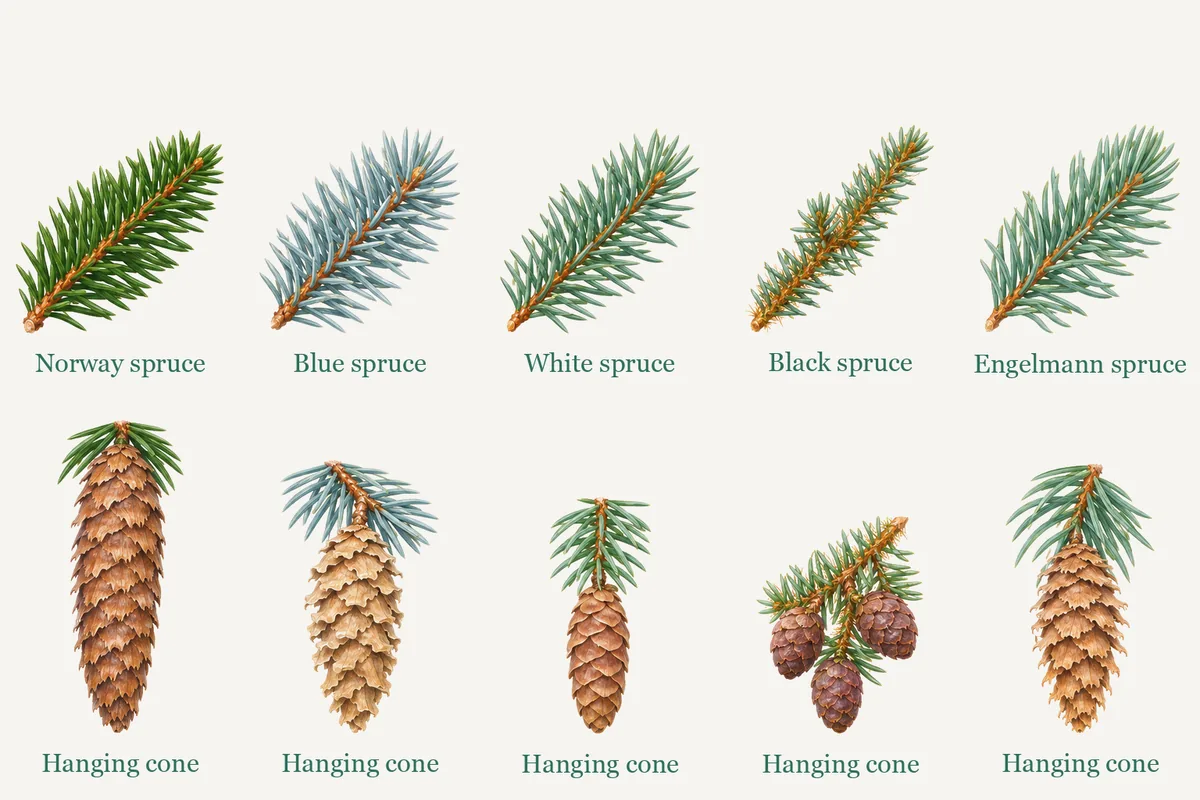
Black spruce vs white spruce, red spruce and tamarack
| Trait | Black spruce | White spruce | Red spruce | Tamarack |
|---|---|---|---|---|
| Needles | Single, 8–15 mm, dull grayish-green | Single, 15–22 mm, smell pungent | Single, 10–16 mm, shiny yellow-green, curved | Tufts of 15–60, soft, shed in fall |
| Young twig | Hairy | Hairless | Hairy, shiny orange | Spur shoots |
| Cone | About 1 in, round when open, stays years | 3–6 cm, slender cylinder | 3–5 cm, chocolate-brown | 1–2 cm, few scales |
| Site | Bogs, wet ground; uplands in the North | Many soils, old fields | Moist uplands, mountains | Bogs, with black spruce |
Sources: NRCan factsheets and Virginia Tech's white spruce fact sheet, which gives white spruce cones 1 1/2 to 2 1/2 inches long, cigar-shaped, with smooth-edged scales.
The tree most often confused with black spruce in a bog is not a spruce at all. Tamarack grows in the same peatlands and looks like a pale spruce in summer, but its needles come in soft tufts and turn gold and drop in autumn; a bare, dead-looking conifer beside a green black spruce in winter is usually a tamarack. The detailed pages on white spruce and red spruce cover the other two eastern spruces.
Where black spruce grows
The USDA Forest Service's Silvics of North America describes a broad band from northern Massachusetts and northern Labrador on the Atlantic coast west across Canada to the west coast of Alaska. Its southern limits are isolated patches in northern New Jersey, Pennsylvania, southern Michigan and southern Manitoba. It usually grows at 500 to 2,500 feet, and in some mountains it forms the tree line at 1,000 to 4,000 feet, but local drainage matters more than elevation.
Habitat is the strongest clue in the South. Black spruce usually grows on wet organic soils such as peat bogs and swamps, and NRCan says that in the south of its range it is mostly found on wet, poorly drained sites, alone or with tamarack. Farther north it forms extensive pure stands or mixes with jack pine, white spruce, balsam fir, white birch, trembling aspen and lodgepole pine, on uplands and permafrost as well as in bogs. Common shrubs underneath include speckled alder, Labrador-tea and bog birch (USDA Forest Service). The Canada tree guide lists its neighbors province by province.
Shape, layering and size
On wet ground black spruce is narrow and spire-like. On well-drained uplands, NRCan describes short branches whose lower ones droop with upturned tips, and an upper crown that is often very dense, irregular and heavy with cones. Virginia Tech notes a poorly pruned trunk.
Black spruce can also reproduce by layering: lower branches pressed into moss take root and grow up as new stems. The USDA Forest Service says layering is important on some sites, more common in open, poorer stands, and frequent at tree line, where it forms "candelabrum" clumps of stems around an old tree. A ring of small spruces around a larger one in a bog is a typical sign.
Size varies with the site. The Forest Service gives 40 to 65 feet tall and about 9 inches across on good sites, 25 to 40 feet and about 5 inches on poor ones, extremes of about 90 feet in the Ontario Clay Belt, and only 10 to 20 feet in the far north. NRCan gives up to 20 m on poorly drained sites and up to 30 m on well-drained uplands. Average maximum age is about 200 years, with ages up to 280 reported. Roots are very shallow, especially on organic soils with a high water table (NRCan).
Cones and fire
Black spruce cones are built for fire. The USDA Forest Service says they remain partially closed and disperse seed for several years, that fire opens them and speeds seedfall, and that some viable seed may stay in the cones for as long as 25 years. That is why a black spruce carries cones of many ages at once, and why burned boreal stands often regrow as black spruce.
Planted black spruces are uncommon in yards, though NC State Extension lists dwarf cultivars such as 'Nana', a dense mound 1 to 2 feet tall, and notes that the species prefers wet, acidic soils and cool climates and dislikes summer heat. A dwarf cultivar will not show the wild tree's spire, so judge it by twig hairs and needles. Tree Identifier's follow-up chat can help with questions like that, and the conifer identification key sorts the other evergreens of the northern forest.
Look-alikes and how to tell them apart
White spruce (Picea glauca)
White spruce twigs are hairless and shiny, its needles longer (15 to 22 mm) and unpleasant-smelling when crushed, and its cones slender cylinders 3 to 6 cm long that open in late summer. Black spruce has hairy twigs, shorter needles and small rounded cones that stay on for years.
Red spruce (Picea rubens)
Red spruce needles are shiny yellowish-green and curved, and its chocolate-brown cones, 3 to 5 cm, are usually shed the year after they ripen. Black spruce needles are dull grayish-green and its cones are smaller and stay on. The two hybridize where they meet.
Tamarack (Larix laricina)
Tamarack shares the same bogs but carries soft needles in tufts of 15 to 60 on short spur shoots and drops them all in fall, turning gold. Black spruce keeps single, stiff, four-sided needles all year.
Balsam fir (Abies balsamea)
Fir needles are flat and soft and leave a smooth round scar, with no woody peg. Fir cones stand upright on the top branches and fall apart there; black spruce cones hang and stay whole on the tree.
What a photo can't settle
- Black spruce hybridizes with red spruce, and the USDA Forest Service reports introgression in Nova Scotia, New Brunswick and Quebec, plus a natural hybrid with white spruce in northern Minnesota; trees with mixed traits cannot be named from a photo.
- A stunted spruce in a bog may be decades older than its size suggests, and on poor sites black spruce can be only 10 to 20 feet tall, so height is not a useful clue.
- Sources give different needle and cone sizes (cones about 1 inch for Virginia Tech, 1 to 4 cm for the USDA Forest Service), so read every figure here as a range.
Questions people ask
How do you tell black spruce from white spruce?
Check the twig and the cone. Black spruce twigs carry short brown hairs; white spruce twigs are hairless. Black spruce cones are about 1 inch, nearly round when open and can stay on the tree for decades; white spruce cones are slender cylinders 3 to 6 cm that open in late summer. Crushed white spruce needles also smell unpleasant.
Why do black spruce trees have clumps of cones at the top?
Natural Resources Canada notes that black spruce cones often cluster near the top of the tree, are produced nearly every year, and can stay on the branches for up to 30 years. The USDA Forest Service adds that they stay partly closed and release seed over several years, and that fire opens them.
Where does black spruce grow?
In a broad band from Labrador and northern Massachusetts across Canada to western Alaska, with isolated southern stands in northern New Jersey, Pennsylvania, southern Michigan and southern Manitoba, according to the USDA Forest Service. It usually grows on wet peat bogs and swamps, but in the North also on mineral soils and permafrost.
How tall does black spruce get?
Usually 40 to 65 feet on good sites and 25 to 40 feet on poor ones, according to the USDA Forest Service, with extremes of about 90 feet in the Ontario Clay Belt and only 10 to 20 feet in the far North. Virginia Tech gives up to 70 feet. Trees average up to about 200 years old.
Is black spruce the same as bog spruce?
Yes. Natural Resources Canada and NC State Extension list bog spruce and swamp spruce as other common names for black spruce, Picea mariana. The names describe its usual habitat in the southern part of its range.
Sources
- Black spruce (Picea mariana), Trees, insects and diseases of Canada's forests — Natural Resources Canada, Canadian Forest Service
- Black Spruce (Picea mariana), Silvics of North America — USDA Forest Service
- Black spruce fact sheet — Virginia Tech Dendrology
- Picea mariana (Black Spruce, Bog Spruce, Swamp Spruce) — North Carolina Extension Gardener Plant Toolbox, NC State University
- White spruce (Picea glauca), Trees, insects and diseases of Canada's forests — Natural Resources Canada, Canadian Forest Service
- White spruce fact sheet — Virginia Tech Dendrology
Keep reading
- Tree profileSpruce trees (Picea): how to identify the species
- Tree profileTamarack (Larix laricina): how to identify it
- Tree comparisonSpruce vs fir: how to tell them apart
- Canada field guideTree identification in Canada, region by region
- Field guideConifer identification: three questions about the needles, then the cone